
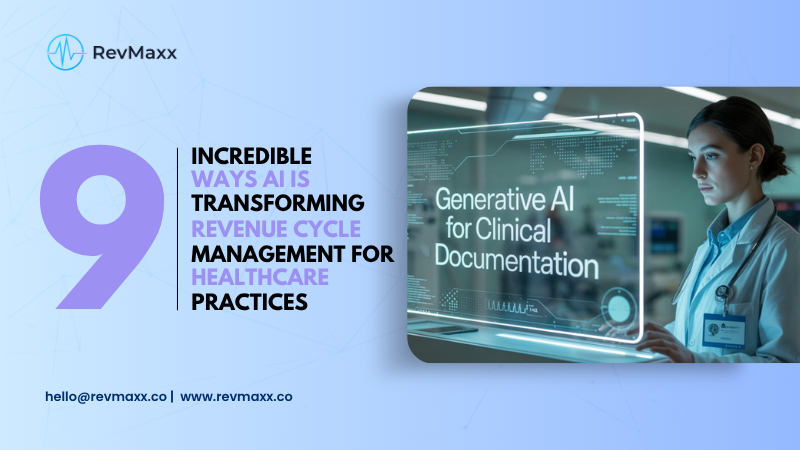
Revenue cycle management for healthcare has become one of the biggest priorities for healthcare practices today. Medical practices are facing immense pressure from many sides. Claim denials are increasing and administrative tasks are growing. Staff shortages continue to affect operations. At the same time, patients expect faster and clearer financial experiences.
Healthcare providers are losing revenue through small issues that often go unnoticed. Missing modifiers, inaccurate patient details, delayed claims, coding mistakes, and denied reimbursements create long-term financial pressure. Recent healthcare reports show that claim denial rates continue to rise, with many providers reporting denial rates above 10%.
Artificial intelligence is changing this situation. AI is helping healthcare practices reduce errors, improve efficiency, shorten reimbursement cycles, and create stronger financial performance.
Read this article carefully and learn how AI is transforming revenue cycle management for healthcare and why healthcare organizations are paying close attention.
What Is Revenue Cycle Management for Healthcare (RCM for Healthcare)?
RCM, or Revenue Cycle Management, refers to the financial process healthcare organizations use to manage patient revenue from the first appointment until the final payment is collected. It covers every activity connected to billing, claims, payments, and reimbursements.
RCM is not only about sending bills. It starts when a patient schedules an appointment and continues through registration, insurance verification, medical coding, claims submission, payment posting, denial management, and patient collections. Every step directly affects the financial health of a healthcare practice.
Without the help of effective RCM processes, healthcare practices may experience delayed payments, increased denials, and revenue loss.
Why Revenue Cycle Management for Healthcare Practices Matters ?
Strong revenue cycle processes help organizations maintain stable cash flow and improve operational efficiency. Healthcare organizations depend on timely reimbursements to support staffing, patient care, and daily operations.
Poor revenue cycle management creates financial gaps. Even small documentation errors can lead to claim rejection. Efficient RCM also improves provider and patient satisfaction levels, because patients receive clearer billing information and fewer payment surprises. Better processes reduce staff stress and allow teams to focus more on patient care instead of administrative work.
What are the 7 Steps of the Revenue Cycle?
The revenue cycle contains multiple connected stages. A problem at one step often creates issues later in the process. Understanding these steps helps organizations identify where revenue leakage occurs.
Step 1: Patient Registration
Patient registration is the first and one of the most important stages of the revenue cycle. During this process, healthcare staff collect patient demographic information such as name, address, date of birth, contact information, and insurance details.
This step may appear simple, but it creates the foundation for everything that follows. Even small mistakes during registration can create larger issues later in the process. Incorrect spelling of a patient’s name, inaccurate policy numbers, missing insurance details, or outdated information can result in claim denials and delayed reimbursements.
Registration staff must also verify whether information entered into the system is complete and updated. Healthcare organizations increasingly use digital intake forms and automated verification systems to reduce manual data entry errors. Strong registration practices can improve claim acceptance rates and reduce administrative rework.
Step 2: Insurance Eligibility Verification
Insurance eligibility verification confirms whether a patient’s health plan is active and whether specific medical services are covered under that plan. This process helps providers understand what services qualify for reimbursement before care is delivered.
Without proper eligibility verification, healthcare organizations may unknowingly provide services that are not covered by insurance plans. This can create payment issues for both patients and providers. In many cases, claims are denied because of inactive coverage, benefit limitations, or authorization requirements.
Eligibility checks also help providers determine patient responsibilities, including copayments, deductibles, and coinsurance amounts. Providing this information early creates better financial transparency and reduces billing confusion later.
Many organizations now use real-time eligibility systems that can instantly verify coverage information and improve efficiency.
Step 3: Medical Documentation and Charge Capture
Medical documentation and charge capture involve recording the services, procedures, treatments, and clinical activities delivered to patients during their visits.
Accurate documentation is extremely important because it creates the clinical evidence used for billing and reimbursement. Physicians and healthcare professionals must document all procedures clearly and completely.
Charge capture ensures that every service provided to a patient is properly recorded and included for billing purposes. Missing procedures, incomplete notes, or undocumented services can lead to lost revenue opportunities.
Poor documentation may also create compliance risks and increase the likelihood of audits. Healthcare organizations often implement electronic documentation systems and AI-assisted tools to improve accuracy and reduce missing information.
Step 4: Medical Coding
Medical coding converts healthcare documentation into standardized codes that insurance companies use for claims processing and reimbursement purposes. Common coding systems include ICD codes for diagnoses and CPT codes for procedures and services.
Medical coding plays an important role because it translates clinical care into billable information. Accurate coding ensures providers receive proper reimbursement for services delivered.
Even small coding mistakes can create serious financial consequences. Incorrect diagnosis codes, missing modifiers, or mismatched procedures may result in claim denials, delayed payments, or compliance issues.
Specialty healthcare providers often face additional coding complexity because of detailed documentation requirements. Many organizations are now using AI-assisted coding tools to improve coding accuracy and reduce manual workload.
Step 5: Claim Submission
Claim submission involves preparing and sending billing information to insurance companies for reimbursement. After coding is completed, healthcare organizations create claims that include patient details, diagnosis information, procedure codes, and supporting documentation.
Submitting clean claims is essential for maintaining a healthy revenue cycle. A clean claim contains accurate information and does not require additional corrections or review.
Incomplete claims, missing documentation, coding inconsistencies, or data errors can result in rejection before processing even begins. Rejected claims require correction and resubmission, which creates additional administrative work and delays payments.
Healthcare organizations frequently use claim-scrubbing software to identify potential errors before claims are submitted.
Step 6: Payment Posting and Denial Management
After insurance companies process claims, payments are received and recorded within the healthcare organization’s billing system. This process is known as payment posting.
Payment posting helps healthcare providers understand reimbursement amounts and identify any remaining patient balances. Staff members compare expected reimbursement amounts with actual payments to detect discrepancies.
Denial management becomes necessary when claims are partially paid or completely rejected. Denials can occur for many reasons, including coding issues, missing information, eligibility problems, or authorization failures.
Research shows that claim denials continue to affect healthcare revenue significantly, making efficient denial management a critical area for financial improvement. Organizations often dedicate substantial time and resources to analyzing denial patterns and preventing repeat issues.
Step 7: Patient Billing and Final Payment Collection
The final stage of the revenue cycle focuses on collecting remaining balances from patients after insurance payments have been processed.
Patients receive billing statements that explain the services provided, insurance contributions, and remaining financial responsibility. Clear and easy-to-understand billing communication is important because confusing statements can delay payments and affect patient satisfaction.
Healthcare organizations are increasingly offering digital payment options, online billing systems, and flexible payment plans to improve collection rates.
A positive financial experience matters because patients now expect the same level of convenience from healthcare billing that they receive from other industries. Better communication and payment flexibility can strengthen patient trust while supporting overall financial performance.
What are common RCM mistakes?
Small mistakes across the revenue cycle often create major financial consequences. Revenue leakage frequently happens because organizations focus only on large issues while ignoring repetitive operational errors.
Many practices continue using disconnected systems and manual workflows. This increases the possibility of mistakes throughout the billing process.
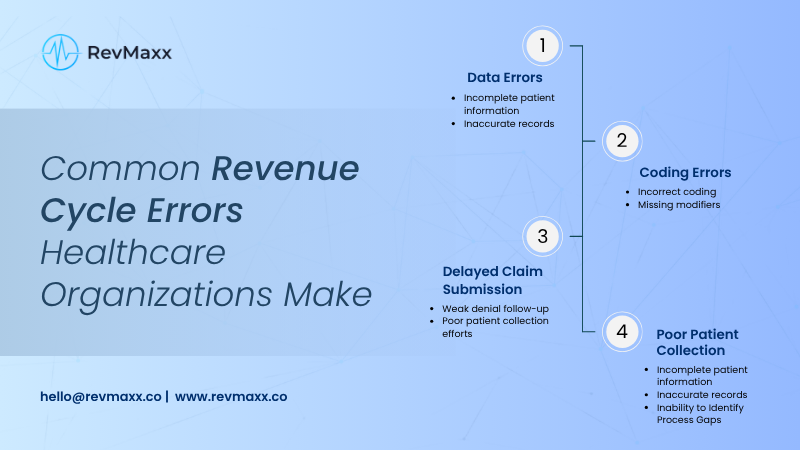
Common Revenue Cycle Errors Healthcare Organizations Make
Incomplete patient information remains a common problem. Research shows that missing or inaccurate data remains one of the largest contributors to healthcare claim denials. Incorrect coding and missing claim modifiers create billing complications. Delayed claim submissions also affect reimbursement timelines.
Organizations sometimes struggle with denial follow-up and patient payment collection processes. Lack of performance reporting can also prevent leaders from identifying operational weaknesses.
How To Improve Revenue Cycle Management for Healthcare?
Improving revenue cycle management for healthcare requires more than fixing billing issues after they happen. Healthcare organizations need a proactive strategy that addresses problems before they affect payments. A strong revenue cycle combines accurate processes, trained staff, patient engagement, and modern technology. Even small inefficiencies can create revenue loss over time, especially when they happen repeatedly across thousands of patient encounters.
Many healthcare providers are now shifting from manual and reactive workflows to data-driven approaches. Modern RCM improvement focuses on reducing denials, increasing clean claim rates, shortening payment cycles, and improving patient financial experiences. Industry guidance also shows that organizations with strong front-end processes and automation often experience faster reimbursements and lower administrative costs.
Best Practices to Improve Revenue Cycle Performance
- One of the first areas organizations should improve is patient eligibility verification. Insurance information should be checked before services are delivered because incorrect coverage details remain a major cause of denied claims. Real-time verification tools can reduce these avoidable errors.
- Healthcare organizations should also focus on documentation and coding accuracy. Incomplete records and coding mistakes can lead to underpayments or rejected claims. Standardized documentation templates, coding audits, and staff training help improve billing accuracy.
- Another important strategy is improving clean claim rates. Industry reports suggest high-performing organizations often aim for a first-pass resolution rate above 90%, meaning claims are accepted correctly on the first submission. Claim-scrubbing tools and electronic submissions help reduce rework and delays.
- Healthcare leaders should also monitor important performance metrics, including the following:
- Days in Accounts Receivable (A/R)
- Denial Rate
- Net Collection Rate
- Clean Claim Rate
- Patient Collection Rate
Regular monitoring helps identify operational weaknesses before they become larger financial problems. In addition, stronger patient communication, flexible payment options, and AI-driven automation can improve both collections and patient satisfaction.
AI-Driven Strategies for Smarter Revenue Cycle Management
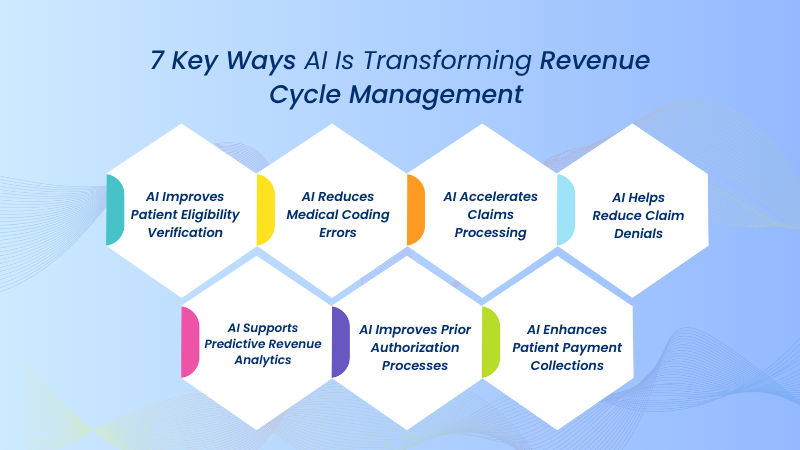
Healthcare organizations are implementing AI across multiple areas of the revenue cycle to improve efficiency and financial performance. One of the most widely used strategies is intelligent automation. Repetitive administrative activities such as appointment scheduling, insurance verification, claim review, and billing workflows can now be automated.
Predictive analytics is another growing area. AI systems analyze historical financial information and use those patterns to forecast future revenue trends. This helps leaders make informed business decisions and identify potential revenue gaps before they become larger problems.
Natural language processing (NLP) also plays a major role in improving coding and documentation workflows. NLP tools can review physician notes and clinical records to identify important information automatically.
AI-assisted claim review systems help healthcare organizations identify missing information, coding inconsistencies, or documentation problems before claims are submitted. Smart payment technologies can also improve patient collections through personalized reminders and flexible payment recommendations.
1. AI Improves Patient Eligibility Verification
Manual eligibility verification has traditionally been one of the most time-consuming processes within healthcare operations. Staff members often contact insurance companies, navigate payer portals, and manually review coverage details. These activities consume valuable time and increase the possibility of human error.
Even small mistakes during eligibility checks can affect later stages of the revenue cycle. Incorrect policy numbers, outdated coverage information, or missing authorization requirements may lead to claim denials and payment delays.
AI systems can verify patient insurance information automatically and in real time. Instead of relying on manual processes, AI integrates with payer databases and retrieves coverage information quickly. These systems can identify issues before patient appointments and reduce avoidable mistakes.
2. AI Reduces Medical Coding Errors
Medical coding errors remain one of the largest contributors to denied claims and delayed reimbursements across healthcare organizations. Coding professionals often work with large volumes of clinical information and complex coding requirements.
Specialty healthcare practices face even greater challenges because of highly detailed documentation and coding guidelines. Small mistakes can result in claim rejection or compliance concerns.
AI-assisted coding tools use natural language processing and machine learning technologies to review physician documentation and suggest appropriate diagnosis and procedure codes. These systems can identify coding inconsistencies and reduce manual workload. Rather than replacing coding professionals, AI functions as a support system that improves speed and accuracy.
3. AI Accelerates Claims Processing
Claims processing remains a major area where healthcare organizations experience operational delays. Traditional claim preparation often involves manual reviews, repetitive data entry, and multiple verification steps.
Errors discovered after claim submission can create additional work because staff members must correct and resubmit claims.
AI improves this process by automating claim preparation activities and identifying issues before submission. AI systems can review patient information, coding details, payer requirements, and documentation simultaneously.
4. AI Helps Reduce Claim Denials
Claim denials continue creating financial pressure across healthcare organizations. Denials often require significant staff effort to investigate, correct, and appeal.
Industry reports show that approximately 41% of providers report denial rates above 10%, creating major revenue challenges for healthcare organizations.
AI helps reduce denials by identifying risk factors before claims reach payers. Instead of reacting after denials occur, organizations can address issues earlier.
5. AI Supports Predictive Revenue Analytics
Predictive analytics allows healthcare organizations to understand future financial trends instead of relying only on historical reporting.
Traditional reporting often focuses on events that have already happened. AI uses historical data and advanced algorithms to identify trends and predict future outcomes.
Healthcare leaders can use these insights to improve planning and budgeting decisions. AI-supported predictive analytics can help organizations identify reimbursement trends, detect revenue gaps, and forecast future financial performance.
6. AI Improves Prior Authorization Processes
Prior authorization requirements continue creating delays for both healthcare organizations and patients. Manual authorization processes often involve extensive paperwork and communication with insurance providers.
AI improves this process by automating document review and identifying required authorization information. Some systems can also predict authorization requirements before claims are submitted. Faster approvals reduce treatment delays and improve patient experiences.
7. AI Enhances Patient Payment Collections
Patient financial responsibility has increased significantly over recent years. Healthcare organizations now collect larger portions of payments directly from patients.
Many organizations struggle because traditional billing systems often create confusion and delayed payments. AI improves patient collection strategies by analyzing payment behaviors and identifying personalized communication approaches. Patients may receive customized reminders, payment recommendations, and flexible installment options.
The Conclusion
Healthcare organizations can no longer rely only on manual workflows and traditional systems. Rising denial rates, administrative burden, and growing operational complexity require a different approach.
AI is changing revenue cycle management for healthcare through intelligent automation, predictive analytics, coding support, denial prevention, and improved patient experiences. Organizations that adopt smarter revenue cycle strategies may reduce revenue leakage, improve cash flow, and support long-term financial stability.
As healthcare systems continue evolving, AI is becoming less of an optional technology and more of a practical business requirement.