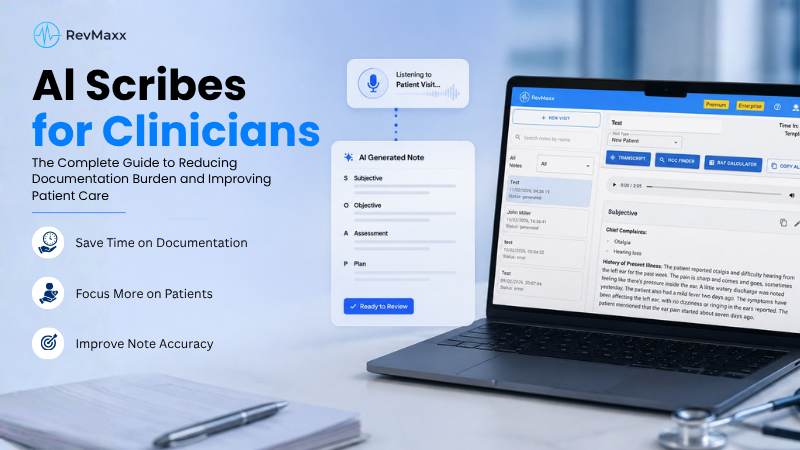
Doctors did not go to medical school to type. Yet most of them spend more time typing than they spend with patients. This is the reason AI scribes for clinicians are becoming one of the fastest-growing tools in healthcare. They listen, write the notes, and give doctors back their precious time.
This guide explains how AI scribes for clinicians work, why clinics are adopting them and what to look for before you choose one, including tools like RevMaxx AI Scribe.
What is an AI Scribes for clinicians?
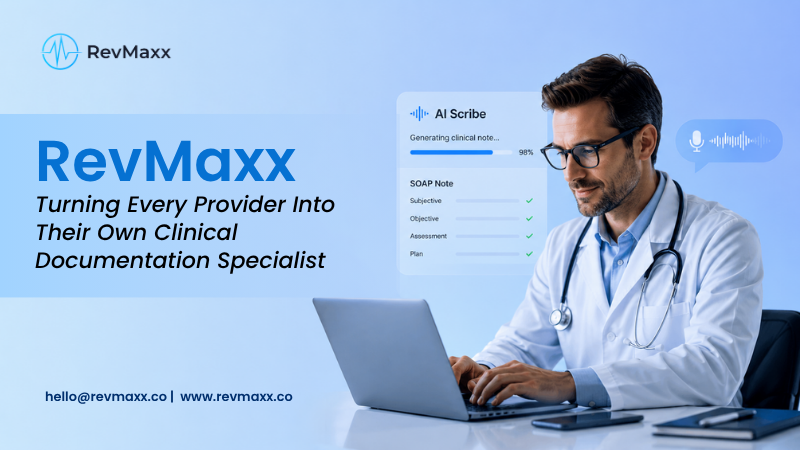
An AI scribe for clinicians is software that listens to a patient visit and turns the conversation into a clinical note. It uses advanced speech recognition and medical language models to understand what was said. Instead of a doctor typing during or after a visit, the AI scribe drafts the note automatically. The clinician then reviews it, makes small edits, and signs off. Tools like RevMaxx AI scribe do this in real time, right inside the exam room.
Understanding How AI Medical Scribes Work
AI medical scribes combine three technologies: voice capture, language understanding, and note formatting. Together, these turn a normal conversation between a clinician and a patient into a structured clinical record. No special phrases or commands are needed. The clinician simply talks the way they normally would, and the system handles the rest in the background without breaking the flow of the visit.
Voice Recognition and Clinical Conversation Capture
The first step is audio capture. A microphone or app records the entire patient visit, picking up speech from both the clinician and the patient. Modern voice recognition models are trained on medical vocabulary, so they can tell apart drug names, lab values, and everyday speech. This matters because regular dictation software often misreads clinical terms, while medical-grade tools like RevMaxx AI scribe are built specifically to catch this language correctly.
Natural Language Processing in Healthcare
Once speech is captured, natural language processing (NLP) interprets the meaning behind the words. NLP identifies symptoms, diagnoses, medications, and follow-up plans, even when patients describe things in plain, non-clinical language. This is the core technology that separates an AI scribe from basic transcription. It does not just write down words; it understands clinical context and decides where each detail belongs in the note.
SOAP Note Generation
After understanding the conversation, the system organizes information into a SOAP note: Subjective, Objective, Assessment, and Plan. This is the standard format used across most specialties. RevMaxx AI Scribe, for example, builds these notes automatically and pushes them into specialty-specific templates, so a cardiology note looks different from a psychiatry note, matching what each provider actually needs in their chart.
How AI Scribes for Clinicians Differ from Traditional Medical Scribes
Traditional scribes are human assistants who sit in or join the visit remotely and type notes for the doctor. AI scribes replace that human step with software. Both aim to reduce typing for the clinician, but they work in very different ways, with different costs, availability, and consistency, which matters when a practice is deciding which option fits its workflow and budget.
Human Scribes vs AI Scribes
Human scribes need hiring, training, scheduling, and ongoing pay. They can get sick, quit, or need a replacement. AI scribes are available every day, do not need vacation time, and cost a fraction of a human salary. A platform like RevMaxx AI Scribe is priced at a flat monthly rate, which is far lower than paying a full-time or part-time scribe across multiple providers in a clinic.
Real-Time Documentation vs Post-Visit Transcription
Human scribes often type during the visit or finish notes shortly after. AI scribes can do both, but the best ones, including RevMaxx AI Scribe, generate notes in real time as the conversation happens. This means the note is often ready before the patient leaves the room, cutting out the lag time that usually pushes documentation into the evening hours.
Why Clinicians Are Turning to AI Scribes
Clinicians are adopting AI scribes for clinicians because documentation has become unsustainable. Charting now eats into personal time, family time, and even sleep. AI scribes promise to give that time back without lowering the quality of medical records, which is why adoption has grown quickly across primary care, speciality practices, and telehealth in the last few years.
The Growing Documentation Burden
Documentation has grown heavier every year due to billing requirements, compliance rules, and longer patient histories. A 2016 study report found that physicians spend nearly 2-3 hours on EHR and desk work for every one hour of direct patient care. That ratio has stayed a problem for healthcare ever since.
Administrative Work After Clinic Hours
Many doctors finish their last patient and then start a second shift of typing, often called “pajama time.” Research says that primary care physicians spend an average of 2.7 hours of personal time on the EHR outside of scheduled patient hours. AI scribes for clinicians directly target this unpaid extra work.
Physician Burnout and Cognitive Load
Typing while listening to a patient splits attention and increases mental fatigue. Studies link this directly to burnout, which now affects more than half of practising physicians in some surveys. When a tool like RevMaxx AI Scribe takes over the writing, clinicians can give full attention to the patient, lowering the constant background stress of multitasking through every single visit.
Benefits of AI Scribes in Clinical Practice
The benefits go beyond saving time. AI scribes change how a visit feels for both the doctor and the patient. Notes become more complete, more consistent, and faster to finish. Many practices using tools like RevMaxx AI Scribe report finishing their charting before leaving the building instead of taking it home every night.
More Face-to-Face Patient Time
When a clinician is not staring at a screen typing, they can make eye contact, ask better follow-up questions, and build trust faster. Patients notice this difference. It often leads to better communication, fewer misunderstandings, and a visit that feels more personal instead of rushed and screen-focused the entire time.
Faster Clinical Documentation
AI scribes draft notes in minutes instead of the 10 to 20 minutes per chart that manual typing can take. Multiply that across a full day of patients, and the time saved becomes significant. RevMaxx AI Scribe users often report notes are ready for review almost immediately after the visit ends, cutting documentation time dramatically, turning every provider to a clinical documentation scpecialist.
Improved Note Consistency
Manual notes vary depending on how tired or rushed a clinician is. AI-generated notes follow the same structure every time, reducing missing details and incomplete charts. This consistency also helps with compliance, since structured SOAP notes are easier to audit and easier for other providers on the care team to quickly understand.
Reduced Administrative Costs
Hiring scribes, transcriptionists, or extra front-desk help adds up quickly. AI scribes for clinicians lower this overhead. A flat monthly subscription, like the one offered by RevMaxx AI Scribe, replaces the ongoing cost of salaries, training, and turnover that comes with human staff handling documentation.
How AI Scribes Work During a Patient Visit
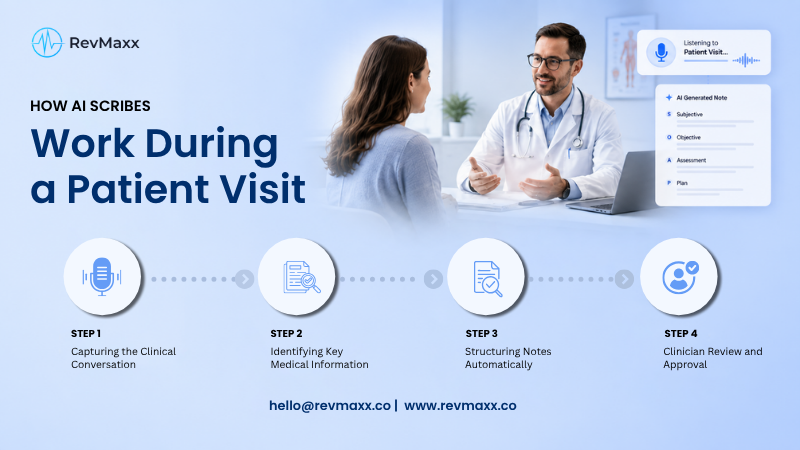
Every AI scribe follows a similar four-step process during a visit. Understanding this flow helps clinicians know what to expect and where they still need to be involved. Even with full automation, the clinician always stays in control of the final note before it becomes part of the patient’s permanent record.
Step 1: Capturing the Clinical Conversation
The visit begins like normal. The clinician starts the recording, often with a single tap, and then talks naturally with the patient. There is no need to speak in a robotic or scripted way. The system, such as RevMaxx AI Scribe, picks up the conversation in the background without interrupting the natural flow of the appointment.
Step 2: Identifying Key Medical Information
As the conversation happens, the AI identifies symptoms, history, exam findings, and treatment discussion. It filters out small talk and focuses only on clinically relevant details. This step relies heavily on NLP trained specifically on medical conversations, not general speech, which is why specialty-built tools outperform generic transcription apps.
Step 3: Structuring Notes Automatically
The system then organizes everything into the correct sections of a SOAP note. Subjective complaints go under “Subjective,” exam findings under “Objective,” and so on. RevMaxx AI Scribe also adds suggested ICD-10, CPT, and E/M codes at this stage, helping connect documentation directly to billing accuracy.
Step 4: Clinician Review and Approval
No note becomes final without the clinician’s review. The provider reads through the draft, makes any edits, and approves it before it syncs to the EHR. This final human checkpoint keeps accuracy high and ensures the clinician remains fully responsible for what goes into the patient’s chart.
Features to Look for in an AI Scribe
Not all AI scribes are built the same way. Some only offer basic transcription, while others support full clinical workflows. When evaluating tools like RevMaxx AI Scribe, it helps to compare them against a checklist of features that actually matter for daily clinical use, not just marketing claims.
Specialty-Specific Templates
A psychiatrist’s note looks nothing like a cardiologist’s note. Good AI scribes offer templates built for different specialties, including primary care, mental health, dermatology, and more. RevMaxx AI Scribe supports specialty-specific formatting so the note structure matches what each type of provider actually needs to document.
EHR Integration
An AI scribe is only useful if the note ends up where it needs to be: inside the patient’s chart. Integration with EHR systems removes the need for copy-pasting or manual data entry, saving even more time and reducing the chance of transcription errors between two separate systems.
Seamless Workflow
The best tools fit into the clinician’s existing routine instead of forcing a new one. RevMaxx AI Scribe integrates with EHR systems like Epic, Cerner, Athena, and eClinicalWorks, often through a simple browser extension, so providers do not need to learn a completely new system just to use it.
One-Click Export
Once a note is reviewed and approved, it should move into the EHR with minimal effort. One-click export removes extra steps like downloading, formatting, or manually re-entering information, which keeps the documentation process fast from start to finish, every single time a note is finalized.
HIPAA Compliance and Data Security
Patient data is sensitive, so any AI scribe must meet strict privacy standards. This is non-negotiable in healthcare. Before adopting any tool, clinics should confirm exactly how patient conversations are stored, encrypted, and protected, and whether the vendor follows HIPAA requirements by design, not as an afterthought.
Encryption Standards
Audio recordings and notes should be encrypted both during transmission and while stored. This prevents unauthorized access at every stage of the process. RevMaxx AI Scribe applies encryption to protect recordings and notes, following privacy-by-design principles built into the platform from the ground up.
Secure Cloud Infrastructure
Cloud storage should follow healthcare-grade security practices, not standard consumer-level cloud storage. This includes regular security audits, data segregation between practices, and infrastructure built to handle protected health information safely and reliably at scale.
Access Controls and Audit Logs
Only authorized staff should be able to view patient recordings or notes. Audit logs track who accessed what and when, which supports compliance reviews and builds accountability into the system, giving practices a clear record if any questions about data access ever come up later.
AI Editing and Customization
Clinicians have different documentation styles, and a good AI scribe should adapt to that instead of forcing a single rigid format on every provider. Customization features turn a generic note generator into a tool that actually matches how each individual doctor likes to document.
Personalized Documentation Styles
Over time, AI scribes can learn a clinician’s preferred phrasing, common diagnoses, and typical treatment plans. This personalization reduces the number of edits needed on future notes, making the system faster and more accurate the longer a provider uses it in daily practice.
AI Scribes Across Different Clinical Specialities
AI scribes are not one-size-fits-all. Different specialties have different documentation needs, visit lengths, and terminology. The most effective platforms adjust their templates and language models to match these differences instead of applying the same generic note format everywhere.
Primary Care Physicians
Primary care visits often cover multiple issues in a short appointment. AI scribes help by quickly organizing several complaints into one clear note. RevMaxx AI Scribe is widely used in primary care because it handles high patient volume and varied visit types without slowing down the provider’s day.
Internal Medicine
Internal medicine often involves chronic disease management and complex histories. AI scribes help track ongoing conditions across visits, keeping notes consistent over time. This is especially useful when comparing past treatment plans to current symptoms during long-term patient relationships.
Mental Health Providers
Psychiatrists spend roughly 35% of their workday on documentation tasks like progress notes and patient histories. AI scribes built for mental health, such as RevMaxx’s psychiatry scribe, let providers stay fully present in sensitive conversations instead of splitting attention between the patient and a keyboard.
Telehealth Clinicians
Virtual visits make in-person scribes impossible, but AI scribes work just as well over video calls. They capture the same conversation quality remotely as they would in person, helping telehealth providers maintain the same documentation standards without needing extra staff on video calls.
Nurse Practitioners and Physician Assistants
NPs and PAs often carry heavy patient loads similar to physicians but with less administrative support. AI scribes reduce this gap by giving them the same documentation speed as larger practices, helping smaller clinics and solo providers stay efficient without hiring additional staff.
AI Scribes vs Voice Dictation Software
Voice dictation tools have existed for years, but they are not the same as AI scribes for clinicians. Dictation simply turns speech into text. AI scribes go further by understanding context, organizing information, and producing a structured clinical note ready for review.
Accuracy Comparison
Dictation software transcribes word-for-word, including filler words and disorganized speech. AI scribes filter and interpret meaning instead. RevMaxx AI Scribe, for example, reaches up to 95% accuracy in structured clinical note generation, far higher than raw dictation accuracy for medical terminology.
Time Savings
With dictation, clinicians still need to speak in a structured way and often edit heavily afterward. AI scribes remove this step entirely by listening to natural conversation and building the note automatically, saving significantly more time across a full day of patient visits.
Documentation Quality
Dictated notes can be messy, repetitive, or missing structure unless the clinician dictates carefully. AI scribes automatically apply the SOAP format, so notes come out organized and clinically complete from the very first draft, without extra formatting work needed afterward.
Workflow Efficiency
Dictation requires a clinician to actively narrate findings, which is still extra work layered on top of patient care. AI scribes work passively in the background, letting the provider focus entirely on the patient while documentation happens automatically and quietly behind the scenes.
AI Scribes vs Human Medical Scribes
Human scribes have helped reduce documentation burden for years, but they come with real costs and limitations. AI scribes for clinicians offer a different set of tradeoffs that are worth understanding before a practice decides which model fits their needs and budget.
Cost Comparison
A human scribe typically costs a yearly salary plus benefits, training, and scheduling overhead. AI scribes like RevMaxx AI Scribe charge a flat monthly fee, ranging from $39/month per provider to $199/month per provider, making them dramatically cheaper for clinics, especially smaller practices with limited administrative budgets.
Availability and Scalability
Human scribes can only work one shift at a time and need replacements during sick days or vacations. AI scribes for clinicians are available 24/7 across unlimited providers at once, making it far easier to scale across multiple clinic locations without hiring additional staff for each one.
Training Requirements
New human scribes need weeks of training to learn medical terminology, clinic workflow, and provider preferences. AI scribes for clinicians come pre-trained on medical language and specialty templates, requiring only a short onboarding period before clinicians can start using them effectively in daily practice.
Accuracy Over Time
Human scribe accuracy depends on individual skill and can vary between staff members. AI scribes improve steadily through updates and learning patterns, and platforms like RevMaxx AI Scribe maintain consistent accuracy rates across every provider using the system, regardless of experience level.
Common Concerns About AI Scribes
Despite the benefits, clinicians often have valid questions before adopting AI scribes for clinicians. Addressing these concerns directly helps practices make an informed decision instead of avoiding a tool that could genuinely reduce daily stress and improve documentation quality.
Will AI Replace Clinicians?
No. AI scribes only handle documentation, not clinical judgment, diagnosis, or treatment decisions. The clinician always reviews and approves every note before it becomes official. Tools like RevMaxx AI Scribe are built to support providers, not replace the medical expertise only a trained clinician can offer.
Is Patient Data Safe?
Reputable AI scribes follow strict privacy standards, including encryption and HIPAA compliance. RevMaxx, for example, is built on a “privacy by design” foundation, meaning security is built into the platform structure itself rather than added on afterward as a separate compliance checkbox.
Can AI Handle Complex Medical Conversations?
Modern AI scribes are trained specifically on medical terminology, clinical shorthand, and specialty-specific language. They can follow conversations involving multiple symptoms, medications, and treatment plans, though clinicians should always review notes for complex or unusual cases before finalizing them.
How Much Editing Is Required?
Editing time varies, but most clinicians only need to make small adjustments rather than rewriting entire notes. With accuracy rates reaching around 95% on platforms like RevMaxx AI Scribe, review time is typically just a quick read-through instead of a full rewrite of the document.
Measuring the ROI of an AI Scribe
Adopting an AI scribe is also a financial decision. Practices should measure real outcomes, not just convenience, to understand whether the investment pays off. Several clear metrics make this calculation straightforward for most clinics considering the switch.
Time Saved Per Patient
If a clinician saves even 10 to 20 minutes per patient on documentation, that adds up to hours saved every single day. Across a full patient panel, this time savings alone often justifies the monthly cost of a tool like RevMaxx AI Scribe within the first few weeks of use.
Increased Daily Patient Capacity
Faster documentation can mean more time available for additional patient visits, directly increasing revenue potential. Practices using AI scribes often find they can see more patients in the same number of clinic hours without extending the workday or adding extra staff.
Lower Staffing Costs
Replacing or avoiding the need for human scribes lowers payroll significantly. A flat monthly subscription is almost always cheaper than even a part-time scribe salary, making AI scribes for clinicians an easy cost-saving decision for most practice budgets, especially smaller clinics.
Reduced Physician Burnout
While harder to measure directly, reduced burnout lowers staff turnover, which is expensive to replace. Happier, less exhausted clinicians also tend to provide better patient care, creating a ripple effect that benefits the entire practice beyond just the documentation itself.
Improved Documentation Quality
Better, more consistent notes reduce billing errors, claim denials, and compliance risks. RevMaxx AI Scribe, for example, suggests accurate ICD-10, CPT, and HCC codes alongside notes, which helps prevent revenue loss from incomplete or mismatched documentation during the billing process.
Best Practices for Implementing an AI Scribe
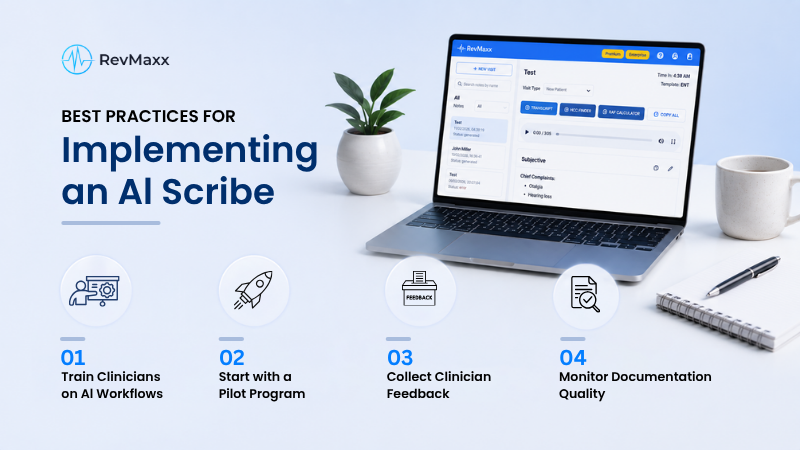
Rolling out an AI scribe smoothly takes more than just signing up for a subscription. A thoughtful implementation plan helps clinicians adopt the tool faster and avoid frustration during the first few weeks of use, when habits are still being formed.
Train Clinicians on AI Workflows
Even simple tools need a short training period. Clinicians should learn how to start recordings, review notes, and make edits efficiently. A brief onboarding session, like the ones offered with RevMaxx AI Scribe, helps providers feel confident using the tool from day one.
Start with a Pilot Program
Instead of rolling out across an entire practice at once, start with a small group of clinicians. This allows the team to identify workflow issues early and gather feedback before expanding the tool to every provider, reducing disruption to daily clinic operations during the transition.
Collect Clinician Feedback
Regular feedback sessions help identify what is working and what needs adjustment. Clinicians using the tool daily will notice details that administrators might miss, and this feedback loop helps fine-tune templates, settings, and workflow integration over time.
Monitor Documentation Quality
Periodically reviewing a sample of AI-generated notes helps confirm accuracy stays high and catches any recurring issues early. This ongoing quality check builds trust in the system and ensures documentation standards remain consistent across the entire practice.
The Future of AI Scribes in Healthcare
AI scribes for clinicians are still evolving quickly. What started as simple transcription tools is becoming a broader category of ambient clinical intelligence, with capabilities expanding well beyond just writing notes from a conversation.
Ambient Clinical Intelligence
Future AI scribes will do more than document; they will understand the full context of a visit passively, without any extra clicks or commands. RevMaxx already positions itself in this direction, working quietly in the background while adapting to different specialties and visit types automatically.
Predictive Documentation
As AI models improve, scribes may begin suggesting likely diagnoses or next steps based on conversation patterns, though always as a suggestion for clinician review, never as an automatic decision. This keeps the clinician firmly in control while speeding up clinical reasoning during busy visits.
AI Clinical Decision Support
Some platforms are beginning to layer decision support on top of documentation, flagging potential coding issues, missed follow-ups, or treatment guidelines. This extra layer adds value beyond just note-taking, turning the scribe into a broader workflow assistant for the entire visit.
Personalized Documentation Preferences
Over time, AI scribes will learn each clinician’s preferred note length, tone, and structure automatically, without needing repeated manual adjustments. This personalization will make future notes require even less editing, saving additional time with every visit a provider completes.
Why More Healthcare Organizations Are Choosing AI Scribes
Across hospitals, clinics, and specialty practices, the shift toward AI scribes for clinicians is accelerating. The reasons go beyond convenience, touching patient experience, provider well-being, and overall operational performance across an entire organization.
Better Patient Experience
When clinicians are not buried in typing, patients get more attention, clearer explanations, and a visit that feels less rushed. This builds trust and often improves patient satisfaction scores, which matter for both care quality and practice reputation in a competitive healthcare market.
Improved Provider Satisfaction
Reducing the burden of documentation directly improves job satisfaction. Clinicians using tools like RevMaxx AI Scribe often report finishing their day without taking unfinished notes home, which significantly improves work-life balance and reduces the daily stress tied to clinical practice.
Greater Operational Efficiency
Faster documentation supports faster billing, fewer claim errors, and smoother daily operations overall. When notes are accurate and complete the first time, downstream administrative work decreases too, creating efficiency gains that extend well beyond the exam room itself.
Scalable Documentation Across Multiple Locations
For healthcare organizations running multiple sites, AI scribe tools offer consistent documentation standards everywhere without needing to hire and train scribes at every location. Platforms like RevMaxx AI Scribe scale easily across practices, making them a practical choice for growing healthcare organizations.
The Conclusion
AI scribes for clinicians are no longer a novelty; they are quickly becoming a standard part of modern practice. By capturing patient-provider conversations, structuring clinical notes automatically, and reducing after-hours charting, RevMaxx AI medical scribe gives clinicians back what clinical documentation and administrative paperwork have been quietly taking away: time, energy, and focus on caring for patients.
From cardiology to primary care, psychiatry to telehealth, the benefits are consistent across various specialties. As adoption grows, the AI scribes for clinicians are set to move beyond note-taking into broader clinical support.