A study reveals that most physicians spend nearly 49% of their workday interacting with electronic health records (EHRs) rather than directly caring for patients. Even doctors spend almost 2-3 extra hours every day completing documentation after clinical hours, often called “Pajama Time.”
This growing documentation burden is one of the biggest challenges in modern healthcare. Physicians must record detailed clinical information for every patient encounter, including diagnoses, treatment plans, medications, and follow-up instructions. These records are essential for patient care, coding accuracy, compliance, and billing.
To manage this complexity, many healthcare organizations rely on a clinical documentation specialist. These professionals review patient records and ensure that clinical notes are complete, accurate, and aligned with coding requirements. However, not every healthcare organization can assign a documentation specialist to every provider.
This is where intelligent documentation tools such as RevMaxx are changing the landscape. By using AI-powered ambient scribe technology, RevMaxx helps physicians capture and structure clinical conversations automatically. The result is faster documentation, improved accuracy, and a workflow where providers can effectively function like their own clinical documentation specialists.
In this article, we will explore why clinical documentation matters, the challenges providers face today, and how RevMaxx helps transform documentation into a more efficient and intelligent process.
Why Accurate Clinical Documentation is that Important?
Clinical documentation is the base of healthcare operations. Every diagnosis, treatment plan, and patient interaction must be recorded accurately. These records help clinicians coordinate care, ensure compliance, and support proper reimbursement.
Healthcare systems today operate in a complex environment that includes regulatory requirements, coding standards, and value-based care models. Poor documentation can lead to coding errors, claim denials, compliance issues, and poor patient outcomes.
Documentation also supports communication between care teams. When patient records are incomplete or unclear, it becomes harder for physicians, nurses, and specialists to coordinate care effectively.
Because of this, healthcare organizations rely on structured documentation processes and trained professionals such as a clinical documentation specialist to maintain record quality. Without accurate documentation, healthcare systems struggle to deliver efficient care and maintain financial stability.
The Documentation Burden Providers Face Today
Despite the importance of documentation, the current system places a heavy burden on physicians. Electronic health records were designed to improve efficiency, but they have also increased the amount of documentation physicians must complete. Many providers spend hours entering data, updating charts, and completing notes after patient visits.
Research shows physicians spend around 35% of their time documenting patient information rather than providing direct care. In addition, many physicians continue working on documentation after clinic hours. These after-hours tasks are often called “pajama time” because doctors complete charts late at night. This documentation workload contributes significantly to physician burnout and dissatisfaction across the healthcare industry.
How Documentation Impacts Physician Productivity
Documentation requirements can significantly reduce physician productivity. Studies show physicians often spend 1.84 hours every day completing documentation outside normal work hours.
When physicians spend more time documenting, they have less time to focus on patient interactions. This can reduce patient satisfaction and limit the number of patients a physician can see during a clinic day. Administrative tasks also create cognitive fatigue. Physicians must constantly shift their focus between patient conversations and computer screens. Over time, this constant multitasking reduces efficiency and increases stress levels among healthcare providers.
Improving documentation workflows is therefore essential to maintaining both provider productivity and patient care quality.
Financial and Operational Consequences of Poor Documentation
Poor documentation does not only affect physicians. It also creates serious financial and operational challenges for healthcare organizations.
Incomplete or inaccurate documentation often leads to coding errors. When coders cannot identify the correct diagnosis or procedure codes, claims may be denied or underpaid by insurance providers. Claim denials create additional administrative work because billing teams must review and resubmit claims.
Poor documentation also increases audit risks. Healthcare organizations must maintain clear records to prove that services were medically necessary and properly delivered. For this reason, healthcare systems rely heavily on clinical documentation specialists to ensure documentation accuracy and prevent revenue leakage.
The Traditional Role of Clinical Documentation Specialists in Healthcare
A clinical documentation specialist plays a critical role in healthcare organizations. Their main responsibility is to ensure that patient documentation accurately reflects the care provided during a medical encounter.
Clinical documentation specialists review patient charts and ensure that the diagnoses, procedures, and treatment plans all are correctly and clearly documented. They work closely with physicians, coders, and billing teams to make sure the documentation supports correct coding and reimbursement.
Their role also includes identifying gaps in documentation and requesting clarification from physicians when necessary. This helps prevent coding errors and ensures compliance with healthcare regulations.
As healthcare systems adopt complex coding frameworks such as ICD-10, the role of the clinical documentation specialist has become even more important. These professionals act as a bridge between clinical care and revenue cycle management.
How RevMaxx Turns Providers into Their Own Clinical Documentation Specialist
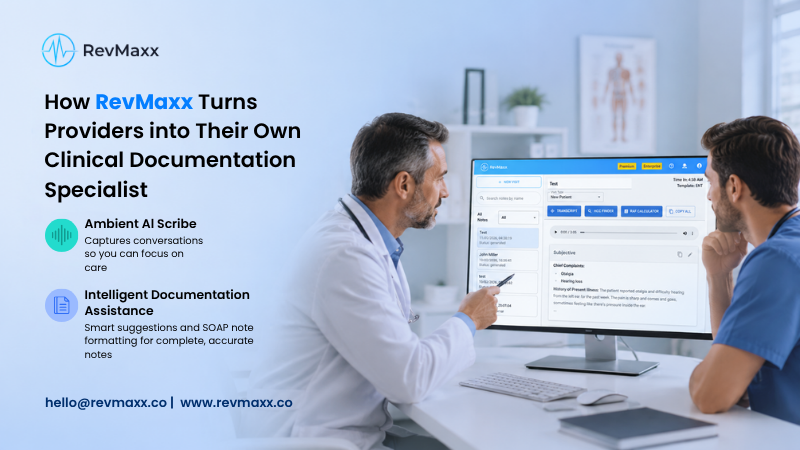
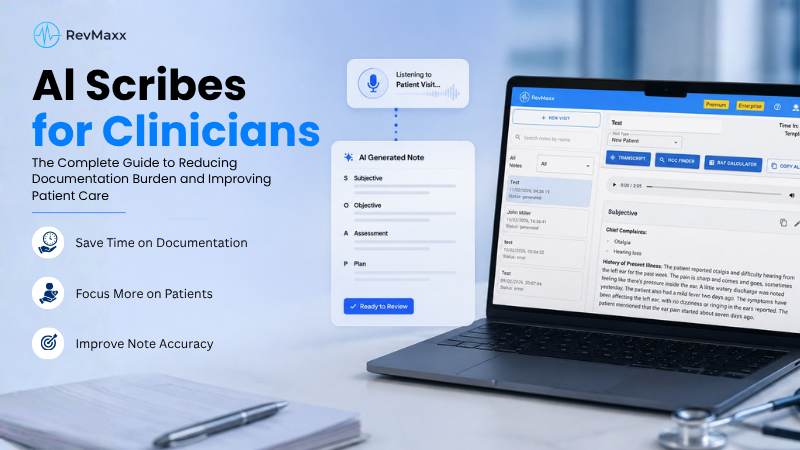
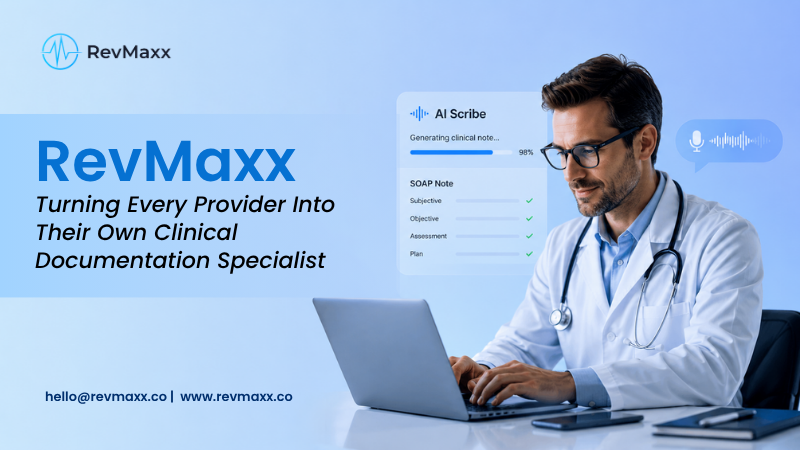
RevMaxx is an ambient AI scribe specially designed to help physicians handle documentation more efficiently by acting as an intelligent clinical documentation assistant. Instead of typing notes manually, providers can rely on ambient AI technology that captures the patient-provider conversation during visits.
The system then converts the conversation into structured clinical notes that can be reviewed and edited quickly. Ambient AI documentation tools are gaining popularity because they reduce manual charting and improve documentation accuracy.
Recent research suggests that ambient AI tools can reduce note-taking time and significantly lower after-hours documentation work. With solutions like RevMaxx, physicians no longer need to function as data entry clerks. Instead, they can focus on patient care while the system assists with documentation.
Ambient AI That Captures Clinical Conversations Automatically
One of the most powerful features of modern AI scribes is ambient listening technology. During the patient visit, this advanced system carefully listens to the conversation between physician and patient. Using advanced speech recognition and natural language processing (NLP) technology, it easily identifies important clinical information. This includes symptoms, diagnoses, medications, treatment plans, and follow-up instructions. The technology then organizes all this information into clear and structured medical notes.
As the process happens in real time, physicians can review and finalize the documentation immediately after the visit. This approach reduces documentation workload and improves clinical efficiency.
Intelligent Documentation Assistance
AI-driven documentation tools do more than just transcribe conversations. They also provide intelligent assistance during the documentation process.
For example, the system can identify missing clinical details and suggest additional information that may be needed for coding and billing. This helps ensure that clinical notes contain the level of detail typically expected from a clinical documentation specialist. The system can also structure notes in standard formats such as SOAP notes, making documentation easier to review.
By providing this level of support, RevMaxx helps physicians create high-quality clinical documentation without spending extra time typing.
Key Features of RevMaxx That Improve Clinical Documentation
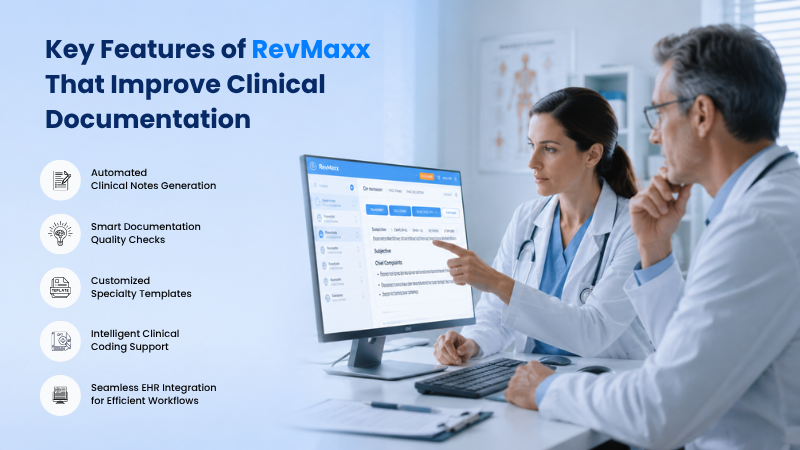
RevMaxx AI medical scribe includes several features designed specifically to improve clinical documentation workflows.
These features help physicians capture accurate clinical information while minimizing manual work. By automating documentation tasks, RevMaxx allows healthcare providers to maintain high-quality records without increasing their administrative burden.
As healthcare documentation requirements continue to evolve, tools that improve documentation efficiency will become increasingly important.
Automated Clinical Notes Generation:
One of the core capabilities of RevMaxx is automated clinical note generation. Instead of typing notes manually, physicians can rely on the system to generate structured notes based on provider-patient conversation during visits. The system captures key clinical details and organizes them into standard SOAP (subjective, objective, assessment, and plan) note formats.
This automation significantly reduces the time physicians spend on documentation tasks. Research shows administrative work often consumes more time than direct patient care, making automation a critical solution for healthcare efficiency. By automating note creation, RevMaxx allows physicians to focus on what matters most: patient care.
Smart Documentation Quality Checks
RevMaxx also performs automated quality checks on clinical notes. The system reviews documentation to ensure key clinical elements are included and properly structured. For example, it may flag missing diagnoses, incomplete treatment plans, or unclear medical terminology.
These checks help physicians maintain documentation standards similar to those used by a clinical documentation specialist. By improving documentation completeness, healthcare organizations can reduce claim denials, coding errors, and compliance risks.
Customized Specialty Templates
A cardiologist, psychiatrist, and primary care physician all document patient encounters differently. Generic documentation formats often fail to capture the clinical details required for specific specialties. RevMaxx addresses this challenge by offering customized specialty templates designed for different medical fields.
These templates are designed to capture the clinical information typically required in different specialties, such as symptoms, diagnosis details, treatment plans, and follow-up instructions. By organizing documentation in a structured format, providers can quickly complete their notes without missing important clinical details.
Intelligent Clinical Coding Support
Clinical documentation plays a direct role in medical coding and reimbursement. When documentation lacks sufficient detail, coding teams may struggle to assign the correct diagnosis and procedure codes. RevMaxx helps address this issue by supporting intelligent clinical coding assistance during the documentation process.
It captures the level of detail required for coding frameworks such as ICD-10, CPT, HCC and E/M codes. This helps coders assign the correct codes without needing multiple clarifications from physicians. As a result, documentation becomes more coding-ready from the beginning.
Seamless EHR Integration for Efficient Workflows
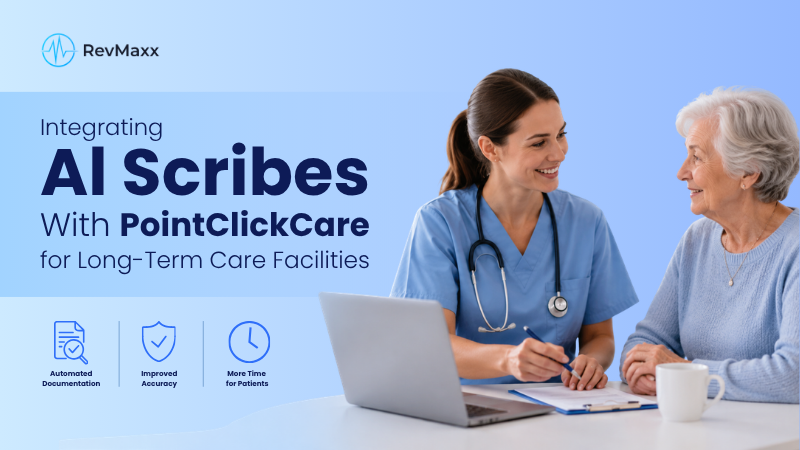
Switching between documentation tools and EHR systems can disrupt provider workflows. RevMaxx is designed to integrate smoothly with major EHR platforms, like PointClickCare, Epic, Cerner, eClinicalWorks, etc. It is allowing clinical notes to flow directly into patient records. This integration helps providers avoid duplicate work and ensures documentation remains organized within the existing healthcare system. By simplifying documentation workflows, RevMaxx helps physicians maintain high-quality records similar to those reviewed by a clinical documentation specialist.
Benefits of Turning Providers into Their Own Clinical Documentation Specialist
When healthcare providers receive intelligent documentation support, the impact can be significant. Instead of relying solely on dedicated clinical documentation specialists, physicians can create high-quality clinical notes with the help of AI assistance. This approach not only maintains clinical documentation accuracy but also improves operational efficiency. Healthcare organizations also benefit from faster chart completion and improved revenue cycle performance.
Reduced Physician Burnout
Documentation overload is one of the leading causes of physician burnout. Studies show physicians who feel they lack time for documentation are 2.8 times more likely to experience burnout symptoms.
When documentation tasks are automated, physicians spend less time on administrative work and more time interacting with patients. This improves job satisfaction and reduces stress levels among healthcare providers. AI documentation tools help restore the balance between patient care and administrative responsibilities.
Better Revenue Cycle Performance
Accurate documentation is essential for effective revenue cycle management. When clinical notes clearly describe patient diagnoses and treatments, coders can assign the correct codes more easily. This leads to cleaner claims and fewer claim denials.
Better documentation also improves compliance during audits and reduces the risk of under-coding or over-coding. By helping physicians document more effectively, RevMaxx strengthens the connection between clinical care and financial performance.
The Future of Clinical Documentation with AI Scribe
Healthcare documentation is evolving rapidly as new technologies emerge. AI-powered documentation tools are becoming an essential part of modern healthcare workflows. These systems help clinicians capture detailed patient information without increasing administrative burden.
As healthcare systems adopt digital technologies, intelligent documentation tools will play a central role in improving efficiency and reducing burnout. The future of clinical documentation will likely involve a combination of AI automation and human oversight.
Why Solutions Like RevMaxx Are Shaping the Future of Healthcare
RevMaxx medical scribe application demonstrate how AI can improve healthcare operations without disrupting clinical workflows. By assisting with documentation in real time, these systems allow physicians to work more efficiently while maintaining accurate patient records.
As healthcare organizations face growing documentation requirements, intelligent solutions will become essential. RevMaxx helps physicians perform documentation tasks at the level of a clinical documentation specialist without requiring additional staff. This approach supports better patient care, stronger documentation, and more sustainable healthcare operations.
The Conclusion
Clinical documentation is one of the most critical components of modern healthcare. It supports patient care, regulatory compliance, and financial stability. However, the growing documentation burden has placed significant pressure on healthcare providers. The traditional model of relying solely on clinical documentation specialists is no longer sufficient to address this challenge.
AI-powered solutions such as RevMaxx offer a new approach by enabling providers to function like their own clinical documentation specialists. By capturing clinical conversations, generating structured notes, and improving documentation accuracy, RevMaxx reduces administrative workload while improving healthcare efficiency.
As healthcare continues to evolve, intelligent documentation tools will play a key role in helping providers focus on what matters most—delivering high-quality patient care.