In long-term care facilities, busy healthcare professionals such as nurses, doctors, and caregivers experience extreme documentation overload every day without really recognizing it as an issue. They typically will lose 30% of their shift with patients due to having to document each time they enter a valid patient data point into an electronic-based system.
Research has shown that doctors spend, on average, 2-3 hours doing administrative and EHR-related work for every hour of actual patient contact. This excessive documentation is causing a dramatic increase in physician burnout rates, and as such, healthcare organizations are beginning to adopt the use of AI scribe long-term care facilities.
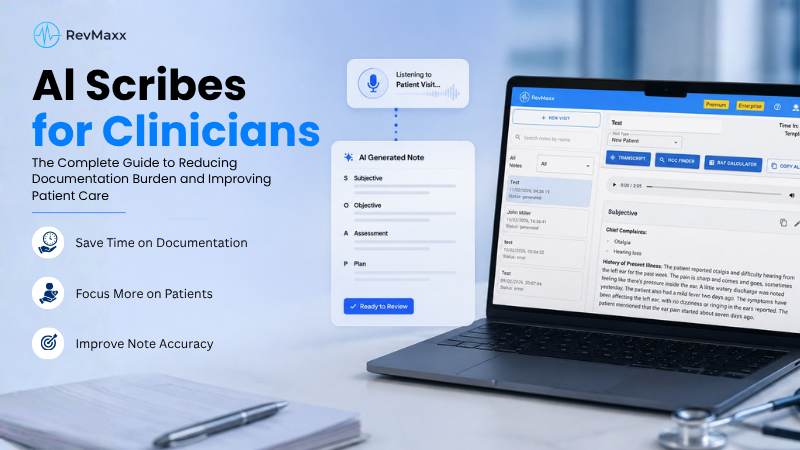
These AI systems can capture clinical dialogue automatically without needing to create them manually. They will also generate structured notes that can be easily reviewed and placed directly into EHR platforms like PointClickCare.
PointClickCare EHR integrated AI scribes for long-term care facilities can dramatically reduce their documentation time, increase accuracy, and give care providers more time to provide direct patient care.
In this blog we will inform you about how the AI scribes function, the integration process with the PointClickCare EHR system, and why these AI scribes are quickly becoming an essential tool for contemporary long-term care facilities.
Understanding the Documentation Challenges in Long-Term Care Facilities
Long term care facilities handle many records each day. This can happen in skilled nursing homes, rehab facilities or assisted living facilities. Unlike hospitals, all individuals at long-term care facilities receive treatment over a long period of time. Thus, patients are often continually monitored, receive medication to be tracked, and be provided with a care plan to follow. All patient interactions must be documented correctly to ensure compliance and safety for the patient as well as make sure the facility is reimbursed for their services.
Key Documentation Challenges for Long-Term Care Facilities
Long-term care facilities face significant documentation challenges due to the high volume of daily records, time-consuming EHR workflows, after-hours charting, and strict regulatory requirements. These demands can place additional pressure on healthcare teams, increase administrative workload, and reduce the time available for direct resident care.
Large Volume of Daily Notes
Long-term care teams manage a high volume of clinical documentation every day. Nurses, physicians, therapists, and caregivers may need to complete nursing assessments, medication administration records, care plan updates, physician progress notes, therapy documentation, and other resident records. With each resident generating multiple records throughout the day, the sheer volume of documentation can quickly become overwhelming and take valuable time away from direct patient care.
Time-Consuming EHR Documentation
Entering clinical information into an EHR can consume a significant portion of a provider’s workday. Care teams often need to navigate multiple screens, enter repetitive information, and review records before completing each note. Over time, these tasks can create substantial administrative burden and reduce the time available for patient interactions and clinical responsibilities.
After-Hours Charting
Many clinicians find themselves completing documentation after their scheduled shifts have ended. This “pajama time” extends the workday, contributes to fatigue, and can negatively affect work-life balance. When documentation consistently spills into personal time, it can also increase the risk of burnout and reduce overall job satisfaction.
Regulatory Compliance Pressure
Accurate and complete documentation is essential for long-term care facilities to support regulatory compliance, quality reporting, audits, and Medicare and Medicaid reimbursement. Missing information, inconsistent records, or documentation errors can create compliance risks and potentially affect reimbursement. As documentation requirements continue to grow, facilities need efficient ways to maintain accurate records without adding more administrative pressure to already busy care teams.
What Are AI Scribes for Long-Term Care Facilities?
AI scribes for long-term care facilities are artificial intelligence tools specially designed to automatically capture conversations between doctors and patients during visits and document them properly into structured clinical notes.
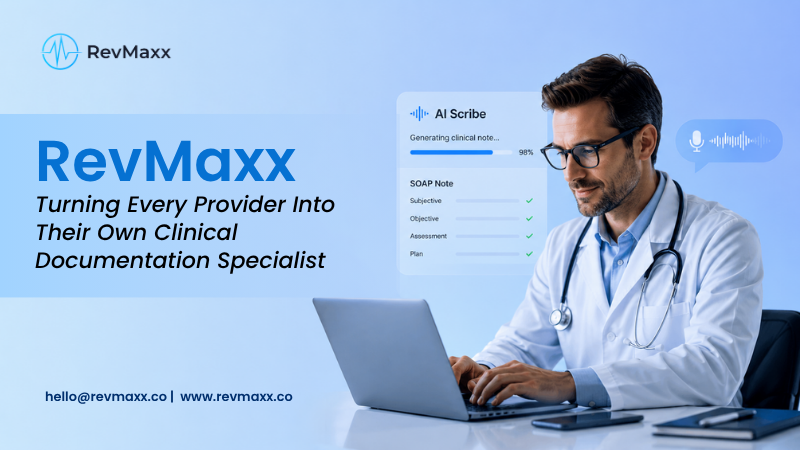
Instead of typing or dictating clinical notes manually, clinicians naturally conduct the patient visit while the AI system ambiently listens and generates a complete and clear medical note. The provider then reviews the draft note, makes edits if needed, and approves it before it is stored in the existing EHR system. It uses advanced speech recognition, natural language processing (NLP) technology, clinical language models, and automated medical documentation generation technology to convert the spoken interactions into structured clinical notes.
Healthcare facilities are increasingly adopting ambient AI scribes. A large study involving over 2.5 million patient encounters found that AI scribes significantly reduced note-taking time and improved physician satisfaction.
How AI Scribes Capture Clinical Conversations
AI scribes operate quietly in the background during a patient interaction.
Here is how the process usually works.
Step 1: Listening to the Conversation
The AI scribe securely captures the conversation between the clinician and patient during the consultation. It works in the background, allowing the provider to focus on the resident rather than manually taking notes. Depending on the solution and workflow, the conversation may be captured through a secure mobile device, computer, or dedicated application, with appropriate patient consent and privacy safeguards.
Step 2: Real-Time Transcription
The AI uses advanced speech recognition technology to convert the spoken conversation into text. It can distinguish relevant dialogue and capture important clinical details as they are discussed. This eliminates the need for clinicians to manually type every detail during or immediately after the visit, helping reduce repetitive documentation work.
Step 3: Clinical Context Understanding
Natural language processing and clinical AI models analyze the transcribed conversation to identify and organize relevant medical information. The system can recognize details such as symptoms, diagnoses, medications, allergies, medical history, assessments, and treatment plans and understand how these details relate to the patient’s visit.
Step 4: Draft Clinical Note Creation
Once the relevant information is identified, the AI organizes it into a structured clinical note based on the facility’s preferred documentation format or template. Depending on the workflow, this may include progress notes, follow-up notes, assessment and plan documentation, or other types of clinical records. The goal is to transform a natural conversation into a clear, organized draft that requires significantly less manual data entry.
Step 5: Clinician Review and Approval
The clinician reviews the AI-generated draft to verify that the information is accurate, complete, and clinically appropriate. They can make corrections, add missing details, or modify the note as needed before approving it. The finalized documentation can then be saved to the appropriate patient record or transferred into the facility’s EHR workflow, such as PointClickCare, depending on the integration. This clinician-in-the-loop process helps maintain provider oversight while reducing the time spent creating documentation from scratch.
Overall, this workflow allows AI scribes to handle much of the repetitive documentation process while keeping clinicians in control of the final record—helping reduce administrative workload and giving care providers more time to focus on patients and residents.
Types of Clinical Notes AI Scribes Can Generate for Long-Term Care Facilities
AI scribes can support long-term care teams by transforming clinician-patient conversations into structured, organized and accurate clinical documentation. Depending on the facility’s workflow, documentation requirements, and AI scribe capabilities, these tools can assist with several common types of clinical notes while allowing clinicians to review and approve the final documentation.
1. Progress Notes
Progress notes document a resident’s current health status and changes in their condition over time. AI scribes can capture relevant information discussed during routine visits and organize it into a structured progress note, helping clinicians efficiently document assessments, treatment responses, and ongoing care.
Progress notes may include:
- Changes in the resident’s health condition
- Current symptoms and concerns
- Clinical assessments and observations
- Treatment progress and response
- Changes to medications or therapies
- Updates to the care plan
- Recommended follow-up actions
2. Nursing Notes
Nursing documentation is an essential part of long-term care and provides a record of a resident’s condition, daily observations, and response to care. AI scribes can help organize relevant information from nurse-patient interactions into structured documentation, reducing the need for repetitive manual data entry.
Depending on the workflow, nursing notes may capture:
- Vital signs and relevant clinical observations
- Changes in physical or behavioral condition
- Medication response or concerns
- Symptoms reported by the resident
- Pain levels and other patient-reported concerns
- Changes in mobility or functional status
- Communication with family members or other care team members
3. Admission Documentation
When a new resident enters a long-term care facility, the care team must collect and document a significant amount of information. AI scribes can assist clinicians in organizing information gathered during the initial assessment and admission process into a structured format.
Admission documentation may include:
- Relevant medical and surgical history
- Current diagnoses and health conditions
- Medication history and current medications
- Allergies and other relevant clinical information
- Initial assessment findings
- Patient and family concerns
- Existing treatment plans
- Initial care recommendations
By reducing the manual documentation burden during admission, AI-powered tools can help care teams complete initial records more efficiently.
4. Care Plan Updates
Resident care plans often change as a patient’s health condition, treatment needs, or functional status evolves. AI scribes can capture conversations about changes in treatment and organize the relevant information for documentation and care plan updates.
Care plan documentation may include:
- Changes in medical condition
- Adjustments to treatments or therapies
- Medication changes
- New care goals
- Changes in mobility or daily living needs
- Recommended interventions
- Follow-up requirements
This can help ensure that important discussions and care decisions are accurately documented and communicated to the broader care team.
5. Follow-Up Notes
Follow-up visits allow clinicians to assess how a resident is responding to treatment and determine whether additional interventions are required. AI scribes can capture the conversation during these visits and generate structured documentation that reflects the resident’s current status and ongoing treatment.
Follow-up notes may include:
- Current symptoms and patient concerns
- Changes since the previous visit
- Response to treatment or medication
- Clinical assessment
- Updated treatment recommendations
- Additional testing or referrals
- Next steps and follow-up plans
Automating the initial documentation process can help providers complete follow-up notes more efficiently while maintaining a consistent documentation workflow.
6. Discharge Summaries
Discharge summaries provide an overview of a resident’s care and clinical status when they leave a long-term care facility or transition to another care setting. AI scribes can assist in organizing relevant information from the resident’s care journey into a structured summary for clinician review.
A discharge summary may include:
- Reason for admission
- Relevant diagnoses and medical history
- Major treatments and interventions
- Medication information
- Resident’s condition at discharge
- Follow-up recommendations
- Ongoing care requirements
- Instructions for the resident, family, or receiving care team
Streamlining Documentation Across the Care Continuum
By supporting multiple types of clinical documentation, AI scribes can help long-term care facilities create a more consistent and efficient documentation workflow. Rather than starting every note from scratch, clinicians can review an AI-generated draft, make necessary corrections, and approve the final documentation.
This approach can help:
- Reduce repetitive manual data entry
- Minimize time spent creating clinical notes
- Improve consistency across documentation
- Support faster completion of patient records
- Reduce after-hours charting
- Give clinicians more time to focus on resident care
- Improve information sharing across the care team
AI scribes are not intended to replace clinical judgment. Instead, they act as documentation assistants that help care providers capture and organize relevant information while keeping the clinician responsible for reviewing and approving the final record.
Overview of PointClickCare in Long-Term Care
PointClickCare is one of the biggest technology platforms used in healthcare for long-term and post-acute care providers. Thousands of organizations rely on this application as a way to manage their clinical documentation of patients as well as manage operational workflows, such as those that take place in a long-term care facility (e.g., skilled nursing facilities and assisted living facilities) or a home health agency.
The platform helps providers:
- Maintain electronic health records
- Coordinate care among teams
- Track medication administration
- Manage billing and compliance
Because long-term care involves multiple caregivers interacting with the same patient, having a centralized system like PointClickCare is essential for maintaining accurate medical records.
Key Features of PointClickCare for Care Providers
Long-term care facilities manage many residents, and each resident has detailed medical information that needs to be recorded and shared with different caregivers. This is where PointClickCare helps. It provides tools that make daily care management easier and more organized for healthcare teams.
Electronic Health Records Management
PointClickCare stores all resident medical information in one digital system. Care providers can quickly view a patient’s medical history, diagnoses, medications, lab results, and care plans. This makes it easier to access records without searching through paper files.
Medication Administration Tracking
Because elderly patients are at a high risk of experiencing serious consequences from medication errors, PointClickCare has developed bolstering tools to track medication administration and who administers medications in order to protect this vulnerable population. Through the system, nurses have the capability to document details of each resident’s medication-related events, ensuring the correct medication is administered to each resident at the correct time.
Care Coordination Tools
Multiple healthcare providers can typically be involved with caring for each resident, including nursing staff, medical providers, therapists, and aids (aka caregivers). By using PointClickCare, each of these individuals can update and access the same patient information from one place, allowing the entire care team to work together more efficiently and in an informed manner.
Regulatory Compliance Support
To comply with the regulations governing long-term care facilities related to healthcare and documentation, providers need a system that allows them to create and manage the records and reports they need for their various audits, inspections, and insurance claims; PointClickCare is that system.
Real-Time Patient Monitoring
Care teams can input new information about patients as soon as they have had an appointment or treatment. Therefore, the other staff has access to this new information instantly without having to wait for a later time. By providing “real-time” updates on patient care, the caregivers can react more quickly when a patient’s symptoms worsen.
How AI Scribes Integrate With PointClickCare
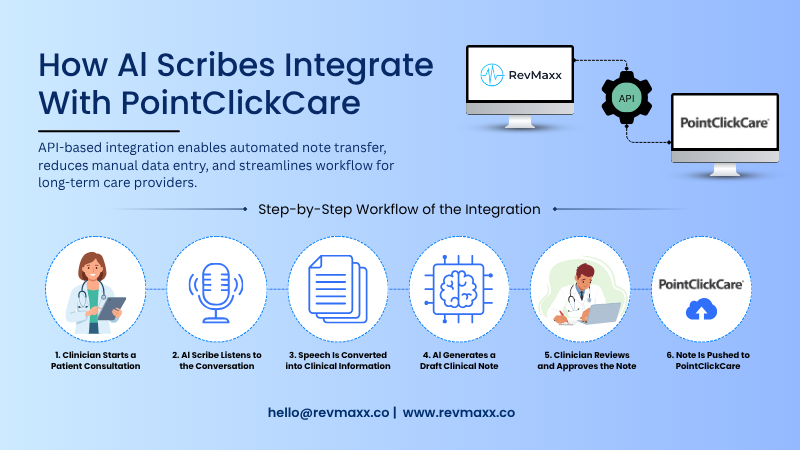
Healthcare providers can use an AI scribes for long-term care facilities (RevMaxx is only AI scribe that is marketplace partner with PointClickCare) as an integrated tool within PointClickCare to help them eliminate their documentation burdens by automating note-taking at each visit with a patient. Rather than manually entering notes into the chart after each encounter, clinicians can have the AI scribe record the dialogue between themselves and the patient, then generate the standardized clinical documentation for them based on the recorded patient dialogue.
The integration of these types of technologies generally takes place via secure connections (e.g., through APIs or other secure protocols) to provide the means for the AI system to communicate with the EHR documentation system. Once connected, the AI medical scribe can send completed notes directly into the patient’s record in PointClickCare.
This process helps reduce manual data entry. Nurses and physicians do not have to switch between systems or spend extra time typing information. The documentation is created during the visit and added to the EHR once the clinician approves it. Because of this smooth workflow, care providers can finish charting faster and spend more time focusing on their residents.
Step-by-Step Workflow of the Integration
The process of using an AI scribe during a patient visit is simple and fits naturally into the clinician’s daily routine.
- Clinician starts a patient consultation
The healthcare provider begins the visit with the resident just like any normal consultation. - AI scribe listens to the conversation
The AI system runs in the background and listens to the discussion between the clinician and the patient. - Speech is converted into clinical information
The system uses speech recognition to turn spoken words into text. It also identifies important medical details such as symptoms, medications, and treatment plans. - AI generates a draft clinical note
The AI organizes the information and creates a structured medical note. - Clinician reviews and approves the note
Before saving the note, the provider checks it for accuracy and makes any necessary edits. - Note is uploaded to PointClickCare
Once approved, the note is automatically saved in the patient’s record inside PointClickCare.
This process removes the need for manual typing and helps clinicians complete documentation faster.
Data Security and Compliance Considerations
Healthcare data is highly sensitive. Any system that records patient conversations or medical information must follow strict privacy rules.
AI scribes used in healthcare must comply with Health Insurance Portability and Accountability Act regulations. These rules protect patient health information and ensure that data is handled safely.
Several security measures are important when integrating AI scribes with EHR systems.
- Secure data encryption
All patient information should be encrypted when it is recorded, stored, or transferred between systems. - Role-based access control
Only authorized healthcare staff should be able to view or edit patient records. - Audit trails
The system should track changes made to documentation. This helps organizations monitor who accessed the data and when. - Secure system integrations
When AI tools connect with EHR platforms like PointClickCare, the connection must be secure to prevent unauthorized access to patient data.
Strong security practices help healthcare organizations protect patient privacy while using advanced technology.
Key Benefits of AI Scribes for Long-Term Care Facilities
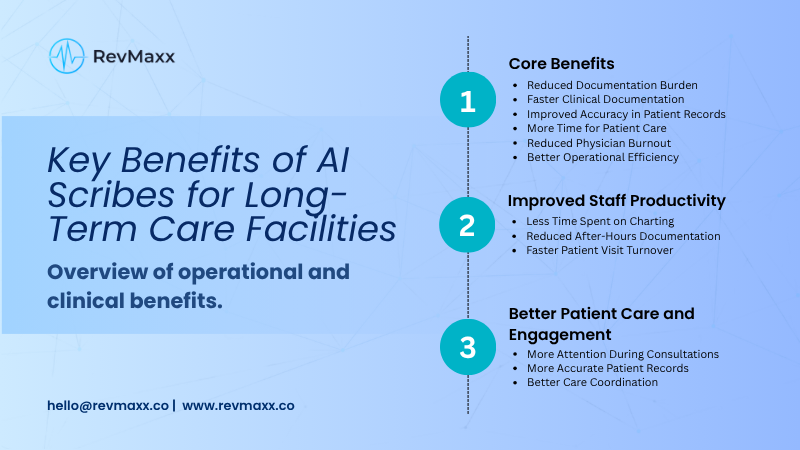
Long-term care facilities manage large amounts of documentation every day. AI scribes can help reduce this workload and make clinical documentation faster and easier. One of the biggest benefits is that caregivers spend less time typing notes and more time caring for residents.
- Reduced Documentation Burden:
AI scribes capture conversations and generate notes automatically. This removes a large portion of manual charting work.
- Faster Clinical Documentation:
Notes are created during the patient visit, so clinicians do not have to spend hours finishing charts later.
- Improved Accuracy in Patient Records:
As the AI scribe for long-term care facilities captures the entire conversation, it can include details that may be missed during manual documentation.
- More Time for Patient Care:
When clinical documentation takes less time, clinicians and providers can completely concentrate more on resident care and better communication.
- Reduced Physician Burnout:
Heavy clinical and documentation workloads are one of the main reasons clinicians feel exhausted. Automating notes can help reduce this pressure.
- Better Operational Efficiency:
Long-term care facilities can easily improve their productivity when staff members spend less time on administrative tasks and focus more on patient care.
- Improved Staff Productivity
AI scribes for long-term care facilities can help care teams work more efficiently during their daily routines.
- Less Time Spent on Charting:
As clinical notes are generated automatically, clinicians spend much less time entering patient details and other information into the EHR system.
- Reduced After-Hours Documentation:
Many healthcare providers complete their charting after working hours. But with the help of AI medical scribes, they can easily finish the documentation during the workday.
- Faster patient visit turnover
When documentation is quicker, clinicians can move more smoothly from one patient visit to the next.
These improvements allow healthcare teams to manage their workload more comfortably.
Better Patient Care and Engagement
One of the most important benefits of AI scribes is the improvement in patient interaction.
When clinicians are not busy typing during visits, they can focus more on listening to the patient and understanding their concerns.
- More attention during consultations
Providers can maintain eye contact and engage in better conversations with residents. - More accurate patient records
Capturing the entire conversation helps ensure that important details are not missed. - Better care coordination
When documentation is clear and complete, other members of the care team can easily understand the patient’s condition and treatment plan.
In long-term care facilities, where residents often require ongoing attention, this improved communication can make a big difference in the quality of care.
Implementation Best Practices for Long-Term Care Facilities
Before adopting AI scribes for long-term care facilities, organizations should take time to plan the implementation properly. Introducing new technology works best when the workflow and staff needs are clearly understood.
The first step is to analyze the current documentation process. Facilities should look at how much time clinicians spend on charting, what type of notes they create, and where delays usually happen. This helps leaders understand where AI scribes can make the biggest difference.
Planning is also important because every care facility has its own workflow. Some clinicians may use mobile devices during visits, while others prefer desktop systems. The AI solution should fit naturally into these existing routines.
Another key step is making sure the AI system works smoothly with the facility’s electronic health record system. For many long-term care providers, this means ensuring compatibility with PointClickCare, and only RevMaxx AI scribe is PointClickCare marketplace partner. When the AI scribe integrates well with the EHR, clinicians can review and approve notes quickly without switching between multiple systems.
Careful planning before implementation can help organizations avoid workflow disruptions and make the transition much easier for staff.
Future of AI Scribes in Long-Term Care Technology
AI scribes are still evolving, and their role in healthcare will continue to grow in the coming years.
Expanding role in healthcare documentation
More hospitals, clinics, and long-term care facilities are exploring AI-powered documentation tools to reduce administrative workload.
Integration with predictive analytics
Future systems may analyze patient conversations and clinical data to identify potential health risks earlier.
Clinical decision support
AI systems may assist clinicians by suggesting treatment options or reminders during patient visits.
Voice-driven workflows in EHR systems
Healthcare technology is moving toward voice-based interaction. Instead of typing notes, clinicians may manage documentation through voice commands.
Expansion across healthcare specialties
While AI scribes are already used in primary care and hospitals, adoption is growing in other areas such as senior care, rehabilitation, and behavioral health.
As these technologies improve, they will likely become a standard part of healthcare documentation.
Conclusion
Documentation is a major challenge in long-term care facilities. Nurses and physicians often spend large portions of their day entering information into electronic systems instead of focusing on residents.
This is where AI Scribes for Long-Term Care Facilities can make a real difference.
By capturing clinical conversations and turning them into structured notes, AI scribes reduce the burden of manual documentation. When integrated with systems like PointClickCare, the process becomes even more efficient because notes can be reviewed and stored directly in the patient’s electronic record. The result is a smoother workflow, more accurate documentation, and more time for patient care.
As healthcare technology continues to evolve, AI-powered documentation tools will likely play an important role in helping long-term care providers improve efficiency, reduce clinician burnout, and deliver better care to residents.