Healthcare organizations face a growing challenge: documentation must be accurate, detailed, compliant, and fast. Yet physicians already spend a large portion of their day documenting instead of caring for patients. When documentation is incomplete or inconsistent, the impact is serious, like claim denials, audit risk, compliance issues, and lost revenue.
This is where accurate clinical documentation AI is becoming essential. AI-driven documentation tools help clinicians capture care details correctly, support coding accuracy, and strengthen regulatory compliance. At the same time, they reduce workload and improve financial outcomes.
So, today in this blog post, we explore how accurate clinical documentation AI works, why it matters, and how it supports both compliance and revenue growth in modern healthcare.
Why Accurate Clinical Documentation Matters More Than Ever
Clinical documentation is not just a record of care. It drives coding, billing, quality reporting, legal protection, and patient safety. When documentation quality drops, every downstream process suffers.
The Growing Complexity of Healthcare Documentation
Healthcare documentation requirements have expanded significantly due to:
- Value-based care models
- Risk adjustment coding
- ICD-10 and ICD-11 specificity
- Regulatory reporting
- Quality metrics and audits
Clinicians must now document more detail than ever before. Even small gaps can lead to coding errors or reimbursement loss. Studies show that 37% of physicians’ notes lack sufficient detail for optimal coding, directly affecting reimbursement accuracy. This means documentation quality is now directly tied to financial performance.
Documentation as the Foundation of Coding and Billing
Medical coders rely entirely on provider documentation to assign ICD-10 and CPT codes. If documentation is incomplete or inaccurate:
- Codes may be missing
- Severity may be understated
- Conditions may not be captured
- Claims may be denied
A recent study reveals that 65% of medical coding errors stem from documentation deficiencies, leading to billions in lost revenue.
Link Between Documentation Accuracy and Patient Safety
Accurate documentation is also essential for:
- Continuity of care
- Clinical decision-making
- Medication safety
- Legal protection
Incomplete records can cause miscommunication between providers and increase risk. Documentation errors can even lead to incorrect treatment or missed diagnoses.
So documentation accuracy is not only a financial issue; it is a patient safety issue.
What Is Accurate Clinical Documentation AI?
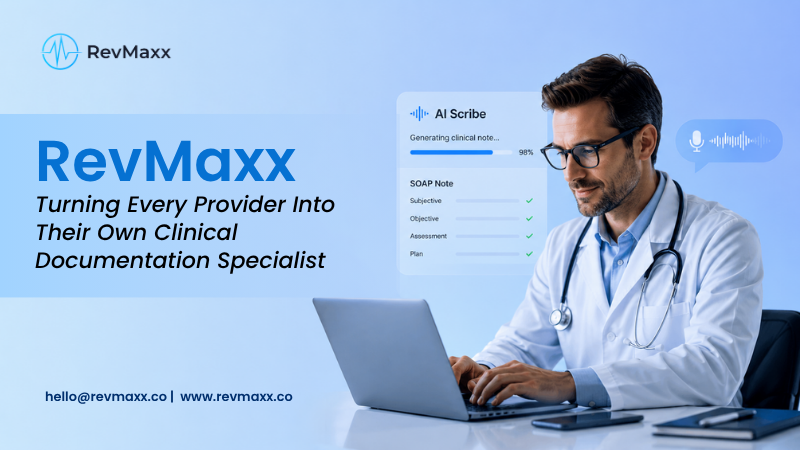
Accurate clinical documentation AI is technology that helps clinicians create complete and correct medical notes. It listens to or reads clinical information, organizes it into structured documentation, and checks for missing or unclear details.
Unlike basic templates, AI understands clinical context and suggests improvements. It uses technologies like natural language processing and speech recognition to capture real care details and convert them into accurate, compliant records that support coding and billing.
Core Capabilities of Accurate Clinical Documentation AI
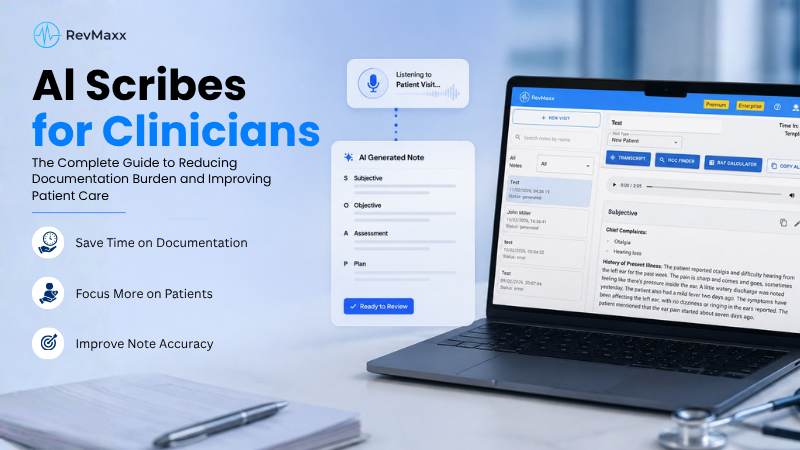
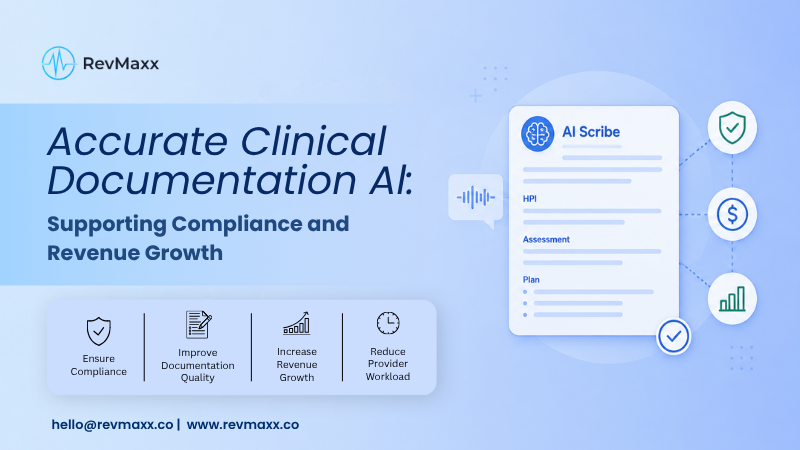
Accurate clinical documentation AI captures clinical encounters in real time, often during the patient visit. It extracts key medical details and places them into structured fields, generating a HIPAA compliant clinical note. The system suggests coding-ready phrases and prompts clinicians to add missing information.
It also checks documentation completeness and compliance requirements. Many tools include specialty-specific templates, so documentation matches the needs of different clinical areas like primary care, behavioral health, or long-term care.
How AI Improves Documentation Quality
AI improves documentation quality by guiding clinicians to include all required clinical elements. It suggests clearer and more specific wording, which helps coding accuracy. Because notes are generated from real conversations instead of copied text, copy-paste errors decrease.
AI also aligns documentation with coding and billing rules, ensuring diagnoses and care details are properly supported. Standardized medical terminology further improves clarity, consistency, and communication across providers.
How Accurate Clinical Documentation AI Supports Compliance
Accurate clinical documentation AI helps organizations meet regulatory and payer requirements by ensuring notes contain all required elements. It guides clinicians during documentation, so compliance is built into the workflow rather than checked later.
AI also creates consistent records across providers and shifts, reducing variation. Because documentation is structured and complete, records are easier to review during audits and better support billing, quality reporting, and legal protection.
Real-Time Compliance Validation
AI systems review documentation as it is created and check for required fields such as diagnosis specificity, severity, and treatment details. If something is missing, the clinician receives an alert before finalizing the note.
The system also supports medical necessity by linking diagnoses with interventions. Documentation can be aligned with payer policies and regulatory rules, helping ensure claims are supported by complete and compliant clinical evidence.
Audit Readiness and Risk Reduction
Accurate clinical documentation AI creates traceable and time-stamped records that show when care was delivered and documented. Structured notes reduce inconsistencies between providers and encounters. Because information is complete and standardized, discrepancies decrease.
This strengthens legal defensibility and audit readiness. During reviews or investigations, organizations can show clear, consistent documentation that supports coding, billing, and clinical decisions, reducing compliance risk and financial exposure.
How Accurate Clinical Documentation AI Drives Revenue Growth
Accurate clinical documentation AI helps organizations capture complete care details that support correct coding and billing. When documentation reflects true patient complexity, reimbursement improves and under-coding decreases.
It also reduces missed charges and speeds up billing cycles. By ensuring diagnoses and treatments are clearly documented, AI supports a higher case mix index and more accurate payment. Better documentation quality directly strengthens financial performance across the revenue cycle.
Improved Coding Accuracy and Specificity
AI helps clinicians document all relevant diagnoses, comorbidities, and severity details during care. This supports accurate DRG, HCC, and RAI-MDS coding. When documentation clearly shows patient acuity, coders can assign appropriate codes without repeated clarification.
This reduces coder queries and prevents under-coding. Clear, structured documentation also helps capture complications and risk factors that affect reimbursement. Overall, coding becomes more precise, complete, and aligned with actual patient conditions.
Reduced Denials and Revenue Leakage
Many claim denials happen because documentation does not support billed services. AI improves alignment between clinical notes and payer requirements by prompting for missing justification and medical necessity details. This leads to stronger, defensible claims.
With clearer documentation, organizations see fewer denials and less revenue leakage. AI also helps identify missed documentation that can support resubmissions or corrections, creating opportunities to recover revenue that might otherwise be lost.
Operational Efficiency and Financial Impact
Accurate clinical documentation AI reduces the time clinicians spend writing and correcting notes. Because documentation is complete the first time, there is less rework and fewer billing delays. Claims can be coded and submitted faster, improving cash flow. Staff productivity improves as coders and billers spend less time clarifying records. Over time, these efficiency gains translate into measurable financial benefits, including lower administrative costs and more consistent reimbursement.
Key Features to Look for in Accurate Clinical Documentation AI
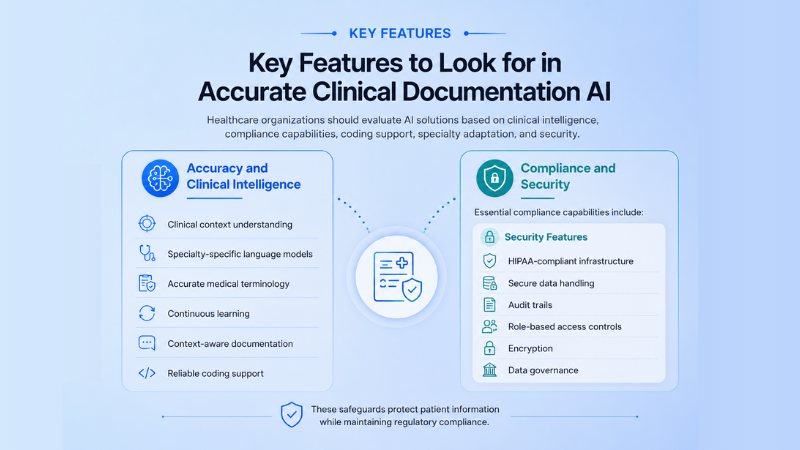
Healthcare organizations should evaluate AI documentation carefully before adoption. Strong solutions combine clinical accuracy, coding awareness, compliance intelligence, and specialty adaptability. Security and privacy protections are also essential in healthcare environments. Systems that understand clinical context and support structured documentation deliver the most value. Choosing tools with these features ensures documentation improvements translate into compliance, revenue, and workflow benefits across the organization.
Accuracy and Clinical Intelligence
High-quality documentation AI understands medical language, context, and relationships between conditions. It recognizes terminology across specialties and suggests clinically accurate phrasing. Specialty-trained models improve relevance for different care settings. Continuous learning helps systems adapt to new guidelines and documentation patterns.
Context-aware intelligence ensures generated notes reflect actual clinical meaning, not generic text. This level of understanding is essential for reliable documentation that supports coding, care decisions, and communication.
Compliance and Security
Healthcare documentation systems must protect patient data while supporting regulatory requirements. Effective AI tools use HIPAA-compliant infrastructure and maintain secure data handling. Audit trails track documentation changes and access history. Role-based permissions control who can view or edit records.
Strong governance and encryption safeguard information across systems. These security and compliance features ensure organizations can adopt AI documentation safely while maintaining regulatory trust and legal protection.
Future of Accurate Clinical Documentation AI in Healthcare
Accurate clinical documentation AI is evolving from simple note support toward broader clinical intelligence. Future systems will predict needed documentation, suggest codes, and alert clinicians to compliance gaps in real time. AI will also help capture population health risk and value-based care metrics automatically.
As technology advances, documentation will become more autonomous and integrated with decision support. This shift will reduce administrative burden while improving accuracy, compliance, and financial outcomes.
The Conclusion
Accurate clinical documentation is the foundation of healthcare compliance and reimbursement. Yet manual documentation processes are error-prone, time-consuming, and inconsistent.
Accurate clinical documentation AI transforms this process by helping clinicians capture complete, structured, and compliant notes in real time. This improves coding accuracy, reduces denials, strengthens audit readiness, and supports value-based care requirements.
The financial impact is significant. Documentation deficiencies drive most coding errors and claim denials, costing healthcare billions annually. AI-supported documentation directly reduces these losses while improving clinician productivity.
As healthcare complexity grows, documentation quality will increasingly determine organizational performance. Hospitals and practices that adopt accurate clinical documentation AI will strengthen both compliance and revenue—while enabling clinicians to focus more on patient care. In the modern healthcare environment, accurate clinical documentation AI is no longer optional. It is a strategic necessity for sustainable, compliant, and financially healthy care delivery.
Signup to RevMaxx now to avail accurate clinical documentation AI!