
The amount of documentation needed by the various clinicians is a large barrier facing health care today. When a doctor, nurse, or therapist sees a patient he or she will then typically spend long periods finishing out the appropriate notes and using their keyboards to type them. This limits the time primarily able to be spent working on actual patients, putting stress on the clinician. Research shows that physicians spend approximately 49% of their work day dealing with paperwork instead of working with patients.
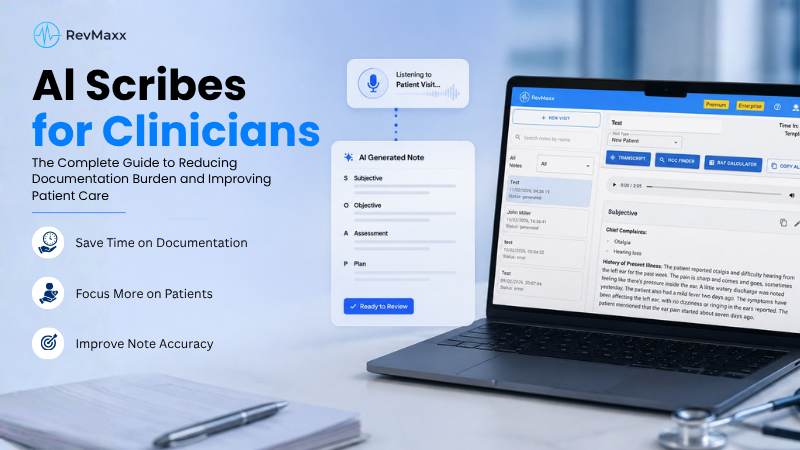
AI Scribes, artificial intelligence systems that perform as scribes, are developing and will be able to lessen the documentation burden as they will be able to “hear” each conversation between a patient and its clinician and then automatically generate clinical notes as to what occurred during that conversation with the patient.
However, using AI systems in the health care environment carries numerous regulatory responsibilities, specifically, ensuring patient data is protected and complying with HIPAA laws.
Let’s read this blog and learn what a HIPAA compliant AI scribe means, why it matters, and what requirements healthcare providers must consider.
HIPAA Compliance in Healthcare AI
HIPAA, short for the Health Insurance Portability and Accountability Act, is a federal law designed to help protect the confidentiality of patient records and to keep personal health information secure. The law defines how patient data can be used and shared, and anything that involves PHI must be in compliance with HIPAA.
Today data breaches in the health care industry are a real and growing concern. Healthcare data breaches continue to affect hundreds of millions of patient records in recent years, highlighting the growing importance of data security and HIPAA compliance. This number exceeds the number of people residing in most countries and shows just how valuable Health Care Data is and the importance of protecting it.
Therefore when incorporating AI into your clinical workflow you must make sure that it complies with HIPAA. If you fail to ensure that your clinical workflow complies with HIPAA you may suffer from legal repercussions, patient distrust, and monetary costs related to the breach. It is not enough to choose an intelligent application: you must also choose one that is compliant and secure.
What is a HIPAA Compliant AI Scribe?
A HIPAA compliant AI scribe is an AI system designed to help providers and healthcare teams create clinical notes while safeguarding PHI. These tools use advanced speech recognition and natural language processing to convert conversations into structured medical documentation. But unlike general AI apps, they must follow strict security rules.
The rules are:
- They protect all patient data they process
- They encrypt information so it can’t be read by attackers
- They integrate with electronic health records (EHRs) without exposing PHI
- They allow clinicians to review and authorize any output
AI scribes are becoming more common because clinicians can save large amounts of time. Some tools report a 60–80% reduction in documentation time, saving providers up to 2+ hours per day.
Other research shows physicians can save an average of 3.2 hours daily on documentation tasks using AI scribe technology. So, these benefits only matter if the system is secure and HIPAA compliant. A tool that saves time but puts PHI at risk is not worth the danger or compliance risk.
Essential Requirements for a HIPAA Compliant AI Scribe
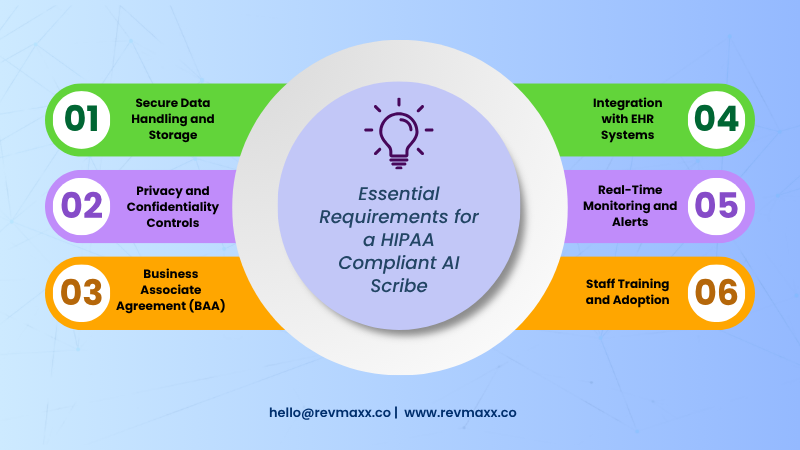
Healthcare providers must consider several requirements before adopting an AI scribe. These are not optional — they are essential for protecting patient data and meeting legal obligations.
Secure Data Handling and Storage
A HIPAA compliant AI scribe must protect all PHI at every stage. This means both data “in transit” and “at rest” must be encrypted. Encryption scrambles data so that unauthorized users can’t read it.
Encryption is now mandatory for healthcare data. Even temporary lapses can be illegal. AI systems processing PHI are treated as business associates under HIPAA, and must take full responsibility for security.
Healthcare IT teams also look for role‑based access control. This means only authorized staff can read certain data. Logs should be kept on who accesses what, and when, to allow audits and investigations.
Secure storage also matters. Some providers choose cloud‑based storage with strong encryption. Others prefer on‑premise servers that they control directly. Either approach can be compliant if done correctly. What matters most is that no PHI can be accessed or leaked without proper authorization.
Privacy and Confidentiality Controls
Beyond encryption, AI scribes must protect patient privacy in other ways. This includes:
- Ensuring the AI does not retain any unnecessary patient data after use
- Applying anonymization or pseudonymization when possible (making data less identifiable)
- Following the HIPAA Privacy Rule for all PHI
For example, in many AI systems, clinicians review and approve notes before they become part of the medical record. This limits automated retention of sensitive data without oversight.
Privacy safeguards protect patients and reduce risk for providers. Without proper controls, even small leaks of patient information can lead to violations and costly fines.
Business Associate Agreement (BAA)
One of the most important legal requirements is a Business Associate Agreement (BAA). This is a contract between the healthcare provider and the AI vendor. It states that the vendor agrees to protect PHI and follow HIPAA rules.
Without a BAA, providers can be held liable for any breaches caused by the vendor. That’s why a BAA is non‑negotiable for HIPAA compliance when using third‑party AI services.
A good BAA clearly describes:
- What data will be shared
- How it will be protected
- What happens in event of a breach
- The vendor’s responsibilities for compliance
Before you choose a vendor, make sure a BAA is offered and acceptable.
Integration with EHR Systems
AI scribes must work seamlessly and securely with Electronic Health Record (EHR) systems like Epic, Cerner, Athenahealth, and others. These systems hold clinical records and billing information. Integration is a potential point of vulnerability if it’s not secure.
A compliant AI scribe does not store PHI outside the EHR unless necessary. Export and sync to the patient’s record must be done using secure APIs and encrypted channels.
Poor integration can expose PHI or create gaps where data is left in unsecured systems. This puts providers at risk of data breach and HIPAA violations.
Real‑Time Monitoring and Alerts
A secure system should actively monitor its own performance. This includes tools to:
- Detect unauthorized access attempts.
- Track suspicious user behavior.
- Alert IT teams in real time about potential threats.
Continuous monitoring helps find problems before they become breaches. Logs and audit trails are also essential for any investigation after an incident.
HIPAA compliance is not a one‑time event. It is an ongoing process that requires vigilance and updates as threats evolve.
Staff Training and Adoption
Technology alone cannot guarantee HIPAA compliance; people must also be trained. Staff should understand how to use the AI scribe correctly and how to protect PHI at all times.
Training helps clinicians:
- Know when to report a potential issue
- Understand how PHI can be exposed
- Use the system without cutting corners on privacy
Even the best AI tool cannot prevent breaches if users ignore security policies. Only staff training reduces risk and builds a culture of compliance.
Evaluating HIPAA Compliance in AI Scribe Vendors
Choosing the right vendor is one of the most crucial decisions for healthcare providers. Here are some key points to consider before selecting an AI scribe:
- Vendor Credentials: Look for evidence of HIPAA compliance, security certifications, and audit results.
- Documentation: The vendor should provide clear security white papers and compliance reports.
- Transparency: You should understand how the AI processes PHI and what safeguards are in place.
- BAA: Always require a strong Business Associate Agreement.
- Reputation & Support: Well‑known vendors with good support teams are usually more reliable.
Many healthcare organizations now publish compliance guidance to help choose vendors. Don’t rush this process. A mistake can lead to a breach that costs millions.
Key Benefits of Using a HIPAA-Compliant AI Scribe
Despite the responsibilities, there are major benefits to adopting a compliant AI scribe:
Reduced Documentation Time
The most clear benefit is saving clinician time. AI scribes can reduce documentation work by 60–80%, allowing clinicians to focus more on patients instead of notes.
Some studies show providers can save over two hours daily by eliminating after‑visit paperwork. For practices seeing many patients per day, this can add up to thousands of hours saved each year.
Improved Accuracy and Quality
AI systems trained on medical terminology can produce highly accurate notes. Research shows AI medical scribe can reach up to 98% accuracy in clinical documentation.
Higher accuracy means fewer errors and better quality records, which can improve care continuity and reduce costly corrections later.
Enhanced Patient Interaction
When clinicians are not focused on typing, they can make better eye contact and truly listen. Surveys report that 84% of doctors feel AI scribes improve patient communication because they can be more present in the room. Patients also notice when their clinician is attentive, which improves satisfaction and trust.
Operational and Financial Benefits
By reducing documentation time, providers can see more patients or end the day sooner. In some practices, AI scribes have helped increase provider throughput and reduce costs associated with overtime. This can positively impact revenue while maintaining quality care.
Common Mistakes to Avoid with AI Scribes
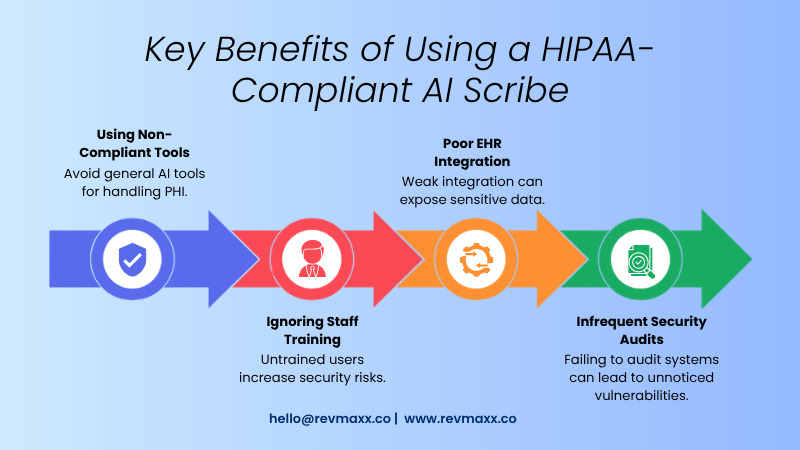
Even with HIPAA-compliant AI scribes, mistakes can still happen if providers do not follow best practices. Some common pitfalls include:
- Using Non‑HIPAA Compliant Tools: Never use general AI chatbots or consumer tools for patient data.
- Ignoring Staff Training: Technology is only as good as the people who use it.
- Poor Integration with EHRs: Failing to secure data flows between systems can expose PHI.
- Infrequent Security Audits: Not reviewing logs or updating security can allow vulnerabilities to grow unnoticed.
By avoiding these mistakes, providers can protect PHI and get the full benefits of AI technology.
Conclusion
A HIPAA compliant AI scribe is not just a trend, it is a necessary tool for modern healthcare documentation. These systems can save time, improve accuracy, enhance patient engagement, and reduce clinician burnout when used correctly.
However, compliance with HIPAA is essential. Providers must ensure secure data handling, strong privacy protections, and legal agreements like BAAs. Integration with EHRs and staff training are also key parts of safe implementation.
With rising data breaches and targeted attacks on healthcare systems, security cannot be ignored. By choosing compliant AI scribe technology, healthcare providers can protect patient data while improving the quality and efficiency of care.