
Long-term care facilities are under growing pressure to manage rising patient loads, staff shortages, and strict documentation requirements. Nurses and caregivers often spend hours updating charts, preparing reports, and completing compliance-related paperwork instead of focusing on residents.
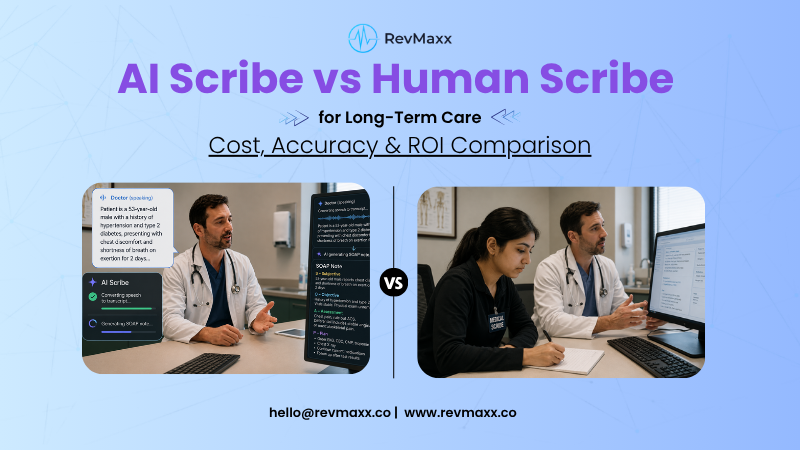
That is why most of the healthcare organizations are now implementing AI scribe for long-term care in their practice. AI-powered clinical documentation tools are being compared with traditional human medical scribes to determine which option offers better efficiency, accuracy, and long-term return on investment (ROI).
But a question arises like “Can AI scribes truly replace human scribes in skilled nursing facilities?”
Let’s read this blog carefully. Here we will compare AI scribes and human scribes based on cost, documentation quality, workflow efficiency, scalability, and operational value for long-term care providers.
Understanding Documentation Challenges in Long-Term Care
Documentation has always been a major challenge in long-term care settings. Nurses and caregivers must record patient conditions, medication updates, treatment plans, progress notes, incident reports, and regulatory documentation every day.
According to research, nurses in long-term care facilities can spend up to ⅓ of their working time on clinical documentation tasks.
This administrative burden often leads to the following:
- Staff burnout
- Reduced patient interaction time
- Delayed documentation
- Increased overtime costs
- Higher risk of compliance issues
As documentation requirements continue to grow, long term care facilities are searching for faster and more efficient solutions.
Why Accurate Documentation Matters in Long-Term Care Facilities
Accurate clinical documentation for long-term care is not just about maintaining records. It directly impacts:
- Medicare and Medicaid reimbursements
- Resident safety
- Care coordination
- Legal protection
- Regulatory compliance
Even small documentation errors can lead to denied claims, compliance penalties, or patient care gaps.
Long-term care facilities also face frequent audits and inspections. Proper documentation helps healthcare organizations remain prepared and compliant at all times.
The Growing Demand for Documentation Automation
Healthcare providers are increasingly adopting AI-driven tools to reduce repetitive administrative workloads.
A recent study in automation technologies because:
- Staffing shortages are worsening
- Documentation workloads continue to increase
- Labor costs are rising
- Care teams need more time for residents
This has accelerated the adoption of AI-powered documentation solutions across healthcare settings.
What Is a Human Medical Scribe?
A human medical scribe is a trained professional who manually documents patient encounters on behalf of healthcare providers.
Human scribes may work:
- Onsite
- Remotely
- Through outsourced healthcare support companies
They assist clinicians by entering data into EHR systems and handling documentation-related tasks during or after patient visits.
Responsibilities of Human Scribes in LTC Facilities
Human scribes typically:
- Document patient-provider interactions
- Update medical records
- Enter EHR data
- Assist physicians and nurses
- Manage clinical documentation workflows
They act as documentation support staff, allowing clinicians to spend more time with patients.
Key Benefits of Human Scribes
Human scribes still provide several advantages:
- Better contextual understanding
- Human judgment during conversations
- Ability to clarify unclear information
- Adaptability in complex care situations
In emotionally sensitive or complicated patient discussions, human interpretation may still outperform AI tools.
What Is an AI Scribe for Long-Term Care?
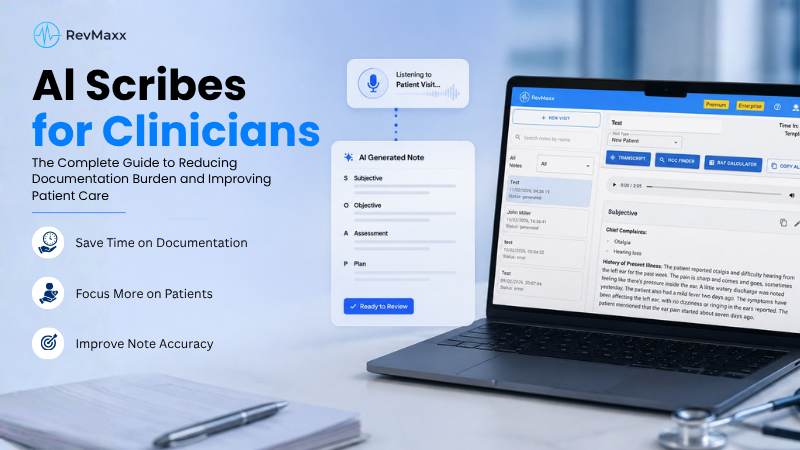
An AI scribe for long-term care is a software tool that uses artificial intelligence, speech recognition, and natural language processing (NLP) to automatically generate clinical notes from provider-patient interactions.
Instead of manually typing notes into an EHR system, clinicians can speak naturally while the AI creates structured documentation in real time.
These systems are often called:
- Ambient AI scribes
- AI medical scribes
- Voice-enabled clinical documentation tool
Many AI scribes can integrate directly with electronic health record (EHR) systems used in nursing homes and skilled nursing facilities.
How AI Scribe for Long-Term Care Settings Work
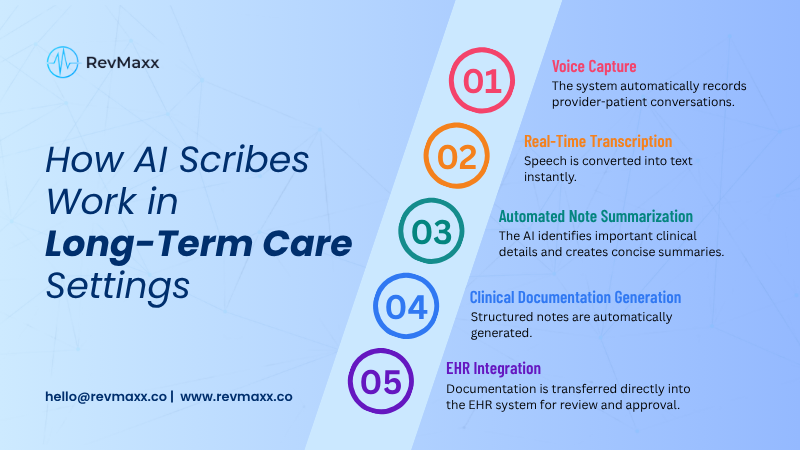
AI scribes typically work through the following:
- Automatic voice capture during patient interactions
- Real-time transcription
- Automated note summarization
- Structured clinical documentation generation
- EHR integration
The clinician then reviews, edits if necessary, and signs the note. This process reduces the need for providers to switch attention between patients and computer screens.
Common Features of AI Scribe Solutions
Modern AI scribe platforms usually offer:
- Speech-to-text transcription
- Automated SOAP notes
- Real-time clinical documentation
- EHR integration
- Compliance-friendly clinical note templates
- Voice commands
- Multilingual support
- Workflow automation
- Some advanced platforms can also identify medication details, care plans, and patient history automatically.
Human Scribe Vs AI Scribe for Long-Term Care: Side-by-Side Comparison
Healthcare organizations rarely choose technology based only on features. Decisions usually depend on cost, workflow impact, documentation quality, and financial return. Long-term care facilities often compare AI and human scribes because both aim to solve the same problem: reducing documentation burden.
AI solutions and human scribes both have strengths and weaknesses. The right option depends on the facility size, patient volume, staffing situation, and operational goals.
Recent studies suggest ambient AI systems improve physician workload and user experience, although implementation success often depends on workflow design and provider adoption.
Cost Comparison
Cost is often one of the biggest decision factors for healthcare organizations. Human scribes usually involve recurring costs including salaries, benefits, training, overtime, and replacement hiring.
AI systems usually operate on subscription or licensing models. Initial implementation costs may exist, but scaling often becomes easier because one platform can support multiple users.
Human scribe costs may include:
- Salaries
- Benefits
- Training
- Recruitment expenses
- Overtime
- Administrative overhead
AI-related costs may include:
- Software subscription fees
- Setup expenses
- Integration costs
- Staff onboarding
- Maintenance
Over time, organizations often find that technology scales more efficiently than repeated hiring cycles.
Accuracy Comparison
Accuracy matters because documentation errors can affect patient safety, reimbursement, and care quality. Human scribes can understand context and ask follow-up questions, but mistakes may still happen because of fatigue or missed details.
AI systems have improved significantly in recent years. Modern AI systems can recognize speech patterns and structure notes efficiently. However, provider review remains important because AI-generated content may occasionally include inaccuracies or missing context.
Research also highlights that AI-generated notes still need human validation before final use.
Accuracy factors include:
- Understanding medical terminology
- Capturing conversation details
- Formatting consistency
- Error detection
- Context interpretation
The strongest results often come from AI-assisted workflows with provider oversight.
Speed and Productivity Comparison
Documentation speed directly affects workflow efficiency. Delayed chart completion creates an administrative backlog and increases provider stress.
AI systems can generate draft notes immediately after conversations. Human scribes may require additional processing time depending on workload and documentation complexity.
Healthcare organizations using ambient AI tools have reported lower documentation burden and improved work-life integration.
Potential productivity improvements include:
- Faster note generation
- Reduced after-hours charting
- More direct patient interaction
- Faster record completion
- Lower administrative workload
Speed becomes especially important in long-term care environments where providers manage multiple residents daily.
Scalability Comparison
Scalability becomes important as organizations expand. A facility with multiple sites may struggle to hire and manage large scribe teams.
Human resources usually increase in proportion to growth. AI systems work differently because expansion often requires software deployment instead of additional hiring.
AI systems may support:
- Multiple providers
- Multiple facilities
- Standardized workflows
- Centralized management
- Faster implementation
Large healthcare organizations often see scalability as a major reason for considering AI documentation solutions.
Comparison Area | Human Scribe | AI Scribe for Long-Term Care |
Cost | Higher recurring labor costs | Subscription-based cost structure |
Accuracy | Strong contextual understanding | Consistent formatting with provider review |
Speed | Depends on workload | Near real-time documentation |
Training | Continuous training needed | Initial onboarding required |
Scalability | Limited by staffing | Easier expansion across sites |
Availability | Shift-dependent | Available continuously |
Workflow Efficiency | Moderate improvement | Can significantly reduce manual work |
ROI Potential | Longer return period | Potential long-term savings |
Cost Breakdown of AI Scribe for Long-Term Care
Cost analysis should include more than software pricing alone. Healthcare organizations sometimes focus only on monthly fees and ignore operational expenses that build over time.
An AI scribe for long term care can involve setup costs in the beginning, but many facilities evaluate long-term financial impact rather than immediate spending.
Typical cost areas include:
- Implementation expenses
- Software subscriptions
- EHR integration
- Staff onboarding
- Technical support
- System maintenance
Human staffing expenses often continue increasing because of salary growth, turnover, and recruitment efforts.
Research from Yale found that physician burnout can also create major financial consequences, with physician replacement costs reaching hundreds of thousands of dollars in recruitment and productivity losses.
Real-World Cost Example: Human Scribe vs AI Scribe for Long-Term Care Facility
Consider a long-term care facility with 10 healthcare providers managing daily documentation.
Human scribe estimated annual costs:
- Average salary per scribe: $40,000–$50,000
- Benefits and taxes: $8,000–$12,000
- Recruitment and onboarding: $3,000–$5,000
- Training costs: $1,500–$2,500
Estimated annual cost for 10 scribes:
- Total: approximately $525,000–$695,000 per year
Now compare this with an AI-based documentation system.
AI scribe for Long-Term care estimated annual costs:
- Software subscription: $250–$500 per provider/month
- Setup and EHR integration: $8,000–$15,000 one-time
- Training and onboarding: $2,000–$5,000
Estimated annual cost for 10 providers:
- Subscription: $30,000–$60,000
- First-year implementation cost: $10,000–$20,000
- Total first-year cost: approximately $40,000–$80,000
Even if actual pricing differs by vendor and facility size, the example shows how technology costs can scale differently than labor costs.
Potential Annual Savings Example
If an organization spends $600,000 annually on human documentation support and moves to an AI-assisted system costing $70,000 annually, the possible direct operational savings could reach the following:
$600,000 − $70,000 = $530,000 annually
Indirect financial gains may include:
- Reduced provider overtime
- Lower burnout-related turnover
- Faster documentation completion
- Better productivity
- Improved reimbursement cycles
Facilities should remember that ROI is not only about reducing expenses. Time savings and improved workflow often create value that becomes visible over several months rather than immediately.
Accuracy in Long-Term Care Documentation: Which Performs Better?
Documentation accuracy has a direct impact on patient care in long-term care environments. Residents often require ongoing monitoring, medication adjustments, chronic disease management, and multiple provider interactions. Even a small documentation error can affect treatment decisions or create reimbursement issues.
The discussion should not focus only on whether humans or machines are better. The real question is how documentation quality can be improved while reducing workload on providers. Studies around healthcare documentation show that both human and technology-assisted systems can make mistakes if processes are not monitored properly. For this reason, many healthcare organizations are moving toward a model where AI assists providers while clinicians continue reviewing final records.
Areas Where Human Scribes May Have Advantages
Human scribes still provide value in situations where emotional context or complex conversations matter. They can recognize unusual situations and ask providers for clarification if information seems incomplete.
Human strengths may include:
- Understanding emotional context
- Handling unexpected situations
- Identifying unclear information
- Adjusting to changing conversations
- Supporting highly specialized workflows
Complex long-term care environments sometimes involve family discussions, behavioral observations, and unique patient situations where human judgment remains useful.
Areas Where AI Scribe for Long-Term Care Performs Well
Modern AI systems have improved rapidly because they learn from large amounts of medical language and documentation patterns. Repetitive documentation tasks are often where AI performs efficiently. AI tools can create standardized notes and process large amounts of information quickly.
Strong performance areas often include:
- Consistent note formatting
- Faster documentation generation
- Reduced repetitive typing
- Automatic organization of clinical information
- Identification of important conversation points
Recent research involving ambient AI systems found reductions in documentation effort and improved clinician satisfaction after implementation. These improvements can help providers spend more time focusing on residents rather than screens.
Best Practice for Maximum Accuracy
Many organizations are finding that the best results do not come from choosing only one approach. Instead, they use a hybrid process where technology assists providers while clinicians review and approve documentation.
Best practices often include:
- Provider review before final submission
- Regular system monitoring
- Staff training
- Continuous workflow improvement
- Quality audits
The goal is not complete automation. The goal is improving efficiency without reducing clinical quality.
Measuring ROI of AI Scribe for Long-Term Care
Healthcare leaders rarely invest in technology only because it looks modern. Financial impact matters. Return on investment, or ROI, helps organizations understand whether a solution creates measurable value over time.
An AI scribe for long term care can create direct and indirect returns. Direct returns include cost savings and productivity gains. Indirect returns may include improved staff satisfaction and reduced burnout.
Research suggests burnout itself carries significant financial impact. Studies estimate that physician turnover and replacement costs can be extremely expensive for healthcare organizations.
Financial ROI
Financial benefits are often the first area organizations evaluate. Reducing repetitive work can lower labor-related costs and improve operational efficiency.
Potential financial gains include:
- Reduced documentation expenses
- Lower overtime costs
- Reduced hiring needs
- Better resource allocation
- Faster billing processes
A more efficient documentation process may also improve reimbursement cycles because records can be completed more quickly.
Operational ROI
Operational improvements can affect the entire organization. Small workflow changes often create larger impacts over time.
Operational benefits may include:
- Faster note completion
- Reduced administrative burden
- Better staff efficiency
- Improved workflow consistency
- Less after-hours charting
Research around AI-assisted documentation found providers reporting better workflow experiences and less time spent on documentation tasks.
Conclusion
Long-term care facilities are under increasing pressure to improve efficiency while maintaining high-quality patient care. Documentation requirements continue growing, and healthcare teams already manage significant administrative responsibilities.
The comparison between human and AI scribe for Long-Term care shows that each approach offers advantages. Human scribes provide flexibility and contextual understanding. AI systems offer scalability, speed, and operational efficiency.
For many organizations, the conversation is becoming less about replacement and more about support. An AI scribe for long-term care can help reduce documentation burden, improve workflow efficiency, and potentially create long-term financial benefits. At the same time, provider oversight remains important to maintain quality and accuracy.
The strongest results often come from balancing technology with human expertise. When documentation becomes easier, providers gain something valuable back: more time for resident care.