
Healthcare documentation has become one of the biggest burdens in modern care delivery. Clinicians today spend large portions of their day interacting with electronic health records (EHRs) instead of patients. Studies show physicians spend nearly 2-3 hours on EHR and desk work for every 1 hour of patient care. This growing documentation load leads to workflow fragmentation, after-hours charting, and clinician burnout.
At the same time, ambient AI medical scribes are rapidly transforming how clinical notes are generated. These tools capture patient-provider conversations in real time and generate structured documentation automatically. However, the real value of ambient AI depends on one critical factor: how well it integrates with the EHR.
This is where ambient AI EHR integration becomes essential. Seamless integration ensures AI-generated notes flow directly into clinical workflows without extra steps, delays, or data loss. When done right, it reduces clicks, enables real-time documentation, improves data quality, and supports efficient care delivery.
Today, in the blog, we will explore Ambient AI EHR integration, how it works, and why it matters.
What Is Ambient AI EHR Integration?
Ambient AI EHR integration refers to the seamless connection between ambient clinical documentation systems and electronic health records so that clinical conversations are automatically captured, structured, and entered into the EHR in real time.
Definition and Core Components
Ambient AI in clinical documentation refers to technology that listens to clinician–patient conversations and converts them into structured medical notes without manual typing. It operates passively in the background during encounters.
EHR integration in healthcare IT means connecting external systems to the EHR so data can be exchanged, inserted, or retrieved automatically.
Therefore, Ambient AI EHR integration = real-time conversation capture + structured EHR data entry.
Key components include:
- Speech recognition converts spoken conversation into text
- Clinical NLP understands medical language and context
- Context awareness identifies speakers, intent, and clinical meaning
- Structured data mapping maps information to EHR fields
- EHR write-back capability inserts notes into the EHR
These components allow documentation to occur automatically during the clinical encounter rather than afterward.
How Ambient AI Connects with EHR Systems
Ambient AI systems integrate with EHR platforms through several technical pathways.
- Native API integrations allow direct communication with the EHR database using secure interfaces
- Middleware or overlay integration places the AI system on top of the EHR interface layer
- RPA-based integration uses automation bots to enter data into EHR screens
- HL7 and FHIR standards enable structured healthcare data exchange across systems.
Integration may also be:
- Real-time – notes appear during the encounter
- Near-real-time – notes sync immediately after visit
- Post-visit – notes inserted later
Real-time synchronization is considered best practice because it supports clinician review and same-day billing.
Examples of Data Flow in Ambient AI EHR Integration
A typical ambient AI EHR workflow follows these steps:
- Clinician and patient conversation is captured during the visit.
- AI converts speech into a structured clinical note
- Data elements are mapped to EHR fields
- Structured note is inserted into the patient chart
- The clinician reviews and signs off
This flow eliminates manual typing while preserving clinician oversight.
Why Seamless Clinical Workflows Depend on Ambient AI EHR Integration
Ambient AI alone does not reduce documentation burden unless it integrates smoothly with the EHR. Workflow efficiency depends on how seamlessly notes appear, update, and finalize within the clinical system.
Reducing Documentation Burden
Documentation workload is a major contributor to clinician burnout. Research shows physicians spend up to 1–2 hours after clinic (“pajama time”) completing documentation. EHR interfaces also require excessive clicking and navigation. One study found physicians perform over 4,000 clicks per shift in some settings.
Common documentation burdens include:
- After-hours charting
- Click fatigue
- Duplicate entry across screens
- Cognitive load during visits
- Manual typing
When Ambient AI EHR integration is seamless:
- Notes are created automatically
- Fields populate in real time
- Duplicate entry disappears
- Post-visit work drops significantly
Clinicians can focus on care rather than data entry.
Improving Clinical Data Accuracy and Completeness
Traditional documentation often relies on memory after the encounter. This leads to missing details and incomplete coding data.
Ambient AI captures information in real time, improving:
- Symptom detail and severity
- Clinical context
- Comorbidities
- Medication changes
- Exam findings
Real-time capture reduces recall errors and ensures structured data consistency. It also improves coding readiness and reduces missing EHR fields.
Enhancing Clinician–Patient Interaction
EHR documentation often forces clinicians to face the computer instead of the patient. Studies show clinicians spend over half of visit time looking at screens.
Ambient AI EHR integration changes this dynamic by enabling natural conversation-based documentation.
Benefits include:
- Less screen time
- More eye contact
- Fewer interruptions
- More natural interaction
- Higher patient satisfaction
Patients perceive clinicians as more attentive when documentation is invisible in the background.
Key Integration Models for Ambient AI EHR Integration
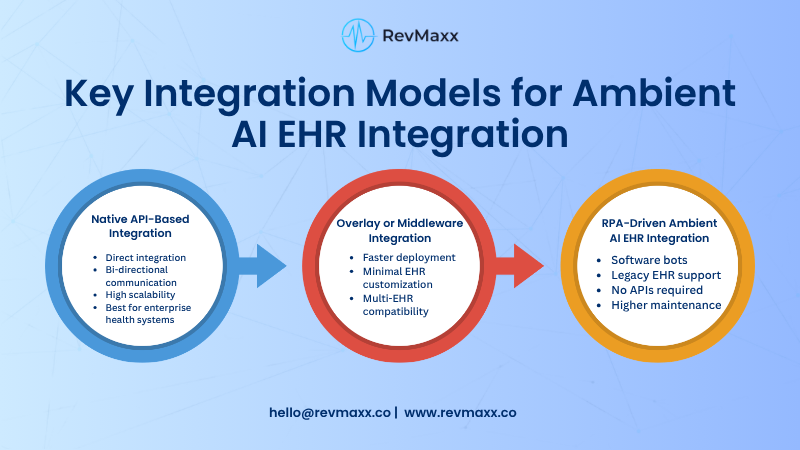
Healthcare organizations can connect ambient AI scribe to their EHR systems in different ways. The right model depends on technical setup, EHR vendor support, budget, and workflow needs.
Some models offer deeper integration and real-time data exchange, while others focus on flexibility and faster deployment. Understanding these options helps leaders choose a solution that fits their clinical and operational goals.
Native API-Based Integration
Native API-based integration connects ambient AI directly to the EHR through secure APIs. This allows real-time insertion of structured data into patient charts. It also supports bi-directional exchange, meaning the AI can both send and receive information.
This model works best for large health systems with standardized platforms. It offers strong speed, accuracy, and scalability. However, it may require vendor coordination and can be technically complex.
Overlay or Middleware Integration
Overlay or middleware integration places the ambient AI system on top of the EHR interface. It reads and writes data through the user interface layer instead of deep system APIs.
This approach usually needs minimal customization within the EHR. It allows faster deployment and works well in organizations using multiple EHR systems. While it may not be as deep as API integration, it provides flexibility and quicker implementation.
RPA-Driven Ambient AI EHR Integration
RPA-driven integration uses software bots to enter AI-generated data directly into EHR screens. The bot mimics how a human user navigates and types within the system. This method is useful when APIs are not available or when working with legacy EHR platforms. It offers strong compatibility across systems. However, it can require ongoing maintenance and may break if the EHR interface changes.
Best Practices for Ambient AI EHR Integration Success
Successful Ambient AI EHR integration depends on planning, workflow alignment, and structured data design. Technology alone is not enough. Healthcare organizations must focus on how documentation happens during real patient visits.
The goal is to reduce burden without disrupting care delivery. When integration supports clinicians instead of slowing them down, adoption improves and long-term value becomes clear.
Align Integration with Clinical Workflow Design
Start by mapping how documentation currently happens in the clinic. Identify where clinicians click too much, repeat information, or document after hours. Decide clearly what the AI should auto-document and where clinicians must review or edit. Keep important checkpoints for safety.
Most importantly, do not add extra steps. The integration should remove friction, not create new tasks for already busy providers.
Prioritize Structured Data Mapping
AI-generated notes must connect to discrete EHR fields, not just free text. Map sections like problem list, HPI, ROS, assessment, and plan into structured areas. Maintain a balance between structured data and narrative text. Use specialty-specific templates for accuracy. Structured documentation supports cleaner coding and reporting. Poor mapping reduces reimbursement value and limits analytics and quality tracking.
Ensure Real-Time or Near-Real-Time Write-Back
Notes should appear during or immediately after the encounter. This allows clinicians to review and edit while details are still fresh. Real-time access reduces after-hours charting and shortens documentation cycles. It also supports same-day billing. When notes are completed quickly, revenue cycle teams can work faster. Timely documentation improves workflow continuity and reduces mental load on providers.
Maintain Clinician Review and Sign-Off
Ambient AI should generate a draft, not a final medical record. Clinicians must review, edit, and sign off on each note. Structured sections should remain editable. AI suggestions must be transparent and clearly identified. Maintaining clinician control ensures accountability, safety, and compliance. When providers feel in charge of documentation, trust grows and adoption becomes much smoother.
Technical Best Practices for Ambient AI EHR Integration
Reliable performance is critical for live clinical use. Integration must be stable, secure, and fast. Healthcare IT teams should design systems that support structured exchange, low latency, and strong privacy controls.
Technical strength directly affects clinician satisfaction. Even highly accurate AI can fail if performance is slow or unreliable during patient visits.
Use Interoperability Standards (FHIR/HL7)
Using standards like FHIR and HL7 supports structured and consistent data exchange. These frameworks allow encounters, medications, problems, and lab results to move between systems safely.
Standardized integration makes multi-EHR environments easier to manage. It also future-proofs the investment. Vendor-neutral architecture reduces dependency risks and improves scalability as healthcare organizations grow or merge systems.
Optimize Latency and Performance
Ambient AI must process quickly during live encounters. Any lag can interrupt conversation flow. Systems should support stable connectivity between the AI engine and the EHR. Organizations must also consider cloud versus edge processing. According to studies, physicians already spend nearly two hours on EHR tasks for every one hour of patient care. Performance delays would worsen this burden.
Ensure Data Security and HIPAA Compliance
Ambient AI systems handle protected health information (PHI). Audio and text data must be encrypted during transmission and storage. Secure write-back to the EHR is essential. Access controls and authentication protocols must be enforced.
Audit trails should document edits and sign-offs. Strong HIPAA compliance policies protect patient data and reduce legal risk for healthcare organizations.
Change Management Strategies for Ambient AI EHR Integration
Technological change can be stressful for clinicians. Proper change management ensures smooth adoption and long-term success. Organizations should introduce ambient AI gradually, provide training, and create feedback channels. When clinicians understand how the system helps them, resistance decreases. Leadership support and clear communication also play a major role in building confidence.
Clinician Training and Onboarding
Training should focus on how ambient AI fits into daily workflow. Clinicians need to understand how to review and edit AI-generated notes. Specialty-specific use cases improve comfort and clarity. Trust builds when providers see consistent accuracy. Quick onboarding support, short learning sessions, and peer champions can speed adoption across departments.
Workflow Pilots Before Full Deployment
Begin with selected departments or specialties. Measure documentation time savings and review note quality. Collect structured feedback from clinicians. Studies show documentation burden is strongly linked to burnout. Pilot programs allow organizations to refine integration before scaling system-wide, reducing risk and improving outcomes.
Continuous Optimization and Feedback Loops
Integration does not end at go-live. Ongoing feedback loops help improve templates, mapping accuracy, and specialty customization. AI models should be tuned based on real-world corrections. Monitor system latency and note completion times. Continuous optimization ensures the technology evolves alongside clinical workflows instead of becoming outdated or misaligned.
Common Challenges in Ambient AI EHR Integration (and How to Avoid Them)
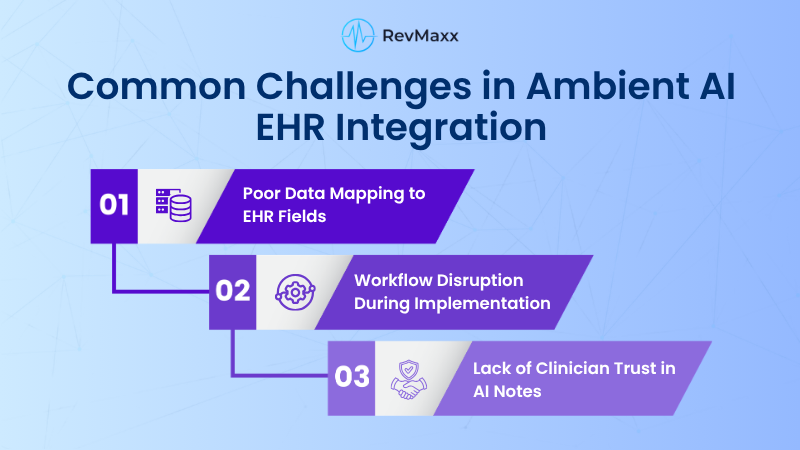
Many implementation challenges stem from poor planning rather than AI performance. Organizations must anticipate mapping issues, workflow disruption, and clinician concerns. Addressing these early prevents frustration and protects adoption rates. A proactive strategy makes integration smoother and more sustainable.
Poor Data Mapping to EHR Fields
If AI notes are stored only as free text, structured data value is lost. This can reduce coding efficiency and reporting accuracy. To prevent this, develop a field-level mapping strategy. Use structured templates and validate integration before full rollout. Testing each mapped field ensures data lands correctly inside the EHR.
Workflow Disruption During Implementation
Adding extra screens or duplicate review steps can frustrate clinicians. Documentation may initially feel slower if workflows are not aligned. Prevent disruption by designing integration around real clinical processes. Use shadow testing and gradual rollout strategies. Early clinician involvement reduces friction and improves usability.
Lack of Clinician Trust in AI Notes
Some clinicians worry about accuracy or liability. Over-editing can reduce efficiency gains. High-accuracy AI tuning and transparent behavior help address concerns. Clear control points and visible draft labeling build confidence. When providers see reliable performance, trust grows naturally over time.
Measuring Success of Ambient AI EHR Integration
Measuring outcomes helps organizations justify investment and identify improvement areas. Success should be evaluated across efficiency, financial performance, and clinician experience. Clear metrics create accountability and support long-term optimization.
Documentation Efficiency Metrics
Track measurable workflow improvements such as:
- Time spent documenting
- After-hours charting
- Note completion time
- Click reduction
- Same-day note closure rate
Research shows physicians can spend up to 49% of their workday on EHR tasks. Even modest reductions significantly improve daily workload.
Clinical and Financial Impact Metrics
Improved documentation supports better coding and revenue outcomes. Track:
- Coding accuracy
- Charge capture improvement
- Case Mix Index (CMI)
- Claim denial rates
- Billing cycle speed
Structured, real-time notes reduce missed charges and improve reimbursement accuracy, strengthening financial stability.
The Future of Ambient AI EHR Integration in Healthcare
Ambient AI EHR integration continues to evolve rapidly. Future systems will move beyond note generation toward intelligent clinical collaboration. Organizations adopting strong integration strategies today will be better prepared for these advancements.
Fully Autonomous Documentation Workflows
Next-generation systems aim to generate fully structured encounters with minimal editing required. Real-time coding suggestions and automated care summaries will become standard. Predictive documentation may suggest likely assessments based on conversation context. These advances could further reduce manual workload and speed billing processes.
Deeper EHR-AI Collaboration
Future EHR interfaces may become context-aware, adapting templates during live visits. Smart prompts could guide clinicians with real-time decision support. Automated care pathways and proactive documentation suggestions may improve consistency. This deeper AI–EHR collaboration will transform documentation from a burden into a supportive clinical partner.
Conclusion
Ambient AI is transforming clinical documentation, but technology alone does not automatically improve workflow efficiency. The real impact depends on how well the system is integrated into the EHR. Strong integration determines whether documentation feels smooth and natural or fragmented and frustrating. Best-practice Ambient AI EHR integration is designed around clinical workflows, built on structured data, available in real time, secure, and always under clinician control.
When implemented correctly, organizations can significantly reduce documentation time, improve data accuracy, strengthen coding and revenue performance, and increase clinician satisfaction. It also allows providers to focus more on patients, leading to better interaction and trust.
Healthcare organizations that invest in well-planned Ambient AI EHR integration gain a meaningful operational and competitive advantage. This is the right time for healthcare leaders to review their documentation processes, assess integration maturity, and choose workflow-first ambient AI solution application that truly support clinicians.