
Every patient visit generates revenue potential, but many healthcare organizations fail to collect the full value of the care they provide. The problem is not always fewer patients or lower reimbursements. Most healthcare providers lose thousands of dollars every month just because of billing errors, missed follow-ups, and inefficient workflow. According to a study, healthcare providers lose nearly 5% of annual revenue because of unresolved claim denials and billing inefficiencies.
This is where RCM in medical billing becomes extremely important. A strong revenue cycle management process helps healthcare practices improve cash flow, reduce claim denials, speed up reimbursements, and create a smoother patient payment experience.
Modern healthcare organizations are now using automation, AI-powered billing tools, analytics, and smart workflows to improve financial stability. So, today, in this blog, we will discuss five smart strategies that can help optimize RCM in medical billing and increase revenue while reducing operational stress.
Understanding RCM in Medical Billing
RCM in medical billing refers to the complete financial process healthcare providers use to manage patient revenue from the first appointment to final payment collection. It includes every step involved in the billing cycle, such as patient registration, insurance verification, medical coding, claim submission, payment posting, denial management, and patient collections.
A well-managed revenue cycle is critical because even small mistakes in one stage can create delays, denied claims, or revenue loss. For example, inaccurate patient information or insurance verification errors often lead to rejected claims. Similarly, incorrect medical coding may reduce reimbursement amounts or trigger compliance issues. As a result, healthcare providers face growing administrative challenges. Data says physicians spend about 12 hours every week handling administrative workload related to billing and insurance.
Efficient RCM processes help healthcare practices
- Improve cash flow
- Reduce administrative burden
- Increase clean claim rates
- Enhance patient satisfaction
- Improve financial forecasting
- Reduce claim denials
Healthcare organizations that invest in better revenue cycle strategies often see faster reimbursements and stronger long-term financial performance.
Why Healthcare Practices Lose Revenue Without Proper RCM Optimization
Many healthcare providers believe revenue loss happens because of major billing mistakes. In reality, most financial leakage happens silently through small operational inefficiencies. Delayed eligibility checks, incorrect coding, missed claims, slow follow-ups, and weak denial management can slowly reduce profitability.
The healthcare industry loses billions of dollars every year because of inefficient billing systems. Survey reveals that almost 15% of medical claims are initially denied, and around 65% of denied claims are never reworked.
Manual processes also increase staff workload and slow down reimbursements. Many billing teams spend hours correcting preventable errors instead of focusing on revenue growth. Delayed claims submission often increases accounts receivable days, which directly affects cash flow.
Healthcare providers that fail to optimize RCM in medical billing may experience:
- Increased claim denials
- Delayed reimbursements
- Higher operational costs
- Staff burnout
- Poor patient billing experiences
- Lower collection rates
Without strong RCM processes, even busy healthcare practices may struggle financially.
5 Key Strategies to Optimize RCM in Medical Billing
Before diving into specific strategies, it’s important to understand that optimizing RCM in medical billing requires a proactive and technology-driven approach. Healthcare providers today face increasing challenges such as claim denials, coding errors, reimbursement delays, and rising administrative costs. By focusing on key areas of the revenue cycle and leveraging automation, analytics, and best practices, organizations can improve cash flow, reduce revenue leakage, and create a more efficient billing process. The following five strategies can help healthcare practices strengthen their revenue cycle performance and maximize financial outcomes.
Strategy #1 - Automate Eligibility Verification and Patient Registration
The front end of the revenue cycle plays a major role in financial performance. Errors during patient registration or insurance verification often create claim denials later in the process. According to HFMA, eligibility-related errors contribute to nearly 27% of denied claims. Automating these steps can significantly improve billing accuracy and reduce delays.
Automated eligibility verification tools allow healthcare providers to check insurance coverage in real time before patient appointments. This helps identify inactive coverage, authorization requirements, and policy limitations early. As a result, billing teams can correct issues before claims are submitted. Automation also improves patient experiences by reducing registration delays and minimizing billing confusion.
Automated eligibility systems help reduce human errors and improve operational efficiency. Instead of manually verifying insurance details, staff can instantly confirm patient coverage through integrated billing platforms.
These systems help healthcare organizations:
- Reduce denied claims
- Improve clean claim rates
- Save staff time
- Speed up patient onboarding
- Improve reimbursement timelines
Real-time verification also helps patients understand their financial responsibilities before treatment, which improves transparency and increases payment collection rates.
Strategy #2 - Improve Medical Coding Accuracy with AI and Audits
Medical coding directly affects reimbursement accuracy. Incorrect coding can lead to underpayments, denied claims, compliance penalties, and delayed reimbursements. As payer rules continue to change, coding accuracy has become more difficult for many healthcare organizations.
AI-powered coding tools are now helping providers improve documentation quality and reduce coding errors. These systems analyze clinical notes and suggest accurate ICD-10 and CPT codes in real time. This reduces manual workload and improves billing consistency. Regular coding audits are also important because they help identify documentation gaps and compliance risks before they affect revenue.
Coding errors can create serious financial problems for healthcare providers. Underbilling reduces reimbursement amounts, while overbilling may trigger payer audits and legal issues. Even small coding mistakes can delay payments for weeks.
Incorrect documentation also affects denial rates. When payer systems identify mismatched codes or missing information, claims are often rejected immediately.
These problems increase:
- Administrative workload
- Rework costs
- Accounts receivable days
- Compliance risks
Improving coding accuracy helps healthcare organizations protect revenue and reduce operational inefficiencies.
Strategy #3 - Strength Denial Management Processes
Denial Management is one of the most important parts of RCM in medical billing. Every denied claim represents delayed revenue and additional administrative work. Without proper denial management, healthcare providers lose significant income every year. According to Experian Health, denied claims cost healthcare providers nearly $20 billion annually in rework expenses.
Many healthcare organizations still use reactive denial management strategies. They address denied claims only after revenue has already been delayed. A proactive approach focuses on identifying denial patterns early and preventing recurring issues. Healthcare providers that actively monitor denial trends often achieve better reimbursement performance.
Healthcare organizations should use claim scrubbing tools to identify errors before submission. Automated systems can flag missing information, coding mismatches, or payer-specific issues in real time.
Additional denial reduction strategies include:
- Monitoring denial trends
- Training providers on documentation
- Improving front-end verification
- Creating dedicated denial workflows
- Using predictive analytics
A proactive denial prevention strategy helps organizations recover revenue faster and reduce administrative costs.
Tracking revenue cycle KPIs helps healthcare providers identify financial weaknesses early. Important denial management metrics include:
- First-pass claim acceptance rate
- Denial rate
- Net collection ratio
- Days in accounts receivable
- Claim turnaround time
Monitoring these metrics regularly helps organizations improve operational efficiency and financial performance.
Strategy #4 - Use Data Analytics and RCM Reporting for Better Decisions
Data analytics has become essential for modern healthcare revenue cycle management. Many organizations collect large amounts of billing data but fail to use it effectively. Real-time analytics can help providers identify financial trends, reduce inefficiencies, and improve decision-making.
Analytics dashboards provide visibility into claims status, denial trends, reimbursement timelines, and collection performance. This allows billing teams to address problems quickly before they affect revenue. Predictive analytics also helps organizations forecast cash flow and identify high-risk claims before submission.
Important RCM KPIs to Track
Key Metric (KPI) | What It Measures | Goal |
Days in Accounts Receivable (A/R) | Measures how long it takes to collect payment after services are provided. Shorter A/R means stronger cash flow and better financial health. | < 30-45 days typical, strive lower |
Clean Claim Rate | Shows the percentage of claims submitted correctly the first time, without any errors or denials. Higher rates mean fewer reworks and faster reimbursements. | High (> 90%) depending on payer mix and practice size |
Denial Rate | Indicates the percentage of claims denied by payers. A lower denial rate reduces administrative burden and protects revenue. | As low as possible Aim for < 5-10% where feasible |
Patient Collection Rate | Measures how much of the billed amounts you actually collect (from payers and patients). This is a key indicator of your practice’s revenue realization. | High |
Strategy #5 – Improve Patient Payment Collection with Digital Solutions
Patient financial responsibility continues to increase because of rising deductibles and out-of-pocket healthcare costs. This has made patient collections one of the biggest challenges in healthcare billing.
Traditional paper billing systems often create delays and confusion. Many patients prefer digital payment methods because they are faster and more convenient. Healthcare providers that offer flexible payment options usually see better collection rates. Improving the patient payment experience is now a key part of optimizing RCM in medical billing.
Healthcare providers should make the payment process simple and transparent. Patients are more likely to pay on time when they clearly understand their financial responsibilities.
Effective collection strategies include:
- Online payment portals
- Flexible payment plans
- Automated payment reminders
- Mobile-friendly billing systems
- Transparent billing communication
Digital solutions also reduce manual work for billing teams.
How RevMaxx Helps Optimize RCM in Medical Billing
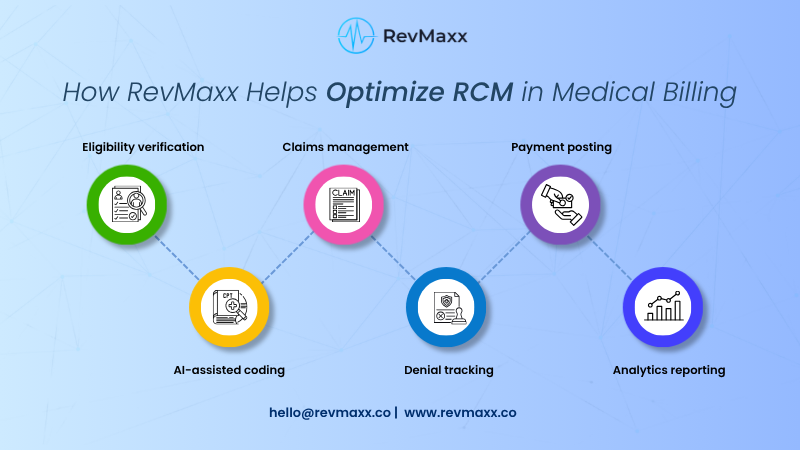
Modern healthcare providers need smarter solutions to manage growing billing complexity. RevMaxx AI RCM automation helps healthcare organizations improve operational efficiency through intelligent RCM automation and AI-driven workflows.
RevMaxx supports healthcare practices by automating critical billing functions such as the following:
- Eligibility verification
- AI-assisted coding
- Claims management
- Denial tracking
- Payment posting
- Analytics reporting
By reducing manual work and improving billing accuracy, RevMaxx helps healthcare providers improve cash flow and reduce revenue leakage.
The platform also provides real-time analytics dashboards that help organizations track financial performance and identify operational gaps quickly. Healthcare practices can use these insights to make faster business decisions and improve reimbursement performance.
With automation-driven workflows, RevMaxx helps healthcare organizations:
- Increase clean claim rates
- Reduce denial rates
- Improve collection performance
- Lower administrative burden
- Speed up reimbursements
For growing healthcare practices, scalable RCM automation solutions like RevMaxx can create long-term financial stability.
Future Trends in Healthcare Revenue Cycle Management
The future of RCM in medical billing will be driven by automation, artificial intelligence, and data-driven decision-making. Healthcare organizations are increasingly investing in cloud-based billing platforms and predictive analytics tools to improve financial performance.
One major trend is the use of robotic process automation (RPA) for repetitive administrative tasks. AI-driven predictive analytics is also helping providers identify claim risks before submission.
Other emerging trends include the following:
- Value-based reimbursement models
- Patient self-service billing
- Advanced cybersecurity measures
- Integrated EHR and billing systems
- Real-time revenue forecasting
As healthcare continues to evolve, organizations that adopt modern RCM technologies will gain a stronger competitive advantage.
The Conclusion
Optimizing RCM in medical billing is no longer optional for healthcare providers. Financial pressures, rising denial rates, staffing shortages, and growing patient payment responsibilities have made revenue cycle efficiency more important than ever.
Healthcare organizations can significantly improve financial performance by focusing on:
- Automated eligibility verification
- Accurate medical coding
- Strong denial management
- Real-time analytics
- Digital patient payment solutions
AI and automation are also reshaping healthcare revenue cycle management by reducing manual work and improving reimbursement speed.
Small improvements in billing workflows can create major financial impact over time. Healthcare providers that invest in smarter RCM strategies are better positioned to reduce revenue leakage, improve operational efficiency, and deliver better patient financial experiences.
Solutions like RevMaxx help healthcare organizations simplify complex billing operations while improving revenue growth and long-term stability.