
Running a healthcare clinic is becoming increasingly expensive nowadays. The reasons behind this are rising operational costs, staffing shortages, and delayed reimbursements. Even as patient volumes grow, many healthcare providers are still noticing that their profit margins are being squeezed from every side.
Most healthcare providers assume medical billing is just a backend function. But in reality, it directly affects revenue, efficiency, and ability to scale. The survey reveals practices spend around 7% of their annual revenue on billing and collection and still face delays and inefficiencies. Delayed claims, coding errors, and high operational costs can drain thousands of dollars every month.
Healthcare practices typically rely on three types of billing approaches:
- In-house billing
- Outsourced billing
- RCM automation
Each comes with its own cost structure, benefits, and limitations.
Today in this blog, we will break down the real costs behind each model, compare their efficiency, and help you make a smarter, data-driven decision for your practice.
Understanding of Three Medical Billing Methods
While optimizing the financial health of any clinical practice and accelerating the cash flow, there are three primary medical billing methods available: in-house, outsourced, and RCM automation. Now you have to learn which one is the right choice for your practice. Let’s take a look at each method.
What is In-House Billing?
This is the most traditional medical billing approach, where the entire revenue cycle is managed by one’s own staff and systems. This includes:
- patient eligibility verification,
- Coding and claim submission
- Denial Management
- Payment posting and follow-ups
Typically, practices set up a dedicated billing team consisting of billers, coders, and administrative staff. They also invest in billing software, training, and compliance systems. This model is most common among small to mid-sized practices that want full control over their financial operations. However, it also means taking on all the operational responsibility and cost.
What is Outsourced Billing?
Outsourced billing involves hiring a third-party company to handle your revenue cycle management (RCM). These companies manage everything from claims submission to denial management.
While this reduces internal workload, it also means giving up a portion of your revenue and having less direct control over billing processes. Most outsourcing providers follow a percentage-based pricing model, typically charging 6% to 10% of monthly collections.
What is RCM Automation?
This modern approach uses AI-driven tools to streamline and optimize medical billing workflows. Instead of relying heavily on manual processes or third-party services, automation platforms handle tasks like eligibility checks, coding assistance, claim submission, and follow-ups in real time.
The report says AI-driven automation can reduce administrative costs by up to 30% in healthcare operations. This model typically follows a flat-fee or subscription-based pricing, making it more predictable and scalable.
Detailed Cost Breakdown of In-House Billing
In-house medical billing may seem straightforward, but the actual cost is much higher than expected.
Staff Salaries:
The largest expense is your billing team. Each biller or coder typically earns $55,000 to $75,000 per year. On top of that, benefits and taxes add another 20–30%.
Software and Technology:
Practices need billing software and EHR systems to manage claims. These can cost $1,000 to $5,000 per user per year.
Office and Equipment Costs:
Running an in-house billing team means you also need to pay for office spaces, computers and printers, internet, and supplies.
Training and Certifications:
Healthcare billing rules keep changing, so your team needs regular training. This can cost around $2,000 to $5,000 per employee every two years.
Detailed Cost Breakdown of Outsourced Billing
Outsourced healthcare billing is usually priced as a percentage of your collections, typically 6% to 10% per month. In some cases, it can also cost around $200 to $1,000+ per provider each month, depending on your specialty and claim volume. This cost usually covers services like coding, claim submission, denial management, and billing software.
Percentage of Collections (Most Common):
The outsourced billing team usually charges 6% to 10% of total revenue. Costs increase as your collections grow.
Flat Fee Per Claim:
Around $3 to $10 per claim. This is easy to predict costs but may focus more on volume than accuracy.
Per-Provider Monthly Fee:
About $200 to $1,000+ per provider/month. It works well for calmer or steady practices
Hybrid Model:
A mix of a base fee + a small percentage. This offers a balance between fixed cost and performance-based pricing
Detailed Cost Breakdown of RCM Automation
Revenue cycle management (RCM) automation in healthcare uses technologies like artificial intelligence (AI) and Robotic Process Automation (RPA) to streamline billing processes. It usually requires an initial setup investment, followed by ongoing subscription or usage-based fees. The cost of implementing an AI-powered RCM system can range from approximately $2,000 to $3,000, depending on the provider/claim.
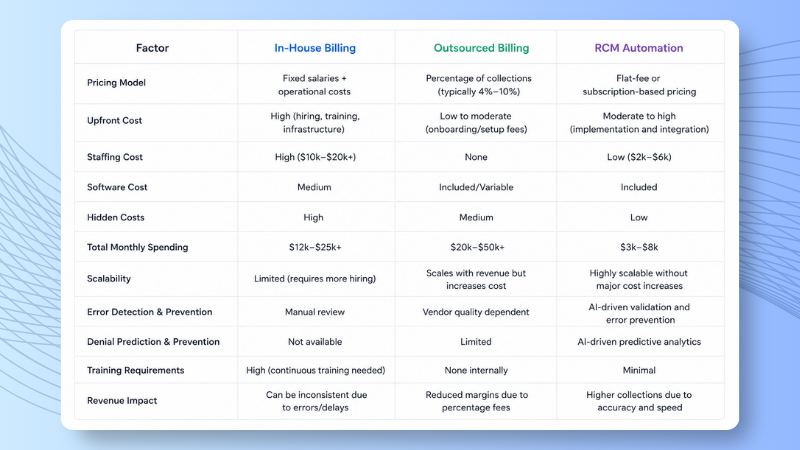
Monthly Cost Comparison Table: In-house Billing vs. Outsourced Billing vs. RCM Automation
Which Model is Best for Your Practice?
Choosing the right billing model depends on how your practice operates, your growth plans, and how much control you want over your revenue. There’s no single “best” option, as each model works differently based on your needs. Studies show that inefficient billing can lead to 5%–15% revenue loss due to errors and delays. So, the goal is not just to manage the billing but also to protect and improve the revenue collections over time.
When to Choose In-House Billing
In-house billing works best for small practices with simple workflows and steady patient volume. It gives you full control over your billing process, from coding to claim follow-ups. This can be helpful if you have an experienced team and want direct oversight. However, it also means managing hiring, training, and compliance on your own, which can increase workload and costs over time.
When to Choose Outsourced Billing
Outsourced billing is a good option if you have limited internal resources or want to reduce administrative burden. A third-party team handles the entire billing process, which can improve efficiency and collections. In fact, outsourcing can increase collections by 10%–15%. The trade-off is less control and ongoing costs tied to your revenue.
When to Choose RCM Automation
RCM automation, such as RevMaxx RCM automation, is ideal for growing practices that want scalability, cost control, and transparency. Instead of paying a percentage of your revenue, RevMaxx RCM automation uses an AI-driven system that automates eligibility checks, coding, claim submission, and denial prevention.
This reduces manual work and helps improve clean claim rates before submission. It is specially designed to reduce administrative burden and improve cash flow by making billing faster and more accurate.
By automating repetitive tasks and improving accuracy at every step, RevMaxx helps practices keep more of what they earn while maintaining full control over their revenue cycle.
The Conclusion
Your billing model is more than just an operational choice. It is a financial strategy that directly impacts your profitability.
In-house billing offers control but comes with high operational costs. Outsourced billing reduces workload but takes a percentage of your revenue. And RCM automation provides a balanced approach with lower costs, better efficiency, and scalability. But our suggestion is to incorporate automation with your in-house billing experts.
When RCM automation is integrated with your billing team, workflows become faster and more accurate. Claims are processed with fewer errors, reducing denials and rework. Staff can focus on higher-value tasks instead of manual entry. As a result, you can achieve quicker reimbursements, better cash flow, and improved efficiency in the revenue cycle
Now is the time to rethink your billing strategy and give RevMaxx RCM Automation along with AI-powered medical scribe tool a must-try.