
The healthcare industry in 2026 is moving faster than ever, and one area seeing major change is medical billing. For hospitals, clinics, and private practices, managing complex payer rules, rising denial rates, and constant compliance updates has become a daily challenge. At the same time, staffing shortages and increasing administrative work are putting more pressure on already stretched teams.
That is why working with an AI medical billing company is no longer just a smart choice, and it is quickly becoming a necessity.
Today, billing errors, coding gaps, and delayed reimbursements continue to cost healthcare providers significant revenue. While many vendors promise that AI can fix everything, from faster payments to fewer denials, the reality is more balanced.
AI is already making a real impact by improving accuracy, automating repetitive tasks, and speeding up the revenue cycle. However, it is not a complete replacement for experienced billing teams. Human expertise is still critical for handling complex cases and ensuring compliance.
The real value lies in knowing what works today and what is still evolving.
In this blog, we will explore how an AI medical billing company is transforming healthcare billing, where it delivers real results, and what practices should realistically expect as they adopt smarter, more efficient billing systems.
The Changing Landscape of Healthcare Billing
Healthcare billing is no longer simple or predictable. Over the last few years, the system has become more complex due to changing payer rules, strict compliance requirements, and increasing patient volumes. According to the American Medical Association (AMA), administrative costs account for nearly 25–30% of total healthcare spending in the U.S.
Increasing Complexity of Payer Rules
Payer rules are changing faster than ever. Insurance companies update their claim requirements frequently, and even small mistakes can lead to rejection. Each payer has different formats, coding rules, and documentation expectations. This makes it difficult for billing teams to stay updated manually. Practices often struggle to track these changes, which leads to delays and revenue loss. An AI medical billing company helps by continuously updating rule databases and applying them automatically during claim processing.
Rising Claim Denial Rates Across Practices
Claim denials are a major problem for healthcare providers. Industry reports suggest that initial claim denial rates range between 10% and 20%, depending on the specialty and payer mix.
Most denials happen due to missing information, incorrect coding, or eligibility errors. Even worse, a large portion of denied claims are never reworked. This leads to direct revenue loss. Practices are now turning to AI-based billing systems to reduce denial rates through predictive checks and real-time validation.
Growing Administrative Burden on Staff
Billing teams today handle far more work than before. They must verify insurance, submit claims, follow up on rejections, and manage compliance documentation. This workload often leads to burnout and mistakes. Studies show that clinicians and staff spend nearly hours every day on administrative tasks instead of patient care.
An AI medical billing company reduces this burden by automating repetitive tasks and allowing staff to focus on higher-value activities.
What is an AI Medical Billing Company?
An AI medical billing company is a service provider that uses artificial intelligence to manage and improve the entire medical billing process. Instead of relying only on manual work, it uses smart systems to handle claims, coding, payment tracking, and denial management. The goal is to make billing faster, more accurate, and less dependent on human effort.
How AI Transforms Traditional Billing Processes
Traditional billing depends heavily on manual entry and human review. This often leads to delays and errors. AI changes this by automating repetitive tasks and analyzing data in real time. It can identify missing information before a claim is submitted and suggest corrections instantly. This reduces rejection rates and improves efficiency. With an AI medical billing company, practices experience smoother workflows and faster reimbursements. Read our previous blog on AI in healthcare billing to learn more.
Key Technologies Behind AI Medical Billing
AI medical billing uses several advanced technologies to improve accuracy and speed. These include machine learning, automation tools, and natural language processing. Together, they help reduce human error and improve decision-making. Each technology plays a different role in optimizing billing performance.
Machine Learning for Claim Prediction
Machine learning models analyze past claim data to predict whether a claim will be accepted or denied. This helps billing teams fix issues before submission. Over time, the system learns payer behavior patterns and improves accuracy. This reduces revenue leakage and improves clean claim rates significantly.
Automation in Claim Submission and Follow-Ups
Automation handles repetitive tasks like claim submission, payment posting, and follow-ups. Instead of manual tracking, the system automatically sends reminders and resubmits rejected claims. This speeds up the entire revenue cycle and reduces human workload.
AI-Assisted Medical Coding
Medical coding is one of the most error-prone parts of billing. AI tools scan or generate clinical notes and suggest accurate CPT and ICD codes. This reduces coding mistakes and improves claim acceptance rates. It also helps coders work faster and more efficiently.
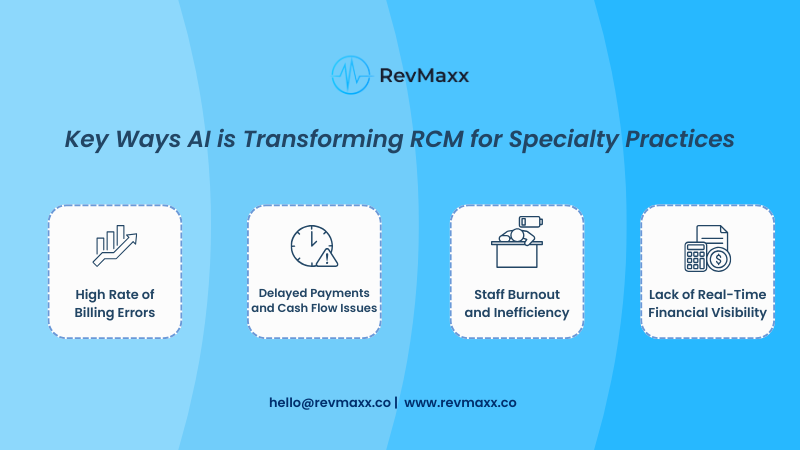
Key Challenges Practices Face Without AI
Healthcare practices that still rely on manual billing face several challenges. These challenges directly affect revenue, staff productivity, and patient satisfaction. Without automation, billing becomes slow, error-prone, and difficult to manage at scale.
High Rate of Billing Errors
Manual billing increases the risk of errors such as incorrect codes, missing modifiers, or incomplete patient information. Even small mistakes can lead to claim rejection. These errors often require time-consuming corrections and resubmissions. Over time, this reduces overall revenue and increases workload for billing teams.
Delayed Payments and Cash Flow Issues
Delayed claim processing leads to slow payments. When claims are rejected or stuck in review, cash flow becomes unpredictable. Many small and mid-sized practices struggle to maintain financial stability because of these delays. An AI medical billing company helps reduce turnaround time and ensures faster reimbursements.
Staff Burnout and Inefficiency
Billing teams often work long hours to manage claim rejections and follow-ups. This leads to burnout and reduced productivity. When staff are overwhelmed, mistakes increase. Automation reduces this pressure by handling repetitive tasks, allowing teams to focus on important work.
Lack of Real-Time Financial Visibility
Without automation, practices often lack real-time insights into their financial performance. It becomes difficult to track claim status, revenue trends, or denial patterns. This makes decision-making slower and less accurate. AI systems provide real-time dashboards for better visibility and control.
Key Benefits of Partnering with an AI Medical Billing Company
Working with an AI medical billing company brings several benefits that directly improve financial and operational performance. These systems are designed to reduce errors, improve speed, and increase revenue efficiency.
Faster Claim Processing and Reimbursements:
One of the biggest benefits of working with an AI medical billing company is faster claim processing. Traditional billing often involves manual verification, repetitive data entry, and delayed follow-ups, which slow down reimbursements. AI automates these steps by checking patient eligibility, validating claim details, and identifying missing information before submission. This reduces processing delays and helps claims move through the payer system faster. According to industry reports, automated claims management can reduce claim processing time by up to 30–40%. Faster approvals mean improved cash flow, better financial stability, and fewer payment bottlenecks for healthcare practices.
Reduced Denials and Improved Clean Claim Rates
Claim denials remain one of the largest financial challenges for healthcare providers. Many denials happen due to incorrect coding, incomplete patient information, or eligibility issues. An AI medical billing company uses predictive analytics and real-time validation tools to identify potential errors before claims are submitted. This improves clean claim rates and reduces the need for rework. Studies show that nearly 65% of denied claims are never resubmitted, which leads to major revenue loss. AI-driven billing systems help practices prevent these losses by reducing avoidable denials and improving first-pass claim acceptance rates.
Lower Operational Costs
Managing an in-house billing operation can be expensive. Practices often spend heavily on staffing, training, claim follow-ups, and administrative management. AI billing solutions reduce these operational costs by automating repetitive and time-consuming tasks. This allows healthcare organizations to manage higher billing volumes without significantly increasing staff size. Automation also reduces overtime work and lowers the cost of correcting billing errors.
According to healthcare automation studies, administrative automation can reduce operational costs by up to 30% in some healthcare settings. Lower costs combined with higher efficiency make AI billing a practical long-term investment.
Enhanced Accuracy and Compliance
Medical billing requires strict compliance with payer rules, coding standards, and healthcare regulations. Even small mistakes can lead to audits, penalties, or payment delays.
An AI medical billing company improves billing accuracy by automatically checking claims against updated payer requirements and coding guidelines. AI-assisted coding tools also help reduce human coding errors and ensure more accurate documentation. This improves compliance and reduces financial risk.
Real-Time Reporting and Insights
Traditional billing systems often provide delayed reports, making it difficult to identify revenue issues quickly. AI-powered billing platforms offer real-time dashboards and analytics that help providers track claim status, denial trends, reimbursement timelines, and overall revenue cycle performance. These insights support faster and better decision-making. Practice owners and administrators can identify problems early and take corrective action before revenue is affected. Real-time reporting also helps improve forecasting, budgeting, and operational planning across the organization.
Why 2026 Is the Tipping Point for AI in Medical Billing
The healthcare industry is reaching a major turning point in 2026, especially in revenue cycle management. Rising administrative costs, growing patient volumes, and increasing payer complexity are forcing healthcare organizations to rethink traditional billing methods. Manual billing processes are no longer sustainable for practices that want to remain competitive and financially stable. This is why more providers are turning toward AI-driven billing solutions.
An AI medical billing company helps practices improve efficiency, reduce costs, and handle growing workloads more effectively. In 2026, AI adoption is shifting from early experimentation to mainstream healthcare operations.
Rapid Adoption of AI in Healthcare
AI adoption across healthcare is growing at a rapid pace. Hospitals, clinics, and specialty practices are increasingly using AI to improve operational efficiency and reduce administrative workload. According to the American Medical Association survey report, nearly 66% of physicians reported using some form of healthcare AI in 2024, and the number continues to rise. Revenue cycle management is one of the leading areas where AI is delivering measurable results. From automated coding to denial prediction, healthcare organizations are realizing that AI can improve both financial performance and staff productivity.
Increasing Pressure to Reduce Costs
Healthcare providers are under constant pressure to reduce operational costs while still delivering quality patient care. Rising labor costs, staffing shortages, and growing administrative responsibilities are making manual billing increasingly expensive. Practices are now searching for smarter ways to control expenses without sacrificing efficiency. AI-powered billing systems help reduce unnecessary manual work, improve claim accuracy, and lower denial-related losses. By automating repetitive tasks, practices can operate more efficiently with fewer resources. This cost-saving advantage is one of the biggest reasons AI medical billing adoption is accelerating in 2026.
Demand for Scalable Billing Solutions
Healthcare organizations are growing, but many billing systems are struggling to keep up. As patient volumes increase, practices need billing solutions that can scale without requiring major increases in staff or operational costs. An AI medical billing company provides scalable systems that can process large numbers of claims efficiently and consistently. Automation allows practices to manage growth without creating workflow bottlenecks. This is especially important for multi-location practices, specialty clinics, and rapidly expanding healthcare organizations that need stable and reliable revenue cycle support.
Competitive Advantage for Early Adopters
Practices that adopt AI billing solutions early are gaining a strong competitive advantage in the healthcare industry. Faster reimbursements, fewer denials, improved reporting, and lower operational costs help organizations stay financially healthier than competitors still relying on manual systems. Early adopters are also better prepared for future changes in payer requirements and healthcare regulations. In a highly competitive healthcare market, efficient revenue cycle management can directly impact growth and patient experience. AI is no longer viewed as an experimental technology—it is becoming a strategic advantage for forward-thinking healthcare providers.
How an AI Medical Billing Company Helps You Scale
Scaling a healthcare practice is not just about increasing patient numbers. It also requires strong operational systems that can support growth without creating delays or inefficiencies. Billing is one of the most critical areas affected during expansion. An AI medical billing company helps practices scale by automating workflows, improving claim management, and reducing dependency on manual processes. These systems allow healthcare organizations to handle larger billing volumes with greater accuracy and speed. As practices grow in 2026, AI-driven billing is becoming essential for maintaining financial stability and operational efficiency.
Managing Higher Patient Volumes Without Hiring
As patient volumes increase, many practices struggle to keep up with billing tasks. Traditional growth often requires hiring additional billing staff, which increases payroll and training costs. AI-powered billing systems help solve this problem by automating repetitive processes such as eligibility checks, claim submission, payment posting, and denial tracking. This allows practices to manage more claims without significantly increasing staffing levels. By improving workflow efficiency, an AI medical billing company helps healthcare organizations grow sustainably while keeping operational costs under control.
Streamlining End-to-End Revenue Cycle
Revenue cycle management involves multiple steps, from patient registration and insurance verification to claim submission and payment collection. When these processes are handled manually, delays and errors become common. AI streamlines the entire revenue cycle by connecting workflows and automating critical tasks.
Claims move faster, denials are identified earlier, and follow-ups happen automatically. This creates a smoother and more efficient billing operation. A streamlined revenue cycle not only improves cash flow but also reduces administrative stress across the organization.
Reducing Dependency on Manual Processes
Manual billing processes are time-consuming and highly dependent on human effort. They also increase the risk of mistakes, delays, and inconsistent workflows. An AI medical billing company reduces this dependency by automating repetitive administrative tasks and improving process standardization. Staff no longer need to spend hours manually reviewing claims or tracking unpaid balances.
Instead, AI systems handle much of the routine work while staff focus on higher-value responsibilities. This creates a more efficient, scalable, and reliable billing environment for growing healthcare practices.
Choosing the Right AI Medical Billing Company
Selecting the right AI medical billing company is an important decision for any healthcare practice. Not all AI billing providers offer the same level of technology, support, or industry expertise. The right partner should improve billing efficiency without disrupting daily operations.
A reliable AI billing company should integrate smoothly with existing systems, provide real-time reporting, and support long-term growth. Healthcare providers should also evaluate customer support, implementation processes, and compliance standards before making a decision. Choosing the right solution can improve revenue cycle performance, reduce denials, and create a more scalable billing operation for 2026 and beyond.
Integration with EHR and Existing Systems
A strong AI medical billing solution should integrate easily with your existing EHR and practice management systems. Poor integration often creates workflow disruptions, duplicate data entry, and billing delays. Smooth integration helps patient information, coding data, and claim details move automatically between systems without manual intervention. This improves operational efficiency and reduces the risk of errors.
Scalability and Flexibility
Healthcare practices grow and change over time, which means billing systems must be able to scale with increasing demands. An AI medical billing company should provide flexible solutions that can handle growing patient volumes, multiple locations, and specialty-specific billing requirements. Scalable systems allow practices to expand without constantly changing their billing infrastructure.
Ease of Use and Implementation
Complicated billing systems often slow down adoption and increase staff frustration. A good AI billing platform should be user-friendly and simple to implement. Healthcare teams should not need extensive technical knowledge to use the system effectively. Easy onboarding, intuitive dashboards, and guided training help practices transition smoothly to AI-driven billing. Faster implementation also reduces downtime and operational disruption.
Vendor Expertise and Support
Technology alone is not enough. The expertise and support provided by the vendor are equally important. A reliable AI medical billing company should have deep experience in healthcare revenue cycle management and understand payer rules, coding updates, and compliance requirements. Strong customer support ensures practices receive quick assistance when issues arise. Providers should also look for vendors that offer ongoing training, regular system updates, and dedicated account management.
Common Myths About an AI Medical Billing Company
Despite the growing popularity of AI in healthcare billing, many misconceptions still exist. Some healthcare providers believe AI is too expensive, difficult to implement, or designed to replace staff completely. These myths often prevent practices from exploring solutions that could improve efficiency and reduce financial stress. In reality, AI billing systems are designed to support healthcare teams, not replace them.
“AI Will Replace Human Staff”
One of the most common concerns is that AI will completely replace billing teams. In reality, AI is designed to support staff, not eliminate them. Billing professionals are still needed for handling complex cases, resolving payer disputes, and ensuring compliance with changing regulations. AI mainly automates repetitive tasks such as claim validation, eligibility checks, and payment tracking. This reduces administrative burden and allows staff to focus on higher-value work. Instead of replacing employees, AI helps improve productivity, reduce burnout, and create more efficient billing operations.
“AI Is Too Expensive for Small Practices”
Many small practices assume AI billing solutions are only affordable for large hospitals or healthcare networks. However, modern cloud-based AI billing platforms are becoming more accessible and cost-effective for practices of all sizes. In many cases, automation helps practices save money by reducing denials, lowering staffing costs, and improving reimbursement speed.
“AI Systems Are Difficult to Implement."
Another common myth is that AI billing systems are difficult and time-consuming to implement. While older healthcare technologies often required complex installations, modern AI solutions are designed for faster deployment and easier integration. Many providers offer onboarding assistance, staff training, and dedicated implementation support. Cloud-based systems also reduce the need for major hardware upgrades or internal IT resources. With proper planning and vendor support, many practices can transition to AI-powered billing with minimal disruption to daily operations.
How to Get Started with an AI Medical Billing Company
Switching to an AI-driven billing system starts with understanding your current revenue cycle challenges and choosing the right technology partner. An AI medical billing company helps practices reduce denials, improve cash flow, and automate repetitive billing tasks. Solutions like RevMaxx RCM automation simplify the transition by combining AI-powered workflows, automated claim management, and real-time reporting into one streamlined system.
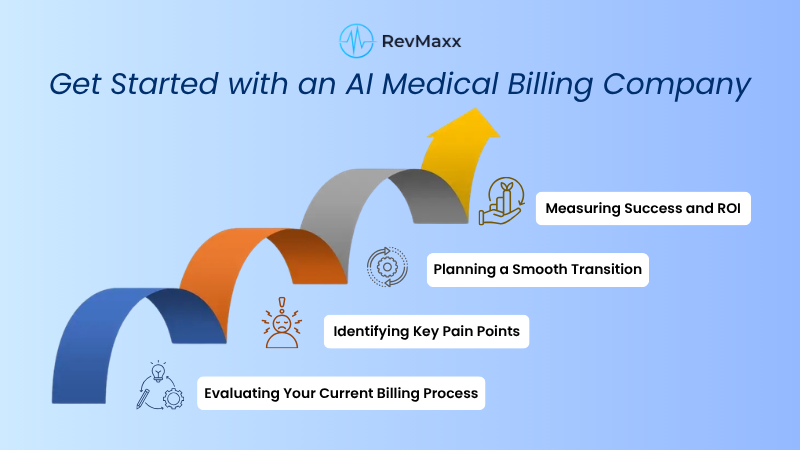
Evaluating Your Current Billing Process
The first step is reviewing your existing billing workflow. Practices should analyze denial rates, reimbursement timelines, coding accuracy, and outstanding claims to identify inefficiencies. This helps determine where automation can create the biggest impact. With RevMaxx RCM automation, providers gain better visibility into revenue cycle performance through AI-driven reporting and workflow tracking, making it easier to identify gaps and improve billing outcomes.
Identifying Key Pain Points
Every practice faces different billing challenges. Some deal with frequent denials, while others struggle with delayed payments, coding errors, or staff overload. Identifying these pain points helps practices choose the right AI billing solution for their needs. RevMaxx RCM automation helps reduce administrative burden through automated eligibility checks, AI-assisted coding, and faster claim processing, allowing practices to improve both efficiency and revenue performance.
Planning a Smooth Transition
A successful transition to AI billing requires proper planning. Practices should create a step-by-step implementation strategy that includes staff training, system integration, workflow testing, and performance monitoring. Clear communication between the practice and the vendor is essential during this process. Many AI billing providers now offer onboarding specialists and dedicated support teams to simplify implementation. A well-planned transition reduces operational disruption and helps staff adapt more comfortably to the new system.
Measuring Success and ROI
After implementation, practices should regularly measure the performance of their AI billing system. Key metrics may include clean claim rates, denial reduction, reimbursement speed, collection improvements, and operational cost savings. Tracking these numbers helps practices understand the return on investment and identify additional improvement opportunities.
Conclusion
An AI medical billing company is no longer just an option for healthcare practices—it is becoming a necessity in 2026. With rising costs, complex payer rules, and increasing administrative pressure, traditional billing systems are no longer enough.
AI brings speed, accuracy, and efficiency to the entire revenue cycle. It reduces errors, improves cash flow, and supports long-term growth. Practices that adopt AI early will be better prepared for the future of healthcare billing.