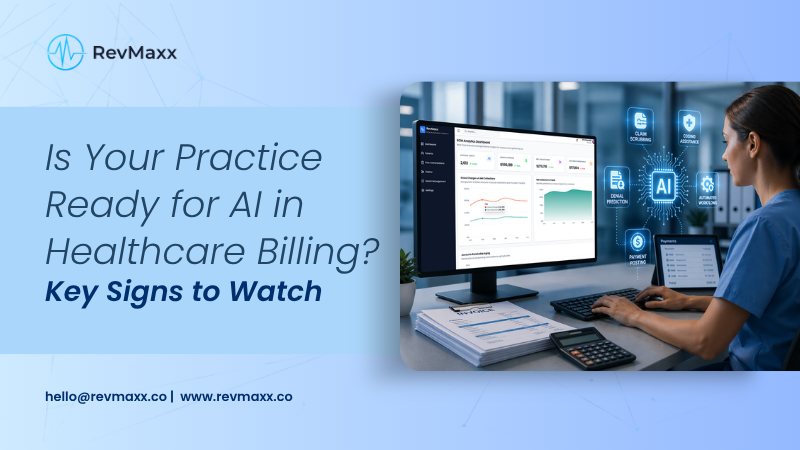
Healthcare billing has become one of the most complex and stressful parts of running a medical practice. Many providers struggle with claim denials, delayed payments, and rising administrative work. These problems directly affect revenue and staff productivity.
Today, AI in healthcare billing is changing how practices manage their revenue cycle. It helps reduce errors, speed up claims, and improve cash flow. But adopting AI is not just about technology. It is about readiness.
According to recent industry data, 41% of providers report that at least 1 in 10 claims is denied, and denial rates continue to rise. This shows how serious the problem has become.
Before adopting AI, practices must understand whether they are truly ready. This blog will help you identify the key signs and guide you toward smarter adoption.
What is AI in Healthcare Billing?
AI in healthcare billing refers to the use of advanced technologies like machine learning and automation to manage billing tasks. These tasks include coding, claim submission, eligibility checks, and denial management.
Traditional billing relies heavily on manual work. Staff enter data, review claims, and fix errors. This process is slow and prone to mistakes. AI changes this by automating repetitive tasks and analyzing large volumes of data quickly.
For example, AI can:
- Automatically assign medical codes
- Check claims before submission
- Predict which claims may be denied
- Identify missing or incorrect data
Studies show that AI-driven systems can achieve up to 99% clean claim rates and 98% coding accuracy, far higher than manual processes.
This shift allows practices to focus less on paperwork and more on patient care.
Why AI in Healthcare Billing is Becoming Essential
Healthcare billing is no longer a simple back-office routine. It has become a critical factor in financial stability.
One major issue is rising claim denials. Industry reports show that denial rates now average 10–15%, and many claims are never resubmitted. This leads to significant revenue loss.
Another challenge is administrative burden. Healthcare staff spend hours correcting billing errors. In fact, 18% of professionals spend more than 20 hours per month fixing billing issues.
At the same time, payment delays are increasing. The average accounts receivable (AR) days range between 45–55 days, affecting cash flow.
AI helps solve these problems by:
- Reducing manual work
- Improving accuracy
- Speeding up reimbursements
- Providing real-time insights
That is why over 54% of healthcare organizations plan to adopt AI-driven billing systems, and many already have.
Key Signs Your Practice is Ready for AI in Healthcare Billing
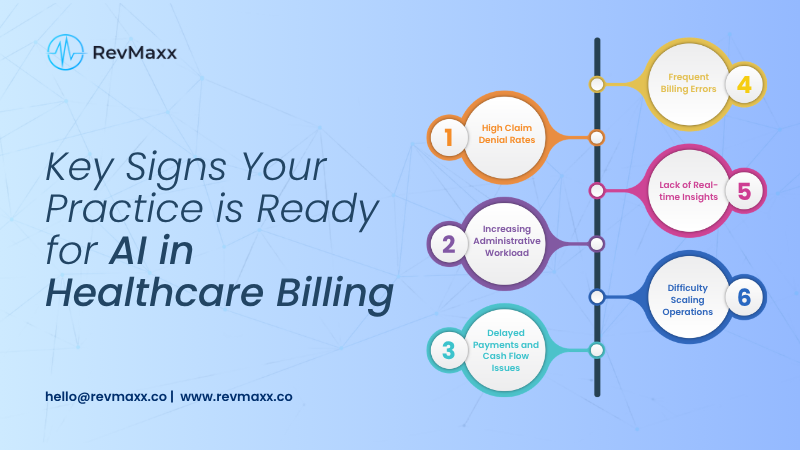
Not every practice adopts AI at the same time. But certain signs clearly show when you are ready to take the next step. If you are facing frequent claim denials, heavy administrative work, or slow payments, it may be time to consider AI in healthcare billing. Growing patient volume and limited staff are also strong indicators. When your current system struggles to keep up, AI can help improve accuracy, speed, and overall efficiency.
High Claim Denial Rates
If your practice is seeing frequent claim denials, it is a strong sign that you need AI support.
Denials often happen due to missing data, incorrect coding, or lack of prior authorization. These errors are common in manual processes. Each denial requires rework, which delays payments and increases costs.
Industry data shows that denial rates can reach over 10% of total claims, creating a major revenue risk. AI can help by analyzing past claims and identifying patterns. It predicts which claims are likely to be denied and fixes issues before submission. Some systems have reduced denial rates from 18% to as low as 5%.
If denials are affecting your revenue, your practice is ready for AI.
Increasing Administrative Workload
Another clear sign is when your staff spends too much time on billing tasks. Manual billing involves data entry, verification, coding, and follow-ups. These repetitive tasks take time and increase the risk of burnout. Reports show that staff often spend 20+ hours per month resolving billing errors, which reduces productivity.
AI can automate many of these tasks. It handles claim scrubbing, eligibility checks, and payment posting. This reduces workload and allows staff to focus on higher-value activities. If your team feels overwhelmed, AI can make a big difference.
Delayed Payments and Cash Flow Issues
Cash flow problems are a common challenge for healthcare practices. Delayed reimbursements often result from claim errors or slow processing. When claims are denied or delayed, it directly impacts revenue. The average AR days in healthcare can go up to 55 days, which is a long wait for payments.
AI improves this by:
- Submitting clean claims faster
- Reducing errors
- Automating follow-ups
Studies show that automation can lead to 30–40% faster payment cycles. If your payments are slow, AI can help stabilize your cash flow.
Frequent Billing Errors
Frequent billing errors are a strong sign that your current process needs improvement. In many practices, billing still depends on manual data entry. Staff enter patient details, insurance information, and codes by hand. This increases the chances of mistakes. Even a small error, like a wrong code or missing detail, can lead to claim rejection.
These errors also create compliance risks. Incorrect coding or incomplete documentation can raise issues during audits. This can lead to penalties or delayed payments. Over time, these small mistakes can cause big revenue losses.
This is where AI in healthcare billing can help. AI tools check claims before submission and catch errors early. They also follow payer rules and coding standards. This improves accuracy and keeps billing consistent. As a result, practices see fewer denials and smoother operations.
Lack of Real-time Insights
Many healthcare practices do not have clear visibility into their billing performance. They rely on reports that are delayed or incomplete. This makes it hard to understand what is going wrong. For example, you may not know why claims are being denied or where revenue is leaking.
Without real-time insights, decision-making becomes slow and reactive. Practices cannot fix issues quickly because they do not see them on time. There is also no way to predict future trends or risks.
AI in healthcare billing solves this problem by providing real-time dashboards. These dashboards show key metrics like denial rates, collections, and AR days. AI also offers predictive analytics. It can highlight patterns and warn about potential issues before they happen.
With better insights, practices can make faster and smarter decisions.
Difficulty Scaling Operations
As a practice grows, billing becomes more complex. More patients mean more claims, more data, and more follow-ups. Handling this increase with manual processes is difficult. Staff may feel overwhelmed, and errors may increase.
Hiring more staff is one option, but it also raises costs. It is not always a sustainable solution. Many practices struggle to balance growth with efficiency.
AI in healthcare billing helps solve this challenge. It automates repetitive tasks and handles large volumes of data easily. This allows practices to scale without increasing staff at the same rate.
With AI, you can manage more patients, process more claims, and maintain accuracy. It supports growth while keeping operations smooth and cost-effective.
Signs Your Practice May Not Be Ready Yet
Not every practice is ready to adopt AI immediately. While AI in healthcare billing offers many benefits, certain gaps can slow down or even block successful implementation.
It is important to identify these challenges early. If your systems, data, or team are not prepared, AI may not deliver the expected results. Instead of solving problems, it may create confusion or inefficiency.
Understanding these signs helps you prepare better. Once these issues are addressed, your practice will be in a stronger position to adopt AI successfully.
Outdated or Disconnected Systems
One major challenge is using outdated or disconnected systems. Many practices still rely on legacy software that does not integrate well with modern tools. These systems often work in silos, meaning they do not share data smoothly.
For example, your billing system may not connect properly with your EHR or RCM platform. This leads to duplicate work, missing data, and delays. It also makes automation difficult.
AI in healthcare billing depends on smooth data flow between systems. Without integration,
AI cannot perform effectively. Before adopting AI, it is important to upgrade or connect your systems. This ensures better performance and accurate results.
Poor Data Quality
Data is the foundation of any AI system. If your data is incomplete or inconsistent, AI will not work properly. Many practices face issues like missing patient details, incorrect insurance information, or inconsistent coding.
These problems affect billing accuracy and increase the risk of claim denials. They also limit the effectiveness of AI tools, as AI relies on clean and structured data.
Improving data quality is an important step before adopting AI in healthcare billing. This includes verifying patient information, standardizing coding practices, and maintaining proper documentation.
Good data leads to better results and helps AI deliver real value.
Resistance to Change
Change can be difficult for many teams. Some staff may feel unsure about using new technology. Others may worry that AI will replace their jobs. This hesitation can slow down adoption and reduce the benefits of AI.
Lack of training is another issue. If staff do not understand how AI works, they may avoid using it or use it incorrectly. This creates confusion and reduces efficiency.
To overcome this, practices need to focus on education and communication. Explain how AI supports staff rather than replacing them. Provide proper training and ongoing support.
When teams feel confident, they are more likely to accept and use AI effectively.
Limited Budget or Resources
Budget is a common concern for many practices. AI solutions require an initial investment in software, integration, and training. This can feel like a big step, especially for smaller practices.
There is also uncertainty about return on investment (ROI). Some practices are not sure how quickly they will see results. This can delay decision-making.
However, it is important to look at the long-term benefits. AI in healthcare billing can reduce errors, improve collections, and lower operational costs. Over time, these benefits often outweigh the initial investment.
Planning and choosing the right solution can help manage costs and improve ROI.
Invest in Staff Training
Technology alone is not enough. Your team must understand how to use it.
Training helps staff learn how AI tools work and how they support daily tasks. It also reduces fear and confusion around new technology. Explain clearly that AI is there to assist, not replace. Show how it can make their work easier and faster.
Encourage open communication. Let staff ask questions and share concerns; provide ongoing support and learning opportunities. When your team feels confident, adoption becomes smoother and more effective.
Benefits of AI in Healthcare Billing
Adopting AI in healthcare billing brings real and measurable benefits to medical practices.
- One of the biggest advantages is reduced claim denials. AI checks claims before submission and catches errors early. This leads to higher clean claim rates and fewer rejections.
- Another key benefit is faster reimbursements. When claims are accurate and submitted quickly, payments are processed faster. This improves cash flow and reduces financial stress.
- AI also improves billing accuracy. It reduces manual errors and ensures correct coding. This helps practices avoid costly mistakes and rework.
- Operational costs also go down. With automation, there is less need for repetitive manual work. Staff can focus on more important tasks instead of fixing errors.
- AI also supports better compliance. It follows payer rules and keeps documentation in line with regulations. This reduces audit risks.
- Lastly, it improves the patient financial experience. Clear and accurate billing builds trust and reduces confusion for patients.
How to Prepare Your Practice for AI in Healthcare Billing
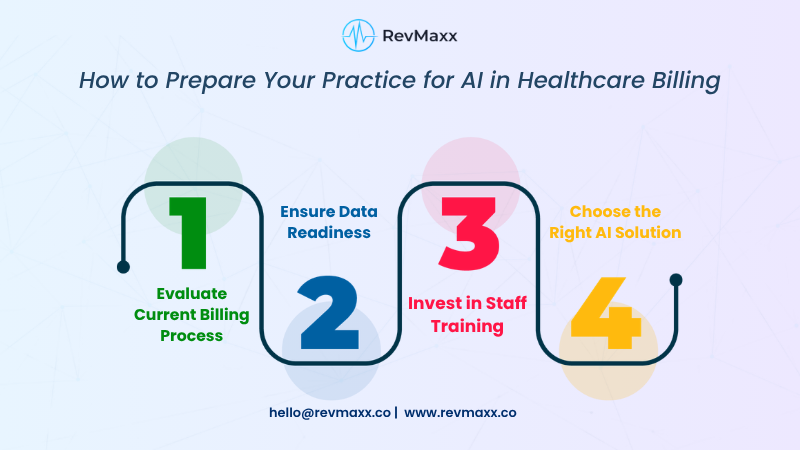
Before adopting AI, it is important to prepare your practice properly. Good preparation ensures smooth implementation and better results.
AI in healthcare billing works best when your systems, data, and team are ready. Without preparation, even the best tools may not deliver value. By taking the right steps, you can avoid common issues and make the transition easier. Preparation also helps your team feel confident and ready to use new technology.
Evaluate Current Billing Process
The first step is to understand your current billing system. Take a close look at how your workflows operate today.
Identify areas where problems occur. Look for delays, frequent errors, or repeated tasks. These are signs of inefficiencies and bottlenecks. You should also audit your workflows. Check how claims move from patient registration to payment. See where time is being lost or mistakes are happening.
This analysis helps you understand where AI can add the most value. It also gives you a clear starting point for improvement.
Ensure Data Readiness
Data plays a key role in AI success. If your data is not clean or organized, AI will not work properly.
Start by cleaning your existing data. Remove duplicate entries and fix incorrect information. Make sure patient details and insurance data are accurate. Standardizing data is also important. Use consistent formats for coding and documentation. This helps AI systems process information correctly. You should also improve documentation practices. Complete and clear records reduce errors and improve billing outcomes.
Invest in Staff Training
Technology alone is not enough. Your team must understand how to use it.
Training helps staff learn how AI tools work and how they support daily tasks. It also reduces fear and confusion around new technology. Explain clearly that AI is there to assist, not replace. Show how it can make their work easier and faster.
Encourage open communication. Let staff ask questions and share concerns; provide ongoing support and learning opportunities. When your team feels confident, adoption becomes smoother and more effective.
Choose the Right AI Solution
Choosing the right tool is an important decision. Not all AI solutions are the same.
- Look for systems that integrate easily with your existing EHR and billing platforms. Good integration ensures smooth data flow and better performance.
- Scalability is also important. The solution should grow with your practice. It should handle increasing volumes without slowing down.
- Ease of use matters as well. A simple and user-friendly system helps staff adapt quickly.
- Finally, consider the vendor. Choose a trusted provider with good support and experience in healthcare billing.
Choosing the right AI solution is critical, and that’s where RevMaxx RCM Automation stands out. It is designed to seamlessly integrate with your existing EHR and billing systems, ensuring smooth data flow and efficient performance. Built for scalability, RevMaxx grows with your practice—handling increasing claim volumes without slowing down. Its user-friendly interface makes it easy for staff to adopt quickly, reducing the learning curve. Backed by a trusted team with deep expertise in healthcare billing, RevMaxx delivers reliable support and consistent results, making it a strong choice for practices looking to modernize their revenue cycle.
Future of AI in Healthcare Billing
The future of AI in healthcare billing looks strong and promising. More practices, both small and large, are starting to adopt AI solutions.
In the coming years, AI systems will become more advanced. They will not just process claims but also predict outcomes and suggest actions. This will make billing more proactive than reactive.
Integration with EHR and clinical systems will improve. This will create a smooth flow of information from patient care to billing. AI will also bring more transparency to patient billing. Patients will receive clearer and more accurate bills, which improves trust.
In the long run, AI will change how revenue cycle management works. It will make processes faster, smarter, and more efficient.
The Conclusion
AI in healthcare billing is becoming an important part of modern healthcare operations. It offers clear benefits, but success depends on readiness.
If your practice is facing issues like high denials, errors, or slow payments, AI can help. But it is important to prepare your systems, data, and team first. Take time to evaluate your current processes. Identify gaps and areas for improvement. This will help you adopt AI in a structured way. Start small, learn from results, and grow step by step. This approach reduces risk and builds confidence.
Now is a good time to assess your billing system and explore how AI can support your practice.