
Running a small clinic often feels like a constant balancing act. Once you are focused on patients, the next second you are buried in billing paperwork, insurance follow-up, and denied claims. Staff are stretched thin, and hiring more people is not always realistic due to rising labor costs and training time.
This is where many clinical practices hit a growth ceiling. More patients should mean more revenue, but instead it often leads to more administrative burdens.
The hidden truth is simple: hiring more staff is not always the most efficient way to scale. Payroll costs, onboarding delays, and human errors can quietly reduce profitability. According to the Commonwealth Fund, administrative complexity is one of the major drivers of rising healthcare overhead in the U.S., with administrative costs estimated at nearly 25% of total healthcare spending.
This is where medical billing automation changes the game. It is not just a billing tool—it is a growth enabler that helps small practices handle more patients without increasing headcount.
Instead of scaling teams, you scale efficiency. The goal is simple: increase revenue capacity without increasing operational burden.
The Growth Challenge in Small Healthcare Practices
Small healthcare practices often start with a lean setup. But as patient volume increases, systems that once worked smoothly begin to break down.
The main challenge is not medical care—it is administration paperwork. Doctors and staff end up spending more time on paperwork than patient care. According to the American Medical Association, physicians spend nearly 2 hours on paperwork for every 1 hour of patient care.
As workload increases, three major problems appear:
- Billing becomes delayed
- Claims become harder to track
- Staff struggle to keep up with insurance rules
Over time, this creates a bottleneck where revenue growth slows even though patient numbers rise.
Where Revenue Gets Stuck
In most small practices, revenue doesn’t disappear suddenly; it gets stuck in everyday processes.
- Delayed Claims Submission: Claims are not sent on time due to workload, leading to slower reimbursements and cash flow gaps.
- Denials and rework cycles: Even small coding or documentation errors lead to claim denials. Each denial requires time-consuming corrections and resubmissions.
- Missed charges and undercoding: When staff are rushed, services are sometimes undercoded or missed completely, directly reducing revenue.
These issues create a silent revenue leak that many practices don’t notice until cash flow becomes tight.
Challenges of Manual Billing in Small Practices
Manual billing creates several operational and financial challenges that are often underestimated.
High Error Rates Leading To Claim Denials
Manual processes depend heavily on human accuracy. Even small mistakes, like incorrect patient details, missing codes, or outdated payer information, can lead to claim denials.
According to the CAQH Index, manual transactions are significantly more expensive and error-prone compared to automated processes.
Each denied claim requires:
- Review and correction
- Resubmission
- Additional follow-up
This not only delays payment but also increases workload.
Time-Consuming Processes
Billing tasks take up a large portion of staff time. Activities like:
- Insurance verification
- Coding
- Claim tracking
- Payment posting
are repetitive but essential. When done manually, these tasks slow down the entire revenue cycle.
In many practices, staff spend hours every day just managing claims, leaving less time for patient-focused work.
Staff Burnout And Turnover
Repetitive tasks, tight deadlines, and constant pressure to fix errors can lead to burnout. Over time, this affects staff morale and productivity. When employees leave, healthcare practices face additional costs and disruptions due to hiring and training new staff.
Lack Of Visibility Into Revenue Cycle
One of the biggest challenges with manual systems is the lack of clear insights.
Practice owners often struggle to answer questions like
- How many claims are pending?
- What is the denial rate?
- Which payer is causing delays?
Without this visibility, it becomes difficult to improve performance or make informed decisions.
What is Medical Billing Automation?
Medical Billing Automation is the use of software to handle repetitive and manual billing tasks in a healthcare practice.
In simple terms, it helps your practice prepare, submit, track, and manage medical claims automatically instead of doing everything by hand.
Traditionally, billing requires staff to:
- Enter patient details manually
- Check insurance eligibility
- Code medical procedures
- Submit claims to payers
- Track payments and follow up on denials
With automation, much of this work is handled by software systems in real time.
This reduces human effort, improves accuracy, and speeds up the entire revenue cycle. According to CAQH, adopting automated administrative processes could save the U.S. healthcare system up to $122 billion annually.
Key Features of Medical Billing Automation Tools
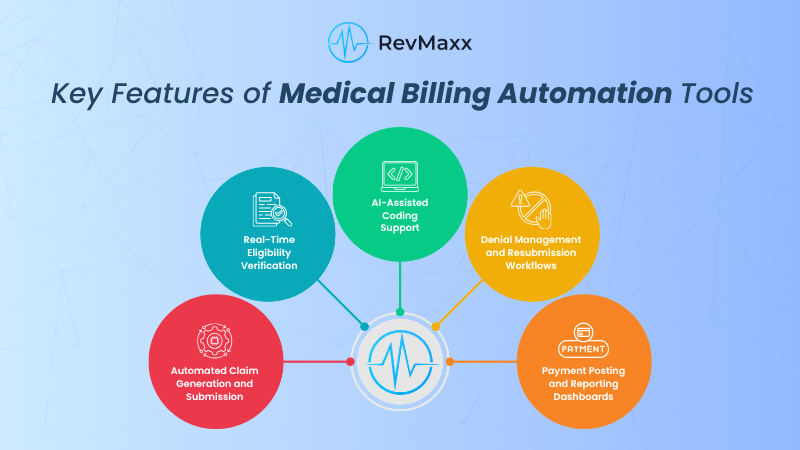
Modern billing automation platforms are designed to support the full revenue cycle.
- Automated claim generation and submission: Claims are created automatically from patient encounters and sent electronically to insurers without manual entry.
- Real-time eligibility verification: Insurance coverage is checked instantly before services are provided, reducing claim rejections.
- AI-assisted coding support: The system suggests correct medical codes based on documentation, improving accuracy and reducing coding errors.
- Denial management and resubmission workflows: When claims are denied, the system identifies the reason and helps correct and resubmit them faster.
- Payment posting and reporting dashboards: Payments from insurers are automatically recorded, and dashboards show revenue trends, pending claims, and performance insights.
Why Small Practices Need Medical Billing Automation
Small healthcare practices are under constant pressure to balance patient care with administrative work. In the early stages, manual billing may seem manageable. But as the practice grows, the same processes start creating delays, errors, and financial gaps.
Limited Staff And Growing Patient Volume
Most small practices operate with lean teams. Front desk staff often handle scheduling, patient communication, and billing tasks at the same time. As patient visits increase, billing workload grows quickly. Each visit generates multiple steps—documentation, coding, claim submission, and follow-ups.
Without automation, this workload becomes difficult to manage. Staff start prioritizing urgent tasks, and billing often gets delayed. Over time, these delays affect cash flow and revenue consistency.
Increasing Complexity Of Payer Rules And Compliance
Insurance billing has become more complex over the years. Each payer has different requirements for:
- Coding formats
- Documentation
- Claim submission timelines
These rules also change frequently. Keeping up manually is time-consuming and risky. Even experienced staff can miss updates, leading to denied or rejected claims.
According to the American Medical Association, administrative complexity is one of the biggest challenges in healthcare, taking up a large portion of practice time.
Rising Administrative Costs
Hiring more billing staff may seem like the obvious solution, but it increases operational costs significantly. Beyond salaries, practices also spend on:
- Training and onboarding
- Software access
- Ongoing supervision
For small practices, these costs can quickly reduce profit margins. Instead of improving efficiency, hiring more people can sometimes create more coordination challenges.
Need For Faster Reimbursements And Steady Cash Flow
Cash flow is critical for daily operations. Delays in claim submission or payment processing can create financial stress. Practices need consistent inflow to cover expenses like salaries, rent, and medical supplies.
Automation helps speed up the billing cycle, ensuring that claims are submitted faster and payments are received on time.
Benefits of Medical Billing Automation for Small Practices
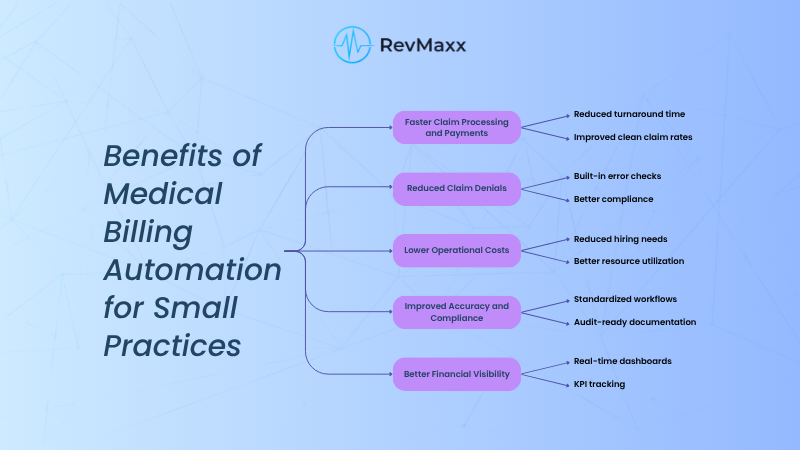
Medical billing automation addresses these challenges by improving speed, accuracy, and control over the billing process. It allows small practices to operate more efficiently without increasing workload.
Faster Claim Processing and Payments
Speed plays a key role in maintaining healthy cash flow. When claims move faster, revenue comes in quicker and that stability helps practices grow without any financial stress.
Reduced Turnaround Time
Automation reduces the gap between patient visits and claim submission. Claims can be generated and sent almost instantly after documentation is complete. This shortens the revenue cycle and ensures faster reimbursements.
Improved Clean Claim Rates
Automation tools check claims for errors before submission. They ensure that:
Required fields are complete
Codes are accurate
Payer rules are followed
According to industry benchmarks, improving clean claim rates can significantly reduce delays and rework.
Reduced Claim Denials
Denials are one of the most common reasons for revenue loss. And they often require some time-consuming follow-up to resolve.
Built-In Error Checks Before Submission
Automation systems identify issues early. Whether it is incorrect patient information, missing modifiers, or coding errors, the medical billing automation systems catch problems at the source. This prevents incorrect claims from being submitted in the first place.
Better Compliance With Payer Requirements
Payer rules and coding guidelines change frequently, thus making it difficult for the billing team to stay updated manually. Automated tools are updated regularly with payer rules and coding changes. This reduces the risk of non-compliance. As a result, practices spend less time fixing denied claims and more time focusing on revenue growth.
Lower Operational Costs
Automation helps practices control costs while maintaining them without affecting performance. As patient volumes grow, billing workloads increase. Traditionally, this would require hiring more staff.
Reduced Need For Additional Hiring
Instead of expanding the billing team, practices can rely on automation to handle increased workloads. With a medical billing automation tool, repetitive tasks like data entry, claim scrubbing, and status tracking are handled efficiently.
Better Resource Utilization
Staff can focus on tasks that require attention and judgment, such as patient communication and complex case handling. According to CAQH, the healthcare industry could save up to $122 billion annually by moving to automated administrative processes.
Improved Accuracy and Compliance
Consistency is key in medical billing. Small errors can lead to claim delays or denials. So with the help of billing automation support, teams can lower the chances of manual errors.
Standardized Workflows
Automation ensures that every claim follows the same process. This reduces variation and improves accuracy. Standardization also makes it easier to train staff and maintain uniform quality across the billing cycle.
Audit-Ready Documentation
All billing data is stored digitally and organized properly. This makes it easier to:
- Track records
- Prepare for audits
- Maintain compliance
This reduces stress during audits and improves overall reliability.
Better Financial Visibility
Clear financial insights help practices make informed and timely decisions.
Real-Time Dashboards And Analytics
Automation tools provide a complete view of the revenue cycle. Practice owners can monitor:
- Claim status
- Payment timelines
- Denial trends
This visibility helps teams identify inefficiencies and address issues before they escalate.
Easier Tracking Of KPIs Like AR Days And Collection Rates
Tracking key performance indicators (KPIs) such as Days in Accounts Receivable (AR), net collection rates, and denial percentages becomes much simpler with automation. The Healthcare Financial Management Association (HFMA) emphasizes that visibility into revenue cycle metrics is essential for financial stability.
Practices can easily identify revenue leakage points, optimize billing workflows, and improve overall financial performance.
How Medical Billing Automation Helps You Scale Without Hiring
Scaling a small practice is not just about increasing patient numbers—it’s about managing growth efficiently. Medical billing automation allows practices to increase revenue without increasing operational burden.
Handling Higher Patient Volume
As patient visits grow, billing workload increases automatically. Without the help of right medical billing automation tool, this can quickly lead to errors, delays and staff burnout.
Systems Process More Claims Without Extra Staff
Automation platforms are designed to handle large volumes of data. They can process hundreds of claims quickly and accurately.
This allows practices to expand their services without worrying about administrative limitations. For example, a practice that struggles to process claims at the end of the day manually can rely on automation to complete tasks in real time.
Streamlining End-to-End Billing Workflows
Automation connects every stage of the billing process into one unified and streamlined system, eliminating the gaps that often exist between departments.
From Patient Intake To Final Payment
With automation in place, the entire revenue cycle becomes interconnected:
- Patient information is captured during registration
- Insurance is verified instantly
- Codes are suggested automatically
- Claims are submitted electronically
- Payments are tracked and recorded
This end-to-end integration reduces delays, improves coordination, and ensures nothing falls through the cracks.
Reducing Dependency on Manual Work
Manual processes slow down growth and increase the risk of errors. They not only slow down operations but also increase the risk of costly errors.
Less Reliance On Human Intervention
Automation handles repetitive tasks with consistency. This reduces mistakes and improves efficiency. By minimizing manual intervention, practices can operate more efficiently with the same team size, even as workloads grow.
More Focus On Patient Care
When staff spend less time on billing, they can focus more on:
- Patient interaction
- Care quality
- Practice growth initiatives
In the long run, this improves both financial performance and patient satisfaction.
End-to-End Workflow: Before vs After Medical Billing Automation
Billing Step | Before Automation (Manual Process) | After Automation (Automated Process) |
Patient Registration | Staff manually enter patient details, increasing chances of errors and missing information | Patient data is captured digitally with validation checks to ensure accuracy |
Insurance Verification | Done manually through calls or payer portals, causing delays | Real-time eligibility verification happens instantly during patient check-in |
Medical Coding | Coders assign codes manually, which can lead to errors or undercoding | AI-assisted coding suggests accurate codes based on documentation |
Claim Creation | Claims are prepared manually, often taking significant time | Claims are generated automatically from patient records and visit data |
Claim Submission | Submitted manually or in batches, leading to delays | Claims are submitted electronically in real time with minimal effort |
Error Checking | Errors are often discovered after claim submission | Built-in checks identify errors before submission, improving clean claim rates |
Denial Management | Staff manually review and fix denied claims, which is time-consuming | System flags denials, identifies reasons, and supports faster resubmission |
Payment Posting | Payments are entered manually, increasing workload and risk of mistakes | Payments are auto-posted directly from payer systems |
Reporting & Analytics | Limited visibility; reports are created manually and may not be real-time | Real-time dashboards provide insights into claims, payments, and performance |
Overall Efficiency | Slow, error-prone, and heavily dependent on staff workload | Fast, accurate, and scalable with minimal manual intervention |
Future of Medical Billing Automation in Small Practices
Medical billing is changing quickly. What started as basic automation is now moving toward smarter, more connected systems. For small practices, this means fewer manual tasks and better control over revenue.
The future is not about adding more tools—it is about making billing simpler, faster, and more reliable.
Role of AI and Machine Learning
Artificial Intelligence (AI) and Machine Learning are at the core of this transformation, making billing systems more proactive rather than reactive.
Smarter Claim Predictions And Denial Prevention
Modern systems can analyze past claim data and identify patterns. This helps predict:
- Which claims are likely to be denied
- What errors commonly occur
- How to fix issues before submission
Instead of reacting to denials, practices can prevent them.
For example, AI can flag missing documentation or incorrect coding before a claim is sent. This improves clean claim rates and reduces rework. Over time, these systems continue to learn and improve, making billing more accurate and efficient. Read our previous blog and learn how medical billing automation tool helps to reduce claim denial rates.
Increased Interoperability
Healthcare systems are becoming more connected, and interoperability is playing a critical role in streamlining billing processes.
Better Integration Across Healthcare Systems
Medical billing automation tools, like RevMaxx RCM automation are now designed to work smoothly with:
- Electronic Health Records (EHRs)
- Practice management systems
- Payer platforms
This means data flows automatically between systems without manual entry.
For small practices, this reduces duplication of work and ensures consistency across all records. It also helps avoid errors caused by mismatched or missing information.
Better connectivity leads to faster workflows and improved coordination.
Shift Toward Fully Automated RCM
The future of billing is moving toward full automation of the Revenue Cycle Management (RCM) process.
End-to-end automation becoming standard. Instead of automating only a few steps, systems are now handling the entire billing cycle, including:
- Patient registration and eligibility checks
- Coding and claim generation
- Submission and tracking
- Denial management
- Payment posting and reporting
This is often called “touchless billing,” where minimal human effort is required for routine tasks.
For small practices, this means:
- Less dependency on manual work
- Faster revenue cycles
- More time to focus on patient care
Conclusion
Medical billing automation is no longer just a helpful tool—it is becoming essential for small practices that want to grow without increasing costs.
It helps solve common challenges like:
- Delayed payments
- High claim denials
- Staff overload
- Lack of financial visibility
By improving speed, accuracy, and efficiency, automation allows practices to do more with the same team.
When you compare the cost of hiring additional staff with the long-term value of automation, the difference becomes clear. Automation not only reduces expenses but also increases revenue by improving billing performance.
Most importantly, it allows practices to scale without adding more people. You can handle more patients, process more claims, and grow your revenue—without increasing your operational burden. If your practice is facing billing delays, rising denials, or staff burnout, this is a good time to take a closer look at your current process.