
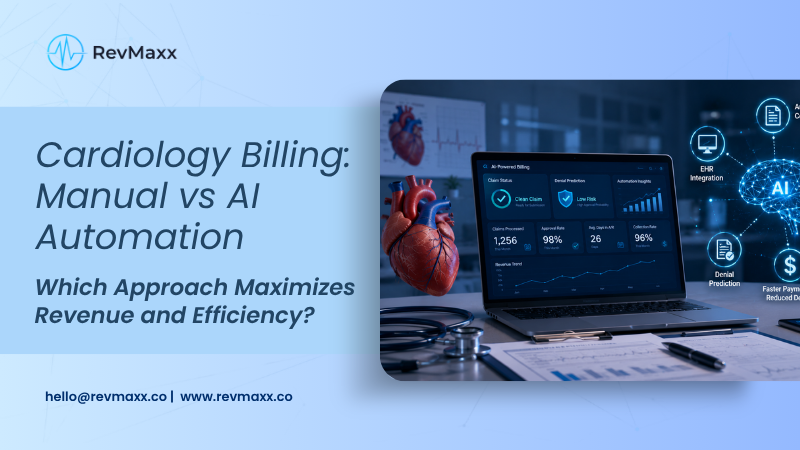
Cardiology Billing is one of the most complex and high-risk areas in healthcare revenue cycle management. It involves high-value procedures, strict documentation rules, and frequent payer scrutiny. Even small errors can lead to claim denials or revenue loss. Today, healthcare providers face a critical decision—continue with manual billing or move toward AI-driven automation.
Recent data shows that nearly 30% of medical claims are denied or rejected on first submission, costing providers billions each year. At the same time, automation tools are helping reduce denials and speed up payments. This blog explains both approaches in detail and helps you understand which one works best for your cardiology practice.
Introduction to Cardiology Billing
“Cardiology billing” refers to the process of coding, submitting, and managing claims for heart-related procedures and services. It is not like general medical billing. It is more detailed and requires deep knowledge of procedures such as angioplasty, echocardiograms, and cardiac catheterization.
The complexity comes from multiple factors. Cardiology procedures are expensive and often need prior authorization. Payers check these claims very closely. Even a small mistake can lead to denial. According to industry data, denial rates in some specialties like cardiology can exceed 15%, which is higher than average.
Because of this complexity, many practices struggle with manual processes. Delays, errors, and rework are common. This is why AI automation is now becoming a key solution in cardiology billing.
Understanding Manual Cardiology Billing
Manual Cardiology Billing is the traditional way of handling claims. It depends heavily on human effort. Staff members perform every step, from data entry to claim submission and follow-ups.
While this method has been used for years, it comes with several limitations. As billing complexity increases, manual systems struggle to keep up.
How Manual Billing Works in Cardiology
The manual billing process follows a structured workflow. It starts with patient registration and insurance verification. Staff collect patient data and confirm coverage details.
Next comes medical coding. Coders assign CPT and ICD-10 codes based on the procedure performed. In cardiology, coding is highly complex due to modifiers, bundled services, and procedure variations.
After coding, claims are submitted to insurance companies. If the claim is denied, the team must review it, correct errors, and resubmit.
Finally, payment posting and follow-ups are done manually. This includes tracking unpaid claims and contacting payers. This entire process takes time. It also depends on the accuracy and experience of staff.
Common Challenges in Manual Cardiology Billing
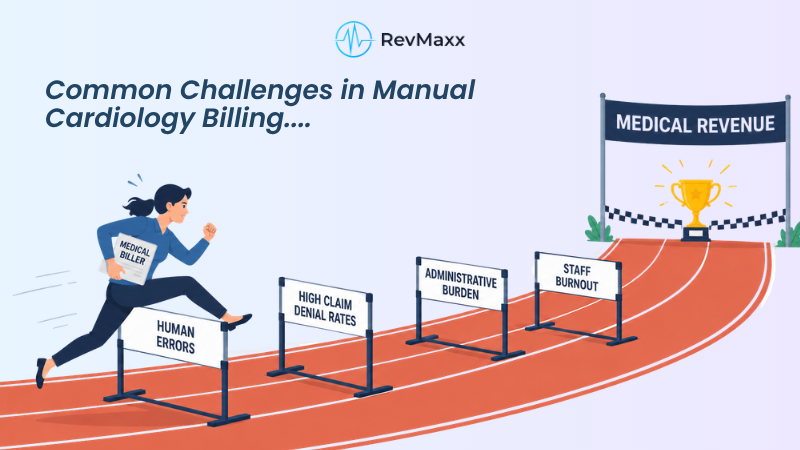
Manual cardiology billing comes with many challenges. The biggest issue is human error. Studies show that medical billing errors can occur in 7% to 49% of claims, depending on the setting.
Another challenge is claim denials. On average, initial denial rates are around 11–14%, and some practices experience even higher rates.
Delays are also common. Many providers wait 6–8 weeks to receive payments. This affects cash flow and financial stability. Manual processes also make it hard to manage prior authorizations and track claims in real time. Staff often spend hours fixing preventable errors.
Impact on Revenue and Operations
The impact of manual billing on revenue is significant. Healthcare providers lose billions each year due to billing inefficiencies. In fact, the industry lost over $48 billion in 2025 due to claim denials and bad debt.
Operational costs also increase. Practices spend 2% to 10% of revenue just to collect payments. Staff burnout is another issue. Billing teams spend most of their time correcting errors instead of improving processes. This reduces productivity and increases turnover.
Patients are also affected. Billing errors lead to confusion and dissatisfaction, which impacts overall patient experience.
What is AI Automation in Cardiology Billing?
AI automation in cardiology billing uses advanced technologies to handle billing tasks automatically. It reduces human effort and improves accuracy.
AI tools can analyze large amounts of data quickly. They can identify errors, predict denials, and optimize workflows. This helps practices improve efficiency and revenue.
Definition and Core Technologies
AI in cardiology billing includes machine learning, predictive analytics, and natural language processing. These technologies work together to automate billing tasks.
Machine learning analyzes past claims data to identify patterns. Predictive analytics forecasts potential denials. Natural language processing extracts data from clinical notes.
These systems also integrate with EHR and billing platforms. This ensures smooth data flow and reduces manual entry.
Key Features of AI in Cardiology Billing
AI-powered billing systems offer several features.
- One key feature is automated coding. AI suggests accurate codes based on clinical documentation.
- Another feature is real-time eligibility verification. This ensures that patient coverage is checked before services are provided. AI also performs claim scrubbing. It identifies errors before submission, reducing rejection rates.
- Denial prediction is another major advantage. AI can flag high-risk claims and suggest corrections. These features help improve efficiency and reduce revenue loss.
Manual vs AI Automation in Cardiology Billing: A Detailed Comparison
Cardiology billing is complex, and choosing between manual processes and AI automation can directly impact revenue and efficiency. Manual billing relies heavily on human effort, which increases the chances of delays and errors. On the other hand, AI-driven automation uses data and predictive insights to streamline the entire billing cycle.
According to industry reports, healthcare organizations using AI in revenue cycle management have seen up to 30–40% improvement in operational efficiency. This comparison helps practices understand which approach delivers better accuracy, faster payments, and long-term scalability.
Accuracy and Error Reduction
Accuracy is critical in cardiology billing because even a small mistake can lead to claim denials. Manual billing depends entirely on human accuracy. Coders must handle complex cardiology procedures, modifiers, and compliance rules, which increases the risk of errors. Studies show that billing errors can occur in up to 10–20% of claims in manual systems.
AI automation improves accuracy by using data-driven algorithms. It analyzes past claims and identifies patterns to suggest correct codes. AI tools can also flag missing or incorrect information before submission. This reduces errors significantly and improves clean claim rates.
Speed and Efficiency
Manual cardiology billing is time-consuming. Each step, from data entry to claim submission, requires human involvement. This slows down the process and delays reimbursements and increase the chances of revenue leakage. Many practices take 30–60 days to receive payments, which affects cash flow.
AI automation speeds up the entire workflow. It processes claims in real time, verifies patient eligibility instantly, and submits claims faster. According to a report by McKinsey, automation in healthcare can reduce processing time by up to 50%. Faster processing means quicker reimbursements and improved financial stability for practices.
Denial Management
Denial management is a major challenge in cardiology billing. Manual systems follow a reactive approach. Teams identify denials after they occur and then work on corrections and resubmissions. This increases workload and delays payments.
AI automation takes a proactive approach. It uses predictive analytics to identify high-risk claims before submission. AI tools can suggest corrections in real time, reducing the chances of denial. Reports show that AI can reduce claim denials by up to 40%, helping providers recover lost revenue faster.
Cost and Resource Utilization
Manual billing requires a large team to manage coding, submissions, follow-ups, and denial handling. This increases operational costs. Healthcare providers often spend 5–10% of their revenue on billing operations.
AI automation reduces the need for manual work. It automates repetitive tasks and allows staff to focus on complex issues. This leads to better resource utilization and lower overhead costs. Practices can operate more efficiently without increasing staff size, which improves overall profitability.
Scalability
Scalability is another key factor in cardiology billing. Manual systems struggle when patient volume increases. More claims require more staff, which increases costs and complexity.
AI systems are highly scalable. They can process large volumes of claims without additional resources. Whether a practice handles 100 or 1,000 claims, AI can manage the workload efficiently. This makes it easier for growing practices to expand without worrying about billing limitations. Scalability ensures consistent performance even during high-demand periods.
Key Benefits of AI Automation in Cardiology Billing
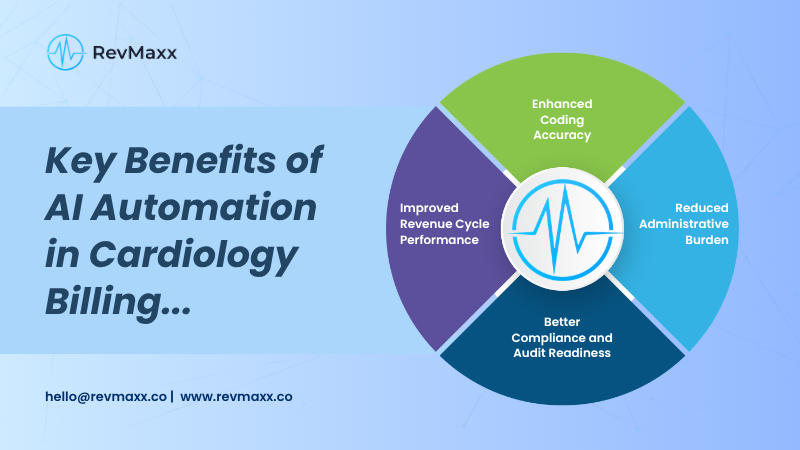
AI automation is transforming cardiology billing by improving accuracy, speed, and overall efficiency. It not only reduces errors but also helps practices achieve better financial outcomes. According to a report by Deloitte, automation in healthcare can reduce administrative costs by up to 30%. These benefits make AI a valuable investment for cardiology practices looking to optimize their revenue cycle and improve patient experience.
Improved Revenue Cycle Performance
AI automation significantly improves revenue cycle performance. It reduces delays in claim processing and speeds up reimbursements. Practices using AI often achieve lower days in accounts receivable (AR), typically under 30–35 days, compared to higher numbers in manual systems.
AI also increases clean claim rates by identifying errors before submission. Faster claim approvals mean better cash flow and financial stability. By reducing denials and improving efficiency, AI helps practices maximize revenue without increasing workload.
Enhanced Coding Accuracy
Coding accuracy is essential in cardiology billing due to complex procedures and strict payer guidelines. Manual coding increases the risk of undercoding or overcoding, both of which can lead to revenue loss or compliance issues.
AI-assisted coding uses advanced algorithms to analyze clinical documentation and suggest accurate codes. It ensures compliance with payer rules and reduces errors. This not only improves reimbursement rates but also minimizes the risk of audits. Accurate coding is one of the biggest advantages of AI in billing.
Reduced Administrative Burden
Administrative workload is a major challenge in healthcare billing. Staff spend hours on repetitive tasks like data entry, claim tracking, and follow-ups. This reduces productivity and increases burnout.
AI automation handles these repetitive tasks efficiently. It automates workflows, tracks claims in real time, and sends alerts for pending actions. This allows staff to focus on more important tasks, such as patient care and complex billing issues. Reducing administrative burden improves both efficiency and employee satisfaction.
Better Compliance and Audit Readiness
Compliance is essential in cardiology billing due to strict regulations and payer requirements. Manual systems often struggle to keep up with changing rules, increasing the risk of errors and penalties.
AI automation ensures real-time compliance by continuously updating rules and guidelines. It checks claims for accuracy before submission and flags potential issues. This reduces the risk of audits and financial penalties.
With proper documentation and automated checks, practices are always audit-ready. This builds trust with payers and ensures smooth reimbursement processes.
When Should Cardiology Practices Switch to AI Billing?
Many cardiology practices continue using manual processes without realizing the hidden cost of inefficiency. Knowing when to switch to AI-driven cardiology billing is important for long-term growth. If your practice is struggling with delays, denials, or increasing workload, it may be time to consider automation. According to industry insights, nearly 25–30% of healthcare administrative tasks can be automated, improving efficiency and reducing costs. Identifying the right moment to adopt AI helps practices stay competitive, improve revenue, and reduce operational stress.
Key Signs Your Practice Needs Automation
There are clear warning signs that indicate your cardiology billing process needs automation. High denial rates are one of the biggest red flags. If your denial rate is above 10–15%; it directly affects revenue. Increasing days in accounts receivable (AR), especially beyond 40–50 days, shows delays in payment cycles. Frequent billing errors, such as incorrect coding or missing data, also indicate inefficiency.
Staff overload is another major issue. When your team spends most of their time fixing errors instead of improving workflows, productivity drops. These signs clearly show that manual processes are no longer sufficient and AI automation can bring better control and efficiency.
Ideal Use Cases
AI automation works best in specific scenarios within cardiology billing. High-volume practices benefit the most because they handle a large number of claims daily. Managing these claims manually increases the risk of errors and delays.
Multi-location clinics also gain value from AI, as it helps standardize billing processes across different locations. Practices dealing with complex cardiology procedures, such as interventional cardiology or cardiac imaging, also benefit greatly. These procedures require precise coding and documentation, which AI can handle more accurately and efficiently than manual systems.
Best Practices for Implementing AI in Cardiology Billing
Implementing AI in cardiology billing is not just about adopting new technology. It requires proper planning and strategy. Without the right approach, practices may face challenges during implementation. Following best practices ensures smooth adoption and maximum return on investment. According to the survey, organizations that follow structured implementation strategies achieve up to 2x higher ROI from automation initiatives. A well-planned approach helps practices reduce risks and improve overall billing performance.
Choosing the Right AI Billing Solution
Selecting the right AI solution is the first step toward successful implementation. Practices should evaluate features such as automated coding, denial prediction, and real-time analytics. Scalability is also important, as the system should support future growth.
Compliance is another critical factor. The solution must follow healthcare regulations and payer guidelines. Integration with existing EHR and billing systems is equally important. A seamless integration reduces disruption and ensures smooth data flow. Choosing the right platform like RevMaxx RCM automation sets the foundation for long-term success in cardiology billing.
Gradual Implementation Strategy
A gradual approach is always better than a full-scale transition. Practices should start with specific workflows, such as coding or claim submission. This allows teams to understand the system and adapt to new processes.
Over time, automation can be expanded to other areas like denial management and payment posting. This step-by-step approach reduces risk and ensures smoother adoption. It also helps staff gain confidence in using AI tools, making the transition more effective and less stressful.
Continuous Monitoring and Optimization
AI implementation does not end after deployment. Continuous monitoring is essential to ensure optimal performance. Practices should track key performance indicators such as denial rates, AR days, and collection rates.
Regular updates are also important. AI systems improve over time by learning from new data. Updating workflows and algorithms ensures better accuracy and efficiency. Continuous optimization helps practices achieve long-term success and maintain a strong revenue cycle.
Conclusion
Manual cardiology billing has served healthcare for years, but it is no longer enough in today’s complex environment. Increasing claim volumes, stricter regulations, and rising denial rates make manual processes inefficient.
AI automation offers a smarter solution. It improves accuracy, speeds up claim processing, and reduces denials. It also lowers operational costs and enhances scalability. Practices using AI are better positioned to handle growth and complexity.
In the long run, AI delivers strong ROI by improving revenue cycle performance. The future clearly points toward automation. Practices that adopt AI-driven cardiology billing today will gain a competitive edge and achieve sustainable growth in the years ahead.