
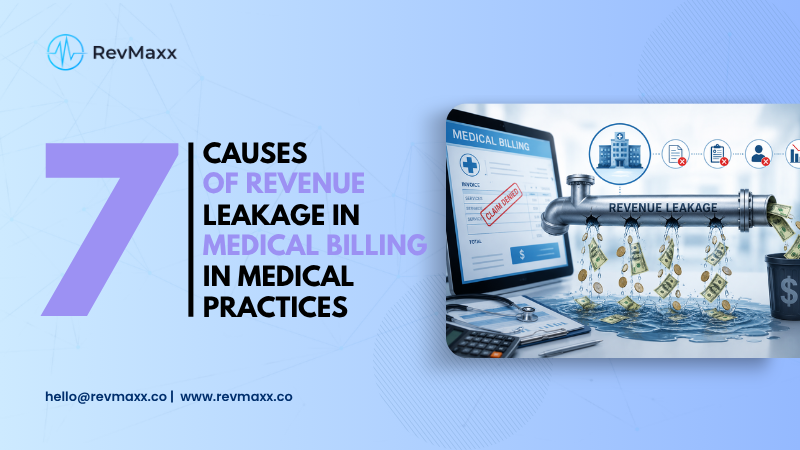
Revenue leakage in medical billing is not a small issue anymore. It is a serious financial problem that affects hospitals, clinics, and private practices across the world. Today, digital transformation in medical billing is becoming the most practical way to solve this challenge. Read our previous blog on this matter.
Now let’s be clear. You are not losing money because patients are not paying. You are losing money because your system is failing to capture, process, and collect what you have already earned.
Recent data shows that hospitals lost nearly $48 billion due to claim denials and uncollected bills in 2025 alone. Even more concerning fact is that healthcare organizations lose 4-5% of total revenue due to preventable billing features.
So, let’s read this blog carefully, and you will learn the top 7 causes of revenue leakage and how to fix them.
What is Revenue Leakage in medical Billing?
Revenue leakage in medical billing means losing money that should have been collected after delivering services. It is not about low patient volume. It is about missed opportunities within the billing process.
Many healthcare providers do not even realize how much they are losing. Studies show that 6.7-11.4% of collectible revenue is at risk due to hidden inefficiencies. These losses happen across the entire revenue cycle.
Digital transformation in billing systems helps identify these hidden gaps. It brings visibility, automation, and accuracy into the system. So, in simple terms, revenue leakage is the gap between what you earn and what you actually collect. This gap is created due to small errors across billing, coding, and claims processing.
For example:
- A missed charge
- A wrong code
- A denied claim that is never followed up
Each of these may seem small, but together, they create a large financial loss over time.
Healthcare studies estimate that billions are lost every year due to billing errors and inefficiencies. This is where AI-driven RCM automation becomes critical: it helps reduce these small but costly mistakes.
Where It Happens in the Revenue Cycle
Revenue leakage does not happen in one place. It happens across three main stages:
Front-end:
- Patient registration errors
- Insurance verification issues
Mid-cycle:
- Coding mistakes
- Missing documentation
Back-end:
- Claim denials
- Poor collections
Each stage has its own risks. If one step fails, it affects the entire process.
Why Is Revenue Leakage in Medical Billing Hard to Detect?
Revenue leakage is difficult to detect because it rarely appears as one large, visible loss. Instead, it builds slowly through small errors that happen every day. A missed charge here, a coding mistake there, or a denied claim that is never followed up—all these small gaps add up over time.
One major issue is that underbilling often goes unnoticed, while denials get more attention. According to the study, many healthcare providers focus only on denied claims, even though underpayments and missed charges can result in equal or higher revenue loss. Without proper tracking systems, these hidden losses remain invisible.
Top 7 Causes of Revenue Leakage in Medical Billing
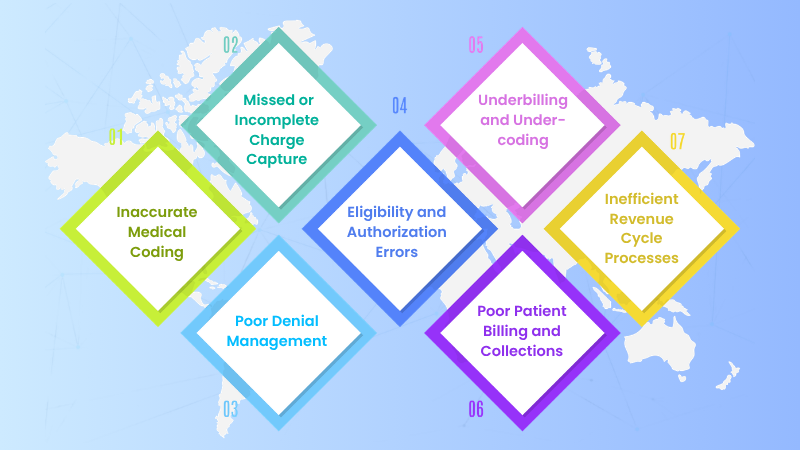
Revenue leakage in medical billing happens at multiple stages of the revenue cycle, and most of it is preventable. Losing revenue isn’t always attributable to major systemic failures; sometimes this is simply due to failures on the operational level (i.e. manual error, inadequate documentation, and poor communication). Billing inefficiencies alone are estimated to cause up to four to five percent of organizations’ total revenues in preventable charges.
Identifying basic causes is an important first step toward rectifying these issues. The following section will cover the seven most common reasons for provider losses and how they affect overall financial performance.
Inaccurate Medical Coding
Inaccurate medical coding is one of the most common causes of revenue leakage. Coding errors include upcoding, downcoding, and completely missed codes. Each of these creates financial and compliance risks. For example, downcoding leads to lower reimbursement, while upcoding can trigger audits and penalties. Coding mismatches between documentation and claims also result in denials or underpayments.
The complexity increases because coding systems like ICD-10 and CPT are updated frequently. According to the report, coding errors are a leading cause of claim denials. Without proper training and validation, these mistakes directly reduce revenue and increase compliance risks.
Missed or Incomplete Charge Capture
Missed or incomplete charge capture is often called “silent revenue leakage” because it is hard to notice. This happens when services are provided but not correctly documented or billed.
In busy clinical practices, providers may forget to record certain procedures or services. Manual processes make this problem worse, as they rely heavily on human accuracy.
The lack of proper integration between the EHR and the billing system is another frequent occurrence resulting in loss or incomplete information. One of the biggest causes of revenue loss for healthcare provider practices is missed charges. Missed charges are never charged, therefore, they are a permanent loss of revenue. This is one of the largest issues that must be addressed in order to remediate loss of revenue.
Claim Denials and Poor Denial Management
Claim denials have an immediate and significant effect on an organization’s revenue. When a claim is denied, it leads to either a delayed or no payment; reworking a denied claim requires both time and resources. The most common causes of denials are missing documentation, coding errors, and eligibility issues.
According to a recent study, the denial rates for many healthcare providers vary from 10% to 15%. A large percentage of these denials could have been avoided; therefore, poor denial management is what causes the majority of these denied claims.
Many healthcare organizations do not keep track of their denial patterns nor follow up on any unpaid claims, so those claims go unpaid. The cost to rework a denied claim is approximately $25, ultimately adding to the provider’s operational expenses and reducing the organization’s overall revenue.
Eligibility and Authorization Errors
At the start of the revenue cycle, eligibility and authorization mistakes happen all the time and greatly affect billing results. This includes:
- Not checking if the patient has insurance
- No prior authorizations
- Incorrect patient demographic information
For example, a small mistake (like entering the wrong patient ID) could cause the claim to reject immediately. Poor eligibility is one of the leading reasons for first-pass claim denials, and proper verification processes can eliminate them. The error rate is much higher when manual verification is performed. Both may delay payment, increase administrative burden, and decrease patient satisfaction.
Underbilling and Under-coding
Healthcare Providers sometimes under-bill or under-code their services. This is usually an accident due to a lack of supporting information, insufficient coding experience or apprehension about possible audits. In certain circumstances, there can be higher codes available for the appropriate coding of services; however, at times lower codes may be chosen in order to protect from a possible audit.
This practice (known as undercoding) is not an obvious source for revenue loss to the provider, and that reason may not trigger an audit. Therefore, it can be very difficult for providers to find the total dollar loss due to undercoding. Continued underbilling can create a large cumulative loss, thus harming the fiscal viability of an organization.
Poor Patient Billing and Collections
Patients are now being asked to pay more towards their healthcare costs, but there are still many providers who have a hard time collecting these funds. Revenue leakage is primarily the result of inefficient billing. The billing statements sent by providers often include confusing information; lack an easily comprehensible price list; and only offer patients limited payment options, typically just cash and credit. Because of the ambiguity of the information contained in the billing statements, patients may choose to delay or ignore their payment if they don’t fully understand what they owe.
Ineffective patient collections can significantly increase bad debt. Another issue is the lack of follow-up on outstanding balances. Without clear communication and flexible payment solutions, healthcare providers lose a large portion of revenue that should have been collected from patients.
Inefficient Revenue Cycle Processes & Manual Workflows
Multiple points of failure exist in the revenue cycle due to manual workflows and inefficient processes. Manual claim tracking, data entry mistakes, and delays in submitting claims all result in revenue loss (leakage).
The lack of system integration leads to either lost or delayed information, resulting in missed billing opportunities. The lack of integration between systems and poor workflow management are the main causes of revenue loss.
Too often, there is a lack of follow-up on accounts receivable (AR), which causes an extended delay before collections occur. Teams are using less time to generate revenues because they are spending too much of their time doing repetitive activities and not enough time doing revenue-generating activities, which causes inefficiencies and financial losses.
Additional Hidden Causes That Shouldn’t Be Ignored
There are many factors that can cause revenue leakage by way of improper billing in both the healthcare industry and through the various entities we’ll be discussing in these articles. Many of these issues remain hidden because they don’t involve everyday billing operations, but have a direct impact on the financials of your facility over time. Issues such as payer contract mismanagement and compliance gaps don’t always produce an immediate effect, but they are a steady drain on revenue.
According to experts, the average healthcare provider is losing approximately 11% of revenue as a result of operational / contractual inefficiencies being pushed aside as administrative issues. Identifying & correcting these “hidden” causes are critical to a hospital’s long-term financial success.
Payer Contract Issues
Payer contract problems create substantial revenue leakage that is frequently overlooked by healthcare providers. Most providers rarely evaluate or track their contracts with payers, which can lead to missed or delayed payments. For instance, if an insurance carrier pays below the contracted amount or misinterprets an agreement, the provider will not get accurately billed at the correct rate. Without ongoing monitoring, underpayments can be undetected.
Lack of contract monitoring can be one of the biggest contributors to the failure of providers to collect the full amount of reimbursement from their payers. Underpayment amounts, no matter how small, can add up over a period of time and create a large amount of revenue that the provider has lost. Regular audits and well-managed contracts can help providers improve their billing accuracy and recover lost revenue.
Compliance and Regulatory Gaps
Noncompliance and/or breaches of regulations can have severe financial and/or legal consequences. When billing for the provision of health care services, there are many strict guidelines that must be followed; even the smallest discrepancy may lead to a penalty or a denial of your claim. The likelihood of an audit increases due to improper coding, inadequate documentation and the use of outdated procedures.
Failing to meet regulations can result in lower reimbursement rates as well as potential lawsuits if the infraction is severe. There are two ways noncompliance can damage an organization: through a loss of revenue, and by harming the organization’s brand. By remaining up to date with the legal requirements for their industry and maintaining accurate documentation on everything they do to comply, organizations can reduce these risks.
How to Identify Revenue Leaking in Medical Billing
The first step in fixing revenue leakage is to find where revenue leakage exists. Numerous healthcare organizations lack the appropriate performance indicators that prevent them from realizing potential missed revenue. Without these key performance indicators to provide a basic level of visibility, it’s challenging to identify where to go through an organization to find out what’s causing revenue losses.
To combat this issue, it’s essential for providers to continuously monitor their organization’s revenue cycle. Continuously monitoring and analyzing revenue cycle data allows healthcare providers to discover patterns and inefficiencies that could lead to substantial revenue loss due to late resolution of issues.
Key Metrics to Track
By measuring the appropriate metrics, healthcare organizations can pinpoint revenue drains or areas where there are issues with claims processing. This includes the denial rate (the percentage of claims denied) and the average number of days the organization requires to collect on cash accounts receivable (AR). The net collection rate identifies how much of the billed amount received via cash, whereas the first-pass acceptance rate of claims provides insight into how many claims are accepted initially, without needing to be resubmitted for subsequent review and payment.
Thus, by increasing first-pass acceptance rates or the number of claims accepted initially, organizations can accelerate their cash flow. Regularly evaluating a facility’s metrics can assist leaders with an understanding of the organization’s overall billing performance.
Warning Signs
Numerous warning signs may indicate possible revenue loss when it comes to healthcare billing. One of the most apparent signs is increased write-offs due to non-payment of claims to the provider’s account. The other obvious sign is frequent reworking of claims, resulting in higher operational costs and delayed revenue. Lastly, when there are inconsistencies between expected and actual revenues (i.e., dropping revenues unexpectedly), there is likely a systemic issue with the billing process.
Many healthcare providers do not recognize these warning signs until they experience significant losses. If organizations are able to identify the above patterns early, they will be able to implement corrective actions and enhance their overall financial results.
How to Prevent Revenue Leakage in Medical Billing
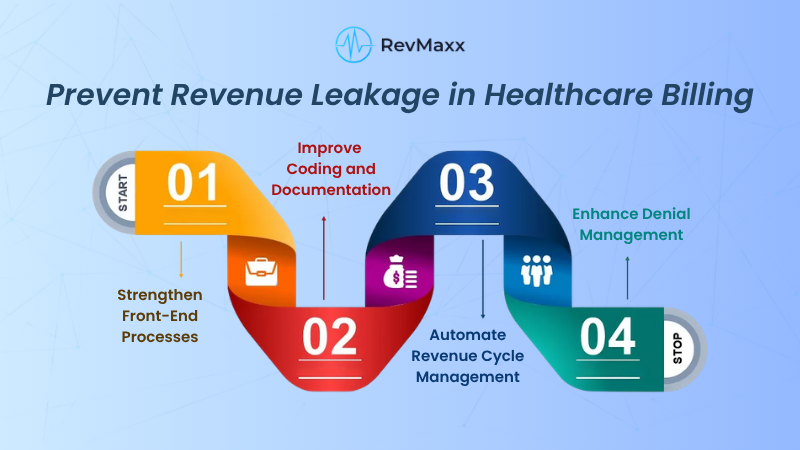
To reduce revenue leakage in medical billing, your organization should take a proactive, structured approach to resolve all revenue cycle issues and identify ways to improve processes throughout the entire revenue cycle. This means optimizing every step of the revenue cycle from patient registration through payment collection.
In fact, many revenue leakage problems could be prevented by using better systems and workflows, according to Business Integrity Services. By using accurate data and trained employees, in combination with automation, providers can greatly reduce their losses and increase their efficiency.
Strengthen Front-End Processes
Front-end processes are the foundation of accurate billing. When mistakes happen in this step, your claims could be denied or delayed in the future stages of the revenue cycle. Primarily, to resolve those issues, you should have accurate patient information which includes complete demographic information and insurance information. Why?
Because by verifying eligibility in real time, you are able to confirm that a patient is eligible for benefits that will be provided to them before delivering these benefits. By maximizing efficiencies through improved process performance, healthcare organizations will minimize the impact of errors and be able to increase their first-pass claim acceptance rates, which, in turn, will enable them to collect revenue more quickly and reliably.
Improve Coding and Documentation
To ensure proper reimbursement, accurate coding and appropriate documentation are essential. Regular training of staff helps keep coding teams informed of any new guidelines and/or changes to existing guidelines. If documentation is not accurate, it could lead to paying less than actually owed (underbilling) or to having claims denied. AI-assisted coding tools also provide a way to reduce errors associated with coding and improve the overall accuracy of coding.
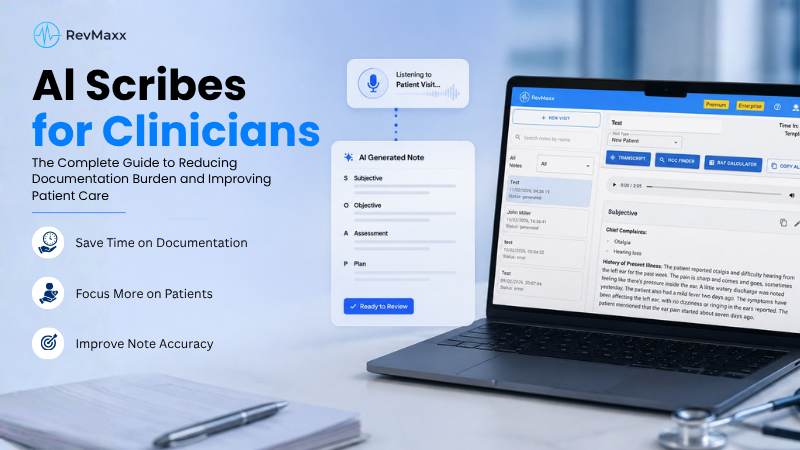
Office Ally states that improved clinical documentation has a direct positive impact on coding accuracy and helps reduce claim rejection rates. Regular staff training, accurate documentation practices, and AI-powered clinical documentation tools can significantly improve billing accuracy and reimbursement outcomes. Solutions like RevMaxx AI Scribe help healthcare providers generate more accurate clinical notes, support better medical coding, and reduce documentation-related revenue leakage.
Automate Revenue Cycle Management
Revenue leakage can be minimized by utilizing automated solutions. Manual processes consume a lot of time and are prone to mistakes. By automating your claim processing, payment posting, follow-ups, and other tasks, you can improve the efficiency and accuracy of your processes. Automating these processes can also significantly reduce the number of billing errors and allow your organization to process claims more quickly.
This means that you will receive payment more quickly and improve your overall cash flow. Additionally, reducing your reliance on manual processes will help you minimize errors and concentrate on strategic activities within your organization.
Enhance Denial Management
Successful claim denial management is critical to recovering lost income. Instead of just reacting to denials, providers should work to identify what the root cause of the denial is. Some of the most common reasons for denial include incorrect coding, incomplete documentation, and eligibility issues. Reviewing the patterns of denial can help to identify other similar denials in the future.
According to Hansei Solutions, a large percentage of denied claims will be recoverable if addressed correctly. Using proactive denial prevention strategies can help reduce rework, enhance performance, and increase total revenue.
Optimize Patient Collections
Recently greater emphasis has been placed on enhancing collections from patients due to the increasing percentage of costs patients must pay out of pocket. Utilizing a clear and detailed billing process allows patients to understand what they will be responsible for, thus decreasing the time and frustration associated with uncertainty.
Providing flexible payment options (i.e., online payments and payment plans) to the patient will also make paying their bill more likely. The report says that through providing clear communication and convenient payment options, a provider will see a significant increase in collection rates. Following up on unpaid accounts via phone and/or mail assists in ensuring payment occurs. A provider that utilizes a patient-friendly approach will equal not only increased collections but also improved overall satisfaction with the patient.
The Conclusion
Revenue leakage is not a one-time issue. It is a continuous problem caused by small gaps in the system. The numbers are clear:
- Up to $262 billion lost annually due to billing errors
- 4–5% revenue loss is common across organizations
The good news is that most of this loss is preventable.
Digital transformation in medical billing is no longer optional. It is necessary.
By adopting automation, AI, and better processes, healthcare providers can reduce errors, improve collections and increase revenue
Start by analyzing your current system. Identify the gaps. Then move towards digital solutions.
Because in healthcare billing, every small fix can lead to big financial gains.