
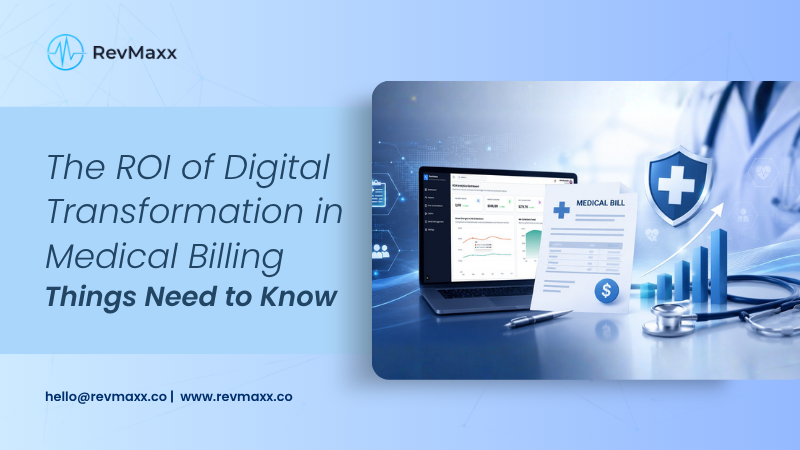
Medical billing has seen its digitized, automated transformation begin to take hold in the present time, as the level of efficiency achieved with digital transformation creates many benefits for both healthcare providers and the patients receiving services from them.
Healthcare providers have experienced many challenges such as slow payment cycles, high denial rates, and excessive manual billing workloads over an extended period of time, all of which produce reduced revenues for the providers and lower productivity levels for the supporting staff.
In addition, as inflation drives up the costs of healthcare, healthcare providers are forced to provide higher-quality care while working at higher levels of efficiency.
The implementation of digital transformation leveraging automation, artificial intelligence (AI), and integration among automation, and the various systems within an organization will improve billing accuracy, reduce billing delays, and increase collectable dollars.
Research has demonstrated a reduction in denial levels of up to 35% through the implementation of automation and a significant reduction in administrative costs.
In this blog, we will break down how digital transformation impacts ROI, what metrics to track, and how providers can get the most value from modern billing systems.
What Is Digital Transformation In Medical Billing?
Digitizing the medical billing process is the act of switching from old methods such as handwritten and paper-based systems to new automated methods. The goal of digital transformation is to improve the complete medical billing experience, from when a patient registers for services until an organization collects their invoices after payment has been made.
Today’s medical billing system is complicated; it comprises many critical operations including coding, submitting claims, communicating with payers, and complying with regulations applicable to the industry. Digital tools simplify these processes and reduce human errors.
Digital transformation in medical billing is the use of technology to improve billing workflows, reduce errors, and increase efficiency. It includes several key components:
- AI-driven automation for coding and claim validation
- Cloud-based billing systems for real-time access
- Revenue Cycle Management (RCM) tools for end-to-end tracking
- EHR integration for seamless data flow
The tools work synergistically to automate work and enhance accuracy of billing. With AI systems, for instance, you can identify missing claim submission data prior to submission. Thus eliminating the possibility of claim rejection.
Research indicates that AI can automate upwards of 85 percent of routine billing activities, thereby exponentially enhancing efficiency.
Traditional Vs. Digital Medical Billing
| Aspect | Traditional Billing | Digital Billing |
| Process Type | Relies on manual processes and paperwork | Uses automated and digital systems |
| Data Entry | Staff manually enter patient and billing data | Automated data capture and system integration |
| Claim Handling | Manual claim checking and follow-ups | Automated claim validation and submission |
| Speed | Slower due to multiple manual steps | Faster processing with real-time workflows |
| Error Rate | Higher risk of human errors | Errors detected early with AI and automation |
| Efficiency | Time-consuming and labor-intensive | Streamlined and efficient workflows |
| Administrative Costs | Higher due to more staff and rework | Lower due to reduced manual effort |
| Scalability | Difficult to scale operations | Easily scalable with technology |
| Revenue Impact | Higher chances of missed charges and delays | Improved revenue capture and faster payments |
Why ROI Matters in Medical Billing Transformation
Return on Investment (ROI) is one of the most important factors for healthcare providers. It helps measure whether digital transformation is worth the cost.
Healthcare organizations operate on tight margins. Even small improvements in billing efficiency can lead to significant financial gains.
ROI in medical billing refers to the financial benefits gained from improving billing processes compared to the cost of implementing new systems.
Key metrics include:
- Cost per claim
- Days in Accounts Receivable (A/R)
- Clean claim rate
- Denial rate
For example, reducing A/R days means faster payments. Improving clean claim rates reduces rework and saves time.
According to industry data, practices can achieve 150%–300% ROI within two years of implementing billing automation.
Key Areas Where Digital Transformation Delivers ROI
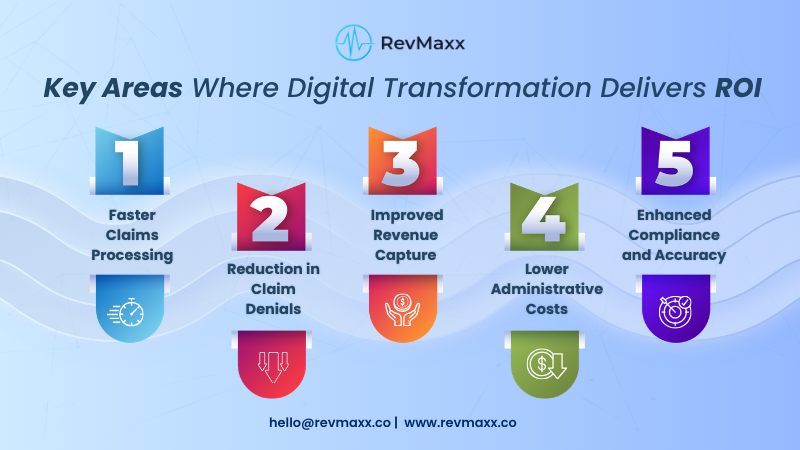
The transformation of medical billing through digitization offers value at all stages of the healthcare revenue cycle. In short: The digital transformation of medical billing is not just about automating previously manual processes; rather, it is about improving the speed and accuracy of revenue collection and ultimately enhancing the financial performance of an organization’s revenue cycle.
Due to inefficient billing processes, healthcare organizations are losing a large amount of revenue. Nearly 30% of claims submitted are denied on first submission (and most are actually preventable).
By using digital tools such as artificial intelligence (AI), automation, and the integration of multiple billing systems, companies will be able to reduce billing errors, improve their claim success rates/timelines, and increase the time it takes to be reimbursed for services provided. These efficiencies will positively affect ROI by resulting in Higher collections with lower operating expenses.
Faster Claims Processing
An advantage of going through digital transformation in medical billing is increased efficiency with processing claims faster than before. With automation, processes no longer have delays due to human error or repetitive jobs. Claims can be submitted at any point and be tracked in real-time.
By using real-time eligibility checking, we can confirm that a patients’ insurance will cover certain types of treatments prior to delivering any medical services to them. This reduces rework later in the billing cycle. According to industry data, automation can improve payment cycles by 30–40% faster processing, helping providers receive payments sooner.
Faster processing directly improves cash flow. It also reduces the time claims spend in Accounts Receivable (A/R), which is a key performance indicator for financial health.
Reduction in Claim Denials
Denial of claims by insurance companies is a significant source of income lost to healthcare providers. Through digital transformation, AI-based tools are now being used to identify errors before claims are submitted. They will identify incomplete information, incorrect coding, and eligibility issues.
Pre-submission validation ensures that claims meet payer requirements. This significantly reduces rejection rates. Research indicates that 86% of all deny fees/categories are preventable and most commonly due to manual errors or insufficient documentation.
A further key advantage would result from improved coding accuracy. Systems using AI can produce correct codes based on inputted information as well as identify mismatches. In turn, the claim denial management reduces the number of denials, decreases resubmissions/rework, and facilitates more rapid payments to providers.
Improved Revenue Capture
Revenue leakage is a silent problem in many healthcare organizations. Missed charges, undercoding, and delayed billing can reduce overall income. Digital transformation in medical billing helps fix these issues through better tracking and automation.
Charge capture tools ensure that every billable service is recorded correctly. Automated systems also reduce undercoding by suggesting accurate billing codes. According to reports, healthcare providers can increase revenue by 7–10% through better coding accuracy and automation.
Additionally, digital systems provide full visibility into the claims lifecycle. This allows billing teams to track claims, identify gaps, and take quick action to recover lost revenue.
Lower Administrative Costs
Manual billing processes require more staff, more time, and more resources. This increases administrative costs significantly. Digital transformation reduces these costs by automating repetitive tasks such as data entry, claim submission, and payment posting.
According to reports, healthcare companies that use automation report a 30–40% increase in productivity, allowing their current employees to do more work with the same number of employees versus hiring additional staff. In addition, fewer errors mean less rework, so there will be savings in both time and money that can be spent on items such as correcting denied claims. As a result, teams can now spend their time working on value-added projects, leading to increased productivity and ultimately reducing overall operating costs.
Enhanced Compliance and Accuracy
Medical billing compliance is essential. Coding errors or documentation errors may cause audits, penalties, and loss of revenue for healthcare organizations. The implementation of digital transformation improves compliance through the use of built-in checks and automated validation rules.
Modern billing systems are continuously updating to be compliant with current coding standards and payers’ requirements, which reduces the risk of submission from outdated or inaccurate information. An example of this would be that 7% to 49% of claims have billing errors, which is evidence of the frequent occurrence of inaccuracies within manual systems.
Digital systems improve on accurate and compliant billing practices, protecting the healthcare organizations’ financial risks while providing accountable and consistent billing practices.
Real Metrics: Measuring ROI in Digital Medical Billing
ROI measurement is critical for understanding the actual impact of a digital transformation project in the field of medical billing. Implementing new technology alone will not be sufficient; an organization must also have a means of measuring its effect on its financial and operational performance. When measuring changes in their financial and operational performance after undergoing a digital transformation project, healthcare providers must use clearly defined metrics.
Organizations using automated or AI-powered medical billing solutions may increase collections by 10%–15% and significantly decrease operational costs (hfma.org). These increases in collections and decreased operational costs are also indicative of the organization’s total ROI. By focusing on what is measurable, such as quicker reimbursements and fewer denials of claims, healthcare providers are able to make better business decisions and ultimately support their total investment in this change effort.
Before Vs After Digital Transformation in Medical Billing
When analyzing performance before and after implementing digital technologies, the return on investment (ROI) for those technologies is clear to see. Many traditional billing systems leave claims residing in Accounts Receivable (A/R) for months or years and have high denial rates because of human error.
After implementing digital tools, providers often experience a reduction in their A/R days (from 45-60 down to 30-40) and see their denial rates decrease by 20-40%. Providers also usually see an increase in total revenue as a result of enhanced charge capture and quicker reimbursement.
As a result of all this, providers experience improved cash flow and greater financial security. In addition, their billing teams have less of a workload, freeing them to concentrate on strategic tasks instead of performing the same job repeatedly to correct those manual errors.
Key KPIs to Track
The effectiveness of digital transformation in medical billing is tracked using Key Performance Indicators. The best representative metric is the “First-Pass Claim Acceptance Rate.” This shows you how many of your claims are accepted on the first try, with no need for rework. The higher the rate, the fewer errors are made, resulting in faster payments.
The net collection rate is how much of the billed amount will actually be collected by the provider. Other great indicators are average reimbursement time and cost to collect; both reflect efficiency and profitability. According to the MGA, the top-performing medical practices are 95% net collection rates or above; these are the “Best Billing Performers.” Monitoring these KPIs regularly ensures continuous improvement.
Challenges in Implementing Digital Transformation
A digital transformation strategy can provide you with an excellent return on investment (ROI) when applied to the area of medical billing. But there are a number of different challenges that exist for providers who want to move to a digital transformation approach. Therefore, in order to provide better care to patients, providers need to embrace the digital transformation strategy.
According to research, many providers struggle with various parts of the digital transformation process, and approximately 70% of all digital transformations in medical billing fail to achieve their goals due to inadequate planning and execution prior to launch. When creating a digital transformation project, it is important to have a strategic plan because it will identify potential obstacles to successful implementation. A good understanding of these common barriers will enable providers to prepare for them and therefore ease the transition from manual to digital transformation in medical billing.
Initial Investment Concerns
Healthcare providers face a major challenge: the upfront cost of digitalization – software licenses, implementing systems, and training staff. When looking at these expenses, many small practices may feel like the costs are overwhelming initially.
However, in the long run, this expenditure will generally (but not guaranteed) be justified because most organizations will recoup their costs within 6 to 18 months by way of improved performance and increased collections. As more operations become automated, it reduces the physical work that was previously being done manually, thus decreasing operational costs over time.
Digital transformation should be seen as a long-term investment and not just as a one-time expense; therefore, through proper planning and budgeting, it is possible for an organization to achieve a quicker return on investment than expected.
Integration with Existing Systems
Integration is a significant problem for digital transformation, where many healthcare organizations will be using multiple systems (e.g., electronic health record (EHR) systems, practice management systems, and billing software), which will need to work together, and this can often be challenging. Some of the most typical examples of these integration issues include:
- Data migration issues
- System compatibility issues
- Workflow disruption issues
Poor integration of these different systems could lead to delays in delivering services and inconsistent data. According to a HIMSS report, one of the biggest barriers to digital transformation in healthcare continues to be a lack of interoperability within these systems.
In order to be successful, providers should select solutions that help to promote seamless integration and be diligent during the implementation of solutions by ensuring that there is proper mapping of data to allow for compatibility between their various systems.
Staff Training and Adoption
Success in business doesn’t come from using technology alone. Staff are key players in the success of a business during its transformation. New systems can be difficult for some employees, especially if they typically use manual processes.
Employees may have resistance to change because they will need to undergo a new learning curve. Even the most effective systems can be rendered ineffective because employees do not receive adequate training on how to use them. Organizations should develop formal, structured programs for teaching their employees how to use new systems as well as provide ongoing support to those employees who are learning how to use the new systems.
When employees are provided with opportunities to participate in the digital transformation in medical billing and shown the advantages of using them, it will encourage more employees to adopt these technologies. Once employees have begun to develop confidence in using the digital technologies, their productivity, and efficiency will improve.
Best Practices to Maximize ROI in Healthcare
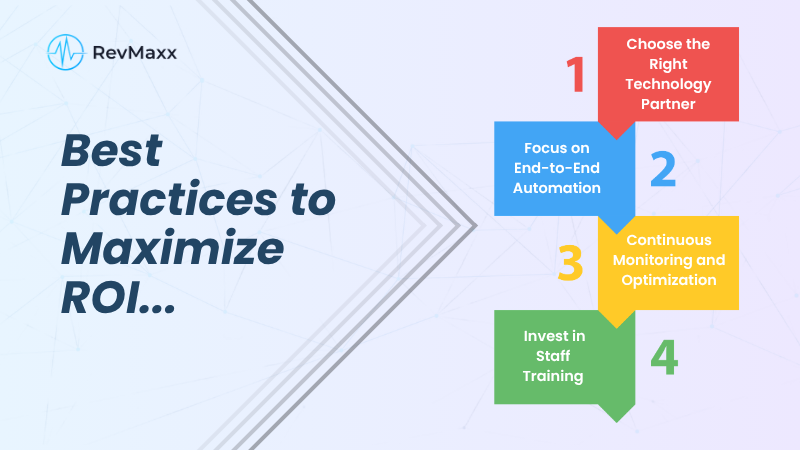
The key to maximizing value from digital transformation in medical billing is to follow best practices. Chronic misuse of technology will lead to ineffective usage, meaning many companies will fail to realize the potential from digital transformation.
Organisations that develop a plan of action that includes strategy, training, and continuous improvement are likely to achieve superior returns on investment than those without such a strategy. A report published by Deloitte indicated that organisations are twice as likely to meet their ROI targets when they have a proactive approach to managing their digital transformation initiatives (source: deloitte.com).
By taking the proper course of action, organizations will be able to create efficiencies, reduce costs, and improve their overall financial performance.
Choose the Right Technology Partner
Choosing the right technology partner is crucial for any organization engaged in digital transformation in medical billing. The level of performance, scalability, and security can vary greatly between different solutions; therefore, the best way to determine which solution is right for your healthcare organization is to consider whether the solutions being offered provide you with a flexible platform that can adapt to your changing needs.
AI-powered Revenue Cycle Management (RCM) solutions, like RevMaxx RCM automation are extremely effective because they automate a great deal of the complexity associated with these processes while providing you with real-time insights into how your revenue cycle is performing. A quality technology partner will have both high-quality customer service and regularly scheduled system updates.
When you partner with an appropriate partner, you will find that the medical billing implementation process is much easier; your systems are better integrated, and you will have long-term success within your medical billing operations.
Focus on End-to-End Automation
Many organizations find that partial automation creates fragmented processes resulting in only a portion of the overall benefit. To maximize the overall return on their investment, providers should concentrate on complete end-to-end automation of the entire billing cycle, which includes patient registration, eligibility verification, coding, claim submission, and payment posting. When all of the various pieces of the billing process work together, the flow of information will also be seamless, and errors will be greatly reduced.
End-to-end automation reduces delays and increases productivity at each step. It also allows for greater visibility into the revenue cycle enabling organizations to identify and address problems as they arise.
Continuous Monitoring and Optimization
Digital transformation is not something that just happens once; it’s an ongoing process. In order to achieve long-term ROI, you need to continually monitor your digital transformation and optimize your overall performance.
To make sure you’re continually optimizing your digital transformation and improving your ROI over time, healthcare providers should be regularly tracking key performance indicators (KPIs) such as denial rates, days in accounts receivable (A/R), and collection rates, as well as using analytics tools to track trends and make data-driven decisions.
For example, if a healthcare provider’s denial rates increase, they can quickly utilize analytics tools to perform root cause analysis on the increased denials so that they can take corrective actions. By doing this, providers will be able to maintain operational efficiency and achieve long-term success.
Invest in Staff Training
One of the biggest investments that businesses make is training employees in order to create a successful digital transformation. Although highly technical, even the most sophisticated solutions require knowledgeable users in order to function properly.
Employees participate in training programs that help them to understand how their jobs will be made easier and more efficient when they use digital tools instead of traditional methods.
By providing their employees with training, employees are able to better utilize the new system when it becomes available, and organizations will receive a return on investment for their technology purchase because the employees are able to implement what was learned during training into their workplace.
Future Trends in Digital Transformation in Medical Billing
Digital transformation in medical billing is evolving quickly as new technologies reshape how healthcare organizations manage revenue. The focus is shifting from basic automation to intelligent, data-driven systems that can predict, prevent, and optimize billing outcomes.
According to a report by Deloitte, over 75% of healthcare organizations are increasing investments in digital technologies, including AI and automation, to improve financial performance.
These advancements are not just improving efficiency—they are changing how billing teams operate. The future will focus on faster processing, fewer errors, and better patient experiences through smarter systems.
AI and Predictive Analytics
AI and predictive analytics are becoming key drivers of digital transformation in medical billing. These technologies analyze large volumes of data to identify patterns and predict outcomes. For example, AI can forecast which claims are likely to be denied based on past data and payer behavior.
This allows billing teams to fix issues before submission, reducing denial rates. AI also helps in revenue optimization by identifying missed charges and improving coding accuracy. According to McKinsey, AI could generate up to $150 billion annually in savings for the U.S. healthcare system.
By using predictive insights, providers can make smarter decisions and improve overall financial performance.
Automation and Touchless Billing
Automation is moving toward a “touchless” billing model, where most processes are completed without human intervention. In this approach, tasks like eligibility verification, claim submission, payment posting, and follow-ups are handled automatically by the system.
End-to-end automated workflows reduce manual effort and improve speed. This not only lowers administrative costs but also minimizes errors. According to industry reports, automation can reduce billing-related workload by up to 60–70%, allowing staff to focus on more strategic tasks.
Touchless billing represents the future of efficient and scalable revenue cycle management.
Interoperability and Data Integration
Interoperability is essential for the success of digital transformation in medical billing. It ensures that different systems, such as EHRs, billing platforms, and payer systems, can communicate seamlessly.
When data flows smoothly between systems, it reduces errors and improves efficiency. For example, patient information entered in the EHR can automatically populate billing systems, eliminating duplicate data entry.
According to HIMSS, improved interoperability can significantly enhance care coordination and reduce administrative burden.
Better integration also improves the patient experience by reducing billing errors and providing clear, accurate billing information.
The Conclusion
Medical billing is clearly benefiting from successful digital transformation. The ROI to healthcare providers is exceptional due to increased efficiency, diminished errors, expedited reimbursements, and greater revenue. The gains from digital transformation can be realized both quickly through improved claim processing and minimized administrative costs, and in the long run.
While there may be some initial capital outlay for implementing digital solutions, the long-term value of digital solutions will exceed the short-term costs. Providers that embrace digital solutions early will also benefit from being among the market leaders in financial performance and operational efficiency.
Smart technology adoption is necessary to be at the forefront of change in the healthcare industry. In order for providers to expedite their billing processes, reduce denials and increase their revenue, they should consider implementing AI-based RCM solutions such as RevMaxx. As a general rule, the sooner that organizations adopt digital transformation, the better positioned they will be for success in the future.