
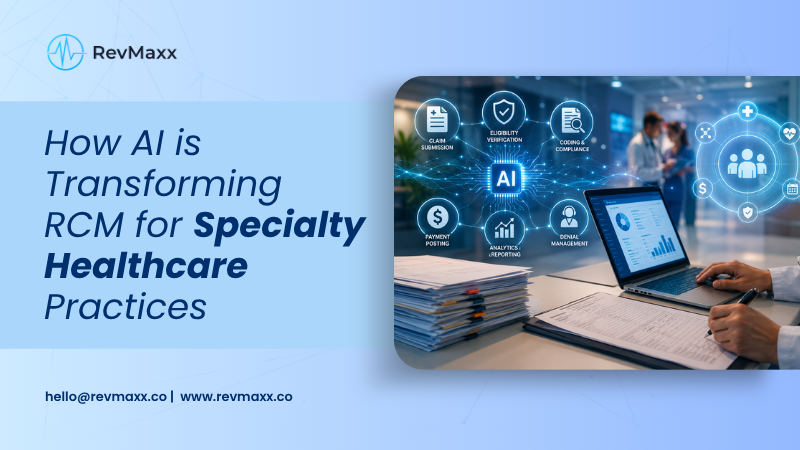
Revenue cycle management (RCM) has always been a critical part of healthcare operations. But for specialty practices, it is far more complex than general care. Providers are dealing with complicated billing rules, multiple payer requirements, and high-cost procedures. At the same time, delayed reimbursements and increasing claim denials are putting pressure on financial performance.
Many specialty practices report waiting 50 to 60 days or more to receive payments. This creates cash flow challenges and slows down operations. According to Experian Health, nearly 73% of providers say claim denials are increasing, making revenue collection even more difficult.
This is where AI RCM for specialty practices is creating a major shift. Providers are leveraging artificial intelligence to streamline their operations, reduce potential errors, and improve financial performance through automated processes. Instead of having to rely solely on manual processes, AI algorithms assist by analyzing large volumes of data, anticipating issues, and automatically initiating action in real-time.
AI is reforming each part of the Revenue Cycle Management (RCM), including coding verification, assessing patient eligibility, managing denials, and posting payments. This blog discusses how AI is solving long-standing challenges in RCM and helping specialized healthcare organizations become more efficient and profitable.
Let’s read this carefully.
Understanding RCM Challenges in Specialty Healthcare
Specialized healthcare practices have a far more stringent billing atmosphere than do primary care providers. The treatments themselves, such as how long each take, the methods used to document them, and the various payer policies, add to the complexity of managing the revenue cycle for specialty providers.
While these challenges can be operational challenges, they will impact the revenue generated from operations as well. Even a minor inefficiency could result in a payment delay or a loss of income.
Complex Coding and Billing Requirements
Specialty practices rely on highly detailed coding systems. Procedures in cardiology, oncology, orthopedics, and other specialties often require multiple CPT and ICD codes. Each code must be accurate and supported by proper documentation.
However, coding rules are constantly changing. Payers may have different requirements for the same procedure. This increases the risk of errors.
The American Medical Association states that one of the main reasons for claim rejection and payment delays is inaccurate coding in their medical documentation system. It is essential that there are no errors in the documentation; otherwise, you will experience delays or get the claim denied.
An example would be oncology therapy, where you need to document the dosage, how the drug was given, and that it was medically necessary. If you do not have all three pieces of information, then your claim will be denied. Specialty practices have trouble with manual coding because it is a complicated process and there is a lot of risk involved.
High Denial Rates and Claim Rejections
Claim denials continue to rise across the healthcare industry. For specialty practices, the impact is even greater because of high-value claims and strict payer rules.
A report from Change Healthcare found that nearly 1 in 10 claims are denied on the first submission, and many of these denials are preventable.
Denials can happen due to:
- Missing patient information
- Lack of prior authorization
- Incorrect coding
- Eligibility issues
Each denial requires rework, which increases administrative burden. It also delays payments and affects cash flow. In specialty care, where treatments are expensive, even a small increase in denial rates can lead to significant revenue loss.
Time-Consuming Administrative Workflows
RCM (Revenue Cycle Management) processes typically require a great deal of manual work by staff (i.e., data entry) that takes up much of their day performing tasks such as submitting claims and following up on those claims; this creates a slowdown in operations while increasing expenses. MGMA reported that 25% of total healthcare spending in the US goes towards administrative costs.
This percentage is likely to be much higher in specialty practices since the workflows tend to be more complex. Staff often have to manage prior authorizations, verify insurance information, and handle post-claim appeal processes for denied claims.
The result is not only a less efficient process but a greater likelihood of burning out on the part of employees because they spend more time performing administrative duties than providing direct patient care.
What is AI RCM for Specialty Practices?
Healthcare organizations’ revenue cycle management is being changed by the arrival of AI technology. Healthcare organizations are implementing automation capabilities as well as quicker processes and improvements in the technologies involved; therefore, bringing about a significant improvement in all processes compared to previously being done manually and with considerable time delays.
AI Revenue Cycle Management for Specialty Practices uses AI technologies (as opposed to manual processes) to manage billing, claims processing, and revenue collection.
These systems are designed to:
- Analyze historical data
- Identify patterns
- Predict outcomes
- Automate repetitive tasks
Instead of reacting to problems after they occur, AI helps prevent them before they happen.
For example, AI can flag a claim that is likely to be denied based on past data. This allows staff to fix the issue before submission.
Key Components of AI in RCM
AI-powered RCM systems use several technologies working together:
- Machine Learning (ML):
Learns from past claims and improves over time. It helps predict denials and optimize workflows. - Natural Language Processing (NLP):
Extracts useful information from clinical notes and converts it into structured data for billing. - Robotic Process Automation (RPA):
Handles repetitive tasks like data entry, eligibility checks, and claim submission.
These technologies work together to create a smarter and faster revenue cycle.
Why Specialty Practices Need AI-Powered RCM
Specialty practices deal with high complexity and high-value claims. Managing these manually is difficult and inefficient.
AI helps by:
- Reducing errors
- Improving speed
- Enhancing decision-making
Without AI, practices may struggle to keep up with increasing administrative demands and payer requirements.
Key Ways AI is Transforming RCM for Specialty Practices
The way that Artificial Intelligence (AI) transforms Revenue Cycle Management (RCM) processes within specialty healthcare settings provides a tangible and measurable benefit to providers.
By providing enhanced speed, accuracy, and intelligence across all phases of the RCM workflow, AI significantly reduces delays and improves the financial performance of specialty practices through advancements in technology-driven solutions for multiple points during the patient visit from the initial code through patient eligibility to denial management and payment posting.
Based on an Experian Health survey of providers who have deployed tools utilizing some form of artificial intelligence, >60% indicated that they have seen improvements in operational efficiencies since implementing these types of tools for RCM. The additional benefits associated with enhancing RCM processes will be important for specialty practices due to their increased complexity for billing.
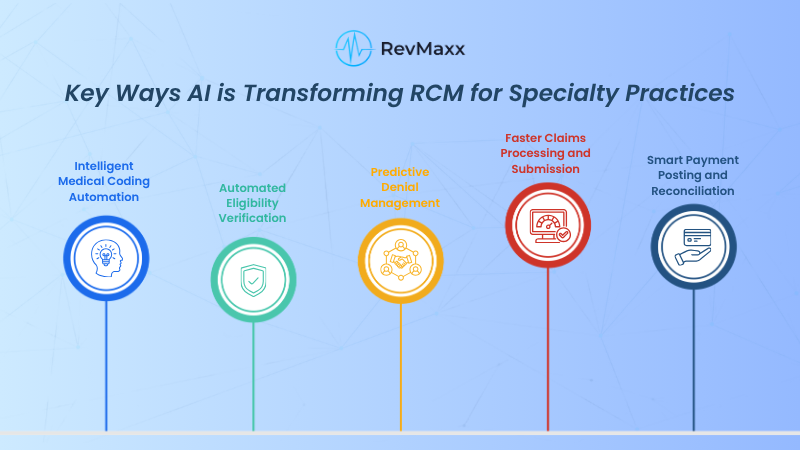
Intelligent Medical Coding Automation
The medical coding portion of revenue cycle management is one of the most complicated aspects of the revenue cycle management process, especially when it comes to specialty practices where multiple procedures require multiple codes and extensive documentation. By using AI-driven medical scribe tools to generate clinical notes and automatically suggest the accurate CPT and ICD code in ‘real time,’ you can reduce the number of errors made by humans, resulting in billing claims being accurately coded prior to the submission of claims.
AI also improves compliance by keeping coding aligned with the latest guidelines and payer requirements. According to a report by McKinsey, automation in coding can reduce errors by up to 30%, leading to fewer denials and faster reimbursements. This makes coding faster, more reliable, and less dependent on manual effort.
Automated Eligibility Verification
Eligibility verification is a critical first step in the revenue cycle. Errors at this stage often lead to claim denials later. AI-powered systems can instantly verify patient insurance details, including coverage, benefits, and authorization requirements.
This real-time validation ensures that correct information is captured before services are provided. It reduces front-end errors and improves the chances of claim approval. According to the Council for Affordable Quality Healthcare (CAQH), automation can save the healthcare industry billions annually by reducing manual eligibility checks. For patients, this also means fewer billing surprises and a smoother financial experience.
Predictive Denial Management
Denial management has traditionally been a reactive process. Staff review denied claims and try to fix them after submission. AI changes this approach by making it proactive.
AI systems analyze historical claim data and identify patterns that lead to denials. They flag high-risk claims before submission, allowing teams to correct errors early. This improves the first-pass claim acceptance rate and reduces rework.
According to Change Healthcare, up to 90% of claim denials are preventable, which shows the potential impact of predictive analytics. By preventing denials before they happen, AI helps specialty practices protect their revenue and reduce administrative workload.
Faster Claims Processing and Submission
The traditional, manual process of claim handling can be lengthy and require a good amount of manpower to enter new claims, validate them, and send them out in batches. By incorporating automation with the use of artificial intelligence (AI), repetitive tasks can be automated and expedite turn-around time for all claims by a substantial amount. Claims can be submitted much quicker (within hours rather than days), leading to a more efficient reimbursement process and ultimately better cash flow for health providers.
Deloitte reported that automating claim processing reduces processing time by 50%, which allows providers to increase operational efficiency. Also, by utilizing automation to process claims faster, there will also be fewer payment delays, which is especially critical to specialty practices that provide prosthetic or reconstructive surgery, which typically involves greater cost than other procedures.
Smart Payment Posting and Reconciliation
Posting and reconciling payments is a crucial aspect of revenue cycle management (RCM) that is frequently neglected. Many manual methods can cause mistakes, missing payments, or inaccurate entry.
Automated payment posting uses artificial intelligence (AI) technology to automate matching payments to claims and validate their accuracy, while also eliminating the need for manual work. In addition, AI will identify underpayments and payment discrepancies, thus enabling the provider to quickly make corrective action.
Automation improves both the accuracy of financial reporting and reduces the time needed to recognize revenue. Some industry estimates and reports state that, with proper automated payment posting procedures, an organization can reduce the amount of manual work associated with this aspect of RCM by 70%, resulting in qualified staff being available to perform more strategic tasks.
Benefits of AI RCM for Specialty Practices
The adoption of AI in RCM brings measurable benefits for specialty healthcare providers. It not only improves financial performance but also enhances operational efficiency and patient experience. By automating complex workflows and reducing errors, AI helps practices achieve better outcomes without increasing workload.
According to a report by Accenture, AI in healthcare could save up to $150 billion annually by 2026. This highlights the significant impact AI can have on revenue cycle management.
Increased Revenue and Reduced Leakage
Revenue leakage is a common issue in specialty practices. Missed charges, coding errors, and denied claims all contribute to lost income. AI helps capture these missed opportunities by ensuring accurate billing and reducing errors.
It also improves claim acceptance rates, which means providers get paid faster and more consistently. According to Experian Health, providers using AI-driven RCM solutions report significant reductions in denials and improved collections.
By minimizing revenue leakage, AI helps practices maximize their earnings without increasing patient volume.
Improved Operational Efficiency
AI reduces the need for manual work in RCM processes. Tasks like data entry, eligibility checks, and claim submission are automated, saving time and effort. This allows staff to focus on higher-value activities such as patient care and decision-making. It also reduces burnout, which is a growing concern in healthcare.
According to MGMA, automation can significantly improve productivity and reduce administrative costs. For specialty practices, this means smoother operations and better resource utilization.
Enhanced Accuracy and Compliance
Accuracy is critical in healthcare billing. Errors can lead to denied claims, audits, and financial penalties. AI ensures that claims are accurate and compliant with current regulations. It continuously updates coding rules and payer requirements, reducing the risk of non-compliance.
A study by the American Hospital Association highlights that compliance issues can cost providers millions in penalties. By improving accuracy, AI helps avoid these risks and ensures smooth operations.
Better Patient Financial Experience
Patient expectations are changing. They want clear, transparent, and timely billing. AI helps improve the patient’s financial experience by reducing errors and speeding up processes. Patients receive accurate bills, faster claim processing, and better communication about costs.
This builds trust and improves satisfaction. According to a survey by InstaMed, over 75% of patients prefer clear and upfront billing information. AI helps meet these expectations effectively.
Real-World Use Cases of AI in Specialty RCM
AI is not just a concept—it is already being used in real-world specialty practices. Different specialties have unique billing challenges, and AI helps address them effectively.
Cardiology Practices
Cardiology involves high-volume diagnostic tests and procedures, each requiring accurate coding and documentation. AI RCM for cardiology pracrtices helps streamline these processes by automating coding and verifying eligibility in real time.
It also speeds up prior authorizations, which are often required for cardiac procedures. This reduces delays and improves claim approval rates. As a result, cardiology practices can handle higher volumes without increasing administrative workload.
Primary Care Practices
Primary care practices manage a high number of patient visits every day. As a result, this creates a huge pressure on the healthcare RCM process. Appointment scheduling, insurance verification, coding, claim submission, and payment follow-ups can become time-consuming if handled manually.
AI RCM for primary care practices helps streamline these activities by reducing repetitive work and improving process accuracy. It can identify missing information before claim submission, support better coding workflows, and flag potential claim issues early, helping primary care providers reduce denials and improve reimbursement cycles.
Dermatology Practices
Dermatology practices often handle a mix of medical, cosmetic, and procedural services. This can make the billing and reimbursement process more complex. Different treatment processes may have different documentation and insurance requirements. So, there is a huge chance of coding errors and denials of claims.
AI RCM for dermatology practices helps in improving revenue cycle workflows by supporting accurate coding, identifying missing claim information, and reducing manual workload. This can help dermatology practices process claims more efficiently, lower denial rates, and maintain a smoother reimbursement process.
Challenges of Implementing AI in Specialty RCM
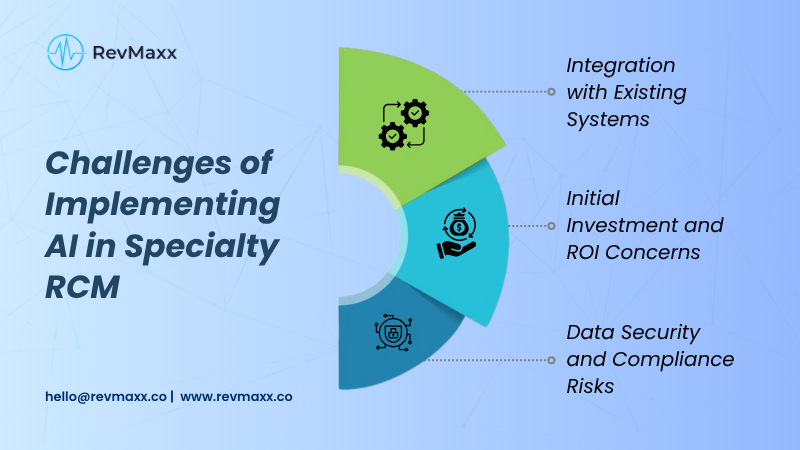
While AI offers many benefits, implementing it in specialty practices comes with challenges. Providers need to address these issues to ensure successful adoption.
Integration with Existing Systems
Many healthcare organizations still use legacy EHR and billing systems. Integrating AI solutions with these systems can be complex. Data migration is another challenge, as practices need to ensure that existing data is transferred accurately.
Without proper integration, the full benefits of AI cannot be realized. This makes it important to choose solutions that are compatible with current systems.
Initial Investment and ROI Concerns
AI solutions require an upfront investment in technology and training. This can be a concern for smaller practices.
However, the long-term benefits often outweigh the costs. Improved efficiency, reduced denials, and faster payments lead to higher revenue over time. According to Deloitte, organizations that adopt automation see significant ROI within the first year.
Data Security and Compliance Risks
Healthcare data is highly sensitive and must be protected. AI systems must comply with regulations such as HIPAA to ensure patient privacy. Data breaches can lead to financial losses and damage to reputation.
Study says, the average cost of a healthcare data breach is $10.93 million, the highest among all industries. This makes security and compliance a top priority when implementing AI in RCM.
Best Practices for Adopting AI RCM for Specialty Practices
Adopting AI in revenue cycle management is not just about technology—it requires the right strategy, planning, and execution. Specialty practices must ensure that AI tools are aligned with their workflows and business goals. Without a structured approach, even the best AI solutions may fail to deliver expected results. According to a McKinsey report, nearly 70% of digital transformation projects fail due to poor implementation strategies. This highlights the importance of following best practices when implementing AI RCM for specialty practices to achieve long-term success.
Choose the Right AI-Powered RCM Solution
Selecting the right AI solution is the first and most important step. Specialty practices should look for platforms that are designed specifically for their field, whether it is cardiology, oncology, or orthopedics. These solutions must support specialty-specific coding, payer rules, and workflows.
Scalability is also critical. As the practice grows, the AI system should be able to handle increased patient volume and billing complexity. Customization is equally important, as every practice has unique needs.
A study says organizations that choose scalable digital solutions are 2.5 times more likely to achieve better ROI. Choosing the right solution ensures long-term value and smoother operations.
Train Staff and Ensure Smooth Adoption
Even the most advanced AI tools will not be effective if staff are not trained properly. Training ensures that employees understand how to use the system and trust its recommendations.
A strong onboarding process helps teams adapt to new workflows without confusion or resistance. Continuous training is also important, as AI systems evolve over time.
According to study, organizations that invest in employee training see up to 37% higher productivity. For specialty practices, this means faster adoption, fewer errors, and better overall performance.
Monitor Performance and KPIs
After implementing AI, it is important to track performance regularly. Key performance indicators (KPIs) such as denial rates, days in accounts receivable (AR), and revenue growth provide insights into how well the system is working.
Monitoring these metrics helps identify areas for improvement and ensures continuous optimization. AI systems also provide real-time analytics, making it easier to make data-driven decisions.
According to HFMA, organizations that actively track KPIs can improve revenue cycle performance by up to 15–20%. Continuous monitoring ensures that AI delivers consistent value over time.
The Conclusion
The healthcare industry is becoming more complex, and traditional RCM methods are no longer enough to keep up. Specialty practices face increasing challenges such as higher denial rates, complex billing requirements, and rising administrative costs.
AI RCM for specialty practices offers a powerful solution to these challenges. It improves accuracy, reduces errors, speeds up processes, and enhances financial performance. Practices that adopt AI gain a strong competitive advantage by improving efficiency and delivering better patient experiences.
To stay ahead in a competitive healthcare environment, adopting AI is no longer optional—it is essential. Solutions like RevMaxx RCM automation can help specialty practices streamline workflows, improve revenue outcomes, and build a more sustainable future.