
Healthcare organizations do not lose revenue only because of denied claims or delayed payments. In many cases, the real problem starts much earlier. A small registration error, a missed authorization, a coding gap, or slow follow-up can quietly slow down the entire revenue cycle. These hidden delays are what many teams experience as RCM bottlenecks. Over time, they increase rework, raise staff pressure, slow reimbursements, and create avoidable financial stress.
The challenge is that most of these issues are not one-time mistakes. They are repeated workflow problems. And when payer rules keep changing, staffing stays tight, and patient financial responsibility keeps rising, manual processes struggle to keep up. That is why more providers are turning to AI—not as a replacement for people, but as a smarter way to reduce delays, improve accuracy, and protect revenue. According to an MGMA Stat poll, 36% of medical practice leaders said their organizations planned to outsource or automate part of RCM in 2025, showing how strong operational pressure is shaping revenue cycle decisions.
What Are RCM Bottlenecks and Why Do They Matter?
RCM bottlenecks are points in the revenue cycle where work gets delayed, stuck, or repeatedly sent back for correction. These delays can happen before a patient is seen, while a claim is being built, or long after a bill has already gone out. In healthcare, even one slow step can affect many others. A missed field during registration can become a rejected claim. A delayed authorization can become a missed payment. A coding gap can become a denial or compliance issue.
These bottlenecks matter because they do not stay isolated. They spread across the workflow. A small front-end issue can become a back-end revenue problem weeks later. That means RCM teams often spend more time fixing avoidable errors than improving financial performance. HFMA notes that denials and rework create significant pressure on cost-to-collect and financial sustainability, which is why organizations need stronger process visibility and prevention strategies.
How RCM Bottlenecks Impact Financial Performance
When revenue cycle workflows slow down, the financial effect is rarely small. Delayed claims mean delayed cash. Incorrect claims mean denials. Poor follow-up means balances stay open longer than they should. As these issues build up, practices often see higher A/R days, slower collections, and more staff hours spent on correction work instead of productive billing activity.
The cost is not only operational. It also affects planning and stability. If reimbursement becomes unpredictable, it becomes harder for a healthcare organization to manage staffing, technology, and growth. HFMA reports that initial claim denials have been rising and that even when many of those claims are eventually paid, the delay still drains time, money, and team capacity. That is exactly why RCM bottlenecks should be treated as a financial strategy issue, not just a billing issue.
Why Traditional RCM Workflows Struggle to Keep Up
Traditional RCM processes depend heavily on human review, manual checks, payer portal lookups, and repeated follow-up. That may have worked better when systems were simpler. But today’s revenue cycle is much more fragmented. Teams are dealing with payer-specific rules, documentation requirements, coding updates, prior auth burdens, patient balance collection, and disconnected systems—all at the same time.
At the same time, staffing remains a real challenge. MGMA reported in 2024 that many medical groups were still facing staffing hurdles while trying to maintain or grow patient volumes. When teams are stretched thin, backlogs grow faster. That creates the perfect conditions for RCM bottlenecks to become a daily operational problem. Manual workflows are not just slower now—they are harder to sustain consistently at scale.
Why AI Is Becoming Essential in Modern Revenue Cycle Management
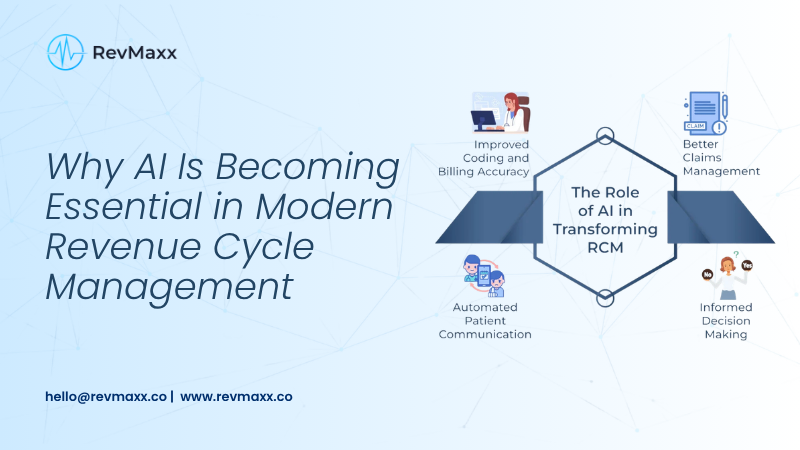
AI is becoming important in RCM because it helps healthcare teams move from reactive work to proactive work. Instead of waiting for a claim to be denied, AI can flag risk earlier. Instead of manually checking every record, AI can identify where attention is actually needed. This is especially useful in workflows where the same errors happen again and again.
The biggest value of AI in RCM is not speed alone. It is consistency. AI can review patterns, detect missing data, route tasks, prioritize worklists, and surface exceptions that humans may miss when they are overloaded. That matters because the modern revenue cycle is full of repetitive tasks that still require judgment. AI helps reduce that pressure. It gives staff more time to focus on higher-value work while helping organizations address RCM bottlenecks before they grow into costly delays.
What AI Can Actually Do in the RCM Workflow
In practical terms, AI can support many parts of the revenue cycle. It can validate patient data, check for missing fields, review claim completeness, identify denial patterns, and prioritize follow-up queues. In coding workflows, it can help review documentation and flag incomplete clinical details. In collections, it can support smarter outreach and prioritization.
This matters because most RCM teams do not need more dashboards. They need fewer avoidable errors. AI works best when it reduces repetitive friction. It can help clean up data earlier, catch risk before submission, and direct team attention where it matters most. That is why AI is increasingly being used not as a standalone “innovation” project, but as a practical tool for reducing RCM bottlenecks across daily operations.
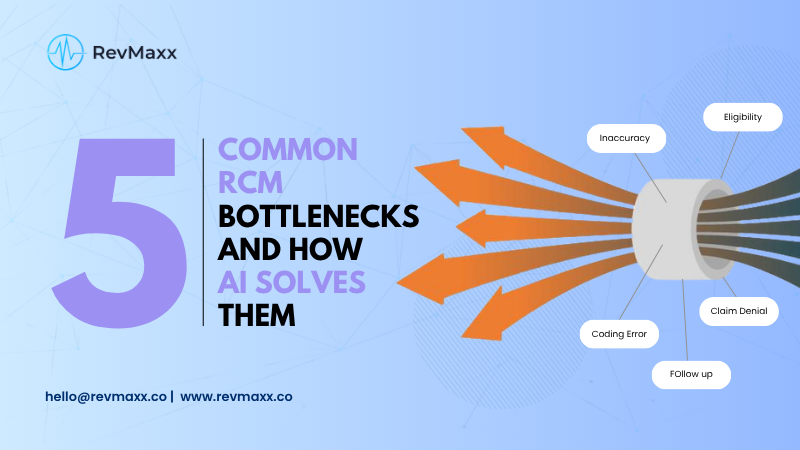
5 Common RCM Bottlenecks and How AI Solves Them
Most revenue cycle problems are not random. They tend to show up in the same stages again and again. That is actually good news, because predictable bottlenecks can be fixed. The key is knowing where they happen and why they keep returning. Once those pressure points are visible, AI can often improve performance without forcing a full workflow rebuild.
Below are five of the most common RCM bottlenecks healthcare organizations face today. Each one affects reimbursement, staff workload, and patient experience in a different way. But they all have one thing in common: when handled manually, they create expensive delays. When handled intelligently, they become much easier to manage.
Bottleneck #1 – Incomplete or Inaccurate Patient Registration
The revenue cycle often starts breaking before a claim even exists. Front-end intake is one of the most overlooked sources of RCM bottlenecks. If demographic details are wrong, insurance information is incomplete, or patient records are duplicated, the error does not stay at the front desk. It follows the account through the rest of the workflow.
This is why registration accuracy matters so much. A misspelled name, wrong member ID, or missing policy detail may seem small in the moment, but it can lead to claim rejection, delayed verification, or patient billing confusion later. These are not rare events. They are common, repeatable workflow failures that quietly create downstream rework and revenue leakage. HFMA has emphasized that data integrity across the patient revenue cycle is critical to reducing denials and avoiding preventable waste.
Why Registration Errors Create Bigger Downstream Problems
Once bad data enters the system, it becomes much harder to fix later. Staff may not discover the problem until the claim is rejected or the patient receives a confusing bill. By then, the issue is no longer a quick correction. It becomes a multi-step rework problem involving front desk staff, billers, and sometimes the patient.
That is why front-end mistakes are such expensive RCM bottlenecks. They create avoidable friction across eligibility, claim creation, payment posting, and patient collections. The longer the error stays hidden, the more time and money it costs. Clean data at the beginning of the patient journey does more than improve accuracy. It protects the rest of the revenue cycle from unnecessary downstream damage.
How AI Solves Front-End Data Capture Issues
AI can improve registration workflows by checking data as it is entered instead of after the damage is done. It can flag missing fields, identify likely duplicate records, compare demographic inconsistencies, and support real-time verification of intake details. This reduces the chance that bad data will travel deeper into the billing process.
This is one of the clearest ways AI helps reduce RCM bottlenecks. Rather than forcing teams to correct errors after a rejection or denial, AI helps prevent those errors at the source. That improves first-pass claim quality and reduces avoidable cleanup work later. For high-volume practices, even small gains in front-end accuracy can create a meaningful impact on clean claims and staff efficiency.
Example Use Cases for AI at Registration
In a real workflow, AI can support registration in several practical ways. It can read insurance cards, extract patient data from digital intake forms, and compare entries against expected payer or demographic patterns. It can also prompt staff when required information is missing before the visit moves forward.
These small workflow improvements matter because they reduce preventable handoffs and interruptions. They also improve the patient experience by lowering the chance of billing confusion later. For organizations trying to eliminate RCM bottlenecks, registration is often one of the fastest and most valuable places to start because the financial impact touches almost every step after it.
Bottleneck #2 – Insurance Eligibility and Prior Authorization Delays
Eligibility checks and prior authorizations are two of the most frustrating parts of the revenue cycle. They are also among the most common RCM bottlenecks. If insurance is not verified correctly, or if authorization is missed before care is delivered, payment problems often follow. These delays do not just affect billing. They also affect scheduling, patient communication, and access to care.
This pressure is very real across healthcare. The AMA reported that physicians complete an average of 39 prior authorizations per physician per week, and doctors and staff spend nearly two business days each week on those tasks. In its 2024 survey reporting, the AMA also found that 93% of physicians said prior authorization delays necessary care, while 82% said it can lead patients to abandon treatment. That shows how deeply this one workflow issue affects both revenue and patient outcomes.
Why Eligibility and Authorization Errors Hurt Revenue
When coverage is not confirmed properly, organizations often deliver care without a clear payment path. That can lead to denials, appeals, rebilling, or patient collections problems later. The administrative burden is high, but the financial risk is even higher because the issue often surfaces only after services have already been rendered.
This is why eligibility and authorization remain such stubborn RCM bottlenecks. They create friction before the claim is even built, yet the cost often shows up much later in denials, delayed reimbursement, or lost collections. When staff are managing these tasks manually across portals, faxes, and payer-specific rules, inconsistency becomes almost impossible to avoid.
What to Highlight in the AI Solution Angle
The strongest message here is that AI supports prevention. It does not simply speed up paperwork but also helps the team identify which services are likely to require authorization, which records are incomplete, and which requests need urgent attention. That means fewer missed steps and fewer avoidable revenue delays.
For healthcare leaders, this matters because prior auth delays are not only a staffing problem. They are also a patient access and reimbursement problem. Reducing these RCM bottlenecks improves operational flow, lowers rework, and protects revenue before the claim ever reaches adjudication.
Bottleneck #3 – Coding Errors and Documentation Gaps
Coding is one of the most sensitive parts of the revenue cycle because it directly affects how services are represented, reimbursed, and audited. When documentation is incomplete or codes do not fully reflect the visit, the result can be underpayment, denial, or compliance risk. That makes coding-related delays one of the most expensive RCM bottlenecks in healthcare.
The challenge is that coding teams often work under pressure. Providers may document quickly, coders may review high chart volumes, and payer expectations may vary by service line. In that environment, small omissions can create large downstream consequences. Missing specificity, incomplete notes, and unsupported codes all increase the likelihood of rework. Over time, this affects not only reimbursement but also trust in the consistency of the revenue cycle.
Common Causes of Coding Bottlenecks
Coding bottlenecks usually come from one of two places: missing clinical detail or delayed review. In many organizations, provider notes are complete enough for care, but not complete enough for billing. That gap creates extra back-and-forth between coders and clinicians, which slows claims and increases manual review time.
These delays are especially costly because they are often repeated at scale. If the same documentation pattern keeps creating coding uncertainty, the organization is not dealing with isolated mistakes. It is dealing with a recurring operational weakness. That is exactly how RCM bottlenecks grow—through patterns that teams are too busy to fix at the root.
How AI Supports Coding Accuracy and Documentation Quality
AI can support coding by reviewing clinical notes, identifying likely documentation gaps, and surfacing coding suggestions for human review. It can also help teams catch incomplete or inconsistent information before the claim goes out. That does not remove the need for expert oversight, but it can reduce repetitive review work and improve consistency.
This is where AI becomes especially valuable in reducing RCM bottlenecks. Instead of waiting until a claim is denied or downcoded, organizations can strengthen documentation and coding quality earlier in the workflow. Better front-end coding accuracy improves charge capture, reduces preventable denials, and lowers the amount of rework required after submission.
AI’s Role in Reducing Revenue Leakage from Coding
A major revenue cycle problem is not always a visible denial. Sometimes it is silent underpayment. If services are not coded completely or accurately, organizations may never recover the full value of the care they delivered. That is a quieter form of revenue leakage, but still a costly one.
AI helps reduce this risk by improving consistency and surfacing missed opportunities earlier. That means more complete documentation, stronger charge capture, and fewer preventable payment losses. For healthcare teams trying to reduce RCM bottlenecks, coding improvement is not only about compliance. It is also about protecting earned revenue.
Bottleneck #4 – Claim Submission Errors and High Denial Rates
Denials remain one of the most visible and expensive RCM bottlenecks in healthcare. They slow payment, increase labor costs, and create unnecessary friction between providers and payers. Many denied claims are eventually paid, but that does not make them harmless. Every denial adds extra work, delays cash flow, and increases the chance that some revenue will never be recovered at all.
Recent data shows how serious this problem has become. HFMA reported that initial claim denials climbed to nearly 12% in 2024 based on Kodiak Solutions data, with a 2.4% year-over-year increase. HFMA also noted that even though many initially denied claims are eventually paid, the rework still creates a major burden on provider resources and slows cash flow. That is exactly why denial prevention is now a top focus area in revenue cycle improvement.
Why Denials Create a Major Revenue Drain
A denied claim is not just a delayed payment. It is a new task. Someone has to investigate it, correct it, resubmit it, and often follow up on it again. Multiply that across hundreds or thousands of claims, and denials quickly become one of the most labor-intensive RCM bottlenecks in the system.
The financial cost is only part of the issue. Denials also create operational drag. Staff attention gets pulled away from proactive work and redirected toward correction. That lowers overall efficiency and makes it harder for teams to improve other parts of the revenue cycle. In many organizations, denials are not simply a payer issue. They are a symptom of upstream workflow weakness.
How AI Helps Prevent Denials Before They Happen
AI helps most when it is used before claim submission. It can review claim data, identify patterns associated with prior denials, and flag high-risk claims for correction before they go out. That is a much more efficient approach than waiting for denial notices and starting rework after the fact.
This predictive layer is what makes AI so valuable in reducing RCM bottlenecks. It turns denial management into denial prevention. Instead of asking teams to manually review every claim equally, AI helps them focus on the ones most likely to fail. That improves clean claim rates, reduces unnecessary resubmissions, and helps revenue teams move faster with fewer avoidable interruptions.
What Makes Predictive Denial Prevention Valuable
Predictive denial prevention matters because it changes the timing of intervention. Problems caught before submission are cheaper and easier to fix than problems caught after rejection or denial. That reduces both financial waste and team frustration.
For organizations dealing with repeated payer edits or recurring submission issues, this is one of the clearest ways AI can reduce RCM bottlenecks. It creates a cleaner workflow at the point where claims are still fixable, which is where the strongest ROI usually lives.
Bottleneck #5 – Slow Follow-Up on Outstanding A/R and Unpaid Claims
Submitting a claim is not the finish line. A large amount of revenue gets delayed because unpaid claims are not followed up on fast enough or in the right order. This is one of the most common but least visible RCM bottlenecks. Teams may have the claims in the system, but if worklists are too large or priorities are unclear, balances sit longer than they should.
This issue becomes worse when every unpaid account is treated the same. Some claims need immediate action. Others have low recovery value. Without a smart prioritization system, staff often spend time on the wrong accounts while high-value claims continue to age. That leads to slower collections, missed appeal windows, and avoidable write-offs—especially in understaffed teams already managing heavy backlogs.
Why Manual A/R Follow-Up Often Fails
Manual A/R follow-up fails not because teams are careless, but because the volume is too high for equal attention. Staff are often working from spreadsheets, static work queues, or generalized aging lists that do not reflect urgency or recovery potential. That makes it hard to know which account deserves action first.
This creates a classic revenue cycle traffic jam. Claims that could be resolved quickly may wait too long, while lower-value accounts consume unnecessary effort. That is how A/R follow-up becomes one of the most stubborn RCM bottlenecks. The process is not always broken. It is often just not prioritized intelligently enough.
How AI Prioritizes A/R Recovery More Effectively
AI can help by ranking unpaid claims based on urgency, payer behavior, aging risk, and likely recovery value. That means teams can focus first on the claims most likely to impact cash flow instead of chasing every account in the same order.
This is one of the clearest examples of AI helping teams work smarter rather than simply faster. Better prioritization reduces wasted effort and improves recovery timing. For organizations trying to reduce RCM bottlenecks, smarter A/R follow-up can create immediate financial impact because it targets one of the last major friction points before revenue is fully realized.
Strong Messaging Angle for This Section
The key message here is simple: not every unpaid claim deserves the same attention. AI helps revenue teams separate noise from opportunity. That means less time lost in low-yield follow-up and more focus on accounts that can actually move cash.
For leaders trying to improve financial performance without adding headcount, this matters a lot. Better A/R prioritization reduces avoidable delay and turns one of the most manual RCM bottlenecks into a more strategic workflow.
Key Signs Your Organization Is Struggling with RCM Bottlenecks
Sometimes organizations know they have revenue cycle issues, but they do not know exactly where the real pressure points are. That is why recognizing the warning signs matters. Most RCM bottlenecks show up in patterns before they show up in financial reports. If teams know what to watch for, they can intervene earlier and more effectively.
Some warning signs are operational, while others are financial. The most important thing is not to look at them in isolation. Rising denials, slower collections, staff frustration, and rework volume often point back to the same root problem: too much preventable friction in the workflow.
Operational Warning Signs to Watch For
Operationally, some of the clearest signs include repeated claim corrections, frequent payer follow-up, staff complaints about backlog, delayed coding turnaround, and growing work queues in registration, billing, or A/R. If teams feel like they are always fixing the same types of problems, that is usually not random. It is a signal of recurring RCM bottlenecks.
These signs matter because they often appear before leadership sees the full financial impact. Workflow friction tends to become “normal” over time. But once delays become routine, revenue cycle performance starts slipping quietly in the background.
Financial Warning Signs to Watch For
On the financial side, warning signs often include rising A/R days, unpredictable cash flow, increasing write-offs, missed collection targets, and growing denial-related rework costs. HFMA and MGMA both continue to point toward revenue cycle pressure as a major area of concern for healthcare organizations.
If these trends are rising together, the organization likely is not dealing with one isolated issue. It is likely dealing with multiple connected RCM bottlenecks that are affecting the full reimbursement timeline.
How to Start Fixing RCM Bottlenecks with AI
The good news is that organizations do not need to rebuild the entire revenue cycle to start improving it. Most RCM bottlenecks can be reduced by targeting the stages where delays happen most often. That usually means looking at where work gets stuck, where rework repeats, and where payer-related errors are most common.
AI works best when it is applied to specific workflow pain points rather than treated like a broad transformation slogan. That is why the smartest first step is not “buy AI.” It is “identify where the current process keeps failing.” Once that is clear, the right automation and intelligence layer becomes much easier to choose.
Start by Identifying the Highest-Impact Bottlenecks
The best starting point is operational visibility. Review denial trends, A/R aging, registration correction rates, coding turnaround time, authorization delays, and staff workload concentration. The goal is to find where friction repeats most often and where the financial cost is highest.
This approach matters because not all RCM bottlenecks have equal impact. Some are annoying but low-cost. Others quietly delay a large amount of revenue every month. AI delivers the strongest ROI when it is applied where repeated workflow failure is already measurable.
Choose AI Tools That Fit Into Existing RCM Workflows
The right AI solution should support existing workflows, not disrupt them. That is where RevMaxx RCM Automation stands out from the crowd. If a tool creates more manual work, adds another disconnected dashboard, or fails to integrate with core systems, it can become another bottleneck instead of solving one.
Healthcare teams need AI that improves visibility, prioritization, and prevention, and RevMaxx delivers exactly that. With intelligent automation support for eligibility checks, claim scrubbing, denial prediction, and follow-ups, it helps healthcare billing teams focus on high-impact tasks while reducing errors and delays. The platform is built to be practical, measurable, and easy to adopt, ensuring minimal disruption during implementation.
RevMaxx RCM automation solution reduces bottlenecks, accelerates reimbursements, and strengthens clinical revenue.
Important Questions to Ask Before Implementing AI in RCM
Before implementing any AI solution, organizations should ask a few practical questions. Does it integrate with the current billing or EHR workflow? Does it reduce rework or simply move it elsewhere? Can it help prevent denials or improve collections in a measurable way?
These questions matter because AI should solve a workflow problem, not just add a new technology layer. The strongest AI investments, like RevMaxx RCM automation, are the ones that reduce real RCM bottlenecks and create visible operational and financial improvement over time.
Let’s read our previous blog to learn how RCM automation is transforming the clinical revenue cycle.
The Conclusion
Most healthcare organizations do not have a revenue problem because they are not working hard enough. They have a revenue problem because too much of their hard work gets slowed down by friction. Registration issues, authorization delays, coding gaps, denials, and weak follow-up are some of the most common RCM bottlenecks, and they are also some of the most fixable.
AI does not solve everything. But it does help organizations prevent avoidable errors, improve workflow consistency, and recover revenue faster. In a healthcare environment where margins are tight and staff are stretched, that is no longer optional. It is becoming essential.