
Revenue cycle management has always been complex. But today, it is no longer just about submitting claims and waiting for payment. Providers now deal with stricter payer rules, prior authorizations, coding complexity, patient payment responsibility, and staff shortages. The old way of handling all this manually is becoming harder to sustain.
This is where AI is making a real difference.
AI RCM Automation helps healthcare organizations improve billing accuracy, reduce denials, speed up reimbursements, and lower the administrative burden across the entire revenue cycle. It allows teams to move from reactive billing work to smarter, more proactive revenue management.
According to the CAQH Index, the healthcare industry continues to save billions annually through the adoption of electronic administrative transactions, while still having over $20 billion in additional savings potential by further automating manual workflows.
In this blog, we will break down what AI RCM automation really means, how it works, where it creates the biggest impact, and why it is changing the future of healthcare finance.
What Is AI RCM Automation?
AI RCM automation refers to the use of artificial intelligence, machine learning, predictive analytics, and workflow automation tools to improve how healthcare organizations manage their revenue cycle.
In simple terms, it helps providers get paid more accurately and more quickly.
Instead of relying only on manual processes, spreadsheets, rule-based edits, and staff follow-up, AI can identify patterns, detect risks, automate repetitive work, and recommend the next best action. This makes the revenue cycle faster, cleaner, and easier to manage.
AI does not just automate tasks. It also adds intelligence to the process.
For example, it can:
- Flag missing insurance information before a claim is sent
- Predict which claims are likely to be denied
- Identify coding mismatches
- Prioritize unpaid high-value claims
- Detect trends that are hurting collections
That is why many healthcare leaders are no longer seeing AI as a future concept. They are seeing it as a practical tool for fixing today’s revenue problems.
What Is Revenue Cycle Management in Healthcare?
Before understanding the role of AI, it helps to understand what healthcare revenue cycle management actually covers.
Revenue Cycle Management, or RCM, includes all the financial and administrative steps involved in getting a provider paid for care delivered.
This usually includes:
- Patient scheduling
- Registration
- Insurance eligibility verification
- Prior authorization
- Medical coding
- Charge capture
- Claim submission
- Payment posting
- Denial management
- Patient billing
- Collections
Every one of these steps affects whether a provider gets paid fully, partially, or late.
If patient data is entered incorrectly, eligibility is missed, documentation is incomplete, or coding is off, the problem often shows up later as a denial or delayed reimbursement. That means one small front-end issue can create major financial consequences downstream.
This is exactly why healthcare organizations are focusing more on automation. The revenue cycle is too connected and too high-stakes to run inefficiently.
How AI RCM Automation Is Different From Traditional RCM
Traditional revenue cycle management depends heavily on human effort. Staff members manually review claims, verify eligibility, track denials, correct errors, and follow up with payers. While experienced teams are essential, manual systems alone are often slow and difficult to scale.
AI changes that.
Instead of waiting for issues to happen, AI can help identify and prevent them earlier.
Here is the difference:
Area | Traditional RCM | AI-Powered RCM |
Workflow Type | Mostly manual or rule-based processes | Intelligent, automated, and data-driven workflows |
Processing Speed | Slower due to manual reviews and repetitive tasks | Faster processing through automation and real-time decision support |
Error Handling | Higher risk of human errors in data entry, coding, and claims workflows | Detects and flags errors early to improve billing accuracy |
Claims Follow-Up | Often delayed because teams work through large queues manually | Prioritizes urgent claims and enables faster, smarter follow-up |
Visibility Into Revenue Issues | Limited visibility into where revenue is getting stuck | Better visibility into bottlenecks, denials, and payment delays |
Pattern Recognition | Difficult to identify repeated denial or payer trends manually | Uses AI to recognize recurring patterns and hidden revenue risks |
Real-Time Alerts | Issues are often discovered only after claims are denied or delayed | Provides real-time alerts for missing data, claim risks, and workflow issues |
Workflow Prioritization | Staff often work claims in fixed or outdated queue order | Helps teams focus first on high-value, high-risk, or time-sensitive claims |
Denial Prevention | Mostly reactive, with teams fixing denials after they happen | Predicts likely denials before submission and supports prevention |
Payment Risk Prediction | Limited ability to forecast reimbursement issues | Identifies claims and accounts at risk for delayed or reduced payment |
Staff Efficiency | More time spent on repetitive administrative work | Frees staff to focus on appeals, revenue recovery, and strategic work |
The shift is important because healthcare revenue problems are rarely caused by just one thing. They are caused by patterns. AI is good at finding those patterns quickly and at scale.
That means providers can stop spending all their time fixing the same problems over and over.
Why Healthcare Organizations Are Turning to AI Now
The move toward AI RCM automation is not happening just because AI is popular. It is happening because healthcare operations are under strain.
Administrative complexity has become one of the biggest hidden costs in healthcare. Teams are being asked to do more with fewer people, while payer requirements keep getting more difficult to manage.
Prior authorization is a good example. According to the American Medical Association, physicians complete an average of nearly 39 prior authorizations per week, with physicians and staff spending around 12–13 hours weekly managing these requests. Additionally, 95% of physicians report that prior authorization contributes to burnout, highlighting the growing administrative strain on healthcare teams.
At the same time, claims performance is becoming harder to maintain.
According to Experian Health’s State of Claims Survey, 41% of providers report denial rates of 10% or higher, more than half say claim errors are increasing, and nearly 7 in 10 report that submitting clean claims has become more challenging.
That combination of rising administrative burden and weaker financial performance is exactly what makes AI so relevant right now.
Healthcare organizations need tools that do more than automate tasks. They need tools that help prevent revenue loss before it happens.
How AI RCM Automation Works Across the Revenue Cycle
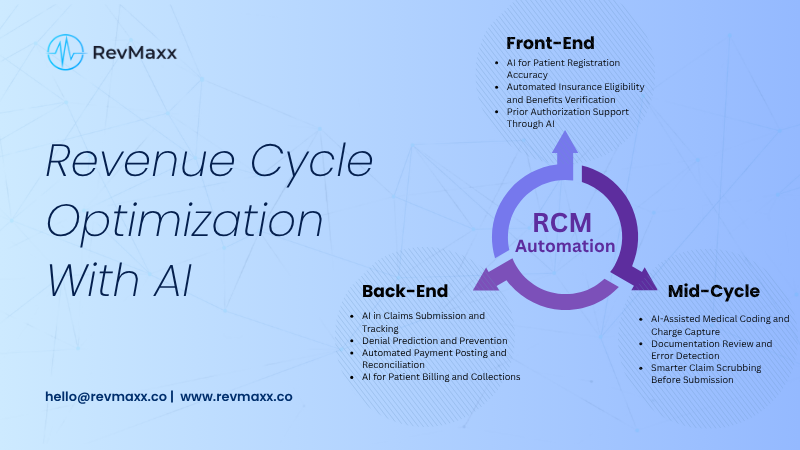
The real value of AI RCM automation becomes clear when you look at how it supports the full revenue cycle, not just one part of it.
AI can improve front-end, mid-cycle, and back-end workflows. And because the revenue cycle is connected, gains in one area often improve results in others.
Let’s walk through where AI creates the biggest impact.
Front-End Revenue Cycle Optimization With AI
The front end of the revenue cycle is where many billing problems begin. If patient data, insurance details, or authorization requirements are missed early, the claim may never have a fair chance of being paid correctly.
AI helps reduce those early breakdowns.
AI for Patient Registration Accuracy
Patient registration may seem basic, but it has a direct impact on claim quality.
When names, dates of birth, insurance IDs, subscriber details, or demographic fields are entered incorrectly, claims can be rejected or delayed before they even reach adjudication.
AI helps by:
- Checking registration fields for inconsistencies
- Flagging missing or invalid patient information
- Identifying duplicate or mismatched records
- Improving data quality at intake
This reduces rework for billing teams later and supports cleaner claims from the start.
Better front-end accuracy also means fewer frustrating billing issues for patients, which improves the overall patient financial experience.
Automated Insurance Eligibility and Benefits Verification
Eligibility errors are one of the most common and costly front-end issues in healthcare billing.
If coverage is inactive, benefits are misunderstood, or payer details are wrong, claims can bounce back quickly. That creates delays, rework, and patient confusion.
AI can help automate and strengthen this process by:
- Verifying active coverage in real time
- Checking plan-specific benefits
- Identifying missing payer information
- Flagging likely coverage conflicts before service
This gives staff more confidence at the point of care and reduces the chances of downstream denials tied to eligibility issues.
It also improves transparency for patients, who increasingly want to understand their financial responsibility before treatment.
Prior Authorization Support Through AI
Prior authorization is one of the most frustrating parts of the healthcare revenue cycle. It creates delays for providers, extra work for staff, and uncertainty for patients.
AI can improve this process by:
- Identifying services that likely require authorization
- Flagging missing documentation before submission
- Organizing supporting clinical information
- Helping teams prioritize urgent or high-value requests
This is especially valuable in specialties where prior auth requirements are frequent and time-sensitive, such as imaging, specialty pharmacy, orthopedics, cardiology, and behavioral health.
When prior authorization workflows are better managed, organizations reduce both care delays and reimbursement risk.
Mid-Cycle Process Improvement With AI
The mid-cycle is where clinical documentation becomes billable revenue. This is also where errors can quietly create major downstream losses.
AI plays a big role here because it helps teams improve the quality and completeness of claims before they are submitted.
AI-Assisted Medical Coding and Charge Capture
Coding accuracy is essential for both reimbursement and compliance.
If a claim is undercoded, the provider may lose legitimate revenue. If it is overcoded or unsupported, the organization may face denials, audits, or compliance issues.
AI supports coding workflows by:
- Reviewing documentation for coding opportunities
- Suggesting relevant CPT, ICD, and HCPCS codes
- Identifying missing or incomplete charge capture
- Helping coders find inconsistencies faster
This does not eliminate the need for trained coders. Human expertise is still critical. But AI helps coders work more efficiently and consistently, especially in high-volume or complex specialties.
It can also help reduce missed charges, which is one of the most common forms of revenue leakage in healthcare.
Documentation Review and Error Detection
Documentation gaps are often discovered too late. By the time a claim is denied, the team has already lost time and cash flow.
AI can review documentation earlier and detect:
- Missing diagnosis support
- Incomplete visit details
- Conflicting chart elements
- Documentation that does not align with billed services
This helps organizations catch errors before claims leave the door.
It also supports stronger compliance by reducing the risk of unsupported billing and improving documentation integrity across teams.
For healthcare organizations trying to improve clean claim rates, this is one of the most valuable AI use cases.
Smarter Claim Scrubbing Before Submission
Claim scrubbing is the process of checking claims for errors before they are sent to payers.
Traditional claim scrubbers rely on static rules. AI-enhanced claim scrubbing goes further by learning from historical denial patterns and payer-specific behavior.
This allows AI to:
- Identify likely claim issues before submission
- Detect missing fields or mismatched codes
- Flag payer-specific risk patterns
- Improve first-pass claim acceptance
This matters because every denied claim costs more than the original billing work. It creates rework, delays payment, and increases staff burden.
A cleaner first pass means stronger cash flow and fewer operational headaches.
Back-End Revenue Cycle Automation With AI
The back end of the revenue cycle is where organizations either recover revenue efficiently or lose time chasing avoidable issues.
This is one of the strongest areas for AI RCM automation because so much of back-end work involves pattern recognition, follow-up prioritization, and repetitive workflows.
AI in Claims Submission and Tracking
Once claims are submitted, the work is not over.
Organizations still need to track claim status, monitor payer response times, and identify claims that are sitting too long without resolution.
AI helps by:
- Monitoring claims in real time
- Flagging delays and stalled claims
- Identifying payer bottlenecks
- Surfacing claims that need immediate action
This improves visibility across the claims lifecycle and helps teams avoid revenue leakage caused by missed follow-up.
Instead of working every unpaid claim the same way, staff can focus on the claims most likely to impact cash flow.
Denial Prediction and Prevention
Denials are one of the biggest reasons healthcare organizations are investing in AI.
Traditional denial management often focuses on reworking claims after they are denied. AI helps shift that strategy from correction to prevention.
AI can analyze historical claims, payer rules, and workflow patterns to predict the following:
- Which claims are at highest risk of denial
- Whose denial reasons are recurring
- Which payer patterns are causing avoidable losses
- Which workflows need correction upstream
This allows teams to intervene before submission, not after rejection.
That is a major shift in revenue cycle strategy.
Instead of asking, “How do we appeal this denial?” organizations can start asking, “Why did this claim become vulnerable in the first place?”
That is where meaningful financial improvement begins.
Automated Payment Posting and Reconciliation
Payment posting may not get much attention, but it plays a critical role in financial accuracy.
Manual posting and reconciliation can be time-consuming, especially for organizations handling large payment volumes across multiple payers and service lines.
AI helps by:
- Matching payments and remittances more accurately
- Identifying discrepancies faster
- Reducing posting errors
- Speeding up reconciliation workflows
This improves account accuracy and helps revenue teams close financial loops faster.
It also gives leadership a clearer picture of what has actually been paid, what is still outstanding, and where underpayments may be happening.
AI for Patient Billing and Collections
Patient financial responsibility continues to rise, and that means patient billing has become a bigger part of the revenue cycle.
But patient collections are not just about sending statements. They are about communication, timing, transparency, and convenience.
AI can support this by:
- Predicting which patients may need early payment support
- Personalizing reminders and outreach
- Improving statement clarity
- Helping organizations prioritize collection efforts more effectively
This can improve collections without making the patient experience feel more aggressive or confusing.
That matters because a poor billing experience can damage trust even when the clinical care itself was excellent.
Key Benefits of AI RCM Automation for Healthcare Organizations
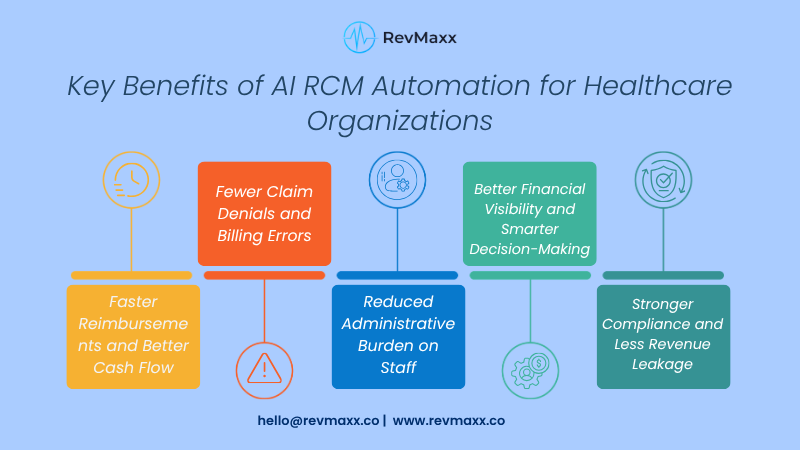
The real reason healthcare leaders are adopting AI RCM automation is simple: it improves financial performance while reducing operational friction.
The benefits are not just technical. They are practical, measurable, and directly tied to revenue health.
Faster Reimbursements and Better Cash Flow
When claims are cleaner, denials are reduced, and follow-up is prioritized intelligently, payments come in faster.
That improves:
- Revenue predictability
- Operational planning
- Financial stability
- Ability to invest in staff and patient care
For many healthcare organizations, improving cash flow is not just a finance goal. It is a survival goal. AI helps by shortening the distance between care delivered and revenue collected.
Fewer Claim Denials and Billing Errors
Denials do not just delay revenue. They consume resources.
Every denial creates:
- Staff review time
- Corrected claim submission
- Payer communication
- Possible appeal work
- Delayed reimbursement
AI helps reduce these avoidable costs by catching issues earlier and identifying patterns that human teams may miss at scale. That means fewer billing errors, stronger clean claim performance, and less revenue left hanging in accounts receivable.
Reduced Administrative Burden on Staff
One of the biggest advantages of AI is not just speed. It is a relief.
Healthcare staff are spending too much time on repetitive administrative tasks that do not require their full expertise. That contributes to burnout and limits productivity.
The CAQH Index found that more automation could significantly reduce wasted administrative effort, with fully electronic workflows saving an average of 70 minutes per patient visit.
When AI handles repetitive validation, tracking, routing, and workflow prioritization, teams can spend more time on the following:
- problem-solving
- appeals strategy
- payer escalation
- patient communication
- revenue improvement initiatives
That is a better use of skilled staff.
Better Financial Visibility and Smarter Decision-Making
Healthcare organizations cannot improve what they cannot clearly see.
AI helps turn large volumes of revenue cycle data into usable operational insight.
That includes visibility into:
- Denial trends
- Payer performance
- Underpayments
- Aging claims
- Workflow bottlenecks
- Collection patterns
This helps leaders move beyond monthly reports and start making faster, data-backed decisions.
Instead of guessing where revenue is being lost, they can pinpoint it.
That is especially valuable for organizations trying to scale, improve margins, or manage multiple specialties or locations.
Stronger Compliance and Less Revenue Leakage
Healthcare billing accuracy is not just a revenue issue. It is also a compliance issue.
AI can help organizations detect:
- Unsupported coding patterns
- Documentation mismatches
- Billing anomalies
- Workflow gaps that create risk
At the same time, it can help uncover small but costly revenue leakage points that often go unnoticed in manual workflows.
These small leaks add up over time.
That is why many healthcare organizations are beginning to see AI not just as a billing efficiency tool but as a financial integrity tool.
Challenges to Consider Before Adopting AI RCM Automation
AI can create major value in healthcare finance. But it is not magic. Healthcare organizations need to approach AI RCM automation with realistic expectations, clear goals, and strong operational planning.
Integration With Existing Systems
AI tools need to work with the systems organizations already use.
That often includes:
- EHR systems
- Practice management software
- Clearinghouses
- Billing platforms
- Payer portals
- Authorization workflows
If AI cannot integrate smoothly, the organization may create more friction instead of less. That is why system compatibility and workflow fit should be part of every vendor evaluation.
Data Quality Still Matters
AI can improve workflow intelligence, but it cannot fully fix poor source data. If patient records, payer information, coding workflows, or documentation quality are inconsistent, AI performance may be limited. Organizations often get the best results when they improve:
- Front-end intake accuracy
- Workflow standardization
- Documentation quality
- Team process consistency
Good automation still depends on good operational foundations.
Staff Adoption and Change Management
Technology projects often fail not because the software is bad, but because the workflow transition is poorly managed. Staff need to understand the following:
- What the AI is doing
- How it helps their work
- Where human review still matters
- How success will be measured
Without training and buy-in, even strong tools can underperform. AI should be introduced as a support system, not a threat to the people doing the work.
Security, Compliance, and Trust
Healthcare organizations must also evaluate AI from a risk and governance perspective.
That includes:
- HIPAA compliance
- Data security
- Auditability
- Workflow transparency
- Decision traceability
This is especially important when AI influences financial or authorization workflows. Trust is not optional in healthcare operations. Organizations need to understand how decisions are made and how exceptions are handled. That is why responsible AI adoption matters just as much as technical capability.
Best Practices for Implementing AI RCM Automation Successfully
Organizations that get the most from AI usually do not try to automate everything at once. They start where the pain is highest and where results can be measured clearly.
Start With the Biggest Revenue Bottlenecks
The smartest place to begin is usually the area causing the most financial friction.
That might be:
- Eligibility errors
- Prior auth delays
- Coding rework
- Denial volume
- Slow claim follow-up
- Patient collections
A focused rollout is often more successful than a broad one. It gives teams a chance to prove value, build trust, and improve workflows before expanding AI use across the entire revenue cycle.
Align AI With Clear Business Goals
AI should support outcomes, not just activity. Before implementation, healthcare organizations should define what success actually means.
That may include goals such as:
- Reducing denial rate
- Improving clean claim rate
- Lowering days in A/R
- Increasing collections
- Reducing staff rework
- Improving first-pass acceptance
Without measurable goals, it becomes hard to know whether the AI is actually helping. Clear KPIs make the investment easier to evaluate and optimize.
Keep Human Oversight in Place
This part is important. AI can improve speed and consistency, but human oversight is still essential in healthcare revenue cycle operations.
That is especially true for:
- Coding review
- Compliance-sensitive workflows
- Denial appeals
- Exception handling
- Payer escalation
- Financial strategy
The strongest AI RCM models are not “human or machine.” They are “human plus machines.” That is the model that tends to work best in real healthcare environments.
Track Performance and Improve Continuously
AI implementation should not end at launch. Healthcare organizations should continue monitoring:
- Denial trends
- Payer response patterns
- Claim acceptance rates
- A/R aging
- Productivity improvements
- Collection outcomes
This helps teams refine workflows and improve results over time. The best revenue cycle performance comes from continuous optimization, not one-time automation.
The Future of AI RCM Automation in Healthcare
The future of AI RCM automation is not just about doing today’s work faster. It is about changing how healthcare organizations think about revenue operations altogether. The revenue cycle is moving from reactive to predictive.
Instead of waiting for denials, delays, and unpaid balances to show up after the fact, AI makes it possible to identify risk earlier and respond more intelligently.
That future likely includes:
- More predictive denial prevention
- Smarter payer rule adaptation
- Stronger automation in appeals workflows
- Better patient payment personalization
- Deeper integration with EHR and financial systems
- Real-time operational intelligence
Market momentum is already showing where things are heading. According to Grand View Research, the global AI in revenue cycle management market was estimated at $20.63 billion in 2024 and is projected to reach $70.12 billion by 2030, growing at a 24.16% CAGR.
That growth reflects something bigger than software adoption.
It reflects a structural shift in how healthcare organizations are trying to protect margins, reduce waste, and modernize financial operations.
Conclusion
Healthcare revenue cycles have become too complex, too manual, and too expensive to manage the old way.
Claim denials are rising. Administrative burden is growing. Staff time is stretched. And every delay in reimbursement puts more pressure on provider organizations already trying to balance care quality with financial sustainability.
That is why AI RCM automation is becoming such a powerful force in healthcare.
It helps organizations reduce billing errors and administrative workload, prevent denials, improve coding and documentation quality, speed up reimbursements, and strengthen financial visibility.
Most importantly, it helps revenue teams move from reactive cleanup to proactive performance improvement. And in today’s healthcare environment, that shift matters.
Organizations that embrace AI thoughtfully, with the right workflows and human oversight, will be in a much stronger position to improve both operational efficiency and long-term financial health.