
Running a medical practice is not only about patient care anymore. It is also about keeping claims clean, payments moving, and staff from drowning in admin work. That is why more providers are paying attention to the benefits of RCM automation.
According to CMS report, the Medicare Fee-for-Service improper payment rate reached 7.66% in FY 2024. This is showing how documentation and administrative errors create major reimbursement problems across healthcare. Even physicians spend an average of 16.4 hours per week on prior authorization work alone, creating a major burden on staff and slowing down revenue operations. One thing is certain based on these numbers: inefficient revenue cycle workflows are not only bothersome, but they also cost money.
Automating certain aspects of the RCM process with AI technology is one way to remedy this issue by decreasing the amount of time spent on repetitive work, improving the accuracy of claims, and allowing practices to identify problems sooner in the billing cycle. Automating all but the most difficult or unique claims and the associated follow up will allow for faster, cleaner and more predictable revenue cycles as opposed to relying solely on manual processes. For medical practices, the impact of being able to increase collections without having to increase the burden on their workforce may be significant.
What Is AI-Powered RCM Automation in Healthcare?
The process of managing the revenue cycle consists of the financial aspects of a patient receiving their care, beginning with scheduling their appointment and culminating in full payment. Revenue cycle management includes, but is not limited to, registering the patient, checking their eligibility for services, assigning codes to their services, submitting their claims, posting payments received from their insurance companies, managing any claim denials, and collecting on any accounts that continue to be outstanding.
Automating these steps using artificial intelligence has enabled healthcare providers to use software to help automate the completion of repetitive tasks, identify probable errors, and assist staff in reaching quicker decisions. By using RCM automation, healthcare providers can identify potential revenue problems prior to the claims being submitted for payment and resolve those issues before submitting the claim to the third-party payor for payment.
Understanding that fines or penalties do not arise at the time of the payment but rather arise from an issue that originated before the payment is received is imperative to understanding how to resolve these issues efficiently and effectively. A wrong insurance detail or incomplete chart can create a chain reaction. AI tools help reduce that chain reaction by improving accuracy across the workflow. For medical practices, that means fewer avoidable losses and better financial consistency.
How AI Is Different From Traditional RCM Tools
Traditional billing systems mostly follow rules. They can process claims, store data, and help teams move work along. But they usually depend on staff to find problems manually. AI adds another layer. It can spot patterns, predict claim risk, flag missing information, and help prioritize what needs attention first. That makes it more proactive than older billing systems.
This difference is important in busy practices. A rule-based system may tell you a field is blank. AI can go further and point out which claims are most likely to be denied based on payer behavior, coding patterns, or documentation gaps. That helps teams work smarter, not just harder.
Why Medical Practices Are Moving Toward Automation
The cause of the move is due to there being very many pressures at play. One example of these pressures includes results from multiple surveys done from 2016 to 2021 by the American Medical Association (AMA), which continue to highlight the administrative burden placed on physicians through the authorization process and other mandated administrative tasks. Since there is no easy way to get around these processes, physicians are spending approximately 16.4 hours on average per week with regard to authorizations, for example. In small- to mid-level-sized facilities, this continues to result in excessive workloads and lost revenue, through proprietorship & Medicare programs are also part of this problem.
On top of that, staffing shortages, claim complexity, and rising patient payment responsibility have made manual RCM harder to manage. Practices are no longer adopting automation only to “save time.” They are adopting it because they need cleaner workflows, more reliable reimbursement, and better operational control.
Why RCM Automation Matters More Than Ever for Medical Practices
Like many businesses, the medical practice environment has become more motivated by financial considerations than before because of increased uncertainty and volatility. Margins are tighter than ever, the payer rules have become more complicated, and every time there is an issue with a claim for reimbursement, it affects the daily operations of the practice. The longer claims sit unpaid, the more work it takes to process additional appeals, and the time an employee spends correcting a preventable error can cost the entire practice financially. It affects payroll, staffing, patient service, and growth plans.
This is why the benefits of RCM automation go beyond billing. Automation helps practices protect revenue earlier in the process. It improves speed, but more importantly, it improves consistency. A consistent revenue cycle is easier to forecast, easier to manage, and much less stressful for everyone involved.
Common Revenue Cycle Challenges Practices Face
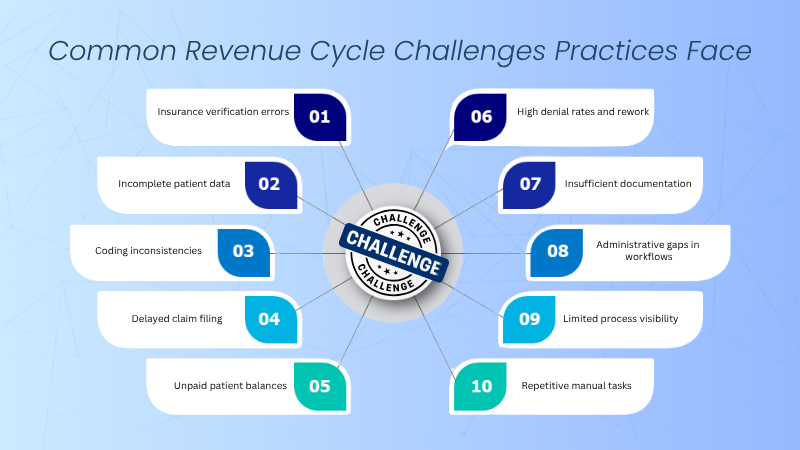
Most practices deal with the same set of pain points. Insurance verification errors, incomplete patient data, coding inconsistencies, delayed claim filing, unpaid balances, and high denial rework are all common. These problems are not always dramatic, but they are expensive because they repeat every day.
CMS continues to show how often payment issues are tied to documentation and administrative gaps. In FY 2024, CMS reported a 7.66% improper payment rate for Medicare Fee-for-Service and said many improper payments were linked to insufficient documentation or missing administrative steps. That is a strong reminder that financial leakage often comes from process quality, not only payer behavior.
How AI RCM Automation Transforms the Entire Revenue Cycle
AI-powered RCM automation improves performance not by fixing one step, but by strengthening every stage of the revenue cycle—from patient intake to final payment. Instead of relying on manual checks and reactive corrections, AI introduces a proactive layer that identifies issues early, reduces repetitive work, and keeps claims moving efficiently. This end-to-end impact is what makes automation so valuable for modern medical practices. The following benefits of RCM automation highlights how AI drives faster workflows, fewer errors, stronger financial outcomes, and a more sustainable operational model across the entire billing process.
Benefit #1 – Faster Claims Processing and Submission
One of the clearest benefits of RCM automation is speed. Manual claim preparation takes time because staff often need to gather data from different systems, check payer rules, correct missing fields, and review claims line by line. AI-powered automation can shorten that process by validating information in real time and moving claims forward with fewer manual delays.
Speed matters because the faster a clean claim is submitted, the faster reimbursement can begin. Delays at the claim creation stage often create delays everywhere else. Practices that automate this step can reduce bottlenecks and create a healthier billing rhythm.
How Automation Speeds Up the Claims Workflow
Automating processes allows for less duplication of effort in regards to repetitive hand-offs. Automating the entry of patient and payer data, checking logic on the coding of claims, flagging modifiers that may be missing, and scrubbing claims prior to submission provides staff members with the ability to not repeatedly research a small amount of errors.
By being able to address potential claim errors while still in the system rather than waiting for an error to occur when a claim is rejected, the potential for unnecessary back and forth is significantly reduced, resulting in significantly faster processing of claims within both the clearinghouse as well as the payer pipeline. In addition, the use of automation allows billing teams to devote more attention to items which fall outside of routine processes as opposed to performing those routine tasks.
Why Speed Matters for Practice Revenue
Faster claim submission directly affects cash flow. Every day a claim is delayed is another day payment is delayed. For practices managing payroll, vendor costs, and provider productivity, those delays are not minor. They add pressure across the business.
When claims go out quickly and cleanly, the revenue cycle becomes more predictable. That predictability helps leadership make better financial decisions and reduces the constant stress that comes from waiting on money that should already be in the door.
Benefit #2 – Fewer Claim Denials and Billing Errors
Denials are expensive because they rarely end with the denial itself. They create rework, slow cash flow, and force staff to spend time fixing claims that should have been right the first time. One of the strongest benefits of RCM automation is its ability to reduce these preventable errors before claims are submitted.
AI-powered tools can review claims for missing information, coding mismatches, modifier issues, payer-specific edits, and documentation gaps. That helps practices stop many common denial triggers early, which is much easier and cheaper than correcting them after the fact.
Common Errors AI Can Help Prevent
A large share of avoidable denials comes from repeatable problems: wrong insurance details, incomplete authorizations, invalid coding combinations, duplicate claims, or missing chart support. These are exactly the types of issues automation is good at catching.
CMS data supports this reality. For Medicaid improper payments in FY 2024, CMS reported that 79.11% were due to insufficient documentation. That does not mean every issue was fraud or abuse. In many cases, it simply means the financial workflow and documentation process broke down somewhere. Automation helps reduce that breakdown.
How Denial Prevention Improves Revenue
Denial prevention is one of the fastest ways to protect revenue. A clean claim has a much better chance of getting paid on the first pass. That means less rework, fewer appeals, and lower administrative cost per claim.
It also improves team productivity. When staff are not buried in avoidable corrections, they can focus on higher-value work like AR follow-up, patient collections, and payer trend analysis. In short, preventing denials helps both the top line and the day-to-day workload.
Benefit #3 – Improved Medical Coding Accuracy
Coding accuracy plays a major role in reimbursement quality. A code that is too vague, unsupported, or mismatched to the documentation can delay payment or create compliance concerns. One of the most practical benefits of RCM automation is that it supports more accurate coding workflows without replacing the coding team.
AI can help review provider documentation, suggest likely codes, flag missing details, and identify inconsistencies before claims go out. That makes coding more efficient and often more reliable, especially in high-volume environments where small mistakes can multiply quickly.
How AI Supports Smarter Coding Workflows
AI does not “guess” the entire coding process on its own. In strong workflows, it acts like a support layer. It can compare note content to likely CPT, ICD, or HCPCS options, identify missing elements, and highlight where documentation may not support the billed service.
That kind of support helps reduce undercoding, overcoding, and missed charge opportunities. It also helps coding and billing teams work with more confidence because they are reviewing better-prepared claims instead of starting from scratch each time.
Why Coding Accuracy Impacts Practice Profitability
Coding accuracy affects more than compliance. It affects whether the practice is paid correctly. Undercoding can leave money on the table. Overcoding can trigger audits and repayment risk. Inaccurate coding also increases denial risk and slows reimbursement.
CMS’ improper payment reporting continues to show how payment accuracy is closely tied to documentation and coding quality. That makes coding support one of the most valuable places for automation to improve financial performance.
Benefit #4 – Better Cash Flow and Faster Payments
Healthy practices need healthy cash flow. It is that simple. One of the most important benefits of RCM automation is that it helps shorten the gap between patient care and payment. That means fewer delays, more consistent collections, and less revenue sitting in limbo.
Cash flow issues often do not come from one large problem. They come from hundreds of small slowdowns—claims waiting to be reviewed, denials waiting to be touched, payments waiting to be posted, and balances waiting to be collected. Automation helps move those pieces faster and with fewer interruptions.
How AI Helps Improve Collections
AI can support collections by helping practices prioritize the right work at the right time. It can identify which claims need follow-up first, which patient balances may require outreach, and which accounts are at higher risk of aging out.
It can also improve the quality of the patient billing process. Cleaner claims and cleaner statements usually lead to fewer disputes and faster payment resolution. That means less time chasing money and more time actually collecting it.
The Link Between Automation and Financial Health
Faster payments create operational stability. Practices can plan better when revenue is not constantly delayed or unpredictable. It becomes easier to invest in staffing, technology, and patient services when reimbursement is moving on schedule.
That is why many organizations do not view automation as just a billing tool. They view it as a financial control system. When revenue flows more smoothly, the whole practice operates with less friction.
Benefit #5 – Reduced Administrative Burden on Staff
Ask almost any billing or front-office team what slows them down, and the answer is usually the same: repetitive admin work. Eligibility checks, claim status lookups, prior authorization follow-up, manual data entry, and denial rework can consume hours every week. One of the most immediate benefits of RCM automation is reducing that burden.
This matters because administrative overload does not only hurt productivity. It also contributes to burnout. When staff spend most of their day fixing avoidable issues, morale drops and turnover risk rises. Automation helps take some of that pressure off.
Repetitive Tasks AI Can Handle
AI-powered RCM systems can support many repetitive tasks, including insurance verification, claim scrubbing, work queue prioritization, payment posting assistance, and claim status monitoring. These are not glamorous functions, but they are exactly the type of work that drains staff time when handled manually.
The AMA has also shown how payer-related admin work can absorb significant physician and staff time. When even one process like prior authorization can consume hours every week, it becomes clear why automation matters at the operational level.
How This Helps Staff Productivity
When repetitive work is reduced, staff can focus on the tasks that actually require human judgment. That includes solving complex billing issues, communicating with patients, improving payer strategy, and monitoring performance trends.
This shift is important. The goal is not to remove people from the process. It is to stop wasting skilled time on tasks that software can complete more consistently. That is where productivity gains become real.
Benefit #6 – Stronger Visibility Into Revenue Cycle Performance
Many practices do not have a revenue problem because they lack effort. They have a revenue problem because they lack visibility. They often find out about billing issues too late—after denials rise, AR grows, or cash slows down. One of the less talked-about but highly valuable benefits of RCM automation is improved visibility.
AI-powered systems can pull together data across the revenue cycle and turn it into usable insights. That helps practices move from reactive decision-making to proactive management. Instead of guessing where money is getting stuck, teams can actually see it.
Key Metrics AI-Powered RCM Tools Can Track
Modern RCM automation tools can help practices monitor denial rates, first-pass acceptance, AR days, aging trends, payer performance, collection rates, and claim turnaround time. These are not just dashboard numbers. They are operational signals.
When these signals are easy to track, leaders can identify which payers are causing the most friction, which specialties need coding support, or where front-end errors are affecting downstream claims. That kind of insight is difficult to get from spreadsheets and disconnected systems alone.
Why Real-Time Visibility Matters
Real-time visibility helps practices fix problems earlier. If denial rates rise for a specific payer or service line, teams can respond quickly instead of waiting until month-end reports show the damage. That speed of response can make a major difference in revenue protection.
It also improves accountability. When everyone can see where performance stands, it becomes easier to improve processes and align teams around measurable goals. Better visibility leads to better management.
Benefit #7 – Better Patient Financial Experience
RCM is not only about insurance claims. It also affects how patients experience the financial side of care. Confusing bills, delayed statements, insurance surprises, and unclear balances can frustrate patients and damage trust. One of the most overlooked benefits of RCM automation is that it can make billing clearer and easier for patients.
This matters more now because patient responsibility continues to grow. When patients are paying more out of pocket, they expect billing to be accurate, understandable, and timely. Practices that ignore this side of RCM often end up with slower collections and more patient dissatisfaction.
How Automation Improves the Patient Billing Journey
Automation can improve the patient experience by supporting cleaner insurance verification, more accurate estimates, clearer billing statements, and faster balance updates. It can also reduce the chance of duplicate or confusing charges reaching the patient.
A smoother billing journey improves trust. Patients are more likely to pay when the bill makes sense and arrives on time. They are also less likely to flood the front desk with billing confusion that staff then need to untangle manually.
Why Patient Experience Matters Financially
Patient experience is not separate from financial performance. It directly affects collection rates, retention, and reputation. A practice that handles billing poorly may still deliver good clinical care, but patients often remember the financial friction just as strongly.
That is why improving the patient’s financial experience is not a “nice to have.” It is a revenue strategy. Clearer billing can support faster payment and stronger long-term patient relationships.
How Platforms Like RevMaxx Apply AI RCM Automation in Real Workflows
While the benefits of AI RCM automation are clear in theory, their real impact depends on how well they are applied across day-to-day workflows. Platforms like RevMaxx are designed to bring these capabilities into practical use—connecting front-end accuracy, claim quality, denial prevention, and financial visibility into a single, streamlined system.
Bringing Front-End and Back-End Workflows Together
In many practices, front-end and billing workflows operate in silos. RevMaxx helps bridge this gap by ensuring that accurate data flows consistently from patient intake through claim submission, reducing errors that typically surface later in the process.
Supporting Cleaner Claims Through Intelligent Automation
By applying AI-driven checks before submission, RevMaxx supports higher-quality claims with fewer missing elements, helping improve first-pass acceptance and reduce avoidable denials.
Reducing Manual Work Without Removing Oversight
RevMaxx automates repetitive RCM tasks such as verification, claim scrubbing, and follow-ups, while still allowing teams to maintain control over complex decisions and exceptions.
Enabling Better Financial Visibility
With structured data and workflow tracking, RevMaxx helps practices gain clearer insight into revenue cycle performance, making it easier to identify issues and improve outcomes over time.
Final Thoughts
The biggest benefits of RCM automation are not only speed and convenience. They are financial stability, cleaner claims, better staff efficiency, fewer preventable errors, and a smoother patient billing experience. In a medical practice, those outcomes matter every single day.
AI-powered RCM automation will not fix every revenue problem overnight. But it can remove many of the recurring issues that quietly hurt reimbursement and overwhelm teams. For practices trying to grow while keeping operations lean, automation is becoming less of a future idea and more of a practical business necessity.