
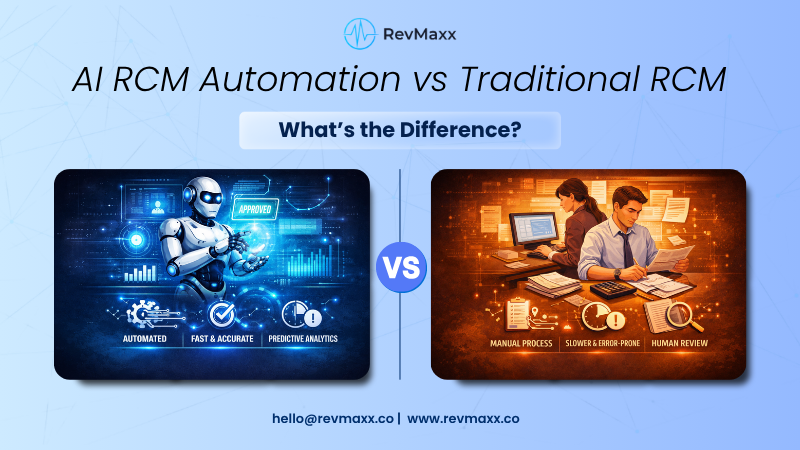
Payments are slower. Denials are rising. Staff burnout is real. And the administrative side of care is getting heavier, not lighter. That is why more providers are now comparing AI RCM automation vs traditional RCM before deciding how to improve billing, collections, and revenue performance.
At the center of this shift is one simple question: Should healthcare organizations continue using old, manual revenue cycle processes or move toward AI-powered automation? The answer matters because the revenue cycle affects everything: cash flow, staffing, patient billing, and financial stability.
The pressure is not small. According to the 2024 CAQH Index, the healthcare industry still has a $20 billion opportunity to reduce administrative waste through greater automation, and providers can save significant staff time by moving more workflows into electronic processes.
In this blog, we will break down the real difference between both models.
Understanding Revenue Cycle Management in Healthcare
The Revenue Cycle Management (RCM) encompasses all aspects of managing a patient’s financial experience from the initial patient appointment through to the receipt of payment by the provider(s). The full cycle consists of chaining all of the above activities. Therefore, the RCM includes patient registration, verification of insurance, documentation, coding, claims submissions, posting of payments, handling of denials, and collections.
Many people think RCM is just billing. It is much bigger than that. A weak revenue cycle can lead to delayed reimbursements, poor patient payment experiences, rising accounts receivable, and unnecessary write-offs. A strong RCM process keeps the business side of healthcare moving so care teams can stay focused on patients.
With revenue cycle performance becoming an increasing focus for healthcare leaders, industry data from the Medical Group Management Association highlights a growing shift toward automation and outsourcing in RCM. Recent MGMA Stat polls indicate that a significant portion of medical groups are actively investing in improving their revenue cycle processes to address challenges like denials, staffing constraints, and delayed reimbursements. This reinforces how critical RCM has become to overall operational strategy. As a result, the conversation is rapidly evolving—from traditional, labor-intensive RCM models to more efficient, AI-powered approaches that can deliver scalability, accuracy, and better financial outcomes.
Key Stages of the RCM Process
The RCM process has several connected steps. It starts with collecting accurate patient and insurance information. Then comes charge capture, medical coding, and claim creation. After that, claims are submitted to payers, payments are posted, and denied or underpaid claims are worked. The final stage often includes patient collections and account resolution.
Every stage matters. If one part breaks, the rest of the cycle slows down. For example, a simple registration error can later turn into a denial. That is why healthcare leaders are now looking closely at where automation can reduce friction across the full cycle—not just at the billing desk.
Why Even Small Workflow Errors Can Hurt Revenue
In healthcare billing, small mistakes are rarely small. A missing authorization, wrong insurance ID, incomplete note, or incorrect modifier can stop a clean claim from getting paid. That leads to rework, staff time loss, and slower cash flow.
This is where the difference between AI RCM automation vs traditional RCM becomes easier to see. Traditional systems often catch problems after submission. AI-based systems are designed to flag many of them earlier. That proactive layer can make a major financial difference over time, especially for organizations processing high claim volumes every week.
And the cost of these problems is growing. According to the Healthcare Financial Management Association (HFMA), claims denials are adding an estimated $25 billion in unnecessary administrative spending to the healthcare system.
What Is Traditional RCM?
Traditional RCM is the older and still common way healthcare organizations manage billing and collections. It usually depends on people doing a large share of the work manually. Front-desk staff enter patient information, billing teams prepare claims, coders review notes, and A/R teams follow up on unpaid claims one by one.
This model can still work, especially for smaller organizations. But it often becomes difficult to manage at scale. As payer rules grow more complex and administrative pressure increases, traditional workflows can create delays, errors, and a heavy dependence on staffing. That is one of the main reasons providers are now evaluating AI RCM automation vs traditional RCM more seriously.
How Traditional RCM Typically Works
Using a traditional approach, the majority of tasks are transferred through people, queues, and manual verification. Insurance verifications, documentation reviews, code assignments, claims creation, claims submission, and tracking of responses from payers typically all require a human touch. In the case of denials, a member of the team will need to investigate, correct, and resubmit to that payor manually.
This method is effective where teams are knowledgeable and workloads can be maintained, but it is also very labor-intensive. It also depends on consistency across many handoffs. When staff are overloaded, even strong teams can struggle to keep up with claim volume and payer changes.
Common Challenges of Traditional RCM
The biggest challenge in traditional RCM is not effort. It is repetition. Teams often spend hours doing tasks that are necessary but highly manual, such as eligibility checks, claim edits, prior authorization follow-up, and denial rework. That slows down reimbursement and adds avoidable cost.
The numbers show how serious this burden has become. According to the American Medical Association, physicians report completing an average of 43 prior authorizations per week, with 12 hours of physician and staff time spent on these tasks weekly. On top of that, 95% say prior authorization contributes to burnout. Those are not small workflow issues. They are operational pressure points.
What Is AI RCM Automation?
The use of AI, along with other technological innovations such as predictive analytics and automated workflows in the revenue cycle (RCM) industry, has revolutionized the way organizations conduct RCM activities. This means that healthcare organizations can speed up their RCM processes and minimize their errors through innovative use of technology.
This does not mean humans disappear from the process. It means repetitive work gets lighter. AI can help check insurance data, suggest codes, scrub claims before submission, flag high-risk denials, and prioritize follow-up work.
So when comparing AI RCM automation vs traditional RCM, the real difference is not just technology. It is how much of the process is reactive versus proactive.
How AI RCM Automation Works in Healthcare Workflows
In any healthcare workflow, AI can step in at multiple points. It can identify missing patient data before a claim is created. It can scan documentation for coding gaps and can review claims before submission to catch common payer issues. Most importantly, these AI tools can sort denied claims by urgency and likely recoverability, helping teams focus on what matters most.
This kind of support changes how teams work day to day. Instead of spending most of their time fixing avoidable issues, staff can spend more time on exceptions, patient communication, and financial improvement. That is why many healthcare organizations now see AI RCM as an operational tool, not just a software feature.
Core Technologies Behind AI RCM
AI RCM systems usually combine several technologies. These include artificial intelligence for pattern recognition, machine learning for continuous improvement, natural language processing for documentation analysis, predictive analytics for denial risk, and workflow automation for repetitive administrative tasks.
The value of these technologies is not in the labels. It is in the output. If the system helps reduce denials, improve claim quality, shorten A/R cycles, and lower staff burden, it is doing its job. That is what makes the comparison of AI RCM automation vs traditional RCM meaningful from a financial and operational point of view.
AI in RCM Does Not Mean “No Human Oversight”
This is an important point. Good AI RCM does not remove human judgment. It supports it. Healthcare billing still involves payer complexity, compliance rules, specialty nuances, and exceptions that require experienced review.
In fact, the best results usually come when AI and people work together. Automation handles repetitive work. Human experts handle the critical decisions. That balance is often where healthcare organizations see the strongest ROI, especially when they are trying to scale without overloading teams.
AI RCM Automation vs Traditional RCM: Side-by-Side Comparison
When healthcare leaders compare AI RCM automation vs traditional RCM, they are usually asking one thing: which model helps us get paid faster, more accurately, and with less friction? The answer becomes clear when both approaches are viewed side by side. Let’s have a look:
Area | Traditional RCM | AI RCM |
Workflow style | Mostly manual | Automated + guided |
Claim preparation | Staff-dependent | System-assisted |
Error detection | Often after submission | Before submission |
Coding support | Manual review | AI-assisted support |
Denial prevention | Reactive | Predictive and proactive |
Staff workload | High repetitive burden | Lower repetitive burden |
Reporting | Delayed or fragmented | Faster and more actionable |
Scalability | Needs more people | Can scale with less added labor |
Cost-to-collect | Often higher over time | Can improve with efficiency |
Revenue visibility | Limited in many teams | Better real-time visibility |
Benefits of AI RCM Automation Over Traditional RCM
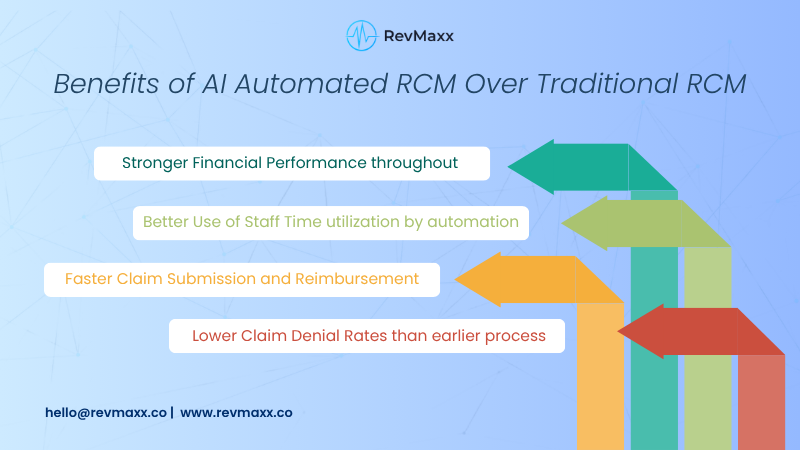
The biggest strength of AI RCM is not that it sounds advanced. It is that it solves practical problems that healthcare teams deal with every day. It helps reduce manual work, improve claim quality, and shorten the time between care delivery and reimbursement.
That is why many organizations looking at AI RCM automation vs traditional RCM are not asking whether AI is “interesting.” They are asking whether it improves outcomes. In many cases, the answer is yes. It is especially when denial rates, staff burden, and payment delays are already affecting performance.
Faster Claim Submission and Reimbursement
Faster workflows lead to faster revenue. When claims are built, checked, and submitted with fewer manual delays, the reimbursement cycle becomes more stable. This matters a lot for organizations trying to improve cash flow consistency.
The value here is not only speed. It is reliable. Faster clean claims reduce the stop-start pattern that many billing teams deal with when preventable errors slow the process down. Over time, that creates a healthier financial rhythm.
Lower Denial Rates
A large share of denials are preventable. Missing patient information, claim formatting problems, coding mismatches, and authorization issues are all areas where AI tools can help before submission.
That is why denial prevention is one of the strongest business cases for automation. If fewer claims bounce back, teams spend less time in rework and more time on productive recovery and optimization. In RCM, fewer denials often means less hidden waste.
Better Use of Staff Time
Healthcare teams are stretched. Billing staff are stretched. Front-desk teams are stretched. Providers are stretched. The real promise of AI RCM is not replacing people. It is helping them stop spending so much time on repetitive tasks that do not require human judgment.
That shift matters. When staff can focus on exceptions, follow-up strategy, and patient communication instead of constant manual corrections, the whole operation becomes stronger and more sustainable.
Stronger Financial Performance
At the end of the day, the purpose of revenue cycle improvement is financial performance. Better claims, fewer denials, faster turnaround, lower cost-to-collect, and stronger collections all feed into healthier margins.
This is why the AI RCM automation vs traditional RCM conversation is not just about operations teams. It is also a leadership and CFO conversation. Revenue cycle performance has a direct impact on the financial stability of the organization.
How RevMaxx Helps Modernize Revenue Cycle Operations
RevMaxx focuses on improving revenue cycle performance through AI-driven automation across key RCM workflows. By streamlining processes such as eligibility verification, claim preparation, and denial management, it helps reduce manual errors, improve data accuracy, and support cleaner claims from the start.
The platform is designed to automate repetitive and time-intensive RCM tasks, enabling more consistent workflows and faster processing. By reducing gaps in data, minimizing rework, and proactively identifying potential issues before submission, it helps create a stronger connection between operational efficiency and financial outcomes—where many revenue leaks typically occur.
What Makes RevMaxx Different
One of the practical advantages of RevMaxx is that it is positioned around workflow support, not just isolated automation. That matters because RCM performance often depends on what happens before the claim is ever created. If documentation is more complete and coding support is stronger, the downstream billing process usually becomes smoother.
In other words, tools like RevMaxx can support a cleaner front-end foundation for the revenue cycle. And when organizations compare AI RCM vs traditional RCM, that upstream support can become a meaningful difference in long-term billing performance.
Another key differentiator is RevMaxx’s pricing model. Unlike traditional RCM vendors that charge a percentage of collections—where costs increase as revenue grows—RevMaxx offers a flat fee per provider for its AI RCM automation. This means organizations retain full control over their earnings without sharing a portion of their revenue, while also benefiting from predictable costs as they scale.
Final Thoughts
If we keep it honest and simple, traditional RCM still works in some environments. But for many modern healthcare organizations, it is becoming harder to manage efficiently. The cost of manual work, rework, delays, and staff strain is getting too high.
That is why, in most growth-focused or operationally stretched environments, AI RCM automation vs traditional RCM is no longer a close comparison. AI RCM usually offers better speed, stronger accuracy, lower administrative drag, and more scalable financial performance. The future of healthcare revenue is moving toward intelligent automation.