
Claim denials are becoming one of the biggest revenue threats in modern healthcare practices. According to the survey report, 41% of providers said that their denial rates are now 10% or higher. 54% reported that claim errors are increasing, and 68% said submitting clean claims is harder than it was a year ago. On top of that, 43% of providers said they are understaffed, making it even harder to keep up with denials, rework, and payer follow-up.
This growing pressure is exactly why more healthcare organizations are turning to AI-driven revenue cycle tools. If your goal is to reduce claim denials with AI RCM, the answer is not simply working harder after claims are denied. It is building smarter workflows before claims are submitted. AI RCM automation helps providers catch missing data, eligibility issues, authorization gaps, and coding risks early, before they turn into delayed payments or lost revenue. In a revenue environment where speed, accuracy, and collections matter more than ever, AI is quickly becoming a practical solution, not just a future trend.
Why Claim Denials Become a Growing Revenue Problem in Healthcare
A claim denial happens when a payer refuses to pay a submitted healthcare claim, either fully or partially. This is different from a rejected claim, which is usually kicked back before it enters full payer processing due to missing or invalid data. A denied claim typically requires correction, documentation, appeal, or resubmission. Understanding that difference matters because rejected claims are often front-end data issues, while denials often point to deeper workflow, authorization, coding, or payer-rule problems.
There is also a difference between denied claims and underpaid claims. Underpayments may not look like denials on the surface, but they still create revenue leakage. A mature RCM strategy looks at all three together: rejections, denials, and underpayments. That is exactly where AI becomes useful. It can surface patterns across these categories and help billing teams fix the root cause instead of chasing the same problem again next month.
Common Reasons Claims Get Denied
Most claim denials come from problems that are preventable. Common causes include missing patient information, insurance eligibility issues, prior authorization errors, incorrect coding, lack of documentation, duplicate claims, and services that do not meet payer rules. Experian data reported by Becker’s found that the top denial triggers continue to be missing or inaccurate data, authorization issues, and incomplete or incorrect patient registration information.
What makes these denials so expensive is that many begin long before the billing team ever touches the claim. A small registration error at check-in, a missed authorization, or incomplete charting can create a denial days or weeks later. That is why denial prevention cannot live only in the business office. It has to be built into the full workflow, from scheduling and registration to coding and submission. AI RCM is effective because it connects those dots earlier.
How Denials Hurt Revenue and Collections
Denials hurt collections in two ways. First, they delay reimbursement. Second, they increase the cost of collecting each dollar. When billing teams spend hours correcting claims, filing appeals, or answering payer requests, the organization is spending more money just to recover revenue that should have been paid the first time. That lowers net collections and increases days in A/R.
There is also a hidden collections problem inside denials: not every denied claim gets appealed or recovered. That is especially true when staff are short on time. AMA coverage of KFF analysis noted that only 1 in 10 denied prior authorization requests were appealed in Medicare Advantage, even though 83.2% of appeals were partially or fully overturned. That gap shows how much revenue can be left behind when teams are stuck in manual workflows.
What Is AI RCM Automation and How Does It Work?
AI RCM automation uses artificial intelligence, machine learning, predictive analytics, and workflow automation to improve how healthcare organizations manage billing, claims, denials, payments, and collections. In simple terms, it helps revenue cycle teams spot issues faster, reduce repetitive work, and make better decisions based on real data instead of guesswork. It is not about replacing people. It is about helping teams work with fewer avoidable errors and fewer missed opportunities.
Traditional RCM systems are often reactive. They tell you what went wrong after the damage is already done. AI changes that by helping teams predict what is likely to go wrong before the claim is submitted. That is a big shift. Instead of spending most of the day fixing denials, teams can spend more time preventing them and focusing on high-value follow-up.
Understanding AI in Revenue Cycle Management
In revenue cycle management, AI works by analyzing large volumes of claims, payment, payer, and workflow data to identify patterns humans may miss or take too long to find. For example, AI can recognize that a certain payer frequently denies a certain CPT code when a modifier is missing or that one registration field is often causing downstream rejections. That turns raw billing activity into usable operational insight.
The value is not only speed. It is consistent. AI does not get tired, overlook the same pattern for weeks, or rely only on someone’s memory of “what usually gets denied.” It can continuously monitor claim behavior and flag high-risk situations earlier. When paired with strong human oversight, this can dramatically improve billing accuracy and collections performance.
Key Functions of AI RCM Automation
AI RCM automation can support many parts of the revenue cycle. Common use cases include eligibility verification, authorization tracking, coding support, claim scrubbing, denial prediction, remittance analysis, payment variance detection, A/R prioritization, and patient payment workflows. Each one addresses a known friction point that often leads to delays or revenue leakage.
What matters most is how these functions work together. A good AI RCM workflow does not just automate one task in isolation. It creates continuity across the full process. That is where organizations see stronger first-pass claim performance, less manual rework, and faster collections.
Where AI Fits in the Revenue Cycle Workflow
AI can support nearly every phase of the revenue cycle. At the front end, it can validate insurance, check coverage, and flag missing registration details. In the middle, it can support documentation quality, coding accuracy, and claim readiness. At the back end, it can identify denials, detect underpayments, and prioritize accounts that need immediate action.
This full-cycle approach matters because denial prevention starts long before the claim goes out the door. If organizations only use AI after denials happen, they miss a big part of the opportunity. The best outcomes come when AI is embedded early enough to prevent avoidable friction before it becomes lost cash.
How AI Helps Reduce Claim Denials Before They Happen
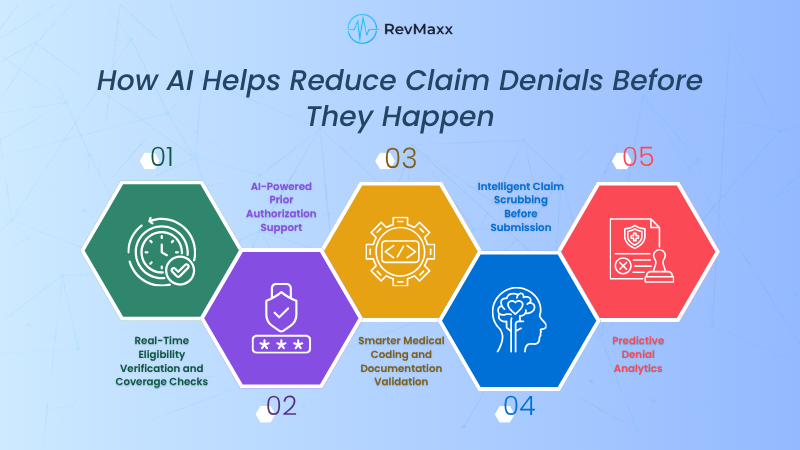
This is where the biggest value shows up. The strongest reason providers invest in AI RCM is not just to manage denials better. It is to stop preventable denials from happening in the first place. If you want to truly reduce claim denials with AI RCM, your workflow has to become more predictive and less reactive. AI helps do that by identifying risk signals before a claim is submitted and by reducing the gaps between front-end, clinical, and billing teams.
Denials usually do not happen because one person made one mistake. They happen because small issues move through disconnected systems without being caught in time. AI can act as a checkpoint layer across those workflows. That gives teams a better chance to submit clean, complete, payer-ready claims the first time.
Real-Time Eligibility Verification and Coverage Checks
Eligibility and coverage errors are one of the most common sources of preventable denials. A patient may appear active in one system but have changed plans, lost coverage, or shifted to a different benefit structure. If those issues are not caught before the visit or before claim submission, denials are almost guaranteed. AI can help by checking eligibility in real time and surfacing exceptions that need attention.
This is more important than it sounds. According to the 2024 CAQH Index, the industry still spends heavily on administrative transactions, with providers carrying most of the burden. Better automation in front-end tasks like eligibility verification can remove a surprising amount of wasted time and billing friction.
AI-Powered Prior Authorization Support
Prior authorization is one of the most painful denial drivers in healthcare. It is manual, inconsistent, and time-consuming. CAQH notes that only 35% of medical industry prior authorizations are conducted fully electronically, and providers still spend significant time completing them through portals, fax, phone, or email. The 2024 CAQH Index also found that provider staff spend an average of 24 minutes on a manual phone/fax/email prior authorization request and 16 minutes through a portal.
AI can help by identifying which services require authorization, matching requests to payer rules, tracking status, flagging missing documentation, and surfacing likely approval risks before care is delivered. That matters because prior auth delays are not just an admin issue. AMA reporting shows more than 90% of physicians say prior authorization delays care, and 82% say it can lead patients to abandon treatment.
Smarter Medical Coding and Documentation Validation
Coding errors and documentation gaps often create denials that could have been avoided with earlier review. AI can help by checking whether documentation supports the billed service, whether diagnosis specificity is strong enough, and whether the coding combination matches common payer expectations. This does not replace certified coders. It helps them focus on exceptions and risk instead of manually reviewing every line the same way.
That kind of support is especially valuable in specialties where payer rules are complex and documentation requirements are tighter. It also reduces back-and-forth between clinical and billing teams. Cleaner documentation upstream usually means fewer billing surprises downstream, which is exactly how denial prevention should work.
Intelligent Claim Scrubbing Before Submission
Traditional claim scrubbing relies on static edits. That is useful, but limited. AI-enhanced claim scrubbing goes further by looking at payer behavior, historical denials, coding patterns, missing data combinations, and anomalies that standard rules may miss. It does not just ask, “Is this field complete?” It asks, “Does this claim look like one that is likely to get denied?”
That difference matters a lot. Clean claim performance is not just about filling in boxes. It is about matching the full claim to how payers actually adjudicate it. AI can make scrubbing more adaptive, which helps providers catch issues earlier and submit more claims right the first time.
Predictive Denial Analytics
Predictive denial analytics is one of the clearest examples of how AI changes RCM from reactive to proactive. Instead of waiting to see what gets denied, AI looks at past claim behavior to predict which new claims are most likely to fail. It can identify high-risk payers, high-risk service lines, repeat authorization failures, or provider-specific trends that are driving denials.
That helps organizations focus where it matters. Rather than reviewing every claim with equal effort, teams can prioritize the claims with the highest denial probability. Over time, that creates a much more efficient denial prevention strategy and a much healthier revenue cycle.
How AI RCM Improves Collections and Cash Flow
Reducing denials is only half the story. The other half is what happens to collections when more claims go out clean, more accounts move faster, and staff spend less time in rework. Better claim quality almost always leads to better collections performance. AI RCM improves collections by helping providers get paid faster, identify revenue at risk sooner, and reduce the operational drag that slows cash flow.
Collections improve when fewer claims stall in the system. That may sound obvious, but many organizations still manage collections mostly from the back end. AI helps move collections improvement upstream by improving claim quality, payer readiness, and follow-up prioritization before cash flow problems build up.
Faster Clean Claim Submission
A clean claim is one that is accurate, complete, and ready for payer adjudication without avoidable edits or manual intervention. Clean claims are the foundation of strong collections because they move faster through the payment cycle. When claims are clean on first submission, providers reduce the time and cost spent fixing preventable errors after the fact.
This is one reason AI is becoming more important in RCM. Becker’s coverage of Experian’s State of Claims report noted that 68% of providers said submitting clean claims has become more challenging, while 67% said time to reimbursement is increasing. Those are exactly the kinds of issues AI is built to address.
Reduced Days in Accounts Receivable (A/R)
High A/R days are often a symptom of hidden process breakdowns. Claims may be sitting unworked, waiting on payer responses, or tied up in preventable denials and information requests. AI helps reduce A/R days by identifying stalled claims sooner, prioritizing follow-up based on value and risk, and helping staff work the right accounts first instead of just working down a generic queue.
That matters because not all outstanding claims are equally urgent. AI can help organizations focus on claims that are aging, underpaid, or likely to miss filing windows. This improves cash flow without simply asking staff to work harder or faster.
Smarter Follow-Up on Underpaid and Unpaid Claims
Not all revenue leakage shows up as a denial. Some claims are paid incorrectly, partially paid, or delayed through payer requests that slow the process without fully rejecting the claim. AI can analyze remittance data and contract patterns to flag underpayments, inconsistencies, and missed reimbursement opportunities that might otherwise go unnoticed.
This has become more important as payer behavior grows more complex. Kodiak reporting highlighted how requests for more information are being used at scale to delay billions in payments, even when many of those claims are eventually paid. AI helps teams detect those patterns faster and act sooner.
Better Patient Payment Collections
Collections are no longer only about payers. Patient responsibility now makes up a larger share of provider revenue, which means front-end financial accuracy matters even more. AI can support patient collections by improving eligibility checks, generating clearer estimates, segmenting balances, automating reminders, and helping teams identify which accounts need a different payment approach.
That does more than improve cash flow. It also improves patient experience. Clearer billing and fewer surprise issues create more trust. And when patients understand what they owe earlier, providers are more likely to collect it without creating frustration at the end of care.
Key Benefits of Using AI RCM Automation for Denial Prevention and Collections
The biggest benefit of AI RCM is not just that it makes billing faster. It makes revenue operations more predictable. Instead of constantly reacting to denials, delays, and payment gaps, organizations gain more control over what is happening in the revenue cycle and where they are losing money. That creates a stronger financial foundation.
This is especially important for practices and health systems trying to grow while controlling labor costs. Administrative pressure is not getting lighter. CAQH estimates the medical industry spends $83 billion annually on routine administrative transactions, with providers bearing 97% of those costs. That is why smarter automation matters so much now.
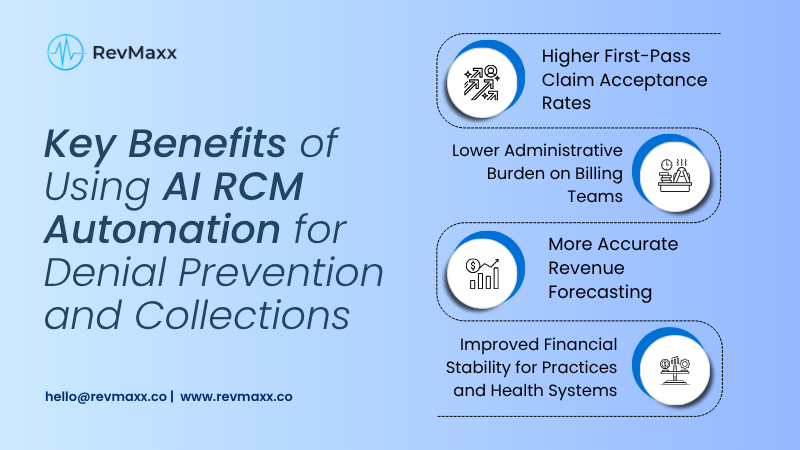
Higher First-Pass Claim Acceptance Rates
First-pass claim acceptance is one of the clearest operational signs of a healthy revenue cycle. The higher the first-pass rate, the fewer resources the organization has to spend on rework and correction. AI improves this by helping teams catch missing data, authorization gaps, and claim-level inconsistencies before submission.
Higher first-pass acceptance also improves morale. Billing teams spend less time cleaning up preventable issues and more time doing strategic work. That makes the whole RCM function more efficient and more scalable.
Lower Administrative Burden on Billing Teams
Manual denial management is exhausting work. It requires constant checking, correcting, resubmitting, documenting, and following up. AI reduces that burden by automating repetitive steps and surfacing the claims that need attention most urgently. This is especially helpful for organizations dealing with staffing shortages or rising volume.
The labor side of the problem is real. Becker’s reported that 43% of providers in Experian’s 2025 survey said they were understaffed, while claim errors were increasing. AI cannot solve every staffing challenge, but it can help teams do more with the people they already have.
More Accurate Revenue Forecasting
When denials are high and collections are unpredictable, financial planning becomes harder. AI helps improve forecasting by giving leaders a clearer view of claim status, denial trends, payer behavior, expected reimbursement timing, and collection risk. That helps revenue leaders make better staffing, budgeting, and operational decisions.
Forecasting may sound like a finance-only issue, but it is also an operations issue. If leaders can see earlier where claims are slowing down or where payer friction is rising, they can intervene before the problem turns into a cash shortfall.
Improved Financial Stability for Practices and Health Systems
At the end of the day, the goal is not just fewer denials. It is a stronger revenue engine. AI RCM helps organizations protect revenue, improve cash flow, reduce waste, and create a more stable financial base for growth. That matters whether you are a specialty practice trying to protect margins or a larger system managing complex payer relationships at scale.
The real value is durability. When your revenue cycle becomes more proactive, you are less exposed to the same avoidable issues month after month. That kind of consistency is what healthy collections are built on.
Final Thoughts
Healthcare reimbursement is getting harder, not easier. Payer rules are shifting. Administrative burden remains high. Denials are still consuming too much staff time and delaying too much revenue. That is why more organizations are moving toward AI-driven RCM. They need a smarter way to protect cash flow without expanding manual work.
If your goal is to reduce claim denials with AI RCM, the path is clear: prevent avoidable errors earlier, strengthen claim quality, prioritize follow-up better, and make collections more proactive. AI RCM automation does not solve every revenue problem overnight. But when implemented well, it gives healthcare organizations a much better chance of getting paid accurately, quickly, and consistently. That is exactly what modern revenue cycle performance now demands.