
Healthcare leaders are under pressure from every side. Reimbursements are slower. Denials are harder to fight. Staffing is tighter. Patients are paying more out of pocket and asking for clearer billing. That is why more practices are turning to end-to-end RCM automation to make the revenue cycle faster, cleaner, and easier to manage. In simple terms, AI RCM means using artificial intelligence and automation to improve the full revenue cycle—from scheduling and eligibility to claims, denials, posting, and collections. It is not just about saving time. It is about protecting revenue before it slips away.
The opportunity is large: the 2024 CAQH Index estimated $20 billion in savings from moving healthcare administrative work from manual to automated processes.
What Is AI RCM?
AI RCM stands for Artificial Intelligence in Revenue Cycle Management. It uses automation, predictive analytics, rules engines, and workflow intelligence to improve how a practice captures, bills, and collects revenue. Traditional RCM often depends on staff manually checking insurance, chasing missing information, correcting claims, appealing denials, and following up on balances. AI RCM reduces that friction by identifying errors early, flagging risks before submission, and automating repetitive tasks across the full billing journey.
At its best, AI RCM does not just automate one isolated step. It connects the full process. That means patient registration data can support eligibility, coding, claims accuracy, denial prevention, and patient billing without the same information being re-entered again and again. This matters because revenue cycle problems usually do not begin at the back end. They begin much earlier with intake errors, missed authorizations, poor documentation, or coding gaps. AI RCM works best when it is connected across the full workflow, not bolted onto one task.
Why “End-to-End” Matters More Than One Small Automation Tool
Many practices already use some automation. They may have an eligibility checker, a claims scrubber, or automated reminders. Those tools help, but they often operate in silos. One team fixes front-end issues. Another handles coding. Another works on denials. The result is often duplicate work, disconnected reporting, and delays that nobody catches until the claim gets rejected or aged in A/R. End-to-end RCM automation matters more when it connects these workflows into one continuous revenue process.
That “end-to-end” view also gives practices better visibility. Instead of asking, “Why are denials rising?” After the fact, leaders can ask, “Which intake fields, payer edits, or coding patterns are creating avoidable denials?” That shift is powerful. It moves a practice from reactive cleanup to proactive prevention. And in revenue cycle work, prevention is almost always cheaper than rework. Experian’s 2025 State of Claims findings show that denials and claims errors remain a major issue, with many organizations reporting that clean claims are getting harder to submit—not easier.
How the Revenue Cycle Automation Works from Start to Finish
The revenue cycle starts before a patient is seen and ends only when every dollar is collected, posted, reconciled, or written off. Many practices still think of revenue cycle problems as billing-office problems. In reality, the revenue cycle is shared across front desk teams, clinical teams, coders, billers, and patient finance staff. One small mistake early in the process can delay or reduce payment weeks later. AI RCM is most effective when it supports every stage of that journey.
To understand how AI RCM works, it helps to break the revenue cycle into three parts: front-end, mid-cycle, and back-end. Each stage affects cash flow in a different way. When these stages are disconnected, the practice loses time and revenue. When they are connected through AI RCM, performance improves across the board.
At the front end, AI strengthens appointment scheduling, registration, insurance verification, and prior authorization by catching missing data, inactive coverage, and payer requirements early. This matters because poor intake data is still a major reason claims fail later. Experian’s 2025 findings show that 68% of providers say inaccurate or incomplete patient data contributes to denials, while 68% also say submitting clean claims is harder than a year ago.
In the mid-cycle, AI supports charge capture, clinical documentation, and coding. It helps ensure that what was documented clinically is fully and correctly translated into billable claims. That means fewer missed charges, fewer coding inconsistencies, and less revenue leakage.
At the back end, AI improves claims scrubbing, payment posting, denial management, appeals, and patient collections. It can flag claim issues before submission, automate payment matching, and prioritize denials based on value and recovery potential. This reduces rework and speeds up cash flow. Experian reports that 90% of denied claims still require human review, showing how costly manual follow-up remains.
AI also helps with one of the biggest pain points in healthcare: prior authorization. The American Medical Association reports practices complete 39 prior authorizations per physician per week, and staff spend 13 hours weekly managing them.
To learn more about end-to-end RCM automation, check out our previous blog on AI RCM automation.
Step-by-Step Process of End-to-End RCM Automation
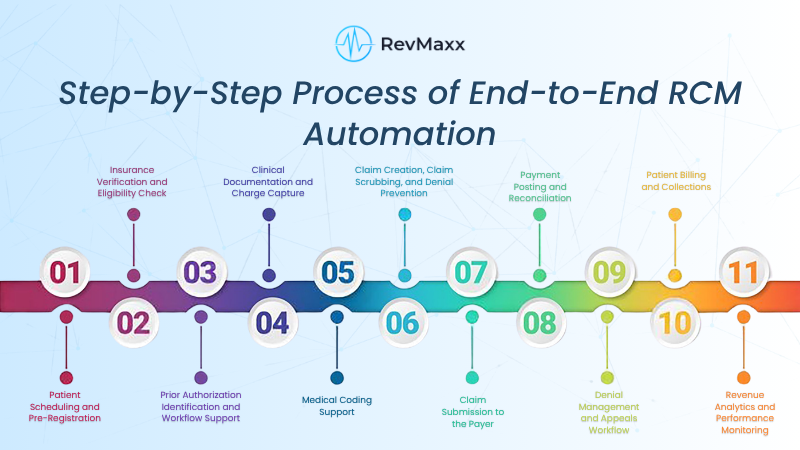
AI-powered revenue cycle management automation works by improving every stage of the revenue cycle, from the moment a patient books an appointment to the final payment collection. Instead of relying on disconnected manual work, AI helps practices reduce errors, speed up billing and improve cash flow through smart and connected workflows.
Patient Scheduling and Pre-Registration:
The process starts when a patient books an appointment. At this stage, AI RCM tools collect basic patient details such as name, date of birth, insurance information, and reason for visit. AI does the following:
- Checks if required information is missing
- Flags duplicate patient records
- Reduces manual registration errors
- Organize intake data in a structured format
If patient information is wrong at the beginning, the claim may get rejected later. AI RCM helps prevent those mistakes before they create billing issues.
Insurance Verification and Eligibility Check:
Once the patient is registered, AI RCM automatically verifies insurance coverage before the visit. AI does:
- Confirms whether the insurance policy is active
- Checks benefits, co-pay, deductible, and coverage limits
- Identifies if the payer requires referral or prior authorization
- Flags mismatched insurance details
This step helps practices avoid denied claims caused by inactive coverage or incorrect payer information.
Prior Authorization Identification and Workflow Support:
Some treatments, tests, or procedures need payer approval before the service is provided. AI RCM helps identify this requirement early. AI does here:
- Detects services that need prior authorization
- Matches payer rules with scheduled procedures
- Alerts staff before the patient visit
- Tracks authorization status and pending documents
Without prior authorization, the claim can be denied even if the treatment was medically necessary. AI helps prevent avoidable revenue loss.
Clinical Documentation and Charge Capture:
After the patient visit, the provider documents the care delivered. AI RCM helps make sure the documentation supports billing correctly.
- Reviews visit documentation for completeness
- Helps identify missing billable services
- Connects clinical notes with charge capture workflows
- Reduces missed charges and underbilling
If a service is performed but not documented properly, it may never be billed. AI helps practices capture all legitimate revenue.
Medical Coding Support:
Once documentation is complete, the next step is translating the visit into medical codes for billing. AI does here:
- Suggests appropriate CPT, ICD-10, or HCPCS codes
- Flags coding inconsistencies
- Identifies missing modifiers
- Supports coding accuracy and compliance review
Wrong coding can lead to underpayment, denials, or compliance issues. AI helps coders and billing teams submit cleaner claims.
Claim Creation, Claim Scrubbing, and Denial Prevention:
After coding, the claim is created and prepared for submission to the payer. Before it goes out, AI RCM checks it for errors.
- Reviews claims for missing or incorrect fields
- Applies payer-specific billing rules
- Flags formatting and coding conflicts
- Detects errors before submission
This is one of the most important steps in AI RCM automation. A cleaner claim means a higher chance of getting paid on the first submission.
Even before a payer denies a claim, AI RCM helps practices prevent them proactively.
- Identifies claims likely to be denied
- Uses past payer behavior and denial patterns
- Flags high-risk claims for correction before submission
- Helps billing teams focus on problem areas early
Claim Submission to the Payer:
Once the claim passes the validation stage, it is submitted electronically to the insurance company.
- Automates clean claim routing
- Prioritizes claims based on urgency or payer rules
- Tracks submission status
- Monitors whether claims are accepted, rejected, or pending
Faster and more accurate submission improves reimbursement timelines and reduces backlogs.
Payment Posting and Reconciliation:
Once the payer processes the claim, the payment comes back to the practice. AI RCM helps post and reconcile it correctly.
- Matches payments to submitted claims
- Automates ERA/EOB posting
- Flags underpayments or mismatched amounts
- Improves financial accuracy
Incorrect payment posting can hide revenue problems. AI helps practices know exactly what was paid and what is still missing.
Denial Management and Appeals Workflow:
If a claim is denied, AI RCM helps manage the denial more efficiently. What AI does here:
- Sorts denials by type and financial priority
- Identifies root causes
- Suggests the next action
- Supports appeal documentation and resubmission workflow
Not every denial should be handled the same way. AI helps teams focus on denials that are recoverable and financially important.
Patient Billing and Collections:
If there is still a remaining balance after insurance payment, the patient is billed. AI RCM does the following:
- Generates clear patient statements
- Sends reminders automatically
- Supports digital payment options
- Predicts payment behavior and follow-up timing
Patient collections are now a major part of healthcare revenue. AI helps improve collections while keeping the patient experience smoother.
Revenue Analytics and Performance Monitoring:
One of the biggest strengths of AI RCM automation is that it does not just process tasks. It also helps practices understand performance.
- Tracks KPIs like denial rate, A/R days, clean claim rate, and collection performance
- Finds recurring revenue leaks
- Shows workflow bottlenecks
- Helps leaders make better operational decisions
Without visibility, practices often react too late. AI helps teams see financial issues early and fix them faster.
Key Benefits of AI RCM for Healthcare Practices
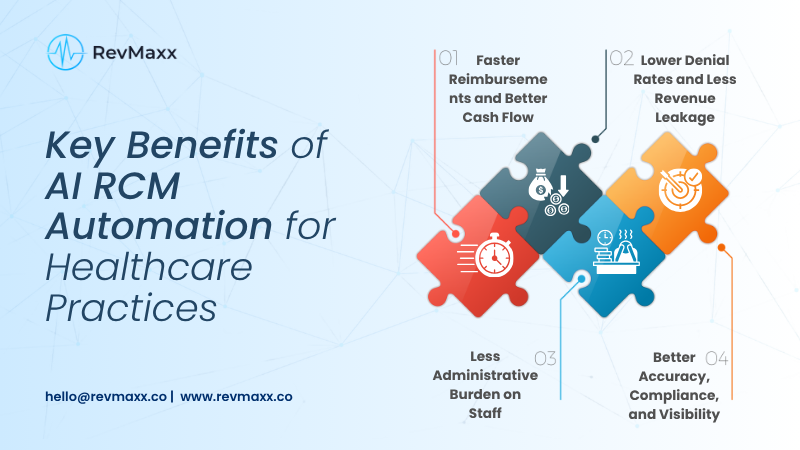
The biggest reason practices invest in AI RCM is simple: it helps them keep more of the revenue they already earned. It does this by reducing preventable errors, speeding up repetitive work, improving visibility, and helping staff focus on the tasks that actually need human attention. In a high-pressure environment, those gains matter financially and operationally.
Faster Reimbursements and Better Cash Flow
When claims go out cleaner and faster, payments usually follow. AI RCM reduces the lag caused by manual checks, incomplete information, and preventable rejections. It also shortens the time staff spend correcting the same types of errors over and over again. Faster reimbursement means better cash predictability and less stress on the business side of the practice.
Lower Denial Rates and Less Revenue Leakage
Denials often look like a payer problem, but many begin with data, coding, authorization, or documentation issues inside the workflow. AI RCM helps surface those issues earlier. That means fewer claims fall into the denial cycle in the first place. For practices already overwhelmed by rework, this is often one of the fastest areas where automation shows ROI.
Less Administrative Burden on Staff
Administrative overload is a major practice problem. The CAQH Index estimated a $20 billion opportunity to reduce waste by shifting more administrative tasks to automated workflows. When staff no longer spend hours on repetitive checks, manual posting, or avoidable claim cleanup, they can focus on higher-value work instead.
Better Accuracy, Compliance, and Visibility
AI RCM does not just help speed things up. It helps practices work with more consistency. Standardized workflows, cleaner claims, coding support, and better dashboards make it easier to see where money is being lost and where teams need support. That kind of visibility is hard to achieve when reporting is fragmented across separate systems.
Signs Your Practice Needs End-to-End RCM Automation
Many practices do not realize they need AI RCM until financial stress becomes visible. But there are warning signs long before that point. If your team is constantly reworking claims, chasing missing documentation, or explaining confusing patient balances, the workflow is likely carrying more manual friction than it should.
Common red flags include rising denials, frequent registration errors, slow prior authorization turnaround, increasing A/R days, staff overtime, missed follow-up, and poor reporting visibility. If leadership cannot clearly answer where revenue is getting delayed or lost, that alone is a signal that the process needs better automation and insight
What to Look for in an AI RCM Solution
Not every automation tool is true AI RCM. Some only solve one small problem. If a practice wants real revenue cycle improvement, it should look for a platform or workflow strategy that supports the full journey. That includes front-end validation, authorization support, coding assistance, claims edits, denial analytics, payment posting, patient billing, and actionable dashboards. This is where platforms like RevMaxx AI RCM Automation stand out—by connecting these workflows into a single, intelligent system rather than addressing them in isolation.
Integration also matters. The solution should work well with your EHR, practice management system, clearinghouse, and payer workflows. If the tool creates more data silos, it may add complexity instead of removing it. Solutions like RevMaxx are designed to work seamlessly within existing systems, reducing manual handoffs and improving visibility across departments—not just within one billing function.
Common Challenges When Implementing End-to-End RCM Automation
AI RCM is powerful, but implementation still matters. If data quality is poor, automation will only move bad data faster. If workflows are inconsistent, the system may struggle to deliver clean outcomes. That is why successful adoption usually begins with process cleanup, role clarity, and realistic change management- not just software selection.
Staff adoption is also important. Teams may worry that automation will replace them. In reality, the best AI RCM strategies usually support staff rather than remove them. They reduce repetitive work and help teams focus on exceptions, judgment, and patient-facing needs. The goal is not fewer people doing worse work faster. The goal is better systems helping people do smarter work.
Best Practices for Adopting AI RCM Successfully
The strongest AI RCM rollouts usually start with a revenue cycle assessment. Before choosing tools, practices should review denial patterns, intake quality, A/R performance, prior auth friction, and patient collections. That helps identify where the biggest financial drag exists today.
It also helps to start with high-impact areas first. Many practices begin with eligibility, claims edits, denials, or patient collections because those areas often show measurable ROI quickly. A phased rollout usually works better than trying to automate everything at once. AI RCM works best when people, process, and technology are aligned from the start.
Improved Financial Stability for Practices and Health Systems
At the end of the day, the goal is not just fewer denials. It is a stronger revenue engine. AI RCM helps organizations protect revenue, improve cash flow, reduce waste, and create a more stable financial base for growth. That matters whether you are a specialty practice trying to protect margins or a larger system managing complex payer relationships at scale.
The real value is durability. When your revenue cycle becomes more proactive, you are less exposed to the same avoidable issues month after month. That kind of consistency is what healthy collections are built on.
The Future of Revenue Cycle Management Is More Predictive
Revenue cycle management is moving away from reactive cleanup and toward proactive revenue intelligence. That means identifying risk before the claim goes out, estimating payment behavior before the bill is sent, and spotting workflow gaps before they become write-offs. That is exactly where end-to-end RCM automation creates long-term value.
Still, there is an important caution here. AI should improve workflows—not create new barriers. The AMA warned in 2025 that many physicians are concerned about inappropriate payer use of AI in prior authorization and denials. So the lesson is clear: AI RCM should be used to support transparency, accuracy, and patient access, not to automate bad decisions faster.
Conclusion
If your practice is dealing with rising denials, slow reimbursement, growing admin work, or weak visibility into revenue performance, AI RCM is no longer a “nice to have.” It is becoming a practical necessity. The revenue cycle is too connected and too financially important to keep managing it through disconnected manual workflows.
The real promise of end-to-end RCM automation is not just automation. It is control. Better data. Cleaner claims. Smarter follow-up. Faster payments. Less rework. And a better experience for both staff and patients. For practices trying to grow without letting revenue leakage grow with them, that is a very meaningful shift.