
Cash flow is the backbone of every medical practice. But many practices struggle to maintain steady revenue due to claim denials, billing errors, and slow reimbursements. This is where revenue cycle management automation plays a major role.
RCM automation helps healthcare providers manage billing, claims, and payments using technology instead of manual work. It reduces errors, speeds up processes, and improves collections. A study shows that automation in claims management alone can save providers nearly $25 billion annually.
So let’s read this blog carefully and learn how RCM automation improves cash flow.
What is Revenue Cycle Management Automation?
Revenue cycle management automation is the use of AI technology and rule-based systems to handle the entire billing and payment process in healthcare. It covers everything from patient registration to final payment collection.
Traditional RCM tasks were handled manually. Staff had to verify insurance, enter data, submit claims, and follow up on payments. This process was slow and prone to errors. Automation replaces these manual steps with intelligent systems that work faster and more accurately.
Key components of automated RCM include:
- Patient eligibility verification
- Medical coding and charge capture
- Claims submission and tracking
- Payment posting and reconciliation
Automation also uses AI to learn from past data. It can detect patterns, identify errors, and suggest improvements. This makes the entire revenue cycle more efficient.
Today, automation is not optional. With rising denial rates and increasing administrative workload, medical practices must adopt revenue cycle management automation to stay financially stable.
Why Cash Flow Is a Challenge for Medical Practices
Cash flow issues in healthcare are very common. Many practices provide care but struggle to collect payments on time.
One of the biggest problems is claim denials. Industry data shows that around 10–15% of claims are denied on the first submission.
This means a significant portion of revenue is delayed or lost.
Another issue is billing errors. Reports show that up to 80% of medical bills contain errors, which can lead to rework and payment delays.
There are also operational challenges:
- Incorrect patient information
- Missing prior authorizations
- Coding mistakes
- Delayed claim submissions
These issues increase accounts receivable (AR) days. Ideally, payments should be collected within 30 days. But many practices exceed this benchmark due to inefficiencies.
Poor cash flow affects:
- Staff salaries
- Operational costs
- Patient experience
This is why many practices are now turning to revenue cycle management automation to fix these problems.
7 Ways Revenue Cycle Management Automation Improves Cash Flow
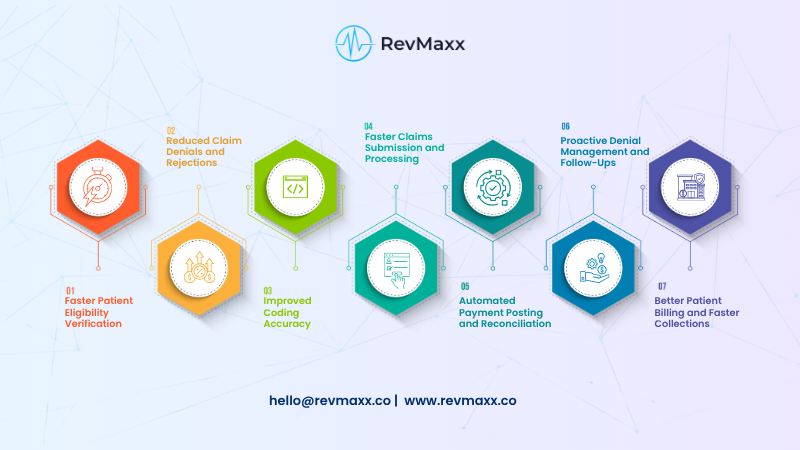
1. Faster Patient Eligibility Verification
Eligibility verification is the first step in the revenue cycle. If this step is wrong, the entire process fails.
Manual verification is slow and often inaccurate. Staff may enter incorrect insurance details or miss coverage issues. This leads to claim rejections later.
Revenue Cycle Management Automation solves this problem by verifying insurance in real time. It checks patient eligibility instantly and ensures that all required information is accurate.
Key Benefits
- Faster patient check-in process
- Reduced claim rejections due to eligibility errors
- Improved upfront collections
Automation also improves financial transparency. Patients know their coverage and out-of-pocket costs before treatment. This increases trust and payment rates.
2. Reduced Claim Denials and Rejections
Claim denials are one of the biggest threats to cash flow. Many of these denials are preventable.
Automation helps reduce denials by checking claims before submission. It identifies missing data, incorrect codes, and formatting issues.
Clean claim rates improve significantly with automation. Top-performing organizations achieve over 95% clean claim rates, compared to an average of around 85%.
Key Benefits
- Higher first-pass claim acceptance
- Lower administrative costs
- Faster reimbursements
Automation also learns from past denials. It identifies patterns and prevents the same errors from happening again.
3. Improved Coding Accuracy
Medical coding is complex. Even small errors can lead to claim denials or underpayments.
Studies show that coding errors contribute to about 12% of total claim denials. Revenue cycle management automation uses AI to assist with coding. It analyzes clinical documentation and suggests accurate codes.
Key Benefits
- Reduced coding errors
- Better compliance with regulations
- Higher reimbursement rates
Accurate coding ensures that providers are paid correctly for the services they deliver. It also reduces the need for rework and appeals.
4. Faster Claims Submission and Processing
Delays in claim submission directly impact cash flow. The longer it takes to submit a claim, the longer it takes to get paid.
Automation speeds up this process. Claims are generated and submitted instantly without manual delays.
It also integrates with clearinghouses and payer systems. This ensures that claims are processed quickly and efficiently.
Key Benefits
- Shorter revenue cycle
- Faster turnaround time
- Improved cash flow predictability
Faster submission means faster payment. This helps practices maintain steady revenue.
5. Automated Payment Posting and Reconciliation
Payment posting is another time-consuming task. Manual posting can lead to errors and delays.
Revenue cycle management automation matches payments with claims automatically. It also identifies discrepancies and flags them for review.
Key Benefits
- Faster revenue recognition
- Reduced accounting errors
- Better financial visibility
Automation ensures that every payment is tracked accurately. This improves financial reporting and decision-making.
6. Proactive Denial Management and Follow-Ups
Denial management is one of the most resource-intensive tasks in healthcare. In fact, 76% of revenue cycle leaders say it is their most time-consuming activity.
Automation helps by tracking denied claims in real time. It prioritizes high-value claims and automates follow-ups.
Some systems also use predictive analytics to identify claims that are likely to be denied.
Key Benefits
- Higher recovery rates
- Reduced AR backlog
- Improved staff productivity
Practices using structured workflows can reduce AR days by up to 40%.
7. Better Patient Billing and Faster Collections
Patient payments are becoming a larger part of healthcare revenue. But collecting from patients is often difficult.
Automation improves patient billing by generating accurate statements and offering digital payment options.
Studies show that 50% of patients would switch providers for better payment experiences.
Key Benefits
- Faster patient payments
- Improved patient experience
- Increased collection rates
Automated reminders and easy payment options make it easier for patients to pay on time.
Additional Benefits of Revenue Cycle Management Automation
Beyond improving cash flow, revenue cycle management automation offers several other advantages. It reduces administrative workload. Staff spend less time on repetitive tasks and more time on patient care. Automation also improves compliance. It ensures that all billing and coding processes follow regulations.
Real-time reporting is another major benefit. Practices can track performance metrics such as denial rates, AR days, and collection rates instantly. Automation also supports scalability. As a practice grows, automated systems can handle an increased workload without adding more staff.
Finally, it integrates easily with EHR and practice management systems. This creates a seamless workflow across the organization.
How to Successfully Implement Revenue Cycle Management Automation
Implementing Revenue Cycle Management Automation requires careful planning and a clear strategy. It is not just about adopting new technology. It is about improving your entire financial workflow.
Start by assessing your current revenue cycle. Review each step, from patient registration to final payment. Identify where delays, errors, or revenue leaks happen. Many practices lose 10–15% of net revenue due to inefficient RCM processes.
Next, choose the right automation tools. Not all solutions are the same. Look for platforms like RevMaxx RCM automation solutions that integrate easily with your EHR and practice management systems. A good solution should support eligibility verification, coding, claims management, and payment posting in one place.
Data security is also important. Make sure the system is HIPAA-compliant and protects patient information at every stage.
Training your staff is a critical step. Even the best automation tools fail if teams do not know how to use them. Provide hands-on training and ongoing support. Help staff understand how automation reduces their workload instead of replacing them.
It is also important to redesign workflows. Do not just automate old processes. Improve them. Remove unnecessary steps and create a smoother, faster workflow.
Monitor key performance indicators (KPIs) regularly to measure success:
- Denial rates
- Accounts receivable (AR) days
- First-pass claim acceptance rate
- Collection rates
- Cost to collect
According to MGMA, top-performing practices maintain AR days below 30–40 days, which can be achieved with strong automation and monitoring.
Start small and scale gradually. Begin with high-impact areas like eligibility verification or claims submission. Once you see results, expand automation to other parts of the revenue cycle.
Finally, review performance regularly and optimize your system. Revenue cycle management automation is not a one-time setup. It is an ongoing process that improves over time with better data and insights.
A well-planned implementation can help practices reduce errors, improve cash flow, and build a more efficient and scalable financial system.
Common Mistakes to Avoid When Adopting RCM Automation
Many practices make mistakes when adopting revenue cycle management automation. These mistakes can reduce the overall impact of automation and even create new inefficiencies if not handled properly.
- One common mistake is partial automation. Many practices automate only one or two steps, such as claims submission or eligibility checks, while keeping the rest manual. This creates gaps in the workflow. True value comes when the entire revenue cycle is connected. End-to-end RCM automation improves accuracy and reduces delays across all stages.
- Another major mistake is ignoring staff training. Automation does not work on its own. Teams must understand how to use the system correctly. Without training, staff may rely on old habits or enter incorrect data. This can lead to errors instead of improvements. According to industry reports, lack of user adoption is one of the top reasons why healthcare IT projects fail.
- Poor system integration is also a serious issue. If your automation tool does not connect well with your EHR, billing software, or payer systems, it can create data silos. This leads to duplicate work and inconsistent information. Seamless integration ensures smooth data flow and better decision-making.
- Some practices also fail to track performance metrics. Without clear data, it is difficult to measure success or identify areas for improvement. Key metrics like denial rates, AR days, and collection rates should be monitored regularly.
- Another mistake is choosing the wrong vendor. Some solutions may look good but do not meet the specific needs of your practice. Always evaluate features, scalability, support, and compliance before making a decision.
- Ignoring change management is another risk. Staff may feel uncertain or resistant when new systems are introduced. Clear communication and leadership support are important to ensure a smooth transition.
- Lastly, many practices expect instant results. Automation improves performance over time, not overnight. It requires continuous monitoring, optimization, and updates.
Avoiding these mistakes is key to achieving the full benefits of revenue cycle management automation and building a strong financial foundation.
Leveraging RevMaxx RCM Automation Within Your Implementation Strategy
As you evaluate and select the right automation tools, integrating a solution like RevMaxx RCM automation can help streamline your transition more effectively. Designed to work seamlessly with existing EHR and practice management systems, RevMaxx supports key functions such as real-time eligibility verification, AI-assisted coding, claim submission, and automated payment posting within a unified workflow.
To ensure a smooth implementation, start by deploying RevMaxx in high-impact areas like claim submission or denial management, where immediate improvements can be seen. This aligns well with a phased approach—allowing your team to gradually adapt while maintaining operational continuity. As workflows are redesigned and optimized, RevMaxx enables better coordination across the revenue cycle, reducing manual touchpoints and improving overall efficiency.
With built-in reporting and performance tracking, practices can monitor KPIs such as denial rates, AR days, and collection efficiency in real time. Combined with proper staff training and continuous optimization, integrating RevMaxx into your automation strategy helps create a more connected, accurate, and scalable revenue cycle system.
The Conclusion
Revenue cycle management automation is no longer a luxury. It is a necessity for medical practices. From reducing claim denials to speeding up payments, automation improves every stage of the revenue cycle.
The benefits are clear: faster reimbursements, reduced errors, improved patient collections, and better financial stability. With rising costs and increasing complexity in healthcare, practices must adopt automation to stay competitive.
Investing in RCM Automation today can lead to stronger cash flow and long-term growth in the future.