Healthcare documents continue to pose significant challenges when providing care today. A substantial proportion of the clinician’s day is consumed by electronic health records instead of providing direct patient interaction. Research indicates that physicians typically utilize two hours developing documentation and electronic health record (EHR) records for all 60 minutes of time spent receiving hands-on patient treatment. This significant burden caused by the documentation load is a massive contributor to the high level of physician burnout and the physician workforce shortage problem in the USA.
In conjunction with other efforts to mitigate physician documentation problems, artificial intelligence (AI) platforms for physician documentation creation are appearing to provide assistance in creating physician documentation. AI platforms create structured medical notes from the clinical conversation captured and provided to the clinician at the point of patient care. They promise faster documentation, better accuracy, and improved compliance. However, not all AI tools are equal. Some only transcribe speech. Others lack EHR integration or clinical understanding.
That is why healthcare leaders need a structured AI documentation platform checklist before choosing a solution. This guide explains what to evaluate, what risks to avoid, and how to select the right AI documentation platform for your organization.
Why Healthcare Organizations Need an AI Documentation Platform Checklist
Healthcare organizations today face an overwhelming number of AI documentation vendors. Ambient AI scribes, voice tools, and EHR copilots are entering the market rapidly. While innovation is positive, it also creates confusion for buyers.
The impact of clinical documentation on patient safety, billing accuracy, compliance, and continuity of care is profound. The right AI platform is critical to minimizing these risks. A poorly designed or educated AI can misread the clinical context surrounding an event. Integration with other clinical systems may be lacking, creating workflow disruptions, and weak security measures expose patient information.
The process for purchasing healthcare technology can be complicated. There are many participants, including clinicians, IT personnel, and compliance and finance, who evaluate different components of an acquisition. To be sure all five groups are utilizing the same criteria to evaluate potential vendor products, the use of a formalized checklist can assure this occurs.
Research shows clinician trust is a major barrier to AI adoption. Early documentation tools often required heavy editing or produced inaccurate notes. When clinicians lose trust, adoption drops quickly. A checklist helps organizations identify trustworthy platforms from the start.
So, in simple words, an AI documentation platform checklist reduces risk, supports objective comparison, and improves long-term success.
What Is an AI Documentation Platform in Healthcare?
An AI documentation platform is a healthcare software system that uses AI, or artificial intelligence, to automate the clinical documentation process. It captures patient-provider conversations during visits and converts them into structured medical notes.
These platforms are designed to work alongside EHR systems. They help clinicians document visits faster and more accurately. Instead of typing or dictating long notes, providers review and approve AI-generated documentation.
The goal is simple: reduce administrative burden while improving documentation quality.
Types of AI Documentation Platforms
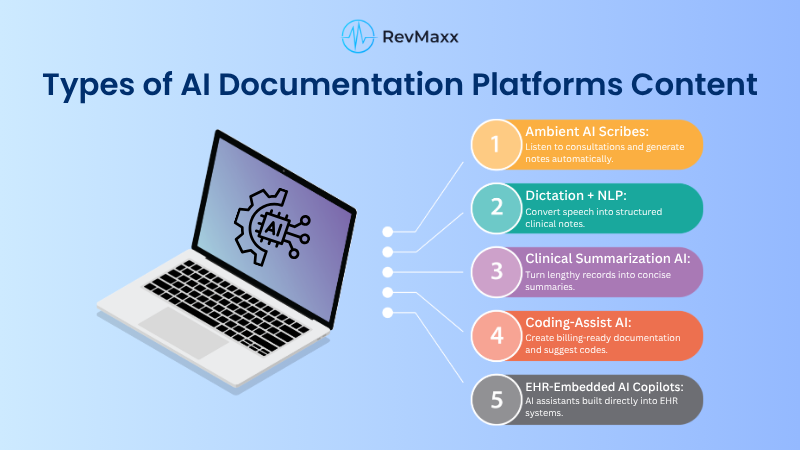
There are several categories of AI documentation tools in healthcare today.
- Ambient AI scribes listen to clinician-patient conversations and generate notes in real time. They require little manual interaction.
- Dictation with NLP tools converts speech into text and then structures it into clinical notes.
- Clinical summarization AI transforms existing documentation into concise summaries.
- Coding-assist documentation AI focuses on billing-ready documentation and code capture.
- EHR-embedded AI copilots are built directly into electronic health record systems.
Each type serves different needs. Organizations should select based on workflow and documentation goals.
How AI Documentation Differs from Traditional Tools
Traditional documentation tools rely on templates, manual typing, or simple transcription. They capture words but do not understand clinical meaning.
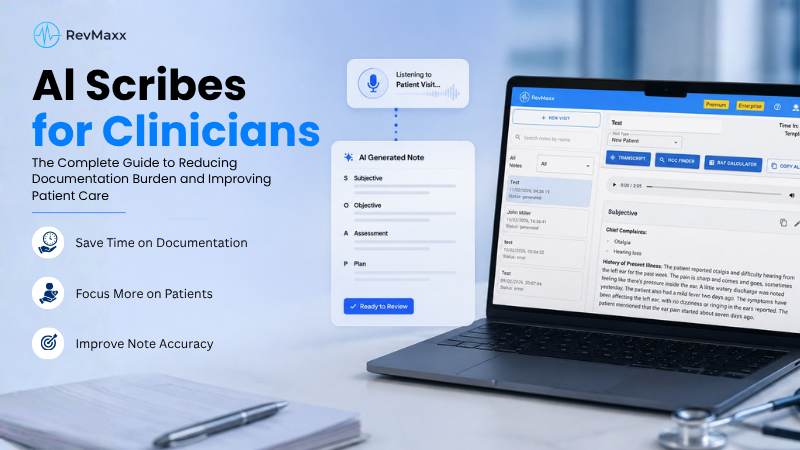
Modern AI documentation platforms go further. They interpret context, identify clinical elements, and structure information into medical formats such as SOAP notes. They also work in real time during encounters, not after visits.
This shift from transcription to clinical understanding is what makes AI documentation transformative.
The Complete AI Documentation Platform Checklist for Healthcare Buyers
Selecting an AI documentation platform requires careful evaluation across multiple dimensions. The following checklist covers the most important factors healthcare organizations should assess.
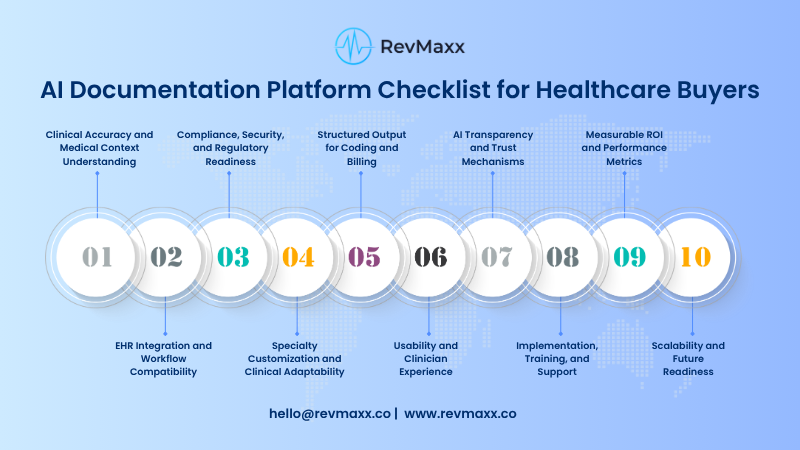
Clinical Accuracy and Medical Context Understanding
Clinical accuracy is the most critical factor in any AI documentation platform. The system must correctly capture patient history, symptoms, diagnoses, and plans without misinterpretation.
Organizations should evaluate whether the AI understands medical terminology and clinical nuance. It should distinguish between past and current conditions, medications, and procedures. Specialty-specific understanding is also essential. For example, cardiology documentation differs significantly from behavioral health or primary care.
The platform should generate structured clinical notes rather than raw transcripts. SOAP, or problem-oriented formats, improves clarity and usability. Buyers should also examine how the vendor prevents hallucinations or incorrect statements.
Clinician review workflows are important. Providers must be able to easily edit and validate notes before finalization. Platforms that learn from edits often improve accuracy over time.
Accurate documentation supports patient safety, continuity of care, and correct billing. Errors can have serious clinical and financial consequences.
EHR Integration and Workflow Compatibility
An AI documentation platform must integrate seamlessly with existing EHR systems. Poor integration is one of the main reasons healthcare IT tools fail.
Organizations should assess whether the AI writes directly into structured EHR fields. Copy-paste workflows create extra work and increase error risk. True integration allows notes, problems, medications, and orders to sync automatically.
Compatibility with major EHR standards such as FHIR or HL7 is also important. These standards enable interoperability and future scalability.
Workflow alignment is equally critical. The AI should operate within the clinician’s normal documentation process. It should not require switching screens or duplicate data entry. Platforms that run in the background or inside the EHR interface reduce disruption.
When AI fits naturally into workflows, adoption increases and documentation burden decreases.
Compliance, Security, and Regulatory Readiness
AI documentation platforms handle protected health information, so security and compliance are essential. Healthcare organizations must verify that vendors meet regulatory requirements.
HIPAA compliance is the baseline expectation. Platforms should encrypt data both in transit and at rest. Access controls must ensure only authorized users can view or edit documentation. Audit trails should record all activity for accountability.
Data storage policies also matter. Organizations should know where data is stored and how long it is retained. Some providers require on-premises or regional storage options for regulatory reasons.
Certifications such as SOC 2 or HITRUST demonstrate strong security practices. Vendors should also provide a Business Associate Agreement.
Security failures in documentation platforms can expose sensitive patient data and create legal risk. Compliance readiness is therefore a non-negotiable checklist item.
Specialty Customization and Clinical Adaptability
Healthcare documentation varies widely across specialties and care settings. A generic AI model may perform poorly outside general practice. Organizations should assess whether the platform supports specialty customization.
The AI should adapt to different clinical vocabularies, workflows, and documentation styles. For example, surgical notes require procedure details, while mental health notes emphasize behavioral observations and assessments.
Customization should also extend to care settings such as inpatient, ambulatory, long-term care, or rehabilitation. Templates, language models, and note structures should reflect these environments.
Platforms that learn from clinician edits and feedback can improve specialty accuracy over time. This adaptability supports long-term usability. Without customization, clinicians may need heavy editing, reducing efficiency and trust.
Structured Output for Coding and Billing
Clinical documentation directly affects reimbursement. Incomplete or vague notes can lead to missed billing opportunities or compliance issues. AI documentation platforms should therefore produce coding-ready output.
Organizations should evaluate whether the system captures diagnoses, procedures, and risk factors clearly. It should support ICD-10 and CPT coding requirements. Risk-adjustment documentation, such as HCC capture, is also important for value-based care.
Structured problem lists, medication details, and assessment plans improve coding accuracy. Platforms that map documentation to billing elements can enhance revenue cycle performance.
Studies indicate documentation improvement technologies can increase coding accuracy and revenue capture. AI tools that support structured billing documentation can therefore deliver measurable financial value.
Usability and Clinician Experience
Even the most advanced AI platform will fail if clinicians find it difficult to use. Usability is therefore a key checklist category.
The system should require minimal clicks or commands during patient visits. Real-time note generation reduces after-hours charting. Ambient or voice capture options allow clinicians to focus on patients rather than screens.
Editing and review workflows should be simple and fast. Clinicians should not spend significant time correcting AI output. Training requirements should also be reasonable. Platforms with steep learning curves often face adoption resistance.
Research shows physicians spend up to 49–55% of their workday on EHR and administrative tasks, contributing to burnout. AI documentation platforms should aim to reduce this burden, not add to it. Good usability supports clinician satisfaction and long-term adoption.
AI Transparency and Trust Mechanisms
Trust is essential in clinical AI. Clinicians must understand how the AI generated documentation and be able to verify accuracy.
Platforms should provide transparency features such as highlighted extracted data, source traceability, or confidence indicators. These features help clinicians review notes efficiently and identify potential errors.
Explainable AI logic can also improve confidence. For example, showing which part of a conversation generated a specific clinical statement allows validation.
Human-in-the-loop workflows further strengthen trust. Clinicians remain the final authority, while AI acts as an assistant. Platforms that detect inconsistencies or missing information can prompt clinicians to review.
Transparent AI systems encourage acceptance and reduce fear of automation errors.
Implementation, Training, and Support
Successful AI adoption depends on implementation quality. Organizations should evaluate vendor support during deployment and beyond.
Deployment timelines vary widely. Some platforms integrate within weeks, while others require months. Vendors should provide clear implementation plans and integration assistance.
Training programs are also critical. Clinicians and staff need guidance on using the platform effectively. Change-management support helps organizations transition workflows smoothly.
Ongoing optimization and customer support ensure long-term success. Vendors should monitor performance, gather feedback, and refine AI models.
Healthcare IT projects often fail due to poor implementation rather than technology limitations. Strong vendor support reduces this risk.
Measurable ROI and Performance Metrics
AI documentation platforms represent a significant investment. Healthcare organizations must evaluate return on investment carefully.
Key ROI metrics include documentation time reduction, decreased after-hours charting, improved clinician productivity, and increased visit capacity. Coding accuracy and revenue improvement are also important financial indicators.
Studies show AI documentation tools can reduce documentation time by 30–40% in some clinical settings. Burnout reduction and clinician retention also contribute to ROI. Replacing a physician can cost hundreds of thousands of dollars. AI tools that improve job satisfaction provide indirect financial value.
Organizations should request vendor case studies and measurable outcomes. Evidence-based ROI strengthens procurement decisions.
Scalability and Future Readiness
Healthcare organizations evolve over time. AI documentation platforms must scale across sites, specialties, and user groups.
Buyers should evaluate whether the platform supports enterprise deployment. Multi-site configuration, centralized governance, and analytics capabilities are important for large organizations.
Continuous AI model improvement is also essential. Medical knowledge and regulations change regularly. Vendors should update models to reflect new guidelines and documentation requirements.
Future readiness includes an integration roadmap, interoperability expansion, and regulatory adaptability. Platforms that cannot scale may require replacement later, increasing costs.
Selecting a scalable solution ensures long-term value.
How to Use This AI Documentation Platform Checklist in Procurement
Healthcare organizations can apply the checklist through a structured evaluation process.
- First, define clinical and operational goals. These may include reducing documentation time, improving coding accuracy, or supporting value-based care. Clear goals guide vendor selection.
- Next, identify stakeholders across clinical, IT, compliance, revenue cycle, and operations teams. Each group provides unique requirements and evaluation criteria.
- Organizations should map existing documentation workflows and identify pain points. Vendors can then demonstrate how their platform addresses these needs.
- Shortlisted vendors can be scored against checklist categories such as accuracy, integration, security, usability, and ROI. Pilot testing in real clinical settings provides practical insights.
- Outcome measurement is essential. Metrics such as documentation time, note quality, and clinician satisfaction determine final selection.
This structured approach ensures informed and collaborative decision-making.
The Conclusion
AI documentation platforms are transforming healthcare documentation. They offer the potential to reduce clinician burden, improve accuracy, and enhance care quality. However, choosing the right platform requires careful evaluation.
A structured AI Documentation Platform Checklist helps organizations assess accuracy, integration, compliance, usability, and ROI objectively. It aligns stakeholders and reduces procurement risk.
Healthcare leaders should prioritize platforms that fit existing workflows, produce structured clinical output, and demonstrate measurable benefits. Pilot testing before full deployment ensures real-world effectiveness.
Ultimately, the right AI documentation platform, like RevMaxx AI scribe, restores clinician time, supports better documentation, and improves patient care. With a clear checklist and evidence-based evaluation, organizations can adopt AI documentation with confidence and long-term success.