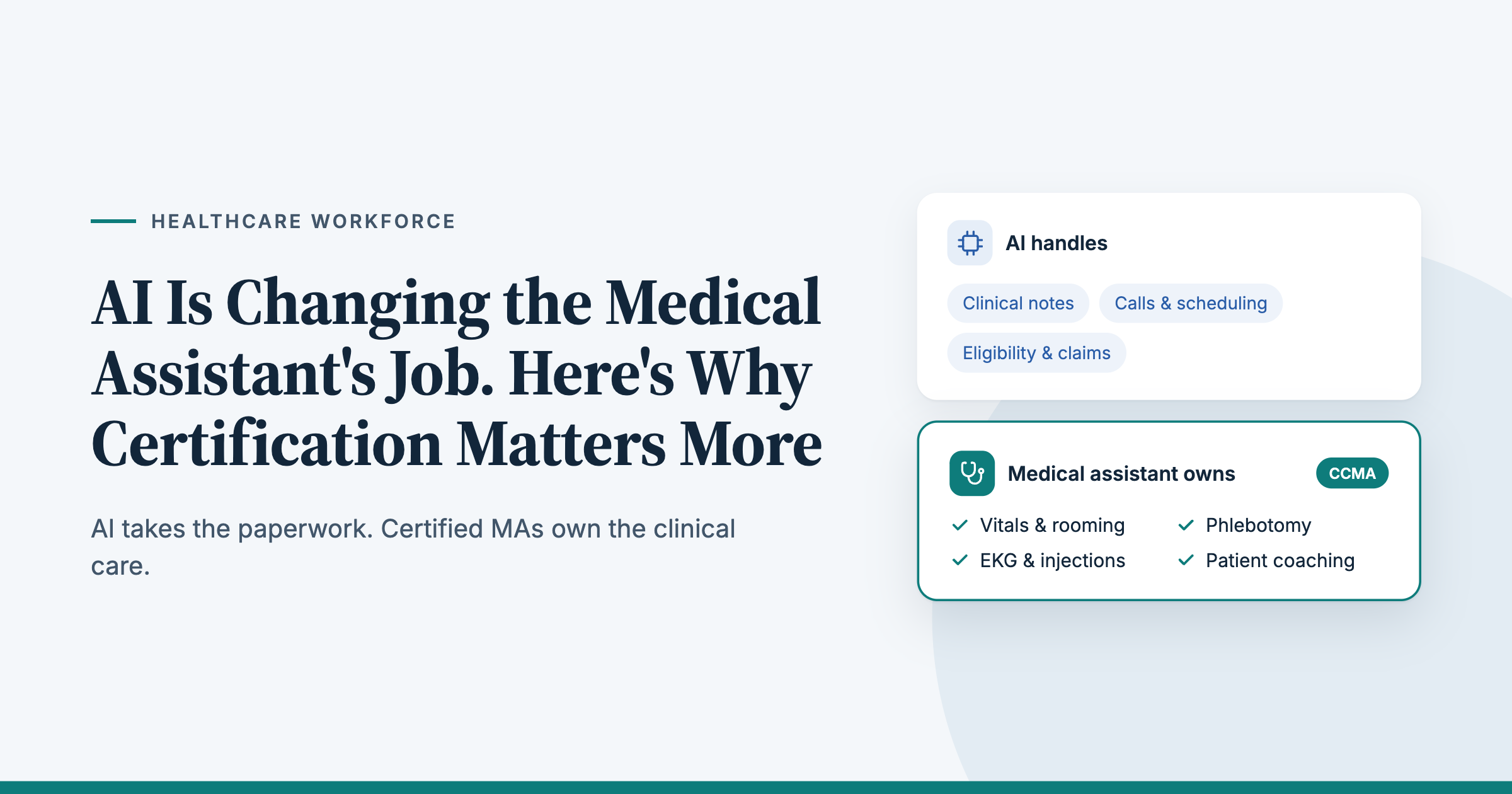
Ambient AI scribes, virtual front desks, and automated billing are no longer pilot projects. They are showing up in everyday outpatient practice, and practice managers are asking a fair question: if software now handles so much of the paperwork, what happens to the medical assistants who used to do it?
The short answer is that the medical assistant’s role is shifting, not shrinking. As AI absorbs documentation and phone traffic, MAs spend more of their day on hands-on clinical work. That work carries higher stakes, and it is exactly what certification exams like the Certified Clinical Medical Assistant (CCMA) are designed to test.
Below, we look at what AI is taking over, what stays firmly human, and how practices can prepare their MA teams for the change.
What AI Takes Off the Medical Assistant’s Plate
In many practices, medical assistants have always juggled a mix of administrative and clinical duties. AI tools are now picking up a growing share of the administrative side:
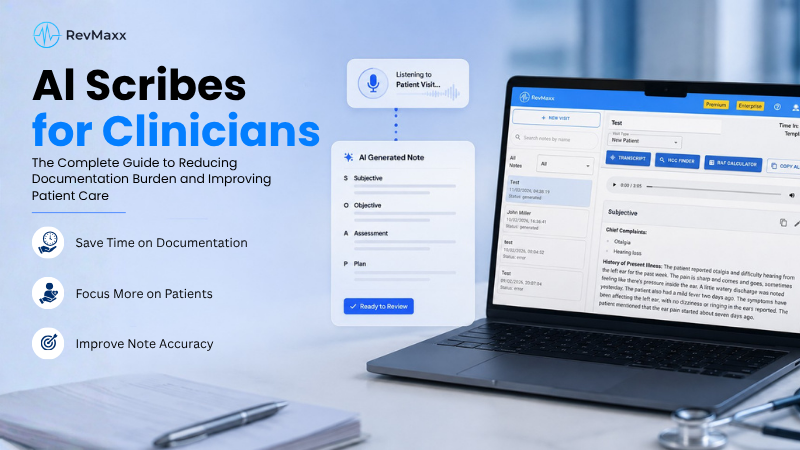
- Documentation. An ambient AI medical scribe listens to the visit and drafts the clinical note, which the provider reviews and signs. MAs spend far less time typing intake details into the EHR after the patient has left.
- Phones and scheduling. An AI front desk answers calls, books and reschedules appointments, and sends reminders around the clock, so MAs are not pulled out of the exam room to pick up the phone.
- Pre-visit and billing tasks. Eligibility checks, prior authorization steps, and claim scrubbing are increasingly handled by AI revenue cycle automation instead of being done by hand between patients.
None of this removes the need for staff. It removes repetitive work that kept skilled people away from patients. The real question for practice leaders is what to do with the time that frees up.
What Stays Human
Software can transcribe a conversation, but it cannot draw blood or calm a nervous patient. The work that remains with medical assistants is the work that needs hands, judgment, and presence:
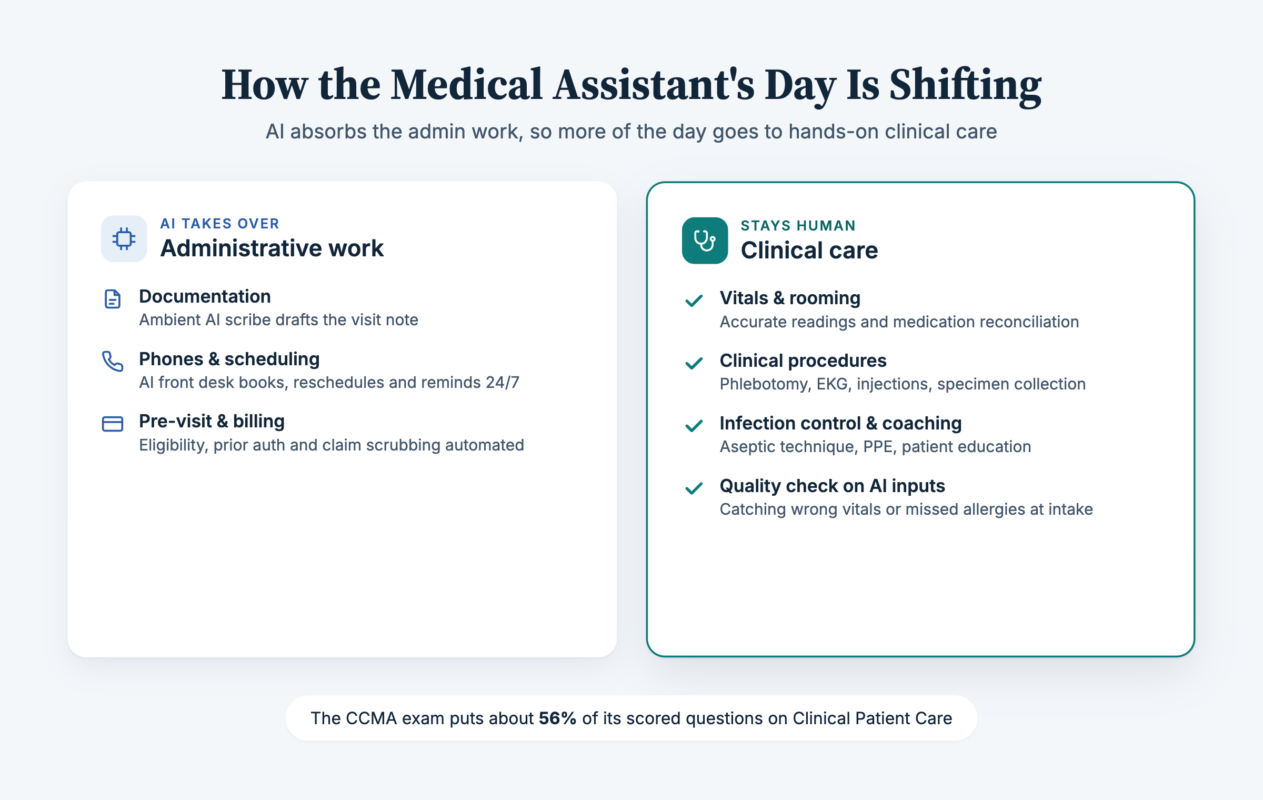
- Vital signs and rooming. Accurate blood pressure, pulse, and temperature readings, plus medication reconciliation at intake.
- Clinical procedures. Phlebotomy, capillary punctures, EKG lead placement, injections, and specimen collection.
- Infection control. Hand hygiene, aseptic technique, correct PPE use, and safe sharps handling.
- Patient coaching. Explaining prep instructions, showing a patient how to use an inhaler, and reinforcing the care plan in plain language.
- Quality control on AI inputs. An AI-drafted note is only as good as the information captured during the visit. A wrong vital sign or a missed allergy at intake flows straight into the record.
That last point is easy to overlook. As more of the chart is assembled automatically, the accuracy of what MAs measure and record matters more, not less. Accurate clinical documentation starts at intake, and a trained eye that catches an implausible reading is one of the strongest safeguards a practice has.
Why CCMA Certification Matters More Now
The CCMA, offered by the National Healthcareer Association (NHA), is one of the most widely recognized credentials for clinical medical assistants. Many employers require it or strongly prefer it.
What stands out about the exam is how closely it lines up with the work AI cannot do. Of its seven content domains, Clinical Patient Care makes up about 56% of the scored questions, covering intake and vitals, infection control, point-of-care testing, phlebotomy, and EKG. The remaining six domains, from anatomy and physiology to medical law and ethics, each account for 10% or less.
Key exam facts at a glance:
- Format: 180 multiple-choice questions, 150 of them scored
- Time limit: 3 hours
- Passing score: a scaled score of 390 on a 200–500 scale
- Renewal: every two years, with 10 continuing education credits
For a practice adopting AI tools, a certified MA brings verified competence in exactly the tasks that now fill more of the day. Certification also gives the practice a clear standard to hire and train against as roles evolve.
Practical Steps for Practices
- Map tasks before you roll out AI. List what each MA does on a typical day, then mark which tasks the new tools will absorb. This shows where time will free up and where skill gaps may appear.
- Redeploy the time into clinical care. Put the hours saved into more thorough intake, patient education, care coordination, and in-house testing, not just into squeezing in more visits.
- Support certification for uncertified staff. Cover the exam fee (about $169; confirm current pricing at nhanow.com) and set aside protected study time. Before booking the exam, staff can take Career Employer’s free CCMA practice test to see their results broken down by domain and focus their study where it counts.
- Train MAs on the AI tools themselves. Make sure they understand what the scribe captures, how it fits into the EHR workflow, how to correct intake errors, and when to flag a problem to the provider.
- Track the results. Watch documentation accuracy, patient wait times, and staff turnover after rollout. These numbers show whether the new workflow is actually working for your team and your patients.
Frequently Asked Questions
Will AI replace medical assistants?
No. AI is taking over repetitive administrative work such as note drafting, phone calls, and claim checks. Clinical tasks like vitals, phlebotomy, injections, and patient coaching still need a trained person in the room.
Which medical assistant tasks are being automated?
Mainly documentation, appointment scheduling and reminders, insurance eligibility checks, prior authorization steps and claim scrubbing.
Is CCMA certification still worth it with AI in the clinic?
Yes. More than half of the CCMA exam covers clinical patient care, which is the part of the job AI cannot do. As administrative work shrinks, those clinical skills make up a bigger share of an MA’s value.
Conclusion
AI is taking over much of the paperwork that once filled a medical assistant’s day. That is good news for staff and patients alike, but only if practices invest in the skills that remain.
The tasks left in human hands are the clinical ones: measuring accurately, performing procedures safely, and catching the errors no algorithm will notice. Certification is the clearest way to confirm those skills are in place. Practices that pair smart automation with well-trained, certified MAs will get the most out of both.