
Billing rarely gets attention until something goes wrong. A batch of claims comes back denied, a payer stops covering a common procedure, or the monthly collections report looks thinner than it should. Behind each of those moments is a process that didn’t run the way it was supposed to. When billing is accurate and consistent, claims get paid on time, staff aren’t stuck redoing work, and leadership can plan with real numbers. When it isn’t, the practice pays twice: once in lost or delayed revenue and again in the hours spent fixing mistakes. That’s why many healthcare organizations take a closer look at who handles their billing and how.
Common Challenges in Managing Medical Billing In-House
Running billing internally gives you direct control, and for some organizations it works well. But it also puts a lot of pressure on a small group of people. Most in-house billing teams are lean, and they’re expected to keep up with every payer, every code update, and every patient question. Turnover makes this harder. When an experienced biller leaves, they take months of knowledge with them, and a replacement needs time to learn your payers and systems. Meanwhile, claims keep coming in. Even well-run teams can slip into a pattern where they’re always reacting to problems instead of preventing them, simply because there aren’t enough hours in the week.
Payer Rules and Coding Complexity
Payer requirements are one of the biggest sources of friction. Each insurer has its own rules for prior authorizations, modifiers, documentation, and filing deadlines, and those rules change regularly. Coding adds another layer. ICD-10, CPT, and HCPCS codes are updated every year, and specialty billing often involves combinations that are easy to get wrong. A single mismatch between the diagnosis and the procedure can trigger a denial. Keeping up means ongoing training, reading payer bulletins, and double-checking claims before they go out. For an in-house team that’s already busy, that level of attention is hard to sustain day after day without something slipping through.
When Backlogs and Denials Start to Pile Up
Once the team falls behind, problems tend to compound. Here’s how it usually plays out:
- Slower submission. Claims wait longer because coding questions sit unanswered.
- Missed deadlines. Some claims pass the payer’s filing limit and can’t be billed at all.
- Growing denial queues. Denials stack up faster than anyone can review them.
- Write-offs. Unworked denials age out and turn into lost revenue.
- Late patient statements. Balances go out late, which leads to more confusion and calls.
Limited internal resources make this cycle hard to break, because the same people handling today’s claims are also expected to clean up last month’s.
How Specialized Billing Support Improves Workflow Consistency
The main advantage of specialized support is consistency. Instead of billing depending on whoever happens to be available, the work follows standardized procedures every time. Claims get reviewed against the same checklist, submitted on a set schedule, and tracked from start to finish. With professional medical billing services, you also get dedicated billing resources: people whose full-time job is your revenue cycle, with backup coverage when someone is out. That removes the single-point-of-failure problem many practices face. When the process runs the same way on a busy Monday as on a slow Friday, errors drop and payment timelines become far more predictable.
Claim Tracking, Follow-Up, and Operational Visibility
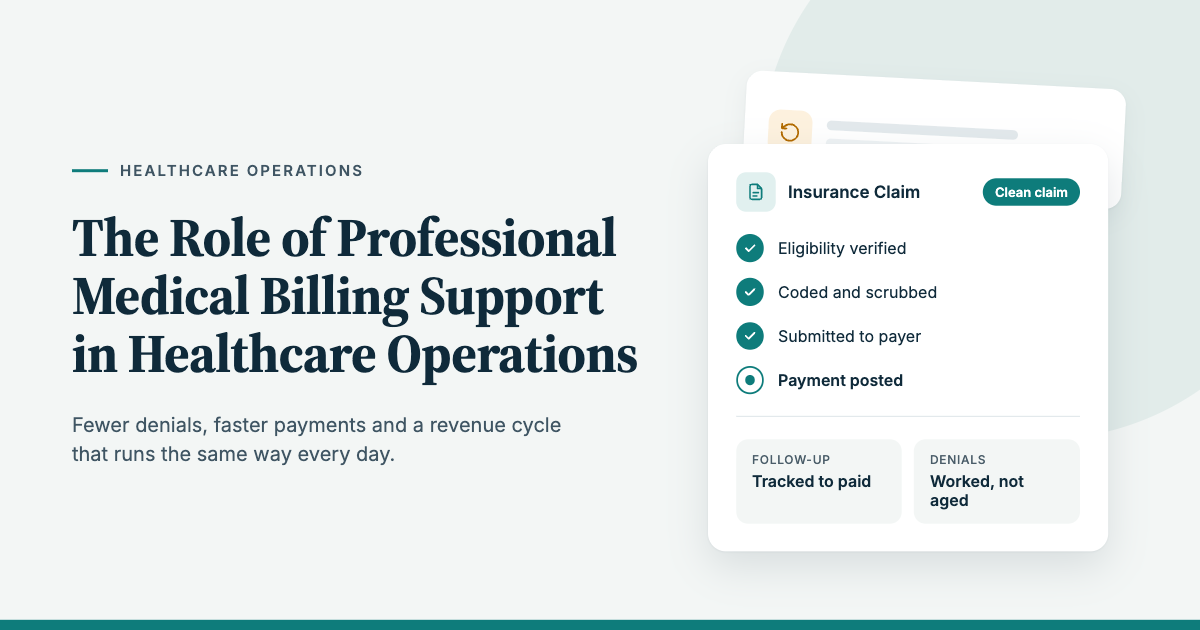
Consistency also shows up after a claim is submitted. Specialized billing teams track every claim until it’s paid, not just the ones that cause trouble. If a payer hasn’t responded within a set window, someone follows up. If a claim is denied, it goes into a defined workflow: identify the reason, correct the issue, resubmit or appeal, and log the outcome. Over time, that log reveals patterns, like a specific payer rejecting a certain code, so the root cause can be fixed. Operational visibility improves too. Instead of guessing, you get regular reports on denial rates, days in accounts receivable, and collections, which makes it easier to spot problems early.
Beyond Billing: The Value of Healthcare-Specific Operational Support
Billing doesn’t happen in isolation. It depends on what happens at registration, during scheduling, and in clinical notes. That’s why many healthcare outsourcing companies offer support beyond claims alone. Depending on the provider, this can include insurance eligibility verification, prior authorization management, payer credentialing, patient billing support, and recovery of older accounts receivable. Some also run revenue cycle audits that show where money is leaking across the whole process. Having one partner handle connected tasks means fewer handoffs and fewer gaps where information gets lost between departments or vendors, which keeps the entire back office moving in the same direction.
Why Healthcare Specialization Matters
General back-office vendors can process paperwork, but healthcare operations come with their own rules. A partner focused on healthcare understands HIPAA requirements, payer contracts, and how clinical documentation ties into reimbursement. They know that credentialing delays can stop a new provider from billing for months, or that a missed authorization can wipe out payment for an expensive procedure. That context helps them catch problems early. Companies such as Pharmbills healthcare solutions show how a specialized provider can combine billing with related back-office services. The real benefit is that your internal team can step back from administrative firefighting and focus on patients.
Evaluating the Right Billing Model for Your Organization
There’s no single billing model that works for everyone. A fully in-house approach gives you direct oversight and keeps everything inside your walls. It can work well for organizations with stable staffing, strong billing leadership, and enough volume to justify a full team and software. The trade-off is that you carry all the risk of turnover, training, and keeping up with regulatory changes. A fully outsourced approach shifts most of that work to a partner. It often suits practices that are growing quickly, struggling to hire, or dealing with persistent denials. The trade-off here is that you need clear agreements, solid reporting, and trust in the partner’s processes.
Is a Hybrid Approach Right for You?
Many organizations land somewhere in the middle. In a hybrid model, the internal team keeps tasks that rely on direct patient contact, like front-desk collections and billing questions, while an outside partner handles coding, claim submission, denial management, or aging accounts. This setup can also be temporary, for example, to clear a backlog or cover a staffing gap. To figure out which model fits, look at your current denial rate, days in accounts receivable, staffing stability, and growth plans. Be honest about where the process breaks down. The right choice is the one that keeps revenue steady without overloading the people who keep your organization running.