
Every AI model is only as reliable as the data it learns from. Whether a company is building a computer vision system, a speech recognition engine, or a large language model, the quality, diversity, and relevance of its training data directly determine how the model performs in real-world conditions. This is why more organizations are partnering with experienced providers of AI data collection services instead of attempting to gather and prepare datasets entirely in-house. A structured, well-managed data collection process reduces risk, shortens development cycles, and gives machine learning teams the confidence that their models are built on a solid foundation.
The Growing Demand for Training Data
As AI adoption accelerates across industries, the demand for high-quality training data continues to grow. Models are becoming more sophisticated, and so are the expectations placed on them. A retail recommendation engine, an autonomous driving system, and a medical imaging tool all require large volumes of carefully sourced, accurately labeled data that reflects the environments in which they will operate. In healthcare, for instance, an AI medical scribe has to understand different accents, medical terminology, and noisy clinic rooms, which is only possible when it is trained on speech data collected under those exact conditions.
At the same time, many companies discover that publicly available datasets are not enough. Open datasets are often too generic, outdated, or unbalanced to support production-grade AI systems. They may lack the specific scenarios, languages, demographics, or edge cases that a particular application needs. Custom AI data collection addresses this gap by producing datasets designed around the exact requirements of a given model and use case.
What AI Data Collection Involves
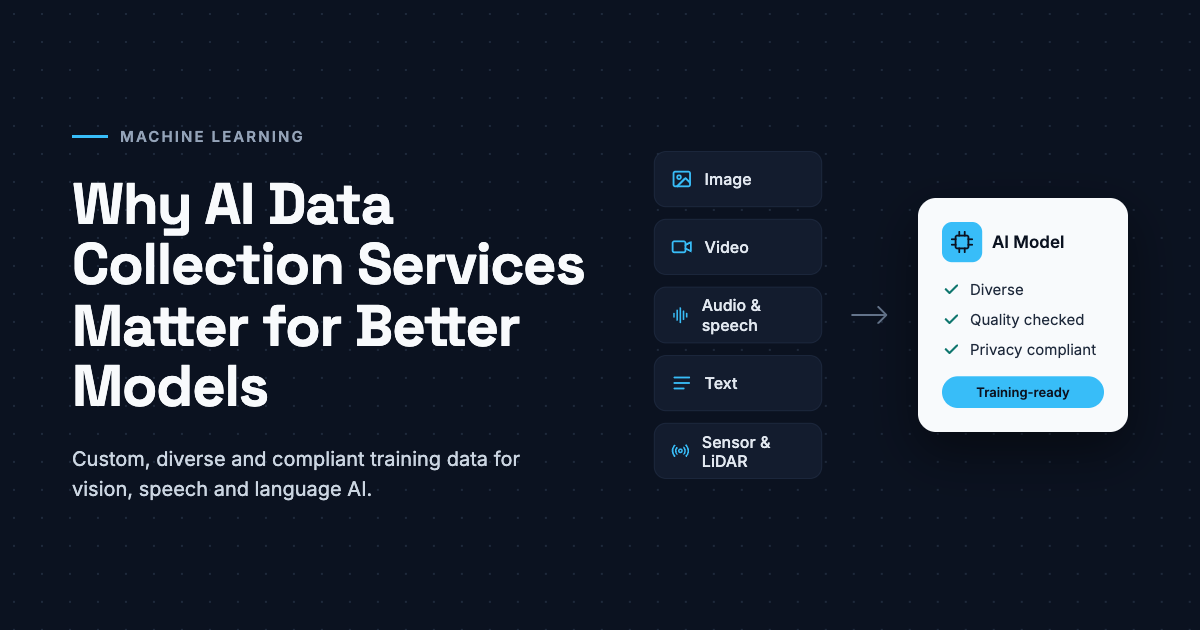
AI data collection is the process of sourcing, gathering, and preparing raw data that will later be used to train, validate, and test machine learning models. Depending on the project, this can include:
- Image data collection — photographs of objects, people, environments, products, or documents captured under varied conditions.
- Video data collection — footage for action recognition, object tracking, surveillance analytics, or autonomous systems.
- Audio and speech data collection — voice recordings across different accents, languages, ages, and acoustic environments for speech recognition, voice assistants, and AI receptionists that handle real customer and patient calls.
- Text data collection — conversational data, domain-specific documents such as legal contracts or clinical documentation, reviews, and multilingual text for natural language processing and LLM training.
- Sensor and geospatial data — inputs from LiDAR, GPS, and IoT devices used in robotics, mapping, and smart infrastructure.
Effective data collection for machine learning is not simply about volume. It requires clear specifications, consistent collection protocols, quality control at every stage, and careful attention to privacy and consent.
Key Challenges Companies Face
Building training datasets internally may seem straightforward, but it often introduces challenges that slow down AI development.
Scale and Speed
Collecting thousands or millions of data points requires significant human resources and coordination. Internal teams that are focused on model development rarely have the capacity to manage large-scale data collection projects alongside their core work.
Diversity and Bias
A dataset that lacks diversity produces a model that performs poorly for underrepresented groups or scenarios. Balanced representation across geographies, demographics, lighting conditions, devices, and languages is essential for building fair and robust AI systems.
Data Quality and Consistency
Inconsistent collection methods lead to noisy datasets, which in turn lead to unreliable model outputs. Without standardized guidelines and multi-level quality assurance, errors accumulate and become costly to correct later in the development cycle.
Compliance and Data Privacy
Data collection must comply with regulations such as GDPR, HIPAA for health data, and other regional privacy frameworks. This includes obtaining informed consent, anonymizing personal information, and maintaining secure data handling practices. Mistakes in this area carry both legal and reputational risks.
The Benefits of Working With a Specialized Data Collection Partner
Outsourcing AI data collection to an experienced provider allows companies to focus on what they do best: designing and improving their models. A dedicated partner brings established processes, trained teams, and the operational flexibility needed to scale projects up or down as requirements change.
The main advantages include:
- Faster time to market. Ready-to-use datasets allow ML teams to begin training sooner and iterate more quickly.
- Custom datasets tailored to the use case. Data is collected according to precise specifications rather than adapted from generic sources.
- Consistent quality control. Multi-stage validation ensures that each data point meets defined accuracy and formatting standards.
- Access to diverse contributors. Large, distributed workforces make it possible to collect data across different languages, regions, and demographic groups.
- Secure and compliant workflows. Professional providers follow strict data protection protocols and maintain transparency about how data is sourced and handled.
- Cost efficiency. Companies avoid the overhead of recruiting, training, and managing large internal teams for short- or medium-term data projects.
How Mindy Support Approaches AI Data Collection
Mindy Support works with companies around the world to provide reliable, scalable data solutions for AI and machine learning. The team understands that every project has its own objectives, constraints, and quality expectations, so each engagement begins with a detailed analysis of the client’s requirements — the type of data needed, target volumes, collection conditions, and success criteria.
Based on these requirements, Mindy Support designs a collection workflow that combines clear contributor guidelines, structured project management, and consistent quality assurance. Collected data can then be seamlessly passed on to data annotation and labeling, allowing clients to receive training-ready datasets from a single, accountable partner.
This end-to-end approach helps AI teams avoid the common pitfalls of fragmented data pipelines, where collection, annotation, and validation are handled by different vendors with different standards.
Building Better AI Starts With Better Data
As machine learning models become more central to business operations, the importance of high-quality training data will only increase. Companies that invest early in well-structured AI data collection gain a measurable advantage: models that are more accurate, more inclusive, and better prepared for real-world deployment.
Choosing the right data collection partner is therefore not just an operational decision but a strategic one. With the right processes, expertise, and commitment to quality, organizations can turn raw data into a dependable foundation for AI innovation — and bring their products to market with greater confidence.