Healthcare documentation has become one of the biggest challenges for clinicians and healthcare providers. Studies show that physicians spend nearly 2-3 hours on documentation for every 1 hour of patient care. SOAP notes, progress notes, discharge summaries, coding details and compliance checks often continue long after clinical hours. This extra work consumes physicians’ energy, focus and time and negatively affects patient care.
To address this growing burden, healthcare organizations started exploring ambient clinical intelligence systems. This evolution led to a new approach where documentation happens in the background, without interrupting the clinical encounters.
Let’s read this blog carefully and learn more about ambient clinical intelligence, how it works and transforms healthcare documentation.
What Is Ambient Clinical Intelligence (ACI)?
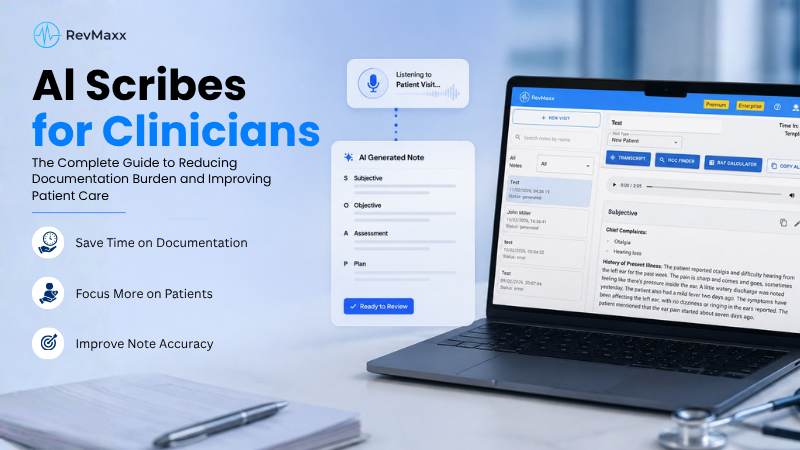
Ambient clinical intelligence is an AI-driven approach that listens to patient-physician conversations, understands clinical context and automatically generates accurate and structured clinical notes. It works silently in the background and captures relevant details without requiring manual input during the visit.
Instead of typing or dictating, doctors can focus fully on the patient. The AI transforms spoken dialogue into usable clinical documentation that aligns with existing EHR requirements.
Passive Listening and Context-Aware AI
Unlike traditional dictation tools, ambient clinical intelligence listens passively. It does not require voice commands or structured speech. The AI technology easily understands who is speaking, what is clinically relevant and what should be included in the note.
It can easily identify symptoms, diagnoses, medications, assessments and care plans based on context, not just keywords.
Difference Between Ambient Clinical Intelligence and Traditional Transcription
Traditional transcription tools convert speech into text. Ambient clinical intelligence goes much further. It understands meaning, filters irrelevant conversations, and organizes information into clinical SOAP (subjective, objective, assessment and plan) note format.
This difference is critical. Transcription creates raw text. Ambient Clinical Intelligence creates usable clinical documentation.
Evolution of Ambient AI in Healthcare
Ambient AI started with the basic speech recognition tools. Over time, healthcare-specific models were developed to understand medical terminology, abbreviations, and clinical workflows. Advances in machine learning and large clinical datasets improved accuracy and reliability.
Today, Ambient Clinical Intelligence systems are capable of real-time clinical documentation, specialty customization, and direct EHR integration.
Why Ambient Clinical Intelligence Matters Today
Today’s healthcare environment demands speed, accuracy, and better patient experiences. Staffing shortages, rising patient volumes, and strict compliance rules make traditional documentation models unsustainable. That is where Ambient Clinical Intelligence comes into action. It directly addresses these challenges by reducing workload, improving note quality, and supporting better care delivery at scale.
How Ambient Clinical Intelligence Works
Ambient Clinical Intelligence (ACI) works by listening to clinician–patient conversations during visits. It captures spoken information, understands clinical terms and terminologies, and turns it into structured medical notes. The system runs quietly in the background, so clinicians do not need to type or dictate, allowing them to focus fully on the patient.
Capturing Clinician–Patient Conversations
At the heart of Ambient Clinical Intelligence is conversation capture. The system listens during the patient encounter and identifies relevant clinical information.
Audio is captured using secure microphones or mobile devices. The system is designed to work in exam rooms, hospitals, and virtual care settings. It filters background noise and focuses on clinical dialogue.
Privacy controls ensure that recording starts and stops appropriately, maintaining patient trust.
Voice and Audio Capture in Clinical Settings
Ambient clinical intelligence uses a combination of secure microphones, audio sensors and signal processing technology to ensure seamless documentation. The system captures clear speech while reducing background noise from medical equipment or nearby conversations.
Speaker detection helps separate clinician and patient voices. Audio is encrypted during capture and storage. The technology works automatically, without voice commands, allowing conversations to flow naturally. It records only during active visits and follows strict privacy controls to protect patient information.
Natural Language Processing and Medical Speech Recognition
Once audio is captured, AI models convert speech into structured data.
Medical language is complex. Ambient Clinical Intelligence systems are trained on clinical datasets that include symptoms, procedures, diagnoses, and medications. The AI understands context, such as whether a symptom is current, historical, or ruled out. This reduces errors and improves note accuracy.
Understanding Clinical Context and Terminology
It helps the ambient documentation system know what matters in a medical conversation. It recognizes symptoms, conditions, medications, and procedures as they are spoken. The Clinical Natural Language Processing (CNLP) technology understands how words are used in healthcare, not just their meaning. It can tell the difference between past history and current problems. It also identifies when a condition is ruled out.
This ensures notes are accurate and relevant. By understanding context, the system captures the right details and avoids unnecessary or incorrect information in clinical documentation.
Real-Time Clinical Note Generation
The AI technology organizes extracted information into structured notes. Ambient Clinical Intelligence can generate SOAP notes, progress notes, discharge summaries, and follow-up documentation. Notes are created in near real time, allowing clinicians to review and sign quickly.
SOAP Notes, Progress Notes, and Discharge Summaries
The key parts of clinical documentation are SOAP notes, progress notes, and discharge summaries. The system organizes conversations into these formats automatically.
Subjective details come from patient statements. Objective data includes findings and vitals. Assessment reflects the clinician’s judgment. Plans capture next steps and treatments. Progress notes track changes over time. Discharge summaries clearly explain diagnoses, care provided, and follow-up instructions.
This structured approach helps clinicians review notes quickly and ensures records are clear, complete, and easy to understand for the entire care team.
Seamless EHR Integration
Integration with EHRs is critical for adoption. Ambient Clinical Intelligence pushes notes directly into the EHRs. This is eliminating the need for copy-paste to the workflows. Most importantly, it reduces errors and saves time across the care team.
Eliminating Double Documentation
Eliminating double documentation means clinicians do not have to enter the same information twice. The system captures details during the visit and sends them directly to the EHR. Notes are created automatically and placed in the correct sections. This reduces manual entry, saves time, and lowers the risk of errors. Clinicians can review and sign notes quickly without repeating work.
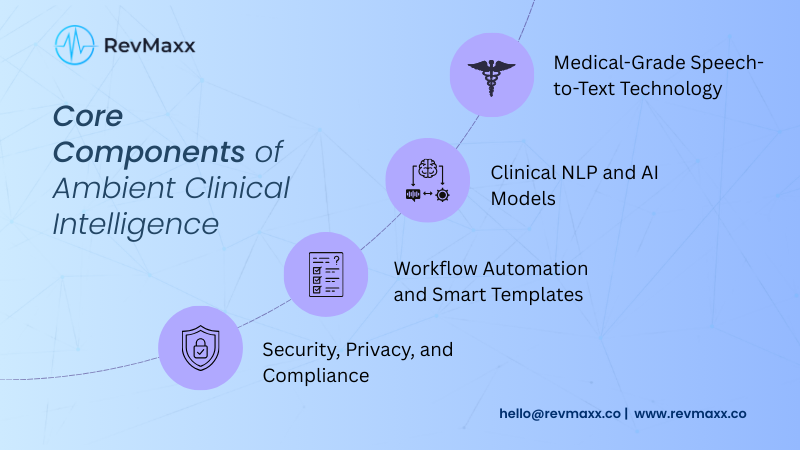
Core Components of Ambient Clinical Intelligence
The core components of Ambient Clinical Intelligence include voice capture, medical speech recognition and clinical language understanding. All these work together to support accurate documentation. The system also uses smart templates and workflow tools to organize clinical notes.
Security and compliance features protect patient data. When combined, these components help create clear, reliable clinical notes without interrupting patient care.
Medical-Grade Speech-to-Text Technology
High-quality speech recognition is the foundation of Ambient Clinical Intelligence.
Different specialties use different languages. Cardiology, psychiatry, and oncology have unique terminology. Advanced systems use specialty-specific models to improve accuracy and relevance.
Specialty-Specific Vocabulary Models
Specialty-specific vocabulary models help the system understand how different clinicians speak. Every specialty uses its own medical terms. Oncology includes drug names, treatment cycles, and staging details. Psychiatry focuses on symptoms, behaviors, and mental health terms.
Recognizing these correctly is important for accurate notes. When the system understands specialty language, it captures the right details the first time.
This reduces missing information and lowers the need for corrections. Clinicians spend less time editing notes, and documentation stays clear, complete, and consistent across visits.
Clinical NLP and AI Models
Natural language processing or NLP technology helps the system understand the meaning of every patient-provider conversation. The ambient AI identifies clinical entities such as conditions, medications, lab values, and procedures. It also understands relationships, such as cause and effect or treatment response.
Entity Recognition and Contextual Understanding
With the help of NLP technology, the ambient medical scribe easily capture what truly matters in a clinical visit. It identifies symptoms, diagnoses, medications and treatment procedures as ther are discussed. The system also understands context. It knows whether a condition is active, part of past history, or ruled out. This prevents incorrect information from appearing in the note. By capturing only relevant details, documentation becomes clearer and safer. Clinicians can trust the notes for decision-making, follow-up care, and accurate communication across the care team.
Workflow Automation and Smart Templates
Automation ensures healthcare documentation fits into existing clinical workflows. Ambient Clinical Intelligence supports coding by capturing billable elements accurately. It automatically captures accurate ICD-10, CPT and E/M codes for every clinical note. This helps reduce missed charges and supports compliant billing.
Automated Coding and Billing Support
Automated coding and billing support helps AI scribe capture important details during the patient visit. The system records diagnoses, procedures, and conditions as they are discussed. This reduces the chance of missed or incomplete information.
Clinicians do not need to think about codes while treating patients. Notes are already structured for coding review. This supports accurate billing and fewer claim issues. Revenue teams receive clearer documentation, which reduces rework and delays. Over time, this leads to better reimbursement and smoother revenue operations.
Security, Privacy, and Compliance
In healthcare AI, maintaining security and compliance is essential. Modern Ambient Clinical Intelligence platforms use encryption, access controls, and audit logs to meet HIPAA and enterprise security standards.
HIPAA-Compliant Architecture
A HIPAA-compliant architecture protects patient information at every stage. Data is encrypted while being transmitted and while stored, reducing the risk of unauthorized access. Role-based access controls ensure only approved users can view or edit records. Audit trails track system activity and support compliance reviews.
Continuous monitoring helps detect potential security issues early. These enterprise-level security standards help healthcare organizations meet regulatory requirements while using advanced documentation tools with confidence and trust.
Benefits of Ambient Clinical Intelligence
Ambient clinical intelligence supports care beyond documentation. It helps reduce daily pressure on care teams and improves how information flows across systems. By capturing accurate clinical details in real time, it strengthens data quality, supports coding accuracy and builds a reliable foundation for care, compliance and long-term operational efficiency.
Benefits for Clinicians or Healthcare Providers
Ambient Clinical Intelligence allows clinicians to focus on medicine, not keyboards. Conversations feel natural and uninterrupted. Clinical details are captured without extra effort. This creates smoother visits and more confidence in documentation. Clinicians spend less time fixing notes and more time thinking about diagnosis, care plans, and patient needs.
Reduced Documentation Time
With Ambient Clinical Intelligence, documentation happens during the visit, not after it. Key details are captured as the conversation happens. Notes are structured and organized automatically. This reduces late-night charting and weekend work. Clinicians can close charts faster while maintaining accuracy and meeting coding and compliance needs.
Lower Burnout and Improved Work-Life Balance
Burnout often comes from unfinished charts and long evenings spent documenting. Ambient Clinical Intelligence reduces this load. Clinicians leave work with fewer open notes. Mental fatigue decreases over time. Better balance leads to higher morale, improved retention, and a healthier clinical workforce that can sustain long-term patient care.
Benefits for Healthcare Organizations
Healthcare organizations gain more than time savings. Ambient Clinical Intelligence improves documentation consistency across providers. It reduces errors and variation in notes. Leadership gains better visibility into clinical data. This supports quality programs, compliance audits, and accurate coding, while lowering operational strain on clinical and billing teams.
Improved Clinical Productivity
When notes are completed faster, schedules run more smoothly. Clinicians can stay on time and reduce visit backlogs. Teams spend less time correcting documentation issues. Productivity improves without rushing patient visits. This balance helps organizations serve more patients while protecting care quality and documentation standards.
Revenue Optimization Through Accurate Documentation
Complete and accurate documentation directly supports coding accuracy. Ambient Clinical Intelligence captures diagnoses, conditions, and procedures clearly. This reduces missed codes and claim rework. Cleaner notes lead to fewer denials and stronger reimbursement. Over time, organizations see better financial performance without increasing clinical workload.
Benefits for Patients
Patients may not see the technology, but they feel the difference. With the help of ambient clinical intelligence visits feel calmer and more personal. Clinicians listen more and type less. Accurate documentation also improves continuity of care, as future providers have clearer records. This leads to safe decisions and more consistent treatment over time.
Better Engagement and Care Experience
When clinicians maintain eye contact and stay present, patients open up more. They ask better questions and share important details. This improves better patient-provider understanding and trust. Better engagement leads to stronger adherence to treatment plans and follow-ups, improving outcomes and overall satisfaction with the care experience.
Use Cases of Ambient Clinical Intelligence
Ambient Clinical Intelligence fits into many care settings. It adapts to different workflows without adding extra steps. Whether care happens in person or remotely, the system listens, understands, and documents accurately. This flexibility makes it useful across the entire care continuum, from outpatient clinics to long-term care facilities.
Primary Care and Multispecialty Clinics
Primary care providers handle many topics in one visit. Ambient Clinical Intelligence captures symptoms, history, screenings, and care plans together. It helps document chronic conditions over time. This supports preventive care, annual wellness visits, and follow-ups while keeping records complete and easy to review.
Specialty Practices (Oncology, Psychiatry, Cardiology, SNFs)
Specialty visits include detailed and sensitive discussions. Ambient clinical intelligence supports long notes without extra effort. It captures assessments, treatment plans and risk factors clearly. Specialty-specific language improves accuracy. This is especially helpful for mental health, complex diagnoses and long-term condition management.
Hospitals and Inpatient Care
In hospitals, documentation happens many times a day. Ambient clinical intelligence supports shift changes, rounds and care transitions.Notes stay consistent across teams. This reduces gaps in information and improves communication. Accurate documentation also supports quality reporting and reduces delays in discharge planning.
Telehealth and Virtual Care Settings
In virtual care, everything depends on conversation during visits. Ambient clinical intelligence systems capture details of every patient visit aaccurately. It works passively during visit, captures and understands every clinical context and generates structured EHR-ready notes in real time.
Post-Acute and Long-Term Care Facilities
Post-acute and long term care settings require proper documentation of every patient encounter. ACI technology can easily capture the daily patient updates, their vitals, changes in health conditions and treatment plans. Clear and accurate clinical notes help the healthcare providers to stay aligned with the complete care process and also supports essential regulatory compliance requirements. As a result, this not only reduces the documentation gaps, but also helps the providers to manage better reimbursement.
Ambient Clinical Intelligence vs Traditional Medical Scribing
| Criteria | Ambient Clinical Intelligence (ACI) | Traditional Medical Scribing |
| Average Time Saved per Clinician | 1–2 hours per day saved on documentation | 30–60 minutes saved, often still requires review and edits |
| Cost Structure | Fixed monthly or annual subscription ($2,000–$3,500 per year) | Ongoing salary, hourly wages, training, and turnover costs ($35,000–$55,000 per year per scribe) |
| Scalability | Easily scales across departments and locations | Limited by hiring, training, and availability |
| Consistency of Notes | High consistency across providers and visits | Varies by scribe skill and experience |
| Accuracy Over Time | Improves continuously with AI learning | Depends on individual scribe performance |
| EHR Integration | Native and automated EHR integration | Manual entry into EHR |
| Impact on Clinician Burnout | Strong reduction in burnout and cognitive load | Moderate reduction, still requires oversight |
| Compliance and Security | HIPAA-compliant with audit logs and encryption | Depends on training and human adherence |
| Long-Term ROI | High ROI through time savings and revenue capture | Lower ROI due to ongoing staffing costs |
Challenges and Limitations of Ambient Clinical Intelligence
Ambient Clinical Intelligence is powerful, but it is not perfect. Like any new technology, it needs the right setup and support. Understanding its limits helps teams plan better. When challenges are addressed early, adoption becomes smoother and results improve over time.
Background Noise and Accent Variability
Exam rooms can be loud. Phones ring. Staff walk in and out. Patients speak softly or with strong accents. These factors can affect accuracy. Modern systems reduce this risk, but occasional review is still needed. Clear audio setup and good workflows help improve results.
Change Management and Clinician Adoption
Some clinicians hesitate to trust new tools. They worry about accuracy or extra steps. Proper training builds confidence. Early feedback matters. When clinicians see time saved and note quality improve, adoption increases. Support from leadership also plays a key role in long-term success.
Continuous AI Training and Optimization
Medicine changes often. New terms, drugs, and workflows appear every year. Ambient AI must keep learning. Regular updates help maintain accuracy. Ongoing monitoring ensures notes stay reliable. Continuous improvement is essential to keep the system aligned with real clinical practice.
How to Choose the Right Ambient Clinical Intelligence Platform
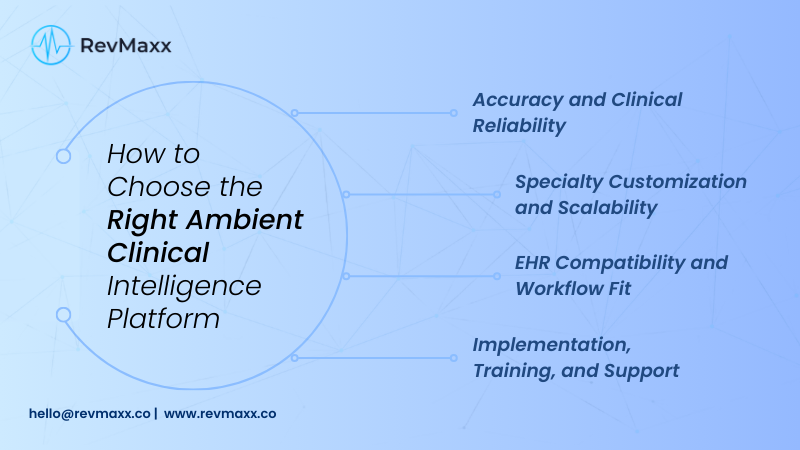
Choosing the right platform is a long-term decision. The right solution should fit daily workflows, not change how clinicians practice. It should improve accuracy, reduce workload, and scale over time. A good choice balances technology, usability, support, and clinical trust across different care settings.
Accuracy and Clinical Reliability
Accuracy is the foundation of trust. Notes must reflect what actually happened during the visit. The platform should perform well across accents, specialties, and visit types. Consistent accuracy reduces rework and corrections. Reliable documentation also supports compliance, coding, and continuity of care across providers.
Specialty Customization and Scalability
Every specialty documents differently. A strong platform adapts to these needs. It should support custom templates and specialty language. As organizations grow, the system must scale easily. Adding new providers or departments should not increase complexity or slow down workflows.
EHR Compatibility and Workflow Fit
EHR integration should feel natural, not forced. Notes should appear in the right place, in the right format. Clinicians should not need extra steps. When workflows align with existing systems, adoption improves. Seamless integration saves time and reduces frustration across clinical teams.
Implementation, Training, and Support
Even the best technology needs proper rollout. Simple onboarding helps teams start quickly. Training should be practical and role-based. Ongoing support matters when questions arise. A responsive support team builds confidence and ensures the platform continues to deliver value long after implementation.
How RevMaxx Delivers Ambient Clinical Intelligence
RevMaxx is designed for real-world clinical workflows. It captures conversations, understands context, and creates structured notes automatically. The platform focuses on accuracy, ease of use, and measurable impact. RevMaxx helps clinicians spend more time on patients, improves documentation quality, and supports operational and financial goals across care settings.
Overview of RevMaxx Ambient AI
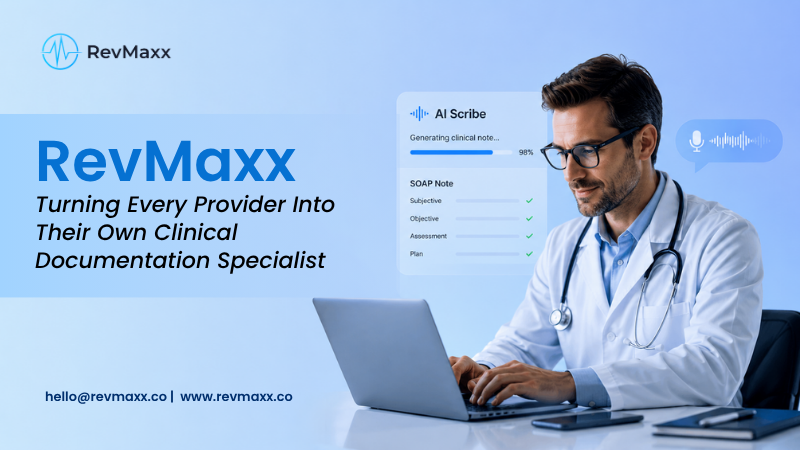
RevMaxx is an ambient AI medical scribe that works silently in the background during patient visits. It listens to conversations, identifies clinically relevant information and structures clear and accurate EHR-ready SOAP notes in real time. The tool fits naturally into your daily clinical workflows and it requires minimal changes from clinicians. This ensures clinical documentation is complete, accurate and available for review immediately after the visit.
Real-Time Clinical Documentation with High Accuracy
RevMaxx AI scribe carefully captures every detail during the patient visits and generates structured clinical SOAP notes in seconds. This reduces the need for after-hours charting. It delivers 95% accuracy which ensures that clinical information is correctly recorded and supports every ICD-10, CPT and E/M coding and HIPAA compliance requirements.
Specialty-Specific Templates and Workflows
RevMaxx supports multiple specialties with customized templates and clinical workflows. Each template captures the data relevant to that field. Clinicians can document complex visits efficiently, whether in psychiatry, cardiology, oncology, or primary care. Tailored workflows save time and reduce errors while maintaining high-quality notes.
Oncology, Psychiatry, SNFs, and More
Different specialties have different documentation demands. Oncology notes require detailed treatment and follow-up plans. Psychiatry notes capture nuanced patient conversation. Skilled nursing facilities need clear, structured records for compliance and billing. RevMaxx AI medical scribe adapts to each specialty with dedicated terminology and workflow support. This is making the clinical documentation process much faster and more accurate than ever before.
Native EHR Integrations
RevMaxx integrates with EHR systems using secure APIs and RPA standards. This allows clinical notes to flow directly into the patient record in real time. The integration works in the background, without manual uploads. Clinicians review and sign notes inside their existing EHR, keeping workflows simple and uninterrupted.
Seamless Integration with Leading EHRs
RevMaxx integrates directly with leading EHRs like eClinicalWorks, PointClickCare, PracticeFusion, NextTech, NextGen, Epic, Cerner etc. Notes flow automatically into the system, reducing manual entry and errors. Clinicians do not need to switch between multiple platforms. This integration improves workflow efficiency, ensures data consistency, and allows the care team to access updated notes in real time.
Coding Support and Revenue Optimization
Accurate documentation improves coding and revenue capture. RevMaxx AI medical scribe highlights billable elements and reduces missed diagnoses. Clean, structured notes support risk adjustment, quality reporting, and insurance claims. This allows organizations to optimize revenue while keeping documentation simple for clinicians. It provides accurate ICD-10, CPT, E/M coding to reduce the claim denials and maximize revenue.
Improved RAF, HCC, and Diagnosis Capture
RevMaxx captures conditions that impact RAF scores and HCC coding accurately. This ensures proper risk adjustment and reimbursement. Better diagnosis capture leads to fewer denied claims, higher revenue, and improved compliance, supporting value-based care programs and organizational financial health.
Security and Compliance with RevMaxx
Security is integrated at every step. Data is encrypted, access is controlled, and audit trails are maintained. RevMaxx helps healthcare organizations stay compliant with HIPAA and other regulations. Sensitive patient information is protected while AI-driven documentation is delivered safely across clinical environments.
HIPAA-Compliant and Enterprise-Grade Security
RevMaxx meets strict healthcare security standards. Patient data is encrypted both at rest and in transit. Enterprise-grade security measures protect against unauthorized access. Audit logs and role-based permissions ensure compliance while allowing clinicians to work efficiently, making RevMaxx both safe and reliable for large healthcare organizations.
Conclusion
Ambient Clinical Intelligence is no longer optional. It is becoming a core part of modern healthcare delivery by reducing burden and improving care quality. RevMaxx ambient AI medical scribe combines accuracy, workflow fit, and revenue support into one unified platform trusted by healthcare organizations.
The future of healthcare documentation is ambient, intelligent, and clinician-friendly. As adoption grows, Ambient Clinical Intelligence or ACI will continue to reshape how care is delivered, documented, and experienced.