Skilled Nursing Facilities (SNF) are the backbone of long-term and post-acute care in the U.S. Yet, clinical documentation has become one of the biggest challenges for providers and healthcare staff. This is taking time away from resident care, driving burnout, and impacting facility revenue. PointClickCare ambient AI integration is emerging as a powerful solution to reduce documentation burden, improve accuracy, and transform workflows in SNFs.
In this blog, we are going to discuss the documentation crisis in SNFs, what ambient AI is, how it integrates with PointClickCare, and why it matters for staff, compliance, and financial outcomes.
Why SNF Documentation is a Major Problem
Documentation in SNF is crucial for compliance, billing, and patient care decisions. But the efforts and time it takes can be overwhelming.
Documentation Takes Too Much Time
Clinicians in healthcare regularly spend far more time on administrative work than direct patient care. SNF staff spend up to 55% of their workday on documentation and administrative tasks, leaving less than half of their time for direct resident care.
Excessive charting often spills into after-hours work, called “pajama time.” This is where clinicians complete documentation at home after their shifts. Ambient AI solutions have significantly reduced this burden, with many clinicians reporting dramatic reductions in after-hours charting once these tools are implemented.
Documentation Drives Burnout
Clinical documentation requirements contribute heavily to burnout in long-term care. For many clinicians, excessive paperwork and electronic health record (EHR) tasks are cited as a top reason for stress, frustration, and leaving the profession altogether.
A recent study revealed that ambient AI implementations can reduce documentation time per appointment by almost 15%. Even clinicians reported better satisfaction and less cognitive burden when using AI tools.
PointClickCare: A Leading EHR for Skilled Nursing Facilities
PointClickCare or PCC is widely known as one of the leading cloud-based electronic health record platforms for skilled nursing and post-acute care. It is specially designed to manage clinical, financial and operational functions of a clinical setting. PointClickCare helps SNFs:
- Track clinical data like vitals, diagnoses and care plans
- Streamline communication between nurse, physicians and therapists
- Support MDS submissions and compliance reports
- Optimize billing and revenue performance through accurate documentation and analytics
The platform’s strength lies in its integrated design, enabling care teams to work from a single source of truth.
What Is Ambient AI?
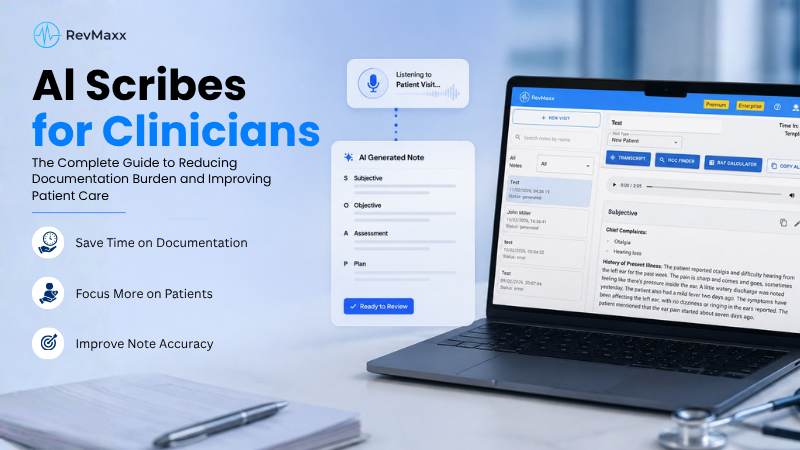
Ambient AI is an advanced artificial intelligence technology that listens, captures, and transforms clinical conversations into structured clinical documentation, reducing the need for manual typing or dictation.
Instead of clinicians spending hours typing or dictating notes, ambient AI does this within a few seconds — capturing clinician-resident interactions and converting them into EHR-ready notes. These notes are then reviewed, edited if needed, and finalized by the clinician.
Benefits of Ambient AI in Healthcare Documentation
Ambient AI is being adopted across hospitals, clinics, and long-term care settings because it:
- Reduces documentation time: Clinicians save time on notes, orders, and coding.
- Improves accuracy: AI can produce high-quality documentation while maintaining compliance standards.
- Enhances clinician satisfaction: Providers report less burnout and better focus on resident interactions.
- Reduces after-hours charting: Many clinicians reclaim their evenings due to near real-time documentation.
A study shows that ambient AI cuts documentation time by up to 90 minutes per day for physicians and helps complete charts within 24 hours, enhancing workflow efficiency.
What is PointClickCare Ambient AI Integration?
PointClickCare ambient AI integration refers to how ambient AI documentation tools connect directly with PointClickCare’s EHR platform, enabling automatic capture and structured documentation within the resident’s record.
PointClickCare EHR integration leverages APIs (application programming interfaces) to pass data securely between the AI tool and PointClickCare in real time. The result? Clinicians spend less time typing and more time with residents, while the EHR automatically receives accurate, structured content.
Key Integration Features
Real-time note generation: Ambient AI captures and writes notes during resident interactions.
- Automated population of EHR fields: Progress notes, MDS updates, and care plans can be auto-filled.
- Compliance-ready documentation: The AI structures content to meet regulatory standards.
- Secure and HIPAA-compliant: Patient data is protected through encryption and secure access controls.
When integrated, ambient AI becomes an extension of PointClickCare’s workflow, turning conversations into records without slowing down the clinician.
How PointClickCare Ambient AI Integration Works in SNFs
There are three core stages of how the ambient AI system functions from the moment clinical conversations happen to when the documentation appears in the PointClickCare EHR. The goal is to reduce clinician burden, improve accuracy, and speed up documentation workflows.
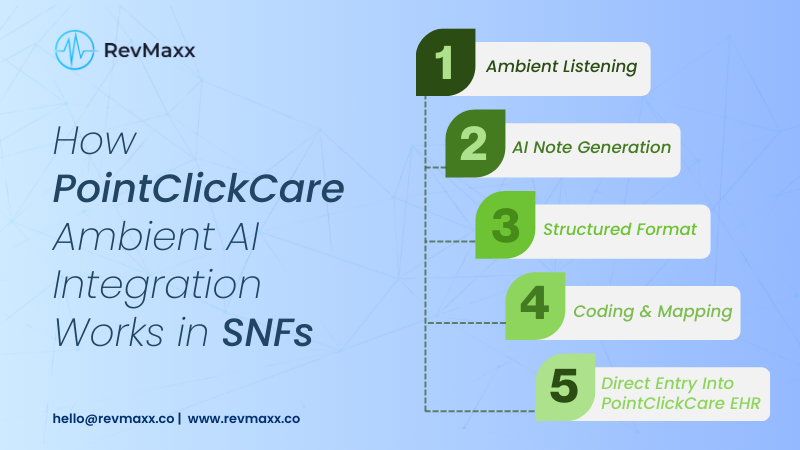
Ambient Listening During Resident Encounters
Instead of clinicians having to stop and type or dictate notes, the ambient AI “listens” in real time while care happens.
The AI uses secure audio capture technology to record conversations between care providers and residents. This is done in a way that doesn’t interfere with the interaction itself. As a result, clinicians can focus fully on care, not typing or dictating.
There’s no need for new devices or complex new steps. The ambient AI works in the background so that clinicians continue using their normal procedures without being interrupted. Instead of clinicians having to dictate notes manually or write them later, the AI handles the conversion from spoken words to structured clinical data automatically.
AI-Powered Clinical Note Generation
Once the AI captures the audio from the encounter, it translates that spoken information into structured clinical documentation. This is where the real “thinking” happens.
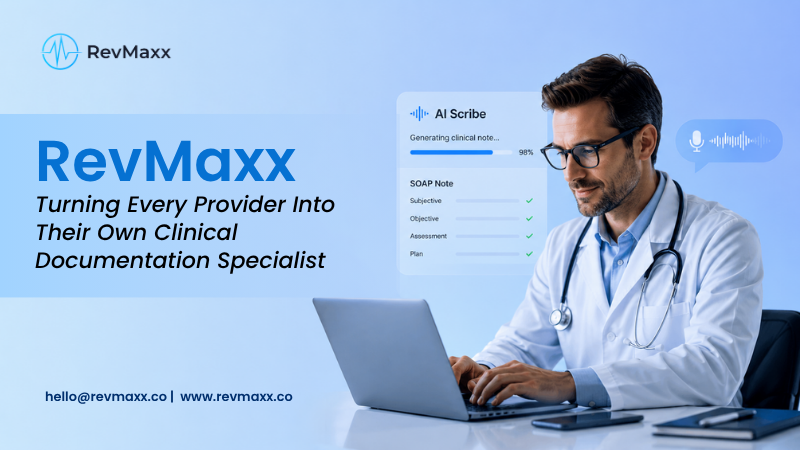
The AI medical scribe translates the conversation into SOAP (Subjective, Objective, Assessment, Plan) format. This ensures notes are organized, useful, and fully compliant with standard clinical needs. Rather than clinicians having to manually enter data into multiple sections of a chart, the system fills in relevant fields automatically. For example, it can populate progress notes, functional assessments, and even care plan components based on what was said.
The AI can recognize key clinical terms and link them to appropriate clinical codes, like ICD-10, CPT and E/M codes and diagnoses. This is especially useful for billing accuracy and clinical categorization.
Direct Entry Into PointClickCare EHR
The final step is integrating what the AI generates back into the environment clinicians already use: the PointClickCare EHR.
The output flows directly into the appropriate charting screens inside PointClickCare, such as progress notes, assessments, interdisciplinary notes, and care plans. The integration maps each piece of AI-generated data to the correct field in the EHR. For example, vital signs go under vital sign documentation, subjective complaints go under clinical notes, and treatment plans go into the care plan section. Once the note is in the EHR, it’s instantly available to nursing, therapy, physicians, and other care team members. This real-time sync improves communication and avoids delays in care planning.
Key Benefits of the PointClickCare Ambient AI Integration
Here’s how ambient AI integration makes a measurable impact for SNFs.
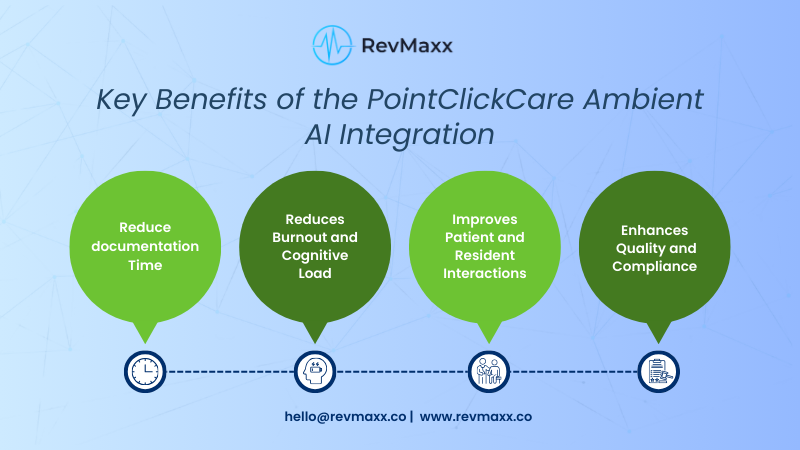
Saves Time:
Multiple studies show that ambient AI solutions significantly reduce documentation time:
Clinicians spend 15% less time in documentation per appointment in certain implementations. Hospital settings using ambient AI have documented 15,791 hours saved in physician documentation, which is equal to 1,794 full workdays.
For SNFs that run multiple shifts and serve many residents, even a few minutes saved per resident encounter can add up to hours of nursing time saved per shift.
Reduces Burnout and Cognitive Load
Studies show that ambient AI does not just save time; it also reduces mental effort and frustration associated with documentation. In one pilot, clinicians reported significant reductions in mental demand scores when using ambient AI technologies.
Better clinician well-being translates into lower turnover, which is especially important given the staffing challenges in long-term care.
Improves Patient and Resident Interactions
Ambulatory clinics using ambient AI have reported clinicians spending more time engaging face-to-face with patients and less time looking at screens. Nearly half of surveyed patients noticed improved clinician attention during visits.
In SNFs, this can mean better resident relationships, improved satisfaction, and a more personalized care experience.
Enhances Documentation Quality and Compliance
AI-generated notes are rapid, thorough, and structured and often more consistent than manual notes. This improves completeness and reduces errors that can affect billing and compliance.
High-quality documentation supports PDPM (Patient-Driven Payment Model) accuracy by capturing comorbidities and therapy minutes correctly, which directly impacts reimbursement.
Conclusion
Documentation in SNFs is at a critical point. Manual charting drains time, impacts compliance, and contributes to burnout. PointClickCare ambient AI integration tools like RevMaxx, offers a practical, scalable solution to these challenges by automating documentation, improving accuracy, and freeing clinicians to focus on what matters most: resident care.
With measurable time savings, improved satisfaction, better documentation quality, and stronger PDPM outcomes, this integration is shaping the future of skilled nursing documentation workflows.
If your facility is struggling with documentation burden or looking to improve efficiency and compliance, exploring PointClickCare ambient AI integration may be one of the most impactful steps you take this year.