Clinical documentation is one of the biggest tasks doctors, nurses, and healthcare teams deal with in everyday practice. They write notes, fill out reports, enter data into electronic health records (EHRs), and make sure every patient’s information is correct. While this work is important for patient care and billing, it takes up a huge chunk of time, which leads to stress and burnout.
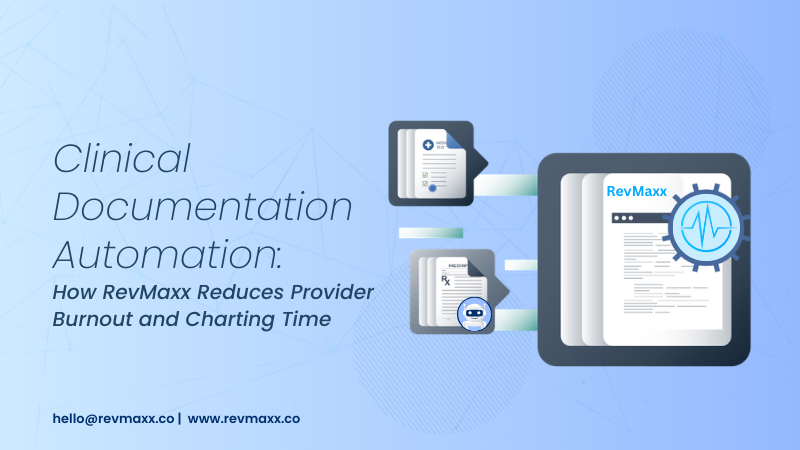
Clinical documentation automation comes in to change the entire scenario. Tools like RevMaxx use ambient artificial intelligence (AI) to reduce the time spent on paperwork and let healthcare providers focus more on patients, not computers.
Today, in this blog, we are going to talk about why documentation automation matters, how it helps reduce burnout, and how RevMaxx makes it easier and faster to complete charting.
The Growing Documentation Burden in Modern Healthcare
While EHR systems were designed to improve care, they have added hours of daily charting, often pushing work beyond regular clinic hours. This growing burden is now a major driver of provider stress and burnout.
How Charting Time Is Impacting Providers
Many clinicians spend 2-3 extra hours each day completing notes after seeing patients. This after-hours charting, often called “pajama time,” happens late at night or on weekends and leaves little time for rest. Over time, it leads to fatigue, poor sleep, and emotional exhaustion.
During patient visits, providers are also forced to split attention between the patient and the EHR. Administrative tasks like clicking checkboxes and entering codes often take priority over conversation, creating an imbalance between documentation and patient care. This reduces job satisfaction and weakens the patient-provider connection.
Burnout Statistics and Industry Trends
Provider burnout is widespread, with over half of physicians reporting burnout symptoms, and EHR workload is a leading cause. Documentation is consistently ranked among the top reasons clinicians feel frustrated with their jobs.
As burnout rises, more providers are cutting back hours or leaving clinical roles altogether. This contributes to staff shortages, higher turnover, and increased pressure on remaining teams. These are making documentation burdens not just a personal issue but a system-wide challenge.
Let’s look at a clear picture of the problem:
Issue | Statistic |
Time spent on EHR/desk work | 49.2% of clinic day |
For every hour with patients, 2 hours on paperwork | 1:2 documentation ratio |
More than 50% of doctors report burnout | >50% burnout |
AI documentation can save 2–3 hours/day | ~2–3 hours saved |
What Is Clinical Documentation Automation?
Clinical documentation automation is a type of technology that uses AI to help write the notes doctors need for patient visits.
Instead of typing everything manually after a busy day:
- AI listens during the patient visit
- Converts spoken words into clear, structured clinical notes
- Helps with medical codes used for billing
- Automatically saves the note into the patient’s EHR
This automation means less typing, fewer errors, and more time to care for patients.
How Automation Fits Into Existing EHR Systems
Clinical documentation automation works alongside existing EHR systems without changing how providers deliver care. Notes can be created in real time during the visit or completed right after, allowing flexibility without delays.
These tools integrate directly with major EHR platforms, so notes flow into patient records automatically without copy-paste. Because automation runs in the background, clinicians can follow their usual routines, focus on patients, and adopt the technology with minimal disruption.
How RevMaxx Automates Clinical Documentation
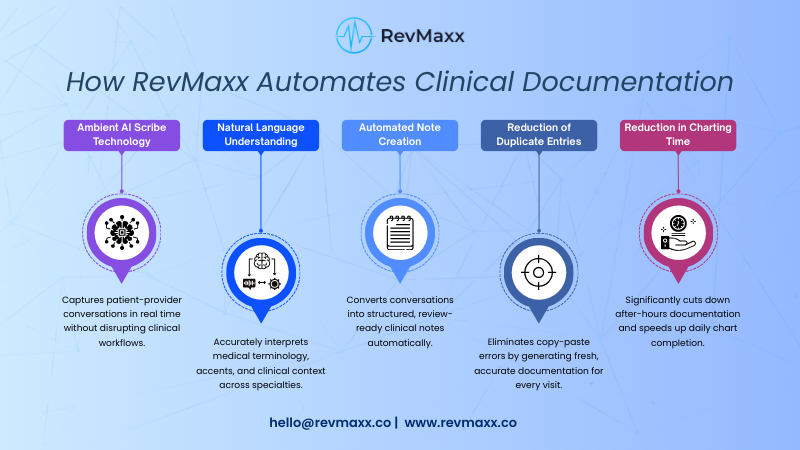
RevMaxx AI medical scribe is built to bear the heavy burden of manual charting without interrupting the existing clinical workflows. It silently works in the background, carefully captures the full clinical story, and turns the patient-provider conversations into accurate and structured medical notes.
Ambient AI Scribe Technology
RevMaxx uses advanced ambient AI technology to document every patient’s care without disrupting the visit session. It carefully listens to physician-patient interaction during the visit without requiring voice commands or manual input. Providers do not need to pause, dictate, or interact with the system.
Documentation happens naturally as care is delivered. The system captures symptoms, medical history, assessments, and treatment plans as they are discussed. Conversations feel more personal, and visits are not broken by typing or screen time.
Natural Language Understanding in Real Clinical Settings
RevMaxx ambient AI scribe uses natural language processing (NLP) technology to understand diverse accents, medical abbreviations, and clinical language. It captures nuances such as symptom severity, timelines, and provider reasoning.
RevMaxx adapts to different specialties, recognizing terminology used in primary care, cardiology, mental health, infusion therapy, and more. Whether in clinics, hospitals, or outpatient settings, RevMaxx performs consistently, even in fast-paced or high-volume environments.
Automated Note Creation and Structuring
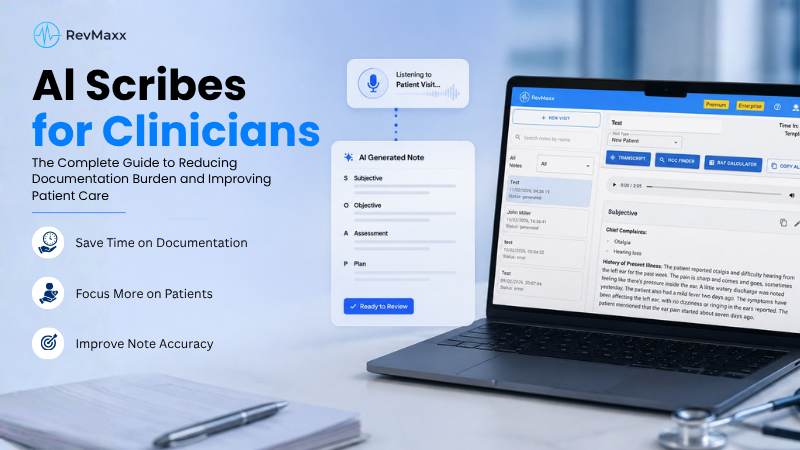
RevMaxx converts conversations into structured, ready-to-review clinical notes. This tool supports SOAP (subjective, objective, assessment, and plan) notes, progress notes, and specialty-specific clinical note formats. This is ensuring that the documentation matches both clinical and organizational standards.
As a result, providers always stay in control. Notes can be reviewed, edited, and approved before final submission, maintaining trust and accountability.
Reduction of Redundant and Duplicate Entries
Manual documentation often leads to repeated copy-paste errors. RevMaxx removes that risk. By generating clinical notes automatically, this ambient AI medical scribe reduces reliance on copying previous records, lowering the risk of outdated or incorrect information. Each note reflects the complete story of a patient visit, improving clinical accuracy and record reliability. Even clean and consistent clinical notes make audits easier and reduce compliance errors.
Measurable Reduction in Charting Time with RevMaxx
One of the biggest benefits of clinical documentation automation is time savings. Notes are ready shortly after the visit ends, reducing delays and backlog. So, with documentation completed on time, providers avoid accumulating unfinished charts. Even by finishing notes during the workday, clinicians reduce evening and weekend charting.
How RevMaxx Helps Reduce Provider Burnout
Provider burnout is often caused by constant screen time, heavy documentation, and long hours spent finishing charts. RevMaxx reduces this pressure by handling clinical documentation in the background, allowing clinicians to focus on care instead of screens.
Restoring Focus on Patient Care
With RevMaxx AI medical scribe capturing the visit automatically, clinicians can have more face-to-face interaction with patients. This improves communication, builds trust, and makes visits feel more personal. Providers no longer need to type while talking. Reduced screen time lowers mental strain and helps clinicians stay engaged and attentive throughout the visit. Even when conversations flow naturally, patients feel heard and understood. This strengthens relationships and improves patient satisfaction and outcomes.
Improving Work-Life Balance
RevMaxx ambient AI medical scribe completes the most documentation during or right after the patient visit. This reduces the need to finish charts late at night or over the weekends. As a result, physicians have less documentation pressure, and they can feel less drained at the end of each shift. By reducing daily burnout, RevMaxx helps providers maintain energy and job satisfaction over time.
Clinical Accuracy, Compliance, and Trust
Accurate documentation is the foundation of safe care, proper billing, and regulatory compliance. RevMaxx is designed to support all three by capturing complete clinical information while keeping patient data secure and protected.
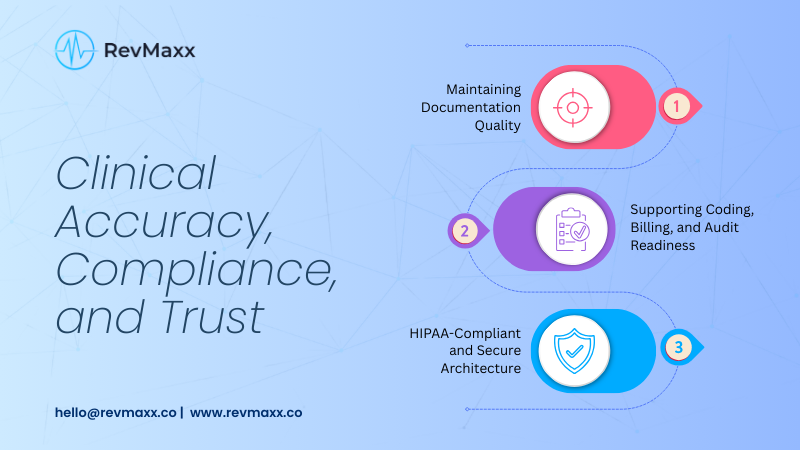
Maintaining Documentation Quality
RevMaxx listens to the full patient conversation and records important details such as symptoms, history, assessments, and care plans. By capturing information in real time, this AI scribe reduces the chance of missing key data that could affect care decisions. Clear and complete documentation helps providers review patient information more easily. This supports better clinical decisions, more accurate diagnoses, and well-documented treatment plans.
Supporting Coding, Billing, and Audit Readiness
RevMaxx helps ensure that services, procedures, and diagnoses discussed during the visit are clearly documented. This supports accurate coding and appropriate reimbursement. Consistent and structured notes reduce missing or unclear information that can lead to claim denials or audit issues. As a result, billing teams received organized, easy-to-understand documentation, which reduced claim denials and speed up the billing workflows.
HIPAA-Compliant and Secure Architecture
Patient information is encrypted when it is shared and when it is stored, helping protect it from unauthorized access. With its role-based access control model, only authorized users can view or edit patient data, ensuring that access is limited to the right people. It follows HIPAA healthcare security standards to safeguard patient data, helping organizations maintain trust and meet compliance requirements.
RevMaxx Across Specialties and Care Settings
Healthcare organizations differ in size, specialty, and workflow. RevMaxx is built to adapt across these differences, making clinical documentation automation useful in many care environments.
Primary Care, Specialty Clinics, and Hospital Use Cases
RevMaxx ambient AI medical scribe supports a wide range of specialties, from primary care to complex specialty practices. It recognizes specialty-specific terminology and documentation needs, ensuring notes are relevant and accurate for each type of care. Small practices benefit from reduced documentation burden without adding staff, while large health systems gain consistency and efficiency across departments. RevMaxx fits both settings without requiring major workflow changes.
Scalability for Growing Organizations
RevMaxx AI scribe tool is simple to adopt, with minimal training required. Providers can start using it quickly without disrupting daily operations. Built to evolve with healthcare needs, RevMaxx supports long-term growth and future advancements in clinical documentation automation.
The Final Thoughts
So, there is no surprise that healthcare providers face a big challenge: they must document every detail of patient care while still building strong patient relationships. For too long, documentation has pulled clinicians away from the reason they went into medicine in the first place.
Clinical documentation automation, powered by tools like RevMaxx, changes that. It turns hours of manual charting into minutes and gives clinicians their time back.
By reducing burnout, improving accuracy, and speeding up workflows, RevMaxx helps providers spend less time typing and more time caring.