“Good documentation supports good medicine—but it shouldn’t get in the way of it.”
Every provider understands the importance of accurate documentation for compliance, coding, and continuity of care. The challenge isn’t why documentation matters—it’s the time and attention it demands during already busy clinical schedules. As patient volumes grow and EHR requirements expand, many clinicians find themselves balancing meaningful patient conversations with the pressure to capture every detail in the chart.
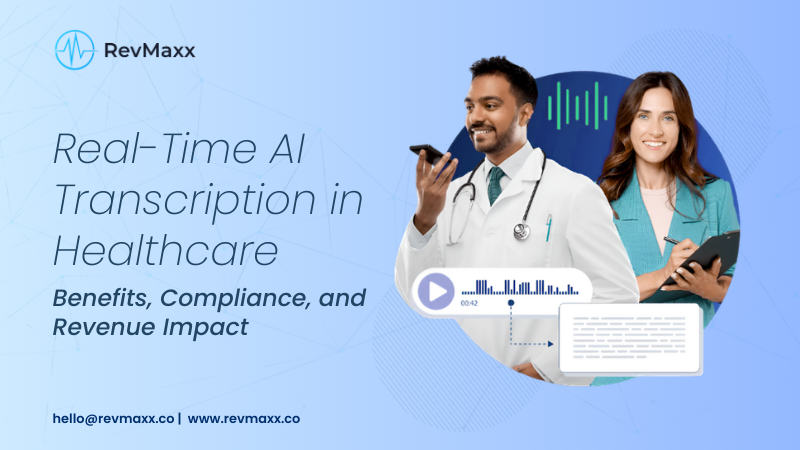
Real-time AI transcription is helping providers regain that balance, capturing clinical conversations as they happen and converting them into structured documentation—so charting becomes faster, more complete, and far less disruptive to patient care.
Today this blog explores the benefits, compliance considerations, and revenue cycle impact of adopting real-time AI transcription in healthcare settings.
Why Documentation Is a Crisis in Healthcare?
Healthcare documentation has ballooned into a systemic issue affecting care quality, provider satisfaction, and operational efficiency:
- Nearly 75% of healthcare professionals report that documentation impedes patient care.
- Physicians can spend nearly 2 hours on paperwork for every 1 hour of direct patient care.
- After-hours charting or “pajama time” is common, with clinicians routinely finishing notes after clinic hours
These immense documentation pressures contribute to burnout and distract clinicians from what matters most: delivering quality patient care.
What Is Real-Time AI Transcription in Healthcare?
Real-time AI transcription healthcare refers to technology that captures spoken clinician-patient interactions and instantly transcribes them into structured clinical documentation. These systems typically use advanced speech recognition, natural language processing (NLP), and machine learning to generate accurate clinical notes that can integrate with EHRs.
Key aspects include:
- Real-time capture of conversations with automatic conversion to medical text
- Integration of clinical terminologies, coding, and SOAP note structure
- Support for specialty-specific workflows
So, in simple words, these tools act like virtual medical scribes. Its main role is listening, transcribing, and organizing clinical notes in real time, often during the patient encounter.
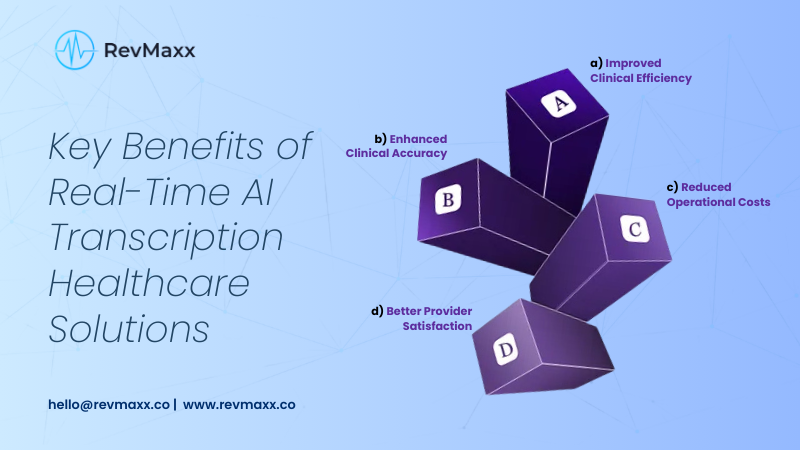
Key Benefits of Real-Time AI Transcription Healthcare Solutions
Real-time AI transcription healthcare tools do more than convert speech into text. They improve how clinicians work every day. They reduce pressure. They improve documentation quality. And they help healthcare organizations stay financially strong. Below are the core benefits in detail.
Improved Clinical Efficiency
Real-time AI transcription helps clinicians finish notes much faster. Instead of typing after every visit, notes are created during the conversation. Many providers can close charts the same day. This reduces “pajama time” and late-night documentation. It keeps work inside office hours. Studies show AI systems can reduce documentation time by 20–50% and save physicians 1-3 hours daily.
With less time spent on the computer, clinicians spend more time looking at patients, listening carefully, and building trust. Appointments feel smoother. Workflow becomes more predictable. Teams face fewer documentation backlogs. Over time, the entire clinic runs more efficiently and with less daily stress.
Enhanced Clinical Accuracy
When conversations are captured in real time, fewer details are missed. Symptoms, medication changes, and care plans are documented clearly. This leads to more complete notes. Problem lists stay updated. Important history does not get lost.
Clear documentation also supports medical necessity. This is critical for coding and reimbursement. Structured notes make it easier for coders and auditors to understand the visit. Better documentation also improves communication between care teams. It supports safer care and better follow-up decisions.
Reduced Operational Costs
Hiring and managing traditional scribes can be expensive. Real-time AI transcription reduces that dependency. Clinics may not need as many external transcription services. This lowers staffing costs over time.
It also reduces overtime expenses. When providers finish notes during clinic hours, payroll costs drop. Documentation backlogs decrease. Staff do not need extra hours to catch up. Productivity improves across the team. Billing teams work faster because documentation is ready sooner.
Better Provider Satisfaction
Documentation burden is one of the biggest drivers of burnout. Real-time AI transcription reduces that pressure. Providers feel less overwhelmed at the end of the day. They leave work on time more often.
Better work-life balance improves morale. Clinicians feel they can focus on medicine again. This improves long-term job satisfaction. When providers feel supported, they are more likely to stay and grow within the organization.
Compliance and Security Considerations
While efficiency is important, compliance is critical. Any real-time AI transcription healthcare solution must protect patient data. It must follow strict regulatory standards. Security and transparency should never be optional. Healthcare organizations must evaluate vendors carefully before implementation
HIPAA and Data Protection
Healthcare data is sensitive. AI transcription systems must use end-to-end encryption. This protects information during recording and storage. Secure cloud environments add another layer of protection.
Role-based access control ensures only authorized users can view patient data. This reduces internal risk. Vendors should also sign Business Associate Agreements (BAAs). This confirms shared responsibility for protecting protected health information (PHI). Strong safeguards build trust with both patients and providers.
Audit-Ready Documentation
Structured documentation helps organizations stay audit-ready. Notes aligned with CMS guidelines make compliance easier. Clear Medical Decision Making (MDM) elements support correct E/M coding levels.
Time-stamped entries create a clear record of care delivery. This improves transparency. When documentation is complete and structured, claim denials decrease. Audit risk becomes lower. Organizations feel more confident during payer reviews. Strong documentation protects both revenue and reputation.
Regulatory Alignment (CMS, MACRA, MIPS)
Real-time AI transcription can support value-based care programs. Clear documentation helps with quality reporting under CMS programs. It improves risk adjustment accuracy.
Complete capture of Hierarchical Condition Category (HCC) codes ensures proper reimbursement for complex patients. Accurate records also support MACRA and MIPS performance measures. When documentation reflects the true patient condition, organizations perform better in regulatory scoring and financial benchmarks.
Revenue Cycle Impact of Real-Time AI Transcription Healthcare
Strong documentation drives strong revenue. When notes are complete and accurate, coding improves. Claims move faster. Payments arrive sooner. Real-time AI transcription healthcare tools support the revenue cycle from the start of the visit to final reimbursement.
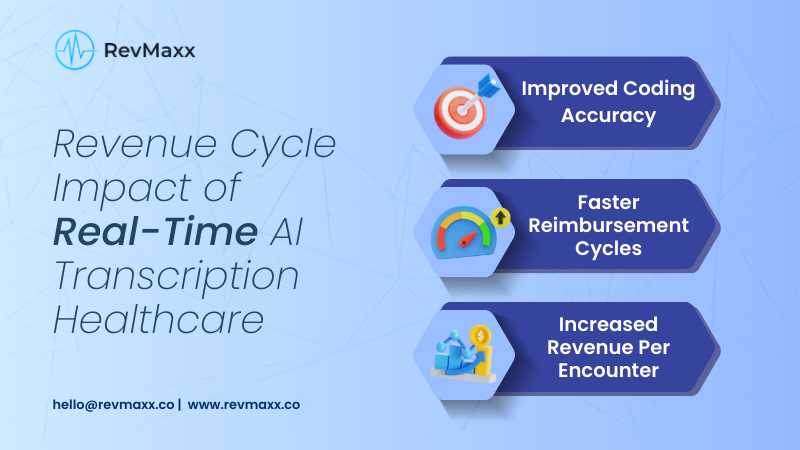
Improved Coding Accuracy
Incomplete notes often lead to undercoding and denials. The American Medical Association estimates that claim denial rates range from 5% to 10%, costing billions in rework annually. AI-supported documentation improves coding precision. Many AI coding systems now report over 95% accuracy, compared to 80–85% with manual processes. More complete documentation means:
- Accurate CPT and ICD-10 code assignment
- Reduced undercoding
- Fewer preventable denials
Better notes directly protect revenue.
Faster Reimbursement Cycles
When documentation is completed the same day, claims can be submitted immediately. The Medical Group Management Association (MGMA) reports that high-performing practices maintain clean claim rates above 90% and keep days in A/R under 30–40 days.
Real-time transcription helps by:
- Enabling same-day chart closure
- Increasing clean claim rates
- Reducing billing delays
Faster claims mean faster cash flow.
Increased Revenue Per Encounter
Missed documentation often means missed revenue. Studies show that undercoding can reduce practice revenue by up to 10% annually. Real-time AI transcription captures detailed clinical conversations. This supports:
- Proper E/M level selection
- Full capture of billable services
- Strong medical necessity documentation
The result is compliant revenue growth without increasing patient volume.
Implementation Best Practices
Successful adoption of real-time AI transcription healthcare requires the right partner, strong onboarding, and measurable goals. A structured rollout ensures clinical, operational, and financial value.
Choosing the Right Real-Time AI Transcription Healthcare Partner
- Select a vendor with deep experience in clinical documentation. Ask for healthcare case studies and measurable outcomes
- The solution must integrate directly into your EHR. Seamless integration reduces clicks and workflow disruption
- Ensure HIPAA compliance, secure cloud hosting, encryption, and a signed Business Associate Agreement (BAA)
- A human-in-the-loop model improves accuracy and reduces compliance risk. It builds provider trust
- Training and Onboarding
- Start with pilot users. Use early adopters to drive broader acceptance
- The tool should feel natural within days. Complex systems slow adoption
- Templates and outputs should match specialty needs. Customization improves long-term usage
The Final Thoughts
Real-time AI transcription healthcare is transforming clinical documentation by reducing administrative burden, improving compliance, and enhancing financial performance. For healthcare organizations looking to boost efficiency, support clinician well-being, and strengthen their revenue cycle, this technology offers measurable value.
As AI-powered tools continue to evolve, real-time transcription is poised to become a cornerstone of modern, patient-centric, and financially sustainable care delivery.
Try RevMaxx AI medical scribe now!