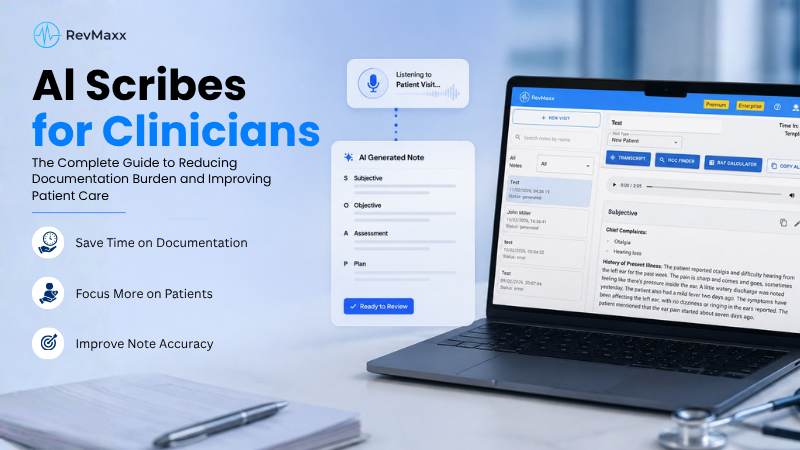

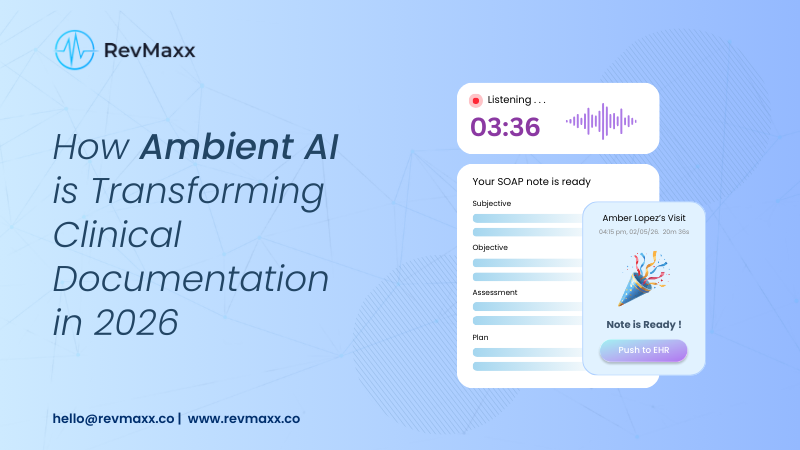
In 2026, the most important change in clinical documentation isn’t faster typing or better templates—it’s that clinicians may no longer need to document visits at all. Ambient AI clinical documentation systems now listen to physician-patient conversations and generate structured clinical notes automatically, often before the visit even ends. What was once a manual administrative task is quickly becoming an automated clinical workflow running quietly in the background.
This blog explores how ambient AI works, why it matters now, what benefits it delivers, real-world results from health systems, challenges ahead, and future prospects for healthcare.
What is Ambient AI in Clinical Documentation?
Ambient AI refers to the intelligent systems that listen to clinical conversations. It uses microphones and speech-recognition technology and then automatically generates structured clinical documentation in real time.
Rather than requiring clinicians to type, click, or dictate after each encounter, the AI continuously captures the dialogue and produces a draft note for review. These systems typically combine speech-to-text, speaker identification, natural language processing (NLP), and integration with electronic health records (EHRs) to format notes into structured templates.
In 2026, this advanced technology is much more than dictation; it understands clinical terms, contextualizes conversation, and supports workflow within higher-order documentation frameworks.
How Ambient AI Clinical Documentation Differs From Traditional Tools
Traditional documentation methods include:
- Manual typing into the EHR during or after patient visits
- Dictation using voice-to-text software where clinicians speak their notes after the fact
- Human medical scribes who accompany clinicians and write notes in real time.
Ambient AI clinical documentation systems differ fundamentally. It captures the patient-provider encounter in real time without interrupting the clinical workflow.
Unlike dictation, it processes entire doctor-patient conversations with minimal clinician pause. And unlike human scribes, it embeds directly into digital workflows, scales easily, and can process large numbers of patient encounters automatically.
How Ambient AI Documentation Works in Clinical Settings
In 2026, ambient AI clinical documentation technology fits naturally into any clinical workflows. It works quietly in the background, capturing conversations, understanding clinical content, and preparing structured clinical notes for quick review. Here is the step-by-step workflow described below:
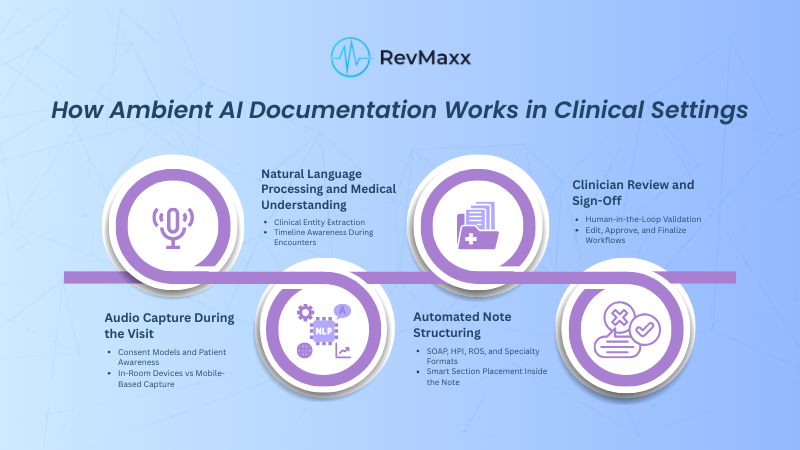
Audio Capture During Visit
The very first step is capturing the patient-provider conversation as it happens. Ambient systems use secure methods to record audio passively during the visit, without interrupting the flow of care.
Consent Models and Patient Awareness:
Most healthcare organizations follow clear consent protocols. Patients are informed verbally or during check-in that audio capture is used only for documentation. This transparency improves trust and supports compliance with privacy regulations.
In-Room Devices vs Mobile-Based Capture:
Audio is captured using in-room microphones, tablets, or mobile devices, depending on the care setting. In-room devices work well for exam rooms, while mobile capture supports rounds and telehealth. Modern medical speech recognition now achieves 96–99% accuracy for clinical conversations, even with medical terminology, reducing the need for rework.
Natural Language Processing and Medical Understanding
After capture, ambient AI applies advanced natural language processing to interpret the conversation.
Clinical Entity Extraction:
The system identifies key clinical elements such as symptoms, diagnoses, medications, allergies, and care plans. Unlike basic dictation tools, ambient AI understands clinical meaning, not just words.
Timeline Awareness During Encounters:
Ambient AI tracks the sequence of the visit—chief complaint, history, examination, and plan. This timeline awareness helps place information accurately within the clinical note, improving clarity and usability.
Automated Note Structuring
Once clinical meaning is extracted, the AI organizes the content into structured documentation.
SOAP, HPI, ROS, and Specialty-Specific Formats:
Ambient AI generates notes in standard formats such as SOAP, HPI, and ROS. It also adapts to specialty-specific requirements, helping ensure important details are consistently captured across care settings.
Smart Section Placement Inside the Note:
The AI automatically places content into the correct sections—patient statements in subjective notes, findings in objective sections, and decisions in assessment and plan. This reduces note clutter and improves review speed.
Clinician Review and Sign-Off
Clinicians remain fully in control of the final record.
Human-in-the-Loop Validation:
Ambient AI produces a draft, but clinicians review, edit, and approve every note. Studies show this approach significantly reduces documentation burden while maintaining accuracy and clinical judgment. Clinicians using ambient AI report less time spent charting and lower perceived workload compared to traditional methods.
Edit, Approve, and Finalize Workflows:
With most notes nearly complete by the end of the visit, many organizations now achieve over 90% same-day note completion, reducing after-hours charting and improving workflow efficiency.
Major Benefits of Ambient AI in Clinical Documentation
Ambient AI reduces documentation time, improves note accuracy, and lowers clinician burnout. By capturing conversations in real time, it helps clinicians focus on patients while producing structured, compliant notes that support better care, coding accuracy, and operational efficiency.
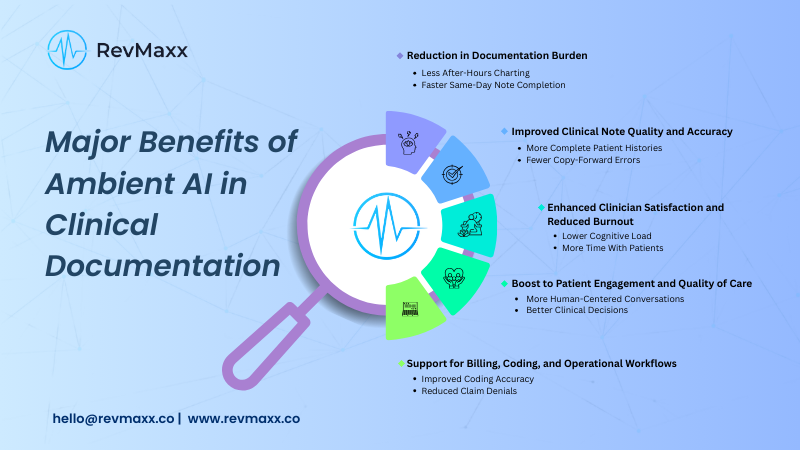
Reduction in Documentation Burden
Research clearly says that documentation is a heavy burden to the physicians. Before adoption of ambient AI clinical documentation, clinicians often spend more time on clinical charting than on patient interaction. A study shows primary care providers spending up to 50% of their workday on documentation tasks.
Ambient AI significantly reduces this burden. For example, the Permanente Medical Group reported that ambient AI scribes saved physicians an estimated 15,791 hours of documentation time in one year. This is equivalent to nearly 1,800 full workdays and more than 2.5 million patient encounters.
These time savings mean clinicians can finish documentation quicker, often within the visit itself, and reduce the need to work after hours—commonly known as “pajama time.” Ambient AI users have shown reductions in after-hours charting and earlier same-day note completion.
Improved Clinical Note Quality and Accuracy
Studies indicate ambient AI can enhance the completeness and structure of clinical notes. Research from a simulated inpatient setting demonstrated that AI-generated progress notes and discharge summaries scored significantly higher on quality metrics (like thoroughness and internal consistency) compared with manual notes.
Other evaluations show ambient AI can capture complete patient histories without missing key details, apply standard medical terminology consistently, and reduce common errors like misplaced copy-forward entries typical in EHR templates.
Higher quality ambient AI clinical documentation not only supports better decision-making but can also reduce documentation revisions, support accurate billing, and strengthen compliance with care standards.
Enhanced Clinician Satisfaction and Reduced Burnout
Burnout among clinicians is increasingly tied to documentation, and in the last few years it has reached crisis proportions. Research shows physicians spend more time on clerical EHR tasks than on patient care, and this imbalance contributes to stress and burnout. They spend 2-3 hours on documentation and EHR charting for every 1 hour of patient visit.
Ambient AI implementations have been shown to lighten this cognitive load. Results from quality improvement pilots reveal statistically significant reductions in perceived documentation effort and cognitive demand when clinicians use ambient AI tools.
Additionally, reductions in EHR time, improvements in job satisfaction, and decreased burden of after-hours work have been reported, helping physicians reclaim personal time and focus more on patient care and clinical judgment.
Boost to Patient Engagement and Quality of Care
When clinicians are freed from screens and keyboards, they can devote more attention to patients. Ambient AI helps clinicians maintain better eye contact, ask more meaningful follow-up questions, and deepen the overall therapeutic relationship.
In some health system reports, providers reported improved patient communication and a stronger connection with patients. This is partly caused by the burden of typing not disrupting the natural flow of the patient visit.
Support for Billing, Coding, and Operational Workflows
Inadequate clinical documentation frequently results in delayed, reduced, or denied reimbursement. Research says nearly $500,000 in forfeited reimbursement due to incomplete notes and coding mistakes. These errors often stem from missing elements in clinical records, which then prevent accurate assignment of codes that reflect the level of service provided.
Well-structured AI-generated clinical notes can enhance operational workflows by automatically suggesting relevant codes and ensuring compliance with billing requirements.
This reduces errors in claims and lowers denial rates. Improved structure also benefits downstream teams like coding and reimbursement departments. It is done by reducing ambiguity and omissions that can trigger post-submission queries and revenue delays.
Real-World Implementation Examples in 2025-2026
Large Health Systems Adopting Ambient AI. Several major U.S. health systems have led the way:
- Kaiser Permanente rolled out Ambient AI documentation tools across multiple regions, medical offices, and hospitals, demonstrating broad adoption and user acceptance with largely positive reactions from clinicians and patients.
- The Permanente Medical Group’s broader pilot involved over 63,000 patient encounters and showed that clinicians spent less time outside clinic hours completing documentation.
Such real-world deployments highlight how Ambient AI is more than experimental. It is becoming operational in large, complex health systems.
Funding and Market Growth Trends
In healthcare, the ambient AI clinical documentation market is rapidly expanding. Investments continue to grow as clinicians and healthcare providers seek advanced technology to support workflow improvements, reduce physician burnout and maintain a well-balanced performance in value-based care models.
In 2024, ambient clinical documentation technology alone was valued at around $1.45 billion globally and the niche is expected to grow at a CAGR of around 27.8% through the next decade. That is reaching beyond USD 13 billion by 2033.
Another report estimates the overall AI in healthcare market sizing to hit tens of billions by 2033–2035, sustained by demand for automation in both clinical and administrative tasks.
These investments reflect a shift in priorities: from basic EHR implementation toward augmentative technologies that address clinical workflow issues directly.
What’s Next for Ambient AI Beyond 2026
Ambient AI is moving beyond documentation. In the next phase, it will act as a source of clinical intelligence, helping clinicians understand patient history, identify patterns, and support better care decisions.
From Documentation to Clinical Intelligence
Ambient AI transforms clinical notes into meaningful insights by creating longitudinal patient summaries and identifying patterns across visits. This helps clinicians understand patient history faster, spot risks earlier, and make more informed care decisions.
Longitudinal Patient Summaries:
Future ambient AI systems will generate longitudinal patient summaries by combining data from multiple visits, labs, medications, and conversations. Instead of reviewing scattered notes, clinicians will see clear trends over time, which is especially valuable for chronic and complex cases. This improves care continuity and reduces time spent searching through records.
AI-Driven Insights from Conversations:
Ambient AI is also beginning to extract insights from clinical conversations. By analyzing patterns across encounters, AI can help flag risks, recurring symptoms, or gaps in care. According to the NIH, AI has strong potential to support clinical decision-making when used to augment, not replace clinician judgment, especially in identifying trends that may be missed in routine workflows.
Deeper Integration With Decision Support
By linking structured documentation with clinical decision support systems, ambient AI enables guideline-based recommendations and alerts. This supports consistent care delivery, improves outcomes, and aligns workflows with value-based care models.
Linking Documentation to Care Recommendations:
As documentation becomes more structured and accurate, it can directly feed clinical decision support systems. AI-generated notes can trigger guideline-based recommendations, reminders, or alerts based on patient history and current findings. Research shows that AI-supported decision tools can improve diagnostic accuracy by over 25% and increase adherence to clinical guidelines across multiple conditions.
Supporting Value-Based Care Models:
Value-based care depends on quality, outcomes, and cost control. Ambient AI supports this model by improving documentation accuracy, reducing unnecessary tests, and helping clinicians follow evidence-based care pathways. NIH-indexed studies highlight that AI-enabled decision support can improve efficiency and care consistency, both of which are critical for value-based reimbursement.
The Conclusion
In 2026, ambient AI is transforming clinical documentation from a time-consuming burden into an efficient, clinician-friendly process. By reducing documentation time, improving note quality, enhancing clinician satisfaction, and supporting operational workflows, ambient AI technologies are reshaping how healthcare providers document care.
Yet challenges, including privacy, system integration, and the need for human oversight must be thoughtfully addressed. As AI continues to mature and regulatory frameworks evolve, ambient AI’s potential to improve healthcare workflows and clinician experience will only grow stronger.
If you are a healthcare leader or clinician exploring ambient AI — the evidence is clear: this technology is not just promising. It is already changing clinical documentation for the better in 2026 and beyond.