In the infusion centers, nurses and clinical teams face a heavy documentation burden every day. More than ever before, these teams are required to record detailed information about medications, patient reactions, vitals, infusion times, and care plans. Apart from these, they have to ensure the accuracy, compliance, and timely billing. This workload often pulls clinicians away from direct patient care and contributes to burnout, reduced productivity, and potential errors.
Today, AI scribe for infusion centers are transforming this scenario. These are specially designed to integrate seamlessly with Electronic Health Record (EHR) systems and automate clinical note generation. As a result, it is helping the infusion centers improve documentation accuracy and nurse productivity in practical and measurable ways.
So, here in this blog, we are going to explain how AI scribe for infusion centers works. Let’s read it carefully.
Why Documentation Challenges are Critical in Infusion Centers?
Infusion centers operate differently from other clinical units. Treatment sessions can last from 30 minutes to several hours. Nurses must record:
- Pre-infusion assessments
- Medication dosing and timing
- Allergic reactions or side effects
- Continuous vitals and intervention notes
- Post-infusion monitoring and discharge education
This level of detail creates a heavy documentation burden—especially when relying on manual EHR entry during or after shifts.
In fact, study shows that healthcare providers spend nearly half of their workday on charting and EHR tasks. This time could otherwise go toward patient care.
Documentation Takes Time and Time is Money
According to research, physicians and nurses—those who are using traditional methods—spend up to 3+ hours per day on EHR documentation. For infusion centers with busy patient schedules and long sessions, this administrative load slows workflows, increases after-hours charting, and can delay patient throughput.
The challenges directly affect:
- Nurse productivity
- Care quality
- Patient satisfaction
- Compliance and billing accuracy
This is where AI Scribe for Infusion Centers makes a miracle. It can save 3.2 hours per day on documentation tasks in clinical settings.
What is an AI Scribe and How It Works?
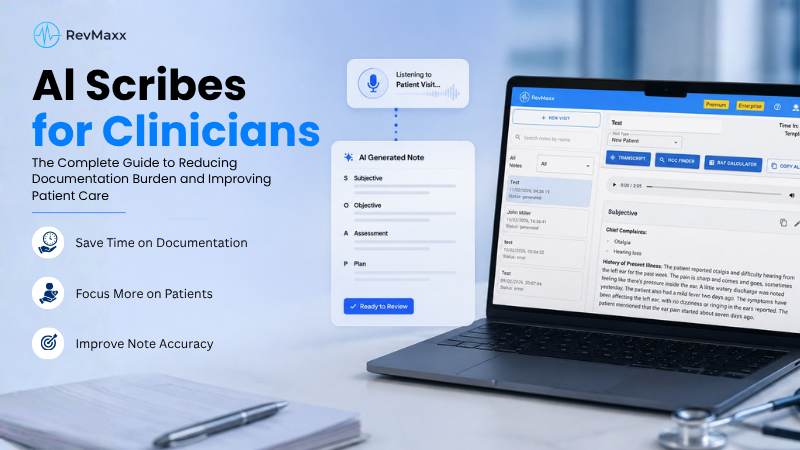
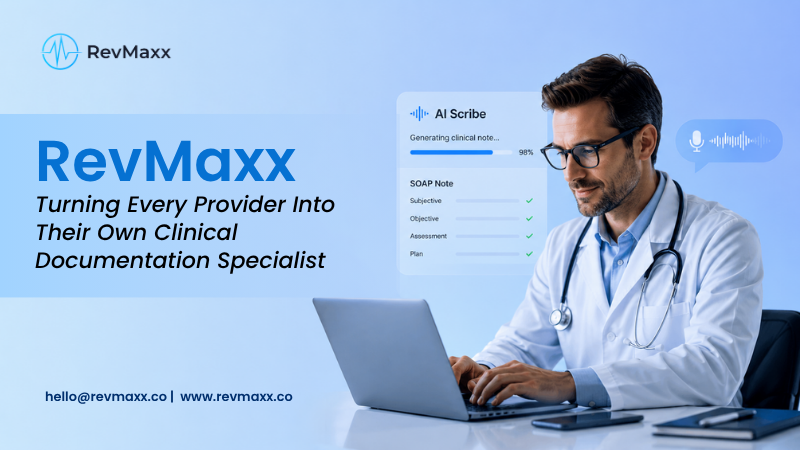
An AI medical scribe is an advanced software assistant that captures key patient-provider conversations and clinical events during visits and automatically generates clear and structured clinical notes that perfectly match EHR templates.
Rather than typing notes manually or hiring any human scribe, infusion nurses can now speak normally during patient care. The AI scribe listens carefully to every interaction, transcribes it, and organizes it all into structured notes ready to review and then syncs the data into the EHR.
How AI Scribes Capture Infusion Data?
- AI scribes use a mix of:
- Automatic speech recognition (ASR)
- Natural language processing (NLP)
- Clinical context understanding
- EHR integration interfaces
These let infusion nurses capture the following:
Data Type | How AI Scribe Captures It |
Patient Symptoms | From spoken dialogue |
Infusion Start/Stop Times | From structured prompts or audio timestamps |
Medication Names/Doses | Recognized through clinical vocabulary |
Reactions/Interventions | Extracted via semantic understanding |
Vitals | Imported from connected monitors or manually spoken |
Once captured, the AI organizes this into clear, EHR-ready notes with SOAP or infusion-specific templates.
Why Accuracy Matters for Infusion Centers?
Accuracy isn’t just a buzzword. It is central to patient safety, compliance, billing, and legal risk mitigation. Errors in documentation can lead to:
- Adverse patient events being missed
- Incorrect medication coding
- Delayed reimbursement
- Compliance violations
With the help of AI scribe for infusion centers, healthcare can achieve accuracy in documentation. Research shows AI medical scribes achieve 95–98% accuracy for general medical terminology, higher than traditional human scribes at 85–90%. Advanced systems also reduce documentation errors by up to 70% compared with manual entry.
This level of performance translates into cleaner charts, fewer missing data points, and better continuity of care. It is particularly important in complex environments like infusion centers.
How AI Scribes Enhance Nurse Productivity?
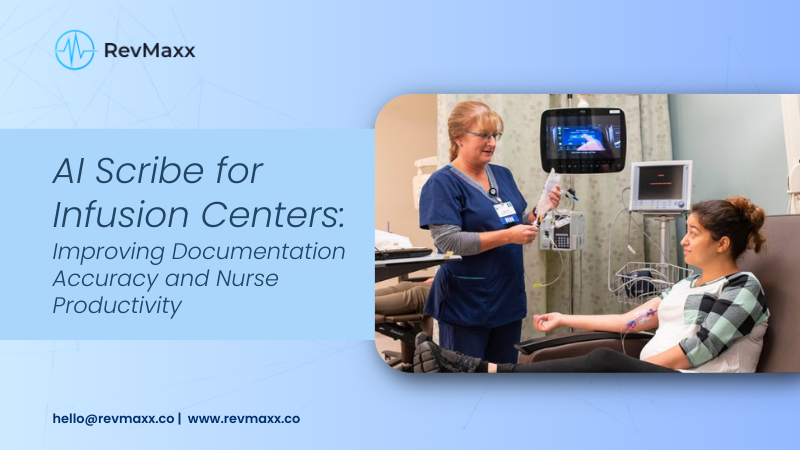
Infusion nurses manage long treatments, multiple medications, and constant patient monitoring. At the same time, they are expected to complete detailed clinical notes. AI scribe technology helps reduce this burden by handling documentation in the background. This allows nurses to work more efficiently without compromising care quality or accuracy.
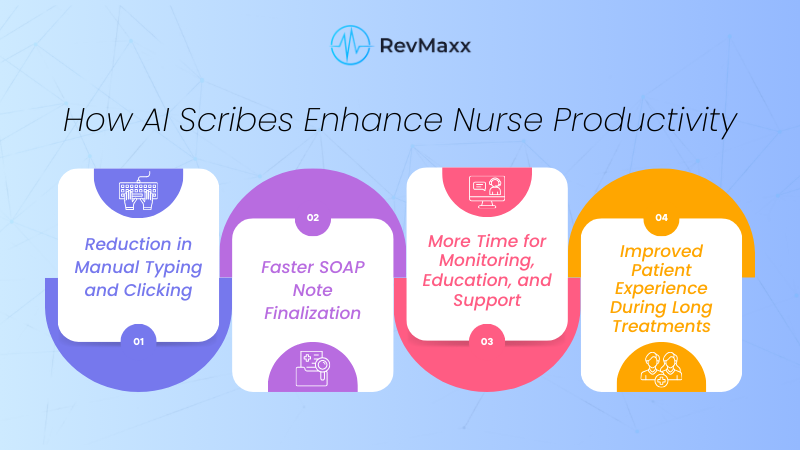
Reduction in Manual Typing and Clicking
Manual documentation requires nurses to switch between patient care and computer screens many times during an infusion session. AI scribes reduce this effort by capturing clinical conversations and key events automatically. Nurses no longer need to type every detail or click through multiple EHR fields. This saves time during each session and reduces interruptions in care.
Faster Note Finalization
With AI scribe support, most of the clinical note is already prepared by the time the infusion ends. Nurses only need to review and approve the note instead of starting from scratch. This speeds up documentation completion and helps close charts on the same day. Faster note finalization also supports timely billing and reduces follow-up work.
More Time for Monitoring, Education, and Support
Infusion treatments often last several hours. During this time, patients need close monitoring and reassurance. When documentation is automated, nurses can spend more time checking vitals, watching for reactions, and answering patient questions. They can also provide better education about medications, side effects, and next steps in care.
Improved Patient Experience During Long Treatments
Patients notice when nurses are present and attentive instead of focused on screens. AI scribes help nurses stay engaged throughout the visit. This leads to better communication, stronger trust, and a more positive experience—especially for patients receiving frequent or long-term infusion therapy.
How AI Scribe for Infusion Centers Impact on Patient Safety and Care Quality
Patient safety is a top priority in infusion centers. Treatments often involve high-risk medications that require close monitoring. AI scribe technology supports safer care by helping nurses and care teams capture accurate, complete, and timely clinical information without distraction.
Accurate Recording of Reactions and Interventions
During infusion therapy, patients may experience side effects such as nausea, dizziness, or allergic reactions. AI scribes help capture these reactions as they are discussed or observed. Interventions like stopping an infusion, giving supportive medication, or notifying a provider are recorded clearly. This reduces the risk of missing important details and supports faster clinical decisions.
Better Clinical Handoffs
Clear documentation is critical when care is handed off between nurses or shifts. AI-generated notes provide a complete picture of what happened during the infusion session. This helps the next caregiver quickly understand the patient’s condition, recent reactions, and ongoing needs. Better handoffs reduce confusion and improve continuity of care.
Easier Care Coordination
Infusion care often involves multiple teams, including physicians, pharmacists, and support staff. AI scribes create well-structured notes that are easy to read and share across the care team. When everyone has access to the same accurate information, coordination becomes smoother, and care decisions are made faster.
Better Outcomes Tracking
Consistent documentation makes it easier to track patient progress over time. Providers can review past infusion notes to identify trends, responses to treatment, or recurring side effects. This supports better treatment planning and helps improve long-term patient outcomes.
RevMaxx: Real-World Use Case of AI Scribe in Infusion Centers
RevMaxx AI Scribe is purpose-built for healthcare documentation and integrates directly into leading EHR systems. Here’s how RevMaxx stands out:
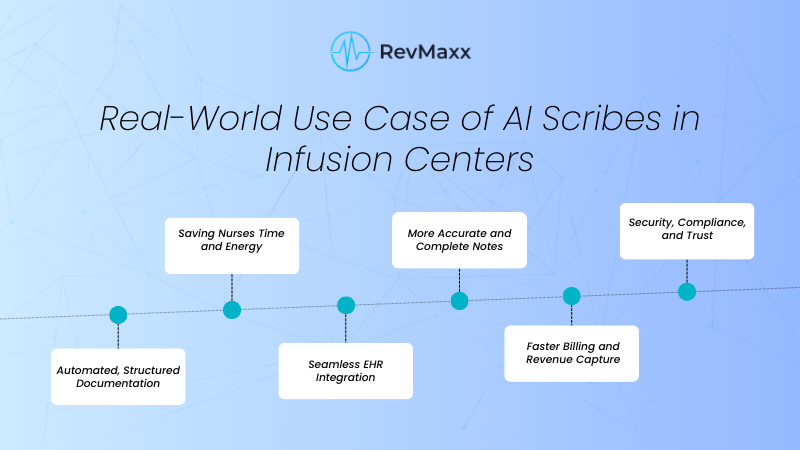
Automated, Structured Documentation
- RevMaxx listens, transcribes, and organizes data into structured clinical notes that match existing EHR templates. This results in:
- Fewer transcription errors
- Consistent formatting across notes
- Improved coding completeness for billing
- According to RevMaxx users, this automation can reduce documentation time by 30–50% daily.
Saving Nurses Time and Energy
- With RevMaxx:
- Nurses spend less time typing and more time with patients
- Documentation closes sooner, often before the shift ends
- After-hours charting (“pajama time”) is greatly reduced
- This shift directly impacts nurse satisfaction, reduces burnout, and improves retention.
Seamless EHR Integration
- RevMaxx connects with widely used EHRs such as:
- Epic
- Athenahealth
- eClinicalWorks
- PointClickCare
- Practice Fusion
- NextGen
- and more.
- When nurses finish an encounter and approve the generated note, RevMaxx automatically syncs it back into the patient record. No copying, no manual entry.
More Accurate and Complete Notes
- Higher accuracy helps improve:
- Billing quality
- Compliance with regulatory standards
- Clinical decision support
- Audit readiness
- In a 2025 benchmark, RevMaxx AI scribes reached up to 95% accuracy in clinical note generation.
Faster Billing and Revenue Capture
- Faster completion of accurate notes means:
- Quicker proper coding (ICD-10, CPT, E/M) and billing cycles
- Reduced denials due to incomplete documentation
- More predictable cash flow
- These operational improvements add up quickly for infusion centers managing high patient volume.
Security, Compliance, and Trust
- Any system handling clinical documentation must meet strict privacy standards. RevMaxx abide by US privacy standards for healthcare.
- RevMaxx is built to be:
- HIPAA-compliant
- Securely encrypted
- Logging events for audit trails
- It also works within existing EHR security frameworks. This means patient data stays protected within clinical systems, and nurses retain control over final approval of notes before they become official records.
The Conclusion
Infusion centers face unique documentation challenges that can strain nurses, slow workflows, and create compliance risks. Manual charting simply can’t keep pace in today’s fast-moving clinical environment.
That’s where AI scribe for infusion centers, especially RevMaxx’s AI Scribe for EHR integration, deliver powerful value.
With proven accuracy improvements, measurable time savings, and seamless EHR workflow integration, RevMaxx turns documentation from a burden into a business advantage. Nurses spend less time typing and more time caring for patients. Clinicians close charts faster. Leadership sees better throughput, lower burnout, and stronger financial performance.