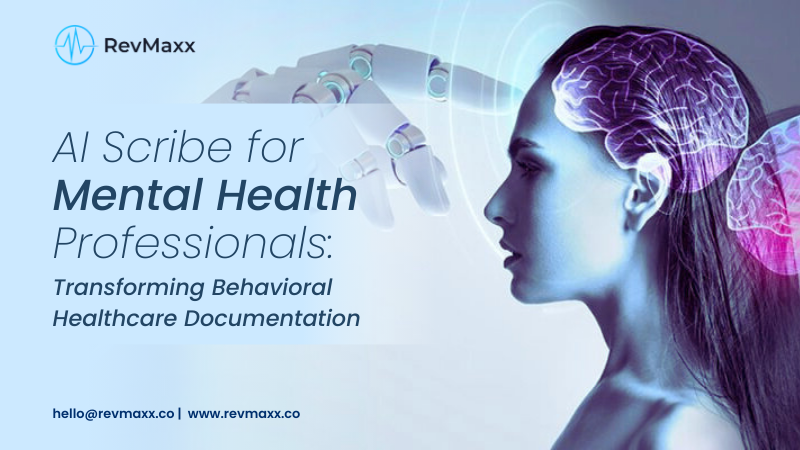
Providers of mental health treatment dedicate a significant amount of time to developing skills that help them to provide therapeutic services to individuals encountering difficult and complicated emotional situations. Unfortunately, most of their time is consumed with documenting clinical data; this represents an extremely large percentage of the total time spent working with clients. The time spent creating therapy notes, psychiatric assessments, risk assessments, and documentation for compliance purposes represents many hours each week of clinical time.
With the assistance of AI scribe for mental health professionals, there is now a new approach to experts documenting client interactions. Utilizing AI technology provides mental health professionals the ability to document clinical sessions accurately and quickly. Therefore, allowing practitioners to redirect their time and energy toward serving clients rather than on writing reports.
What is an AI Scribe in Mental Health Care?
A mental health AI Scribe is a digital documentation tool created to assist behavioral healthcare providers during healthcare encounters. An AI Scribe listens and records conversations between patients and providers, understands the context of the clinical encounter, and creates structured mental health documentation based on what is spoken by the parties involved.
The AI Scribe for healthcare is different from other transcription products because it is trained to identify emotional triggers, terms commonly used in a therapeutic setting, and language related to mental health. As such, AI Scribes are very useful for assisting in documenting information not only during therapy sessions but also with medication management and evaluations, where specific narratives are essential.
Definition and Core Functionality
The underlying purpose of an AI scribe is to support clinical documentation. This product will take relevant data from therapy/psychiatry sessions and provide clear and concise notes based on this information. All notes created by the AI will be under the full authority of the clinician, who will review each note before it is signed off as substantive. AI will not take the place of the clinician’s judgment but will instead assist them in recording their patient accurately, thus providing clinical documentation more effectively without interrupting the flow of conversation between patients and clinicians.
Ambient Listening and Real-Time Clinical Documentation
AI Scribes can operate quietly in the background, allowing them to continue working throughout the length of an appointment as clinicians talk without interruption or pausing to dictate notes. AI Scribes can listen and transmit secure audio files with clinically relevant information over time, ensuring no clinically significant details are lost or misremembered. Furthermore, capturing notes in real-time reinforces the ability for clinicians to better engage with their clients through more natural conversation, which is particularly critical within the mental health field, where establishing rapport and creating a sense of comfort are key goals for successful client outcomes.
Automated SOAP, DAP, and Progress Notes
AI scribes can automatically generate common mental health documentation formats such as SOAP, DAP, and progress notes. Based on the session content, the system structures information into subjective reports, observations, assessments, and plans. This saves time and improves consistency across notes. Clinicians can add, edit, or remove details before signing off. The result is accurate documentation without starting from a blank page after every session.
How AI Scribes Differ from Traditional Medical Scribes?
Traditional medical scribes are human assistants who document encounters in real time or afterward. While effective, they come with limitations related to cost, availability, and scalability. AI scribes offer a different approach. They provide consistent support without scheduling challenges and can be used across multiple sessions and providers. For mental health professionals, this flexibility makes AI scribes a practical alternative to human scribes.
Manual vs AI-powered Documentation
Manual clinical documentation requires clinicians to rely on memory or handwritten notes after a session ends. This often leads to longer charting time and missed details. AI-powered documentation captures information during the session itself. It reduces reliance on recall and supports more complete notes. The clinician still reviews everything, but the heavy lifting of drafting the note is already done, making the process faster and less stressful.
Cost, Accuracy, and Scalability Comparison
Human scribes involve ongoing labor costs and training. Scaling them across a growing practice can be expensive. AI scribes, once implemented, can support multiple providers at a predictable cost. Accuracy improves over time as the system learns clinician preferences and terminology. For group practices and clinics, this scalability makes AI scribes more sustainable than traditional documentation support.
| Aspect | Manual Documentation | AI-Powered Documentation |
| Cost | Higher due to labor, training, and overtime pay | Lower predictable cost with no ongoing human labor |
| Accuracy | Prone to missed details and human error | Higher consistency and fewer omitted clinical details |
| Scalability | Limited by staff availability and scheduling | Easily scales across multiple providers and sessions |
| Workflow Impact | Adds charting burden after sessions | Works in real time with minimal disruption |
| Training Needs | Requires training human scribes | Minimal training; adapts to clinical language over time |
| Consistency Across Providers | Varies by note writer | Standardized documentation formats and language |
| Administrative Overhead | High | Reduced |
Why Mental Health Professionals Need AI Scribes
Due to the nature of the documentation requirements for mental health providers, it can be difficult for clinicians to complete their required documentation. In addition to the challenges of completing the documentation, clinicians are facing increased volume of patients and administrative pressures to complete their work. The introduction of AI scribe for mental health professionals provides a solution by streamlining the process of writing the clinical notes while continuing to uphold a high level of clinical quality. The AI scribe assists in producing more efficient documentation and relieving much of the mental exertion that is placed on clinicians through the repetitive process of documenting in an electronic format.
Documentation Burden in Behavioral Health
Behavioral health documentation is more than checking boxes. It requires capturing patient statements, emotional states, progress over time, and clinical impressions. This takes time and focus. Many clinicians spend hours after sessions completing notes. Over time, this burden contributes to stress and fatigue, making documentation one of the most disliked parts of mental health practice.
Time spent on notes vs patient care
Studies and clinician reports consistently show that therapists and psychiatrists spend more time on documentation than they would like. Evening and weekend charting is common. This reduces time for self-care, supervision, and continued learning. AI scribes help shift this balance. By reducing note-writing time, clinicians can devote more energy to patient care and professional growth.
Administrative burnout among therapists and psychiatrists
Administrative burnout is a growing issue in mental health. Constant documentation demands, compliance requirements, and billing pressures add up. Burnout affects job satisfaction and can lead to reduced hours or leaving the profession altogether. AI scribes help by removing some of the repetitive work. When documentation feels manageable, clinicians are more likely to stay engaged and motivated.
Unique Documentation Challenges in Mental Health
Mental health documentation is different from other medical fields. Sessions are conversation-heavy, symptoms are subjective, and progress is often gradual. Capturing these nuances accurately is essential for continuity of care and compliance. AI scribes designed for mental health understand these challenges and are built to support detailed narrative notes.
Narrative-heavy clinical encounters
Therapy sessions often involve long discussions about thoughts, feelings, and experiences. These narratives are difficult to summarize quickly. AI scribes help by identifying key themes and clinically relevant statements within the conversation. This ensures that notes reflect the session accurately without requiring the clinician to rewrite the entire discussion from memory.
Capturing subjective symptoms and affect
Symptoms like mood, anxiety, and affect are subjective and can change within a session. AI scribes help capture these observations in context. They support documentation of patient-reported experiences and clinician observations in a structured way. This improves clarity and helps track changes over time.
Privacy and consent considerations
Mental health sessions involve sensitive information. Any documentation tool must respect patient privacy and consent. AI scribes are designed with consent-based recording and secure data handling. Clinicians can explain the tool to patients and ensure transparency. This helps maintain trust while benefiting from improved documentation.
Key Benefits of AI Scribe for Mental Health Professionals
AI-powered scribes provide a variety of tangible advantages beyond that of simply saving time. They additionally allow for improvements to clinician wellness, documentation standards, and ways to increase patient engagement. For those working in the field of mental health, these advantages have an immediate and ongoing relationship with daily practice as well as longevity of practice.
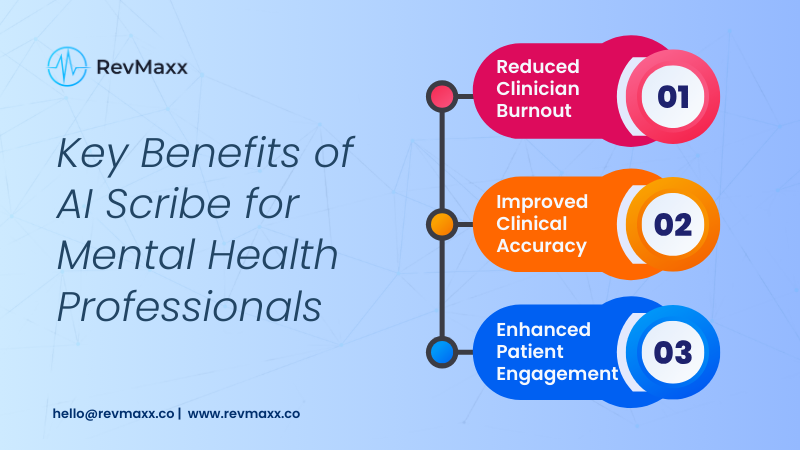
Reduced Clinician Burnout
Burnout within the behavioral healthcare industry is one of the most significant issues for practitioners today. By assisting with documentation duties that can lead to burnout, AI scribes can alleviate some of the stress associated with this field by streamlining documentation processes, allowing for easier access to information throughout the course of a practitioner’s day.
Less After-Hours Charting
One of the most appreciated benefits of AI scribes is reduced after-hours work. Notes are largely completed during or shortly after sessions. Clinicians no longer need to spend evenings catching up on charts. This improves personal time and reduces stress.
Improved Work-Life Balance
If documentation is quicker to do, it allows clinicians to have a better separation of their work and home life, allowing for better work life balance. Additionally, a better work life balance will contribute to improved mental health for the clinicians themselves over time, which is important in an industry that is dedicated to helping other people.
Improved Clinical Accuracy and Consistency
Accurate documentation supports better care, billing, and compliance. AI scribes help ensure that important details are consistently captured across sessions and providers.
Standardized Mental Health Templates
AI scribes use standardized templates tailored to mental health care. These templates guide documentation and reduce variability. Consistency helps with continuity of care, especially in group practices where multiple clinicians may see the same patient.
Reduced Risk of Missing Critical Details
While AI scribe’s ability to collect and document real-time information alleviates the chance that an important detail will be overlooked, this is especially true when assessing safety of medications or treatment plans as well as understanding changes to the medication regimen. Having complete and accurate documentation helps inform clinical decisions and improves overall clinical practice.
Enhanced Patient Engagement
Documentation tools should not interfere with the therapeutic relationship. AI scribes are designed to do the opposite by allowing clinicians to be more present during sessions.
More Eye Contact, Less Typing
When clinicians are not focused on typing, they can maintain eye contact and respond more naturally. This improves communication and helps patients feel heard and understood.
Stronger Therapeutic Alliance
A strong therapeutic alliance is central to effective mental health care. By reducing distractions, AI scribes support deeper connection and trust between clinician and patient. This can improve engagement and treatment outcomes over time.
Use Cases Across Mental Health Specialties
AI scribes support many roles within behavioral health. Each specialty has different documentation needs, and AI scribes adapt to these workflows. Whether the provider focuses on medication, therapy, or team-based care, AI scribes help reduce note-writing time. This allows professionals to focus more on care quality, patient safety, and meaningful clinical conversations.
AI Scribe for Psychiatrists
Psychiatrists manage complex clinical information during short visits. AI scribes help capture key details without slowing the session. This includes symptoms, medication effects, and clinical impressions. With better documentation support, psychiatrists can focus more on decision-making and patient communication instead of typing notes after appointments.
Medication Management And Follow-Up Visits
During follow-up visits, small medication changes matter. AI scribes help document dose adjustments, side effects, and patient feedback clearly. This reduces the risk of missing details. Accurate medication notes also support safer prescribing and better continuity when patients are seen by different providers.
Capturing Mse And Risk Assessments
Mental Status Exams and risk checks require careful attention. AI scribes help structure these observations in a clear format. This improves readability and consistency. Well-documented assessments support clinical decisions and help meet legal and safety requirements without adding extra documentation stress.
AI Scribe for Psychologists and Therapists
Therapy sessions are rich in dialogue and emotional detail. AI scribes help capture progress without interrupting the session flow. Therapists can stay present while still creating complete notes. This is especially helpful for long sessions where remembering every detail later can be challenging.
Progress Notes And Treatment Plans
AI scribes help summarize session progress and update treatment goals clearly. This supports long-term care planning. When notes are well-organized, therapists can easily review past sessions. This improves continuity and helps track patient growth over time without rewriting similar content each visit.
Session summaries for CBT, DBT, and trauma therapy
Different therapy models require different documentation styles. AI scribes adapt to CBT, DBT, and trauma-focused sessions. They help capture techniques used and patient responses. This keeps notes aligned with the therapy approach and supports supervision, billing, and treatment reviews.
AI Scribe for Behavioral Health Clinics
Clinics often manage large volumes of documentation across teams. AI scribes help create consistency across providers. This improves communication and record quality. Clinics benefit from faster documentation, fewer errors, and better readiness for audits or quality reviews.
Multi-provider documentation consistency
When multiple clinicians treat the same patient, consistent notes matter. AI scribes help standardize structure and language. This makes records easier to follow. Clear documentation supports team-based care and reduces confusion during handoffs or case reviews.
Improved Audit And Compliance Readiness
Strong documentation supports compliance and audits. AI scribes help ensure notes are complete and timely. This reduces last-minute corrections. Clinics can respond to audits with confidence, knowing records are clear and aligned with regulatory expectations.
Clinical Documentation Types Supported
Mental health care uses many documentation formats. AI scribes support both common and specialized note types. This flexibility helps providers keep their preferred style. It also supports compliance and continuity across different care settings.
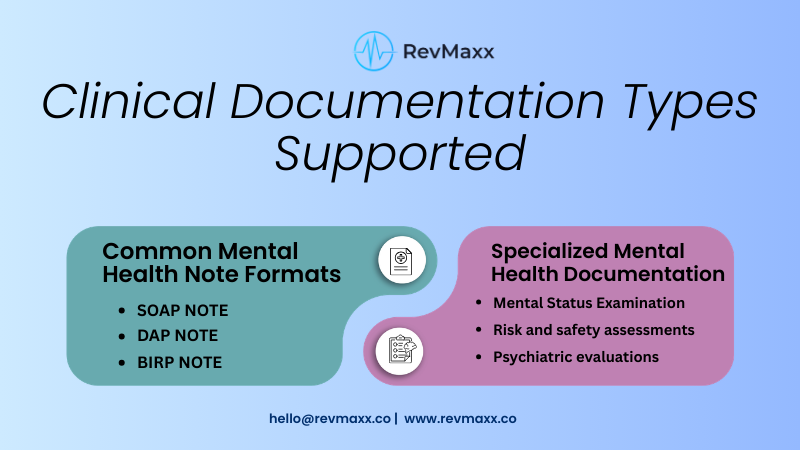
Common Mental Health Note Formats
Different practices prefer different note structures. AI scribes respect these preferences. They help organize content clearly without changing the clinician’s voice. This makes adoption easier and keeps documentation familiar.
SOAP Notes
SOAP notes remain common in mental health. AI scribes help structure “Subjective reports”, “Observations”, “Assessments”, and “Plans”. This keeps notes clear and easy to review. Clinicians can quickly understand past sessions and plan next steps.
DAP Notes
DAP notes focus on session data and clinical decisions. AI scribes help summarize discussions into this format. This reduces repetition and speeds up documentation while maintaining clinical clarity.
BIRP Notes
BIRP notes track “Behavior”, “Interventions”, “Responses”, and “Plans”. AI scribes help capture these elements accurately. This is especially useful in therapy settings where progress tracking is important.
Specialized Mental Health Documentation
Some mental health documentation requires deeper clinical detail. AI scribes support these specialized needs while keeping notes organized and readable.
Mental Status Examination (MSE)
MSE documentation requires consistency. AI scribes help record appearance, mood, speech, and thought processes clearly. This supports clinical comparison over time and improves note quality.
Risk and Safety Assessments
Safety documentation is critical in mental health care. AI scribes help ensure that risk factors and protective factors are clearly noted. This supports patient safety and legal protection for clinicians.
Psychiatric Evaluations
Initial evaluations are detailed and time-consuming. AI scribes help organize patient history, symptoms, and impressions. This reduces fatigue and improves accuracy during first visits.
Compliance, Privacy, and Ethical Considerations
Trust is central to mental health care. AI scribes must protect patient data and support ethical practice. Strong safeguards help clinicians use these tools with confidence.
HIPAA and Behavioral Health Data Security
Mental health data requires strict protection. AI scribes follow security standards to keep patient information safe. This helps practices meet regulatory requirements.
Encryption And Access Controls
Encryption protects data during storage and transfer. Access controls limit who can view records. These safeguards reduce the risk of unauthorized access and data breaches.
Consent-Based Recording
Patients should always know when AI tools are used. Consent-based recording respects patient choice. Clear explanations help maintain trust and transparency.
Ethical Use of AI in Mental Health
Ethical use means supporting care, not replacing judgment. AI scribes are tools, not decision-makers. Clinician responsibility remains central.
Transparency With Patients
Explaining AI use builds trust. Patients feel more comfortable when they understand how their information is handled. Transparency supports ethical care.
Clinician Oversight And Final Note Approval
Clinicians review and approve every note. This ensures accuracy and accountability. AI supports documentation, but clinicians remain fully responsible for care decisions.
How AI Scribes Integrate with Mental Health Workflows
When AI scribes fit naturally into daily work, clinicians use them more consistently. Easy setup and simple controls matter. Providers should not change how they conduct sessions. The tool should work quietly in the background. When integration feels smooth, adoption improves and documentation becomes a routine part of care, not a separate task.
EHR and Practice Management Integration
Strong EHR integration reduces manual effort. Notes appear in the correct patient chart without copy-paste work. This lowers the chance of errors and missing information. Integration also supports scheduling, billing, and reporting needs. When systems talk to each other, clinicians save time and feel less pressure during busy clinic days.
Psychiatry-focused EHR compatibility
Psychiatry EHRs often include therapy notes, medication tracking, and assessments. AI scribes designed for these systems understand this structure. They place notes in the right sections and follow mental health workflows. This helps clinicians trust the tool and spend less time fixing formatting or reorganizing notes after sessions.
Avoiding Double Documentation
Double documentation adds frustration and wastes hours each week. AI scribes help prevent this by creating notes once and sending them directly to the EHR. Clinicians do not need to rewrite or re-enter information. This keeps documentation faster and reduces mental fatigue, especially during full clinic schedules.
In-Person vs Telehealth Sessions
Mental health providers often switch between office visits and virtual care. AI scribes adapt to both without extra setup. The same documentation process works across settings. This consistency helps clinicians stay focused on care instead of learning different tools for different session types.
AI Scribe For Virtual Therapy
In virtual therapy, typing can break eye contact and attention. AI scribes help by capturing conversation in the background. Clinicians stay engaged with patients on screen. Notes are ready sooner after sessions. This improves both patient experience and clinician efficiency during remote care.
Hybrid Care Models
Hybrid care combines in-person and virtual visits. AI scribes support this flexibility. Notes remain consistent no matter how sessions are delivered. This helps with continuity of care and team communication. Providers can move between settings without changing documentation habits or increasing administrative workload.
Choosing the Right AI Scribe for Mental Health Professionals
Selecting the right AI scribe is an important decision for any mental health practice. Not every tool is built for behavioral health needs. A good solution should support clinical accuracy, protect patient trust, and fit daily workflows. Taking time to evaluate features and vendor approach helps avoid future frustration and ensures long-term value.
Must-Have Features
Without the right capabilities, clinicians may spend more time fixing notes than saving time. An effective AI medical scribe must go beyond basic transcription. It should understand therapy language, emotional context, and psychiatric care needs. Strong features reduce manual edits and support clear documentation.
Mental Health–Specific Templates
Mental health templates should reflect therapy sessions, not general medical visits. Templates need space for narrative details, clinical impressions, and treatment goals. When templates match real sessions, notes feel more natural and accurate. This helps clinicians trust the system and rely on it consistently across different patient encounters.
Medication And Diagnosis Capture
Accurate medication and diagnosis capture is essential in mental health care. AI-powered medical scribes should correctly document medication changes, dosages, and diagnoses discussed during sessions. Clear records reduce errors and support continuity of care. This is especially important for patients seen by multiple providers within the same practice.
Questions to Ask AI Scribe Vendors
Before choosing a vendor, clinicians should ask detailed questions about how the system works in real practice. Marketing claims are not enough. Understanding accuracy, flexibility, and support helps avoid surprises after implementation. The right vendor should be open, responsive, and experienced in mental health documentation needs.
Accuracy In Psychiatric Terminology
Psychiatric language is specific and complex. An AI scribe must correctly understand terms related to mood, thought processes, and diagnoses. Poor accuracy can lead to confusing or incorrect notes. Asking vendors about training data and testing in mental health settings helps ensure reliable documentation quality.
Customization And Clinician Control
Clinicians should always have control over their notes. AI scribes must allow easy edits, template changes, and personal preferences. Customization helps notes reflect individual clinical styles. When clinicians feel in control, trust in the tool grows, leading to better adoption and long-term use across the practice.
Platforms like RevMaxx are built with clinical workflows in mind, offering AI-powered medical scribe that supports mental health–specific templates, structured note generation, and accurate medication and diagnosis capture. Designed to reduce documentation burden without disrupting sessions, RevMaxx helps clinicians stay focused on patient care while maintaining compliance, consistency, and full control over final note approval.
The Future of AI Scribes in Mental Health Care
The future of AI scribes in mental health care goes beyond saving time on notes. These tools will support better clinical understanding over long periods. As data builds across sessions, AI scribes can help clinicians see patterns, risks, and improvements more clearly. This supports more thoughtful care decisions while still keeping clinicians in full control of treatment and documentation.
AI-Driven Insights and Longitudinal Tracking
AI scribes are evolving from note-taking tools into long-term clinical support systems. Over time, they can help track changes across multiple sessions and providers. This gives clinicians a clearer picture of patient progress. Longitudinal tracking is especially helpful in mental health, where change happens gradually and patterns matter more than single visits.
Symptom Trend Analysis
Symptom trend analysis helps clinicians understand how a patient’s condition changes over time. AI scribes can highlight repeated mentions of mood, sleep, anxiety, or stress. This makes it easier to notice improvement or worsening symptoms. Clear trend visibility supports earlier interventions and better treatment adjustments without relying only on memory and scattered notes.
Outcome-Based Care Support
Outcome-based care focuses on real patient progress, not just session completion. AI scribes can help organize notes in a way that shows whether goals are being met. This supports data-informed care planning. It also helps clinicians explain progress to patients, supervisors, or payers using clear and consistent documentation.
Scaling Mental Health Access with AI
Mental health systems are under pressure due to rising demand and limited provider availability. AI scribes help practices scale care without sacrificing quality. By reducing documentation time, clinicians can safely see more patients. This supports broader access to mental health services while helping providers maintain focus, accuracy, and emotional energy during sessions.
Supporting Overburdened Providers
Many mental health providers feel stretched thin. AI scribes help by reducing daily workload and mental fatigue. When documentation feels lighter, clinicians can manage fuller schedules without burnout. This support is especially valuable in community clinics and high-demand settings where providers care for many patients each day.
Improving Care Delivery At Scale
As practices grow, consistency becomes harder to maintain. AI scribes help standardize documentation across teams and locations. This improves communication, supervision, and care quality. At scale, better documentation supports safer care, clearer handoffs, and stronger outcomes while allowing organizations to serve more patients efficiently.
Final Thoughts: Is an AI Scribe Right for Your Mental Health Practice?
An AI scribe for mental health professionals is not about replacing human connection. It is all about protecting it. By reducing documentation burden, improving accuracy, and supporting clinician well-being, AI scribes help mental health providers focus on what matters most: their patients.
For practices facing growing demand and limited time, adopting an AI scribe can be a meaningful step toward sustainable, high-quality care.