
For healthcare providers, maintaining clear clinical documentation is a daily responsibility. Accurate documentation keeps everything in the facility working smoothly. One of the most trusted formats used across various hospitals, clinics, and therapy centers is the SOAP note. As a healthcare provider, you have likely written hundreds of such notes. But many are still searching for the real SOAP notes meaning and how to write them correctly.
Today, this blog guides SOAP notes in the simplest way possible. Here you will learn what they mean, how each section works, how to avoid common mistakes, and how to write stronger notes with real examples. You will also see how modern tools make SOAP documentation faster and more accurate.
Let’s get started.
What Is the Meaning of SOAP Notes?
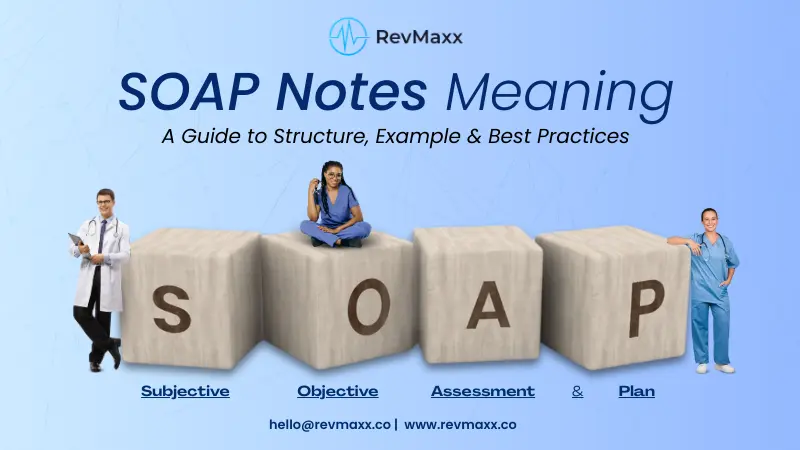
SOAP notes meaning refers to a structured format used by healthcare providers for documenting patient encounters. The word “SOAP” is an acronym:
S- Subjective
O- Objective
A- Assessment
P- Plan
Each section has a specific role in capturing details about a patient’s condition, progress or treatment. This format was first introduced in the 1960s by Dr. Lawrence Weed, the founder of the Problem-Oriented Medical Record (POMR). Since then, SOAP notes have become a standard method in clinical documentation across almost all specialties.
SOAP notes bring order and clarity to clinical documentation. Instead of writing long, unstructured paragraphs, this format breaks the information into clean sections that are easy-to-read and understandable.
Why SOAP Notes Matter in Clinical Practice?
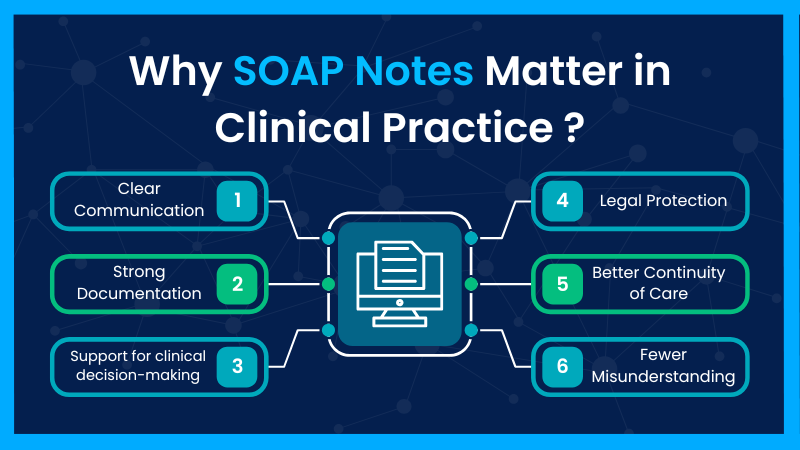
SOAP notes play a major role in patient safety and care coordination. Healthcare staff from different shifts, departments or specialties rely on these notes to understand what happened during previous visits. When written correctly, SOAP notes offer:
- Clear communication
- Strong documentation for follow-ups
- Support for clinical decision-making
- Legal protection
- Better continuity of care
- Fewer misunderstandings
Who Uses SOAP Notes? (Nurses, Physicians, Therapists & More)
SOAP notes are used across almost every area of healthcare. They are popular because they work for nearly all types of patient interactions. Users include:
- Nurses
- Physicians
- Surgeons
- Physician Assistants
- Nurse Practitioners
- Psychologists
- Psychiatrists
- Physical Therapists
- Occupational Therapists
- Speech Therapists
- Dietitians
- Social Workers
- Emergency clinicians
- Community health workers
No matter the specialty, SOAP notes help maintain consistency.
History of SOAP Notes in Healthcare Documentation
SOAP notes format was first created by Dr. Lawrence Weed in 1960s. At that period, patient records are too long, scattered and unorganized. Physicians and healthcare staff would write notes in free text, making it difficult to understand what happened during past visits. Dr. Weed introduced SOAP notes as part of the Problem-Oriented Medical Records (POMR).
His idea was simple: “A standardized layout would reduce confusion and improve clinical reasoning”.
Today, more than six decades later, his format is still one of the most widely used documentation structures in the world.
The Four Components of SOAP Notes Explained
SOAP notes work because each part has a specific purpose. Together, they create a complete and accurate record of the patient encounter.
S – Subjective
The subjective section captures the patient’s point of view. It includes everything the patient tells you about their condition. This may come from the patient directly or from a caregiver, parent, or family member.
This section reflects symptoms, not signs. These are experiences, not measurements.
What Information Goes Into the Subjective Section?
The subjective section may include:
- Chief complaint
- Symptoms the patient reports
- Onset, location, duration, and severity of symptoms
- What makes symptoms better or worse
- Relevant medical history
- Family concerns
- Lifestyle factors linked to the complaint
- Emotional or psychological responses
This section is written in simple, clear language. If the patient uses specific words, you may include them in quotes.
Examples of Strong Subjective Statements
Good subjective statements are clear and specific:
- “The patient reports a dull headache for two days.”
- “Mother says the child has been coughing at night for one week.”
- “Patient states knee pain increases when walking uphill.”
- “The patient feels anxious and has trouble sleeping.”
Weak subjective statements are vague or incomplete: - “The patient feels bad.”
- “Pain on and off.”
- “Not feeling well.”
The subjective section should always answer:
What is the patient experiencing?
O – Objective
The objective section includes information you can measure or observe. This is factual data collected during the physical exam or through tests.
Objective findings help support your assessment.
How Objective Data Is Collected?
Objective information may come from:
- Vital signs
- Physical observations
- Lab results
- Imaging results
- Wound measurements
- Gait observations
- Range of motion tests
- Behavior patterns
- Intake and output records
- Neurological assessments
Nothing in this section should be based on feelings or interpretations.
Objective Note Examples
Strong objective statements include precise details:
- “BP 134/86, HR 92, Temp 100.2°F.”
- “Redness around the wound, measuring 1.5 cm.”
- “The patient walked 20 meters using a walker with minimal assistance.”
- “Lungs clear on auscultation.”
- “CT scan shows mild inflammation.”
Objective data answers the question:
What can be measured or directly observed?
A – Assessment
The assessment section describes the provider’s clinical judgment. It connects subjective and objective details to create a clear understanding of what is happening.
This is where you interpret the information.
Meaning of Assessment in SOAP Notes
The assessment includes:
- Possible diagnosis
- Clinical impression
Risks - Changes in progress
- Expected outcomes
- Response to treatment
It is important to stay clear and structured. Avoid assumptions not supported by data.
Clinical Impression vs Diagnosis
Many providers confuse these terms:
- A clinical impression is your initial interpretation.
- A diagnosis is a confirmed condition.
Example:
“Possible viral infection” → clinical impression
“Influenza confirmed by test” → diagnosis
Both may be used depending on what information is available.
P – Plan
The plan outlines the next steps in the patient’s care. This section is practical and focuses on treatment, tests, follow-up, and patient instructions.
What to Include in the Plan Section
The plan may contain:
- Medications
- Dosage and duration
- Lab tests
- Referrals
- Imaging
- Therapy sessions
- Lifestyle changes
- Follow-up visits
- Home instructions
- Monitoring steps
A clear plan prevents confusion during future visits.
Examples of Treatment Planning
- “Start ibuprofen 400 mg every 8 hours for 3 days.”
- “Order chest X-ray due to persistent cough.”
- “Refer to cardiology for further evaluation.”
- “Begin physical therapy twice a week.”
“Follow up in one week.”
A strong plan answers:
What will we do next, and why?
SOAP Notes vs Other Documentation Formats
While SOAP is widely used, other note structures exist. Understanding the differences helps you choose the right format for your specialty.
SOAP vs DAP Notes:
DAP stands for:
- D – Data
- A – Assessment
- P – Plan
DAP combines subjective and objective details into one “data” section. It is shorter and easier to use in fast-paced environments.
Choose DAP if you want:
- Simplified note
- Shorter documentation format
- General summary of findings
Choose SOAP if you want:
- Detailed clinical decision-making
- Clearer separation of symptoms and findings
SOAP vs BIRP Notes:
BIRP stands for:
- B – Behavior
- I – Intervention
- R – Response
- P – Plan
BIRP notes are common in behavioral health. They focus more on patient behaviors and therapist actions.
Choose BIRP when documenting:
- Counseling sessions
- Behavioral changes
- Emotional responses
- Therapeutic interventions
Which Format Should You Use?
Use SOAP when you need:
- Structured clinical reasoning
- Detailed patient documentation
- Clarity between symptoms and findings
Use DAP or BIRP when documenting brief interactions or therapy sessions.
Common Mistakes When Writing SOAP Notes
Many providers repeat small mistakes that make notes unclear or incomplete. The biggest issues include vague language, missing objective details, and adding personal opinions. Clear, specific, and factual writing helps avoid confusion. Good SOAP notes meaning focus on what was seen, heard, or measured, not assumptions or feelings.
1. Using Vague Language:
Many SOAP notes sound unclear because the wording is too general. Terms like “fine,” “better,” or “normal” do not explain what actually changed. Vague words can confuse other providers and slow down care. Always describe what you observed or what the patient reported. Specific details make the note stronger and easier to understand.
Example:
Be specific instead:
- “Pain reduced from 7/10 to 4/10.”
- “The patient cried during the session and shared feeling lonely.”
2. Missing Objective Evidence:
Some notes meaning include conclusions without facts to support them. This makes the assessment weak and unreliable. Every judgment should connect to a measurable sign, test result, or observation. When you add numbers, measurements, or clear findings, the documentation becomes more accurate and helps guide the next steps in care.
3. Documenting Personal Opinions:
SOAP notes should stay professional. Personal thoughts, assumptions or emotional reactions can make the note sound biased. Stick to facts and avoid guessing about the patient’s behavior or motives. Neutral and clear writing keeps the documentation clean, fair, and helpful for the entire care team.
SOAP Notes Examples for Different Specialties
Understanding SOAP notes meaning becomes easier when you see how different providers use them in real situations. These examples show simple and clear ways to document patient care. Each specialty follows the same format but adds details based on its workflow. These samples help you apply SOAP notes format in daily practice and improve clarity. By comparing them, you can better understand SOAP notes across nursing, therapy, mental health, and primary care.
1. Nursing SOAP Note Example:
S: Patient says she feels light-headed since morning and has mild nausea.
O: BP 102/68. Pulse 90. Skin pale. No vomiting.
A: Possible dehydration.
P: Give oral fluids. Monitor vitals every 30 minutes. Reassess symptoms in one hour.
This example shows how nurses focus on symptoms, vital signs, and quick actions.
2. Physical Therapy SOAP Note Example:
S: Patient reports sharp pain in left knee when standing up.
O: Swelling noted. Flexion limited. Gait unsteady.
A: Signs of ligament strain.
P: Begin gentle stretching. Apply an ice pack. Schedule therapy twice a week.
Physical therapists often include mobility changes, range of motion, and functional limits.
3. Mental Health SOAP Note Example
S: Patient shares feeling stressed and having trouble sleeping. Reports constant worry.
O: Mood low. Voice soft. Limited eye contact.
A: Symptoms suggest anxiety.
P: Start weekly counseling. Teach breathing exercises. Review progress next session.
Mental health notes focus on behaviors, emotions, and thought patterns.
4. Primary Care SOAP Note Example
S: Patient reports sore throat for three days and difficulty swallowing.
O: Temp 99.9°F. Throat red with mild swelling. No respiratory distress.
A: Possible viral infection.
P: Advise warm fluids. Prescribe medication if symptoms worsen. Follow up in two days.
Primary care notes often include common symptoms, physical findings, and simple home care steps.
How AI Helps Improve SOAP Note Writing
Documentation takes a big part of a clinician’s day. Many providers still finish notes after working hours. This adds stress and takes time away from family and rest. Modern tools now help reduce this burden and make SOAP note writing smoother and faster.
1. Reducing Documentation Time:
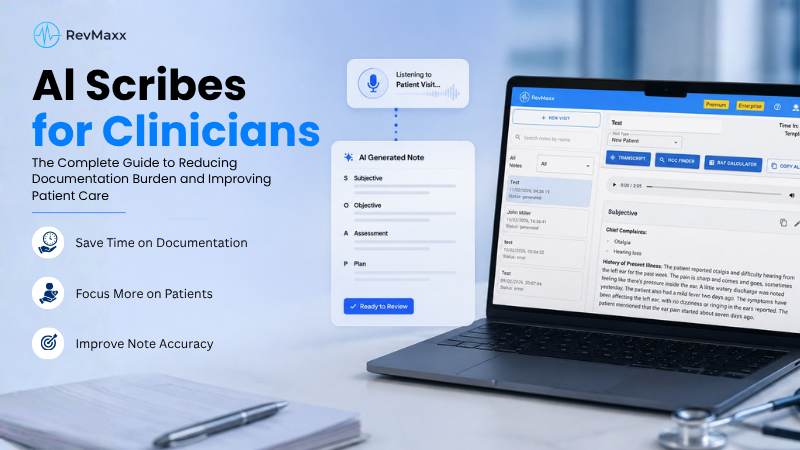
AI medical scribe can turn the entire patient conversation into structured notes within seconds. Providers do not need to type long sentences or switch between screens during the visit.
These tools capture key details, organize them under the right SOAP sections, and prepare a clear draft. This reduces the time spent on paperwork and helps providers stay focused on the patient. Many clinicians finish their notes before the next appointment instead of staying late to complete them.
2. Improving Accuracy & Compliance:
These tools help ensure every SOAP note follows a consistent and correct format. They remind providers to add missing details such as vital signs, symptoms, or follow-up plans.
They also support correct medical terminology, which helps maintain quality and reduces errors.
When notes are complete and structured, it becomes easier to meet coding, billing, and compliance standards. This leads to stronger documentation that is clear, reliable, and easy to review.
3. Eliminating Manual Formatting Errors:
Formatting takes time, and mistakes are common when notes are rushed. AI systems create clean SOAP notes automatically with proper headings, spacing, and layout. Providers do not need to adjust bullets, rewrite sections, or copy-paste content. This keeps every note organized and easy to read. It also saves time during audits, handoffs, and chart reviews.
How RevMaxx Helps Healthcare Providers Write Better SOAP Notes
AI-powered medical documentation tools like RevMaxx uses smart automation to create polished SOAP notes directly from patient conversations. It captures important details, organizes them into structured sections, and removes the stress of manual typing.
This helps clinicians reduce after-hours charting, stay accurate, and focus more on patient care. With RevMaxx, writing clear SOAP notes becomes faster, easier, and more reliable.
The Final Thoughts on SOAP Notes Meaning
Understanding SOAP notes meaning helps every provider document care in a clear and organized way. When notes are simple, structured, and consistent, communication improves. This leads to better patient safety and smoother teamwork. A strong grasp of SOAP notes also saves time and reduces stress during busy clinical days.
When providers understand how to write clear SOAP notes, patient care becomes stronger. Good notes help track symptoms, progress, and treatment results over time. They also prevent confusion during handoffs and team communication. When everyone sees the same information in the same format, decisions become faster and more accurate. This supports better treatment plans and safer care.
Technology is changing how providers write notes. Modern tools now help capture patient conversations and turn them into structured SOAP notes. This makes documentation faster and more accurate. Providers spend less time typing and more time with their patients. As these tools continue to grow, SOAP notes will become easier to create, more detailed, and more consistent across visits.