

For any healthcare provider, to manage revenue cycle management, it is essential to have a clear understanding of Hierarchical Condition Category (HCC) coding. HCC coding plays a key role in risk adjustment, which helps estimate future healthcare costs and ensure accurate reimbursements for treating patients with chronic conditions.
Whether you’re leading a coding team or managing patient data, getting a solid grasp of how HCC works can make a big difference in both clinical and financial outcomes.
Today, in this blog, we will break down what RAF (Risk Adjustment Factor) and HCC Coding really means and how it matters in day-to-day operations.
Let’s get started!
Why Accurate Medical Coding Matters?
Risk adjustment coding helps health plans predict future medical costs based on a patient’s diagnosis. It is especially important for patients with multiple health conditions. When providers document and code accurately, it ensures fair payments that reflect the time and resources needed to care for sicker patients.
In value-based care service, better documentation does not just support billing. It directly impacts how well patients are cared for and how resources are distributed.
A Clear Overview of HCC and Risk Adjustment Coding
HCC or Hierarchical Condition Category coding is a way to group related patient diagnoses into categories that reflect the overall health risk of a patient. These categories are used in risk adjustment models that help health insurance plans get fairly reimbursed for covering patients with varying medical needs.
Each HCC is assigned a value, called a Risk Adjustment factor (RAF). This number helps estimate how much care a patient might need. Government agencies like the Centers for Medicare & Medicaid Services (CMS) use RAF scores for Medicare Advantage Plans, while the Department of Health and Human Services (HHS) uses them for commercial insurance programs.
Let’s have a look on how it works:
Certified risk adjustment coders review patient medical records to identify and code health conditions that affect reimbursement. They make sure that all clinically important diagnoses are captured accurately, based on what’s documented in the patient’s chart.
These coders may work in various settings, such as:
- Healthcare provider organizations
- Health insurance plans
- Third-party vendors supporting health plans
- Government contractors performing audits
Why HCC Risk Adjustment Coding Is Key to a Healthy Revenue Cycle?
While HCC coding doesn’t work the same way as traditional fee-for-service (FFS) billing, it plays a major role in how providers get reimbursed—especially by government programs like Medicare Advantage and commercial insurers. That’s why it should be a central part of any risk adjustment strategy.
When a provider submits a diagnosis on a claim, that information is used by the health plan to calculate a risk score for the patient. This score reflects the patient’s overall health status and helps determine how much the plan will get paid to care for them.
If diagnosis codes are captured accurately and in full detail, they provide a clear picture of the patient’s true health condition. That’s why many payers and vendors now encourage providers to document with a high level of specificity. When documentation supports medical necessity and coding is complete, reimbursement becomes more accurate and reflective of the care provided.
How Risk Adjustment Coding Impacts Value-Based Reimbursement?
In value-based care contracts, payment is often tied to how well providers manage both costs and outcomes. That means accurate HCC coding is essential. If the risk scores don’t truly reflect how sick a patient is, it can lead to underpayments—and make providers appear less effective than they actually are.
For example, if risk scores suggest patients are healthier than they are in reality, it can look like a provider is spending too much for no reason. On the other hand, if those patients are accurately coded as complex, then higher costs are expected—and justified.
In capitation models, where providers are paid a fixed amount per patient, reimbursement may be based on the average risk score of the provider’s patient population. The more complex the patients, the higher the payment. That’s because these patients require more time, attention, and resources.
Important Reminders for HCC Risk Adjustment Coding
When it comes to Hierarchical Condition Category (HCC) coding, a few key practices can make a big difference. The American Academy of Family Physicians (AAFP) shares these important tips:
HCCs are additive – This means that all active and chronic conditions that exist during a patient encounter—and that affect care or treatment—should be reported.
Be specific – Always code diagnoses to the highest level of detail available. This helps ensure claims are properly sequenced and reflect the true complexity of the patient’s condition.
Don’t code resolved conditions – If a condition was treated in the past and no longer exists, it shouldn’t be included as an active diagnosis. Instead, use history codes to indicate past or family history of the condition.
Risk scores reset every year – Each year starts fresh, so conditions must be documented and coded annually to be included in the current risk score.
Sign and credential your documentation – Medical records must include clear signatures and provider credentials to be valid for risk adjustment coding.
How HCC Coding Differs from Fee-for-Service (FFS) Coding
HCC risk adjustment coding is quite different from traditional fee-for-service (FFS) coding. In FFS, providers bill for services using CPT or HCPCS codes, and each service must meet medical necessity based on the patient’s diagnosis.
HCC coding, on the other hand, focuses on ICD-10-CM diagnosis codes only. These codes are submitted to agencies like CMS (Centers for Medicare & Medicaid Services) or HHS (Department of Health & Human Services). CMS then uses those codes to calculate a risk score, which determines a per-member, per-month (PMPM) payment to the Medicare Advantage plan.
Although HCC coding might seem simpler, it actually requires more precision. The diagnosis coding needed for risk adjustment is often more detailed than what’s required just to justify a service in FFS. That’s why certified risk adjustment coders must be trained to carefully review patient charts and follow the specific rules of each risk adjustment program.
Let’s Simplify HCC and RAF Coding with Right Tool
Getting HCC and RAF coding right is more important than ever. It helps ensure patients with serious or ongoing health conditions are fully represented—and that providers are paid fairly for the care they deliver. But let’s face it—coding accurately, year after year, takes time, focus, and a lot of documentation.
That’s where RevMaxx can help.
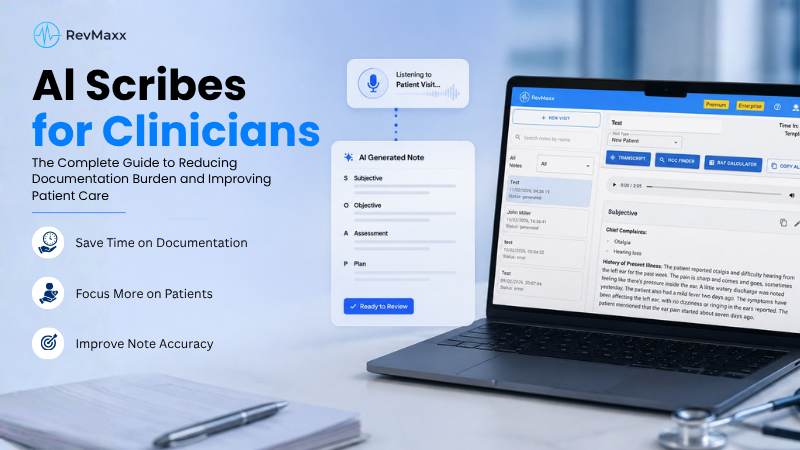
RevMaxx is a smart, easy-to-use tool that works in the background during your patient visits. It listens, takes notes, and helps you capture the correct diagnosis codes—all while you focus on care. It supports accurate HCC coding and helps calculate RAF scores so you don’t miss anything important.
With RevMaxx, you spend less time typing and more time with your patients—while making sure your documentation is complete and your reimbursements are accurate.