Accuracy, time, and efficiency are the most essential aspects of a healthcare facility. Physicians and other healthcare professionals devote 2-3 hours per day for each hour of patient care recording patient encounters. While recording the visit, choosing the appropriate diagnosis and procedure codes and making sure that everything is just right with compliance regulations is very important. Now just imagine, this could happen automatically in real time while doctors can completely concentrate on patient care. Interesting, right?
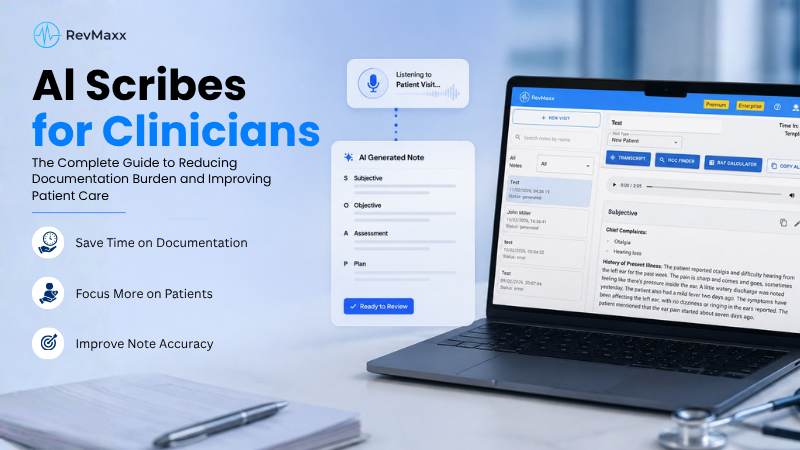
That is where automated medical coding powered by AI scribes comes into action. By using advanced machine learning, algorithms and natural language processing (NLP) technology, AI scribes can listen, understand, and convert patient-doctor conversations into accurate clinical documentation. It also provides clinical and billing codes, like ICD, CPT, HCC and E/M automatically to boost revenue.
This automated coding system not only saves providers valuable time but also reduces burnout, improves revenue cycle management and enhances the overall patient care quality.
So, let’s read this blog to get a complete overview of them.
What is Automated Medical Coding?
Automated medical coding is the process of using AI or artificial intelligence to automatically assign diagnostic and billing codes in clinical notes.
Traditionally, human coders review patient charts, clinical notes, and transcriptions to choose the correct ICD or CPT codes. But sometimes, due to missed details and any other circumstances, human codes may deliver wrong codes, which may affect negatively on clinical revenue.
AI is here to simplify the coding process. It employs sophisticated algorithms to interpret complex medical terminology, recognize applicable conditions and procedures and produce accurate codes within seconds.
Through the automation of the medical coding process, clinics and hospitals can now easily eliminate administrative delays, decrease human error, and provide more consistent accuracy in coding.
How AI and NLP Transform Clinical Documentation?
Artificial intelligence (AI) and NLP (natural language processing) technology are the two important things behind automated coding. NLP allows AI medical scribe to read and interpret complicated medical terms, patient symptoms, diagnoses and treatment plans.
For example:
If a doctor says, “the patient presents with chronic lower back pain”, the AI system identifies “Chronic” and “Back Pain”. After that, it automatically suggests ICD-10 code, M54.5- Low Back Pain.
The Growing Role of AI Scribes in Healthcare Workflows
AI medical scribes have become an essential part of any healthcare teams. Rather than wasting half of their working time typing notes and recommending codes, medical professionals now rely on AI to process the day-to-day administrative work. AI scribe records all patient-provider conversations during visit, translates them into structured clinical notes and recommends CPT and ICD-10 codes automatically.
It allows providers to:
- More focus on patient interaction instead of paperwork
- Limit after-hours charting
- Enhance documentation quality and compliance
- Accelerate billing and payment processes
As a consequence, AI medical scribes are signaling a transition from handwriting to automation, enabling healthcare systems to operate smarter and quicker.
Why Accurate Medical Coding is Essential?
Precise medical coding is the most significant aspect of contemporary healthcare management. It aligns patient care automatically with correct billing, compliance, analytics, and reporting of public health. A minor coding error can lead to claim denial, compliance penalties, and incorrect patient information.
Connecting Patient Care to Billing and Compliance
Each clinical procedure, diagnosis, and medical service should be coded and documented properly. It will ensure the provider gets paid right and patient records remain accurate. These codes are what insurance providers base their reimbursements on, while government programs such as Medicare use them for compliance.
Accurate coding also aids in research, clinical analytics, and quality improvement efforts.
For instance, aggregated ICD data enables public health agencies to monitor chronic illness or emerging outbreaks.
The Cost of Coding Errors in Healthcare
Coding errors are more than just administrative slip-ups. It can cost healthcare organizations thousands of dollars in claim rejections and audits. According to a study report, billing errors cost the U.S. healthcare system billions each year, and around 80% of medical bills contain minor coding mistakes.
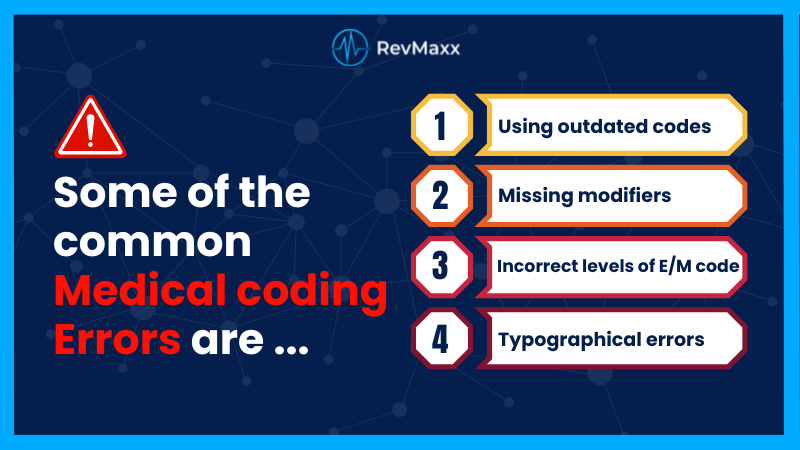
Some of the common errors are as:
- Using outdated codes
- Missing modifiers
- Incorrect levels of E/M coding
- Typographical errors during manual data entry
AI automation significantly reduces these issues by applying consistent, data-backed coding rules and continuously learning from past corrections.
Understanding Different Types of Medical Codes
In order to learn how automated medical coding is done, it is necessary to learn about the most important kinds of medical codes utilized in healthcare: ICD, CPT, HCC, and E/M. All of these code sets have different functions but are used together to finish the process of billing and documentation.
ICD-10 Codes (International Classification of Diseases)
ICD codes are global medical codes doctors and healthcare professionals use to record a patient’s illnesses, signs, and conditions. ICD-10 is the latest standard and contains more than 68,000 codes describing nearly every form of medical condition.
Representing Diagnoses and Health Conditions
ICD codes describe why a patient came for treatment. They define diagnoses such as diabetes, hypertension, or fractures. For example:
- E11.9 – Type 2 diabetes mellitus without complications
- I10 – Essential (primary) hypertension
- J06.9 – Acute upper respiratory infection, unspecified
Common ICD-10 Examples in Daily Practice
ICD codes are available to clinicians to conceptualize chronic and acute disease in routine health care practice.
For example, asthma patient consultation can utilize J45.909, and fracture follow-up can utilize S52.501A (right radius fracture).
These words could be automatically extracted from clinical reports and proposed the matching ICD codes instantly.
CPT Codes (Current Procedural Terminology)
CPT codes outline the clinical procedures or services provided by a health provider. CPT codes were created by the American Medical Association (AMA) and are utilized for billing reasons.
Documenting Procedures and Clinical Services
All tests, exams, and surgery have an associated CPT code. Some examples are:
- 99213 – Office or outpatient visit, established patient
- 93000 – Electrocardiogram with report
- 36415 – Venipuncture, routine
Computer coding systems recognize words such as “ECG done” or “blood drawn” and automatically recommend applicable CPT codes.
How CPT Codes Influence Reimbursement
CPT codes literally dictate what a provider will be paid. Incorrect CPT code selection can result in underbilling (lost dollars) or overbilling (compliance issues). AI scribes eliminate this risk through real-time mapping of clinical activities to the correct CPT levels.
HCC Codes (Hierarchical Condition Category Codes)
HCC codes are applied mainly in risk adjustment models and value-based care to forecast future cost of care. The codes apply a “risk score” per patient depending on the complexity and severity of the conditions.
As an example, a patient with diabetes or chronic heart failure will have a greater HCC score than a typically healthy patient. Proper HCC coding allows for providers to receive equitable reimbursement for treating challenging cases while staying in compliance with the requirements of payers.
How AI Scribes Simplify HCC Code Identification
AI writers utilize advanced NLP software to detect by default chronic conditions mentioned in a patient’s history, like COPD, kidney disease, or hypertension, and map them to respective HCC categories.
This automation helps healthcare organizations to maintain coding consistency across repeated visits, track chronic conditions uniformly, and reduce the risk of under-coding that affects reimbursement and quality reporting.
E/M Codes (Evaluation and Management Codes)
E/M codes represent the time and complexity involved in patient visits- from simple checkups to complex consultations.
What E/M Codes Represent in Patient Visits
E/M codes reflect the type and extent of medical decision-making. For instance:
- 99202: New patient visit, straightforward
- 99215: Established patient visit, high complexity
AI scribes can analyze conversation length, decision complexity, and data reviewed to suggest the correct E/M level.
Levels of E/M Coding:
Based on Time and Complexity, E/M coding depends on three main factors:
- The time spent with the patient
- Complexity of medical decision-making
- Nature of the presenting problem
Automated systems track these variables to accurately assign the right level of E/M coding- avoiding both undercoding and overcoding issues.
How AI Scribes Assist in Accurate E/M Code Selection
AI scribes capture encounter details like history, examination findings, and medical decisions. They review this data in real-time to identify the proper E/M level, with documentation substantiating the code. This renders audits easier and enhances compliance.
The Role of AI Scribes in Automated Medical Coding
Automated coding of medicine does not substitute for human expertise but augments it. AI scribes for medicine play the role of smart assistants that extract, interpret, and code medical encounters at high speed and precision.
How AI Scribes Capture and Convert Clinical Notes into Codes
AI scribes use microphones or available virtually to listen during patient visits. As patient-providers interact, the AI transcribes and structures the information, identifying medical terms, symptoms, procedures, and medications.
Real-Time Transcription and Context Understanding
Compared to traditional transcription software, AI scribes understand context. For example, if a doctor says, “Patient denies chest pain but reports occasional shortness of breath,” the AI understands that “chest pain” should not be coded, but “shortness of breath” should be.
Automated Identification of ICD, CPT, and E/M Codes
After clinical notes are taken, the AI system determines and assigns the proper ICD, CPT, and E/M codes automatically and displays them for clinician review prior to submission, ensuring both speed and accuracy without sacrificing compliance.
Integration with EHR and Billing Systems
Fewer late nights charting translates to more sleep and personal life. By removing the administrative burdens from their shoulders, AI allows nurse practitioners to balance life and work better. They can finish their charting in time, reduce burnout, and maintain the energy needed to offer compassionate care.
Smooth Data Transfer for Quick Reimbursement
Once clinical codes are developed, they automatically get loaded in the billing software or EHR, reducing delays from documentation to payment. This leads to quicker reimbursements and smoother workflows.
Minimizing Manual Coding Errors and Claim Denials
By automating routine coding tasks, AI medical scribes reduce human error and coding variances. Fewer errors translate into fewer rejections of claims, which enhances revenue and operational efficiency.
Benefits of Automated Medical Coding for Healthcare Providers
Automation brings measurable benefits to healthcare teams. Whether it is a solo practitioner or a multi-specialty hospital, automated medical coding simplifies the clinical documentation process. It not only improves the documentation accuracy but also strengthens the clinical revenue cycle. Let’s take a look at how it transforms the everyday healthcare workflow:
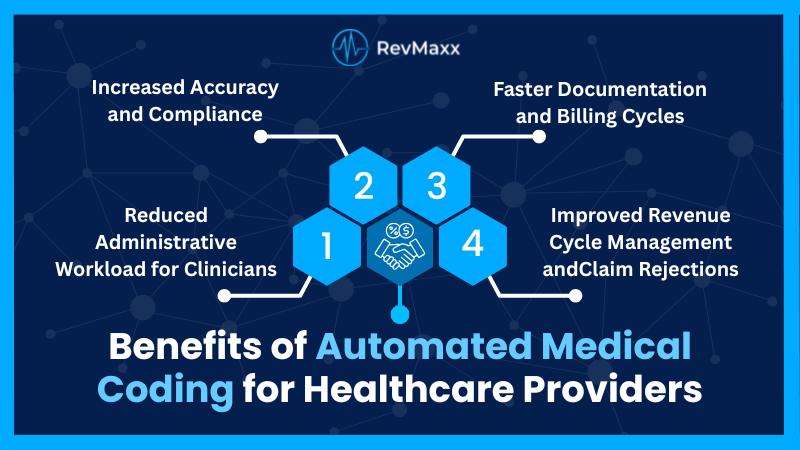
- Increased Accuracy and Compliance: AI-based medical coding guarantees all diagnoses, procedures, and services are accurately captured. Compliance rules embedded in the system ensure payers and regulators are automatically met.
- Faster Documentation and Billing Cycles: Automation greatly compresses the time between documentation and billing. What used to take hours of manual editing can now be done in minutes and accelerating the entire revenue cycle.
- Less Administrative Burden for Clinicians: AI scribes allow clinicians and healthcare professionals to spend less time on data entry and more time with patients. This leads to reduced burnouts, enhanced job satisfaction, and better patient engagement.
- Better Revenue Cycle Management and Less Claim Denials: With accurate clinical coding and timely billing submission, practices realize sooner payments and fewer denials. Ultimately, this results in greater financial stability and improved operations.
Challenges and Considerations in Automated Medical Coding
Despite its benefits, automated coding comes with challenges that healthcare organizations must address thoughtfully. Understanding these considerations always ensures that AI-powered medical coding systems need to be used effectively and safely. This will help them to maximize benefits while minimizing the potential risks.
- Data Privacy and Compliance with HIPAA: AI scribes should be in compliance with HIPAA as well as data privacy legislation. Proper encryption, safe storage, and restricted access to sensitive data are essential to uphold patient trust.
- Managing Hard Cases and Unclear Notes: Artificial intelligence systems can have difficulties with complicated or unclear documentation, particularly when there is medical language ambiguity. Ongoing clinician guidance and feedback mechanisms ensure that accuracy is improved in such instances.
- Continuous AI Training for Specialty-Specific Coding: Different medical specialties use unique coding patterns. Regular AI training with specialty-specific data ensures the system stays accurate across diverse clinical settings- from cardiology to psychiatry.
The Future of Automated Medical Coding with AI Scribes
Automated medical coding support is still evolving, but its future looks incredibly promising. As AI technology advances, clinical coding will become smarter, faster, and more integrated than ever before. As a result, it will transform the way healthcare organizations manage documentation, billing, and compliance.
- Predictive Coding and Smart Validation: Next-generation AI systems will not just code but anticipate likely codes in engagements. Inbuilt verification will guarantee compliance prior to submission, avoiding denials ahead of time.
- Integrated AI Systems for Coding, Billing, and Documentation: Soon enough, the AI scribe will be integrated into systems that will cover documentation, coding, and billing through an integrated system. This is enabling complete automation and transparency from chart to claim.
- The Road to Fully Automated E/M and CPT Selection: Through ongoing AI learning and high-level NLP, E/M and CPT selection will be fully automated. Physicians will just talk, and the system will produce fully compliant documentation and proper billing in real time.
The Final Thoughts
The shift from manual to automated medical coding is a healthcare turning point. AI scribes with automated coding programs are automating documentation, avoiding burnout, and recording all patient interactions.
By eliminating tedious administrative tasks, physicians can do what truly matters: caring for patients. Computer-assisted medical coding not only streamlines things; it allows healthcare workers to think smarter, deliver better outcomes, and forge a healthier future for medicine.