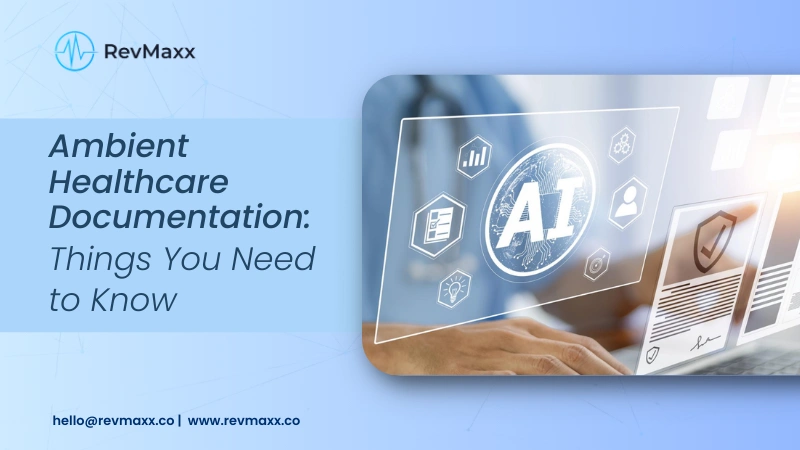
Every day doctors juggle between patient care and mountains of clinical paperwork. While attending to patients, they also have to type notes, fill out charts, and handle insurance claims. The complete process is quite hectic and time-consuming and leaves them exhausted. 75% of healthcare professionals claimed that the documentation workload takes away time from face-to-face patient interaction. To overcome this situation, ambient healthcare documentation steps forward. This technology is designed to quietly capture patient-provider conversations and convert them into accurate clinical notes.
By adopting this advanced technology, doctors can now have to spend less time on after-hours charting, enjoy better job satisfaction, and focus more on their patients. RevMaxx, a most recognized ambient healthcare documentation tool, handles the documentation process seamlessly. It carefully listens during patient visits, understands complex medical terminology, and builds structured clinical notes along with accurate clinical codes.
So, here in this blog, we will cover what ambient healthcare documentation is, how it works and why tools like RevMaxx are becoming a game-changer in healthcare.
What is the Role of ambient healthcare documentation in Reducing Physician Burnout?
Physician burnout is the growing reality of the modern healthcare facility. Doctors nowadays are frustrated with the overloaded administrative paperwork, after-hours charting, and endless EHR clicking. According to a 2021 report, 43% of doctors reported feeling burnt out. Among them, 58% pointed out that the main reason behind it is administrative work, like note-taking and EHR documentation.
This is where ambient healthcare documentation steps in as a practical solution. Unlike traditional tools and human scribes, this artificial intelligence system works quietly in the background. It manages note-taking, charting, documentation, insurance claims, and more in real time, without disrupting the clinical workflow. As a result, doctors are now available to completely concentrate on what truly matters to them: delivering quality care to their patients.
What is Ambient Healthcare Documentation?
Ambient healthcare documentation is a smarter way to handle medical note-taking and administrative paperwork. Instead of doctors typing notes, this advanced technology acts as a silent assistant that carefully listens during patient visits, captures the conversation, and generates structured clinical notes. After that, the generated notes are directly pushed into the electronic health records (EHRs).
How Does Ambient Technology Work?
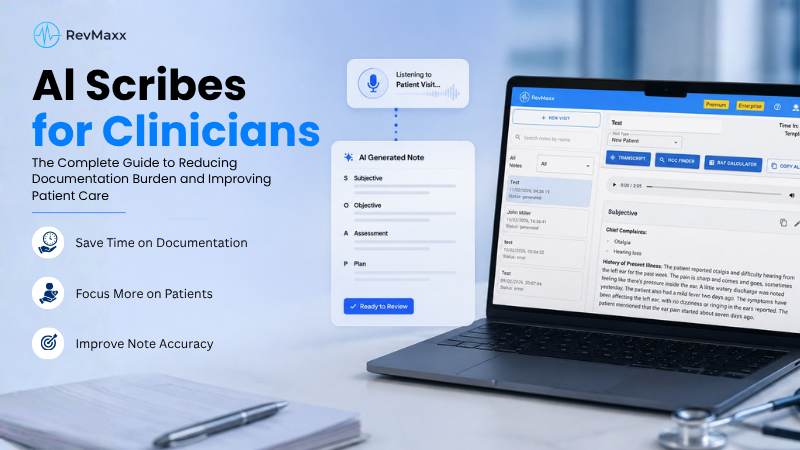
The ambient healthcare documentation process is quite simple. It uses automatic speech recognition (ASR) technology to transcribe the patient-doctor interaction and create a medical report based on that.
During a patient visit, this system silently records the conversation and automatically generates a clinical note. This note is then transferred into the patient’s EHR, ready for the physician’s review and approval. Doctors can even use their smartphone or other recording device for creating notes anytime, anywhere.
What is the Use of an Ambient Artificial Intelligence Tool to Improve the Quality of Clinical Documentation?
Ambient AI solutions vow to revolutionize the cumbersome administrative burden on healthcare professionals. These leverage sophisticated voice recognition, intelligent algorithms, and effortless EHR integration to render clinical note-taking faster, easier, and more accurate than ever.
Better Note Quality:
When doctors manually type notes, some details can get lost or missed. Ambient healthcare documentation tools listen to patient visits and generate notes automatically in real time.
A study reveals using an ambient AI tool significantly increases the documentation quality compared to traditional EHR note-writing. These tools capture every small detail of the patient visit, like the patient’s symptoms, concerns, medications, and even side remarks.
Saving Physician Time:
According to a recent study report, ambient healthcare documentation reduced overall patient consultation time by about 26.3%. That means less time on paperwork and more focus on patient care.
Clinicians using ambient documentation platforms like RevMaxx reported that documentation workflow becomes much easier and streamlined than before. It lowers the burnout risks and enhances physicians’ job satisfaction.
Improving Patient Care:
Doctors who have less paperwork stress can show up more focused on patient visits. On a trial, it has been noticed that, with EHR charting, only 66% of physicians can give their focus completely on face-to-face interaction. But with the help of ambient AI tools, the percentage goes up to 100%.
Most importantly, instant note generation helps doctors and healthcare professionals to spend more “me time” or on self-care.
Clinical Operational Efficiency:
Ambient healthcare documentation tools cut down the errors by transcribing patient-provider conversations accurately by using clinical vocabularies and coding support. This not only improves the clinical note quality but also helps with medical billing, compliance, and regulatory requirements.
The Conclusion
Physician burnout is real, and it comes from an endless documentation workload. So, addressing this issue has now become essential for the future of healthcare.
Ambient healthcare documentation offers a practical and future-ready solution for this. It captures patient conversations and turns them into clear and structured clinical notes and integrates them directly into the existing EHR system. It helps doctors to spend less time on screens and more time with patients. The result is better patient care, stronger connections, and a healthier work-life balance.
With tools like RevMaxx AI medical scribe, physicians can finally spend time break-free from the documentation burden. It gives time back to physicians and restores focus where it belongs: caring for patients.