
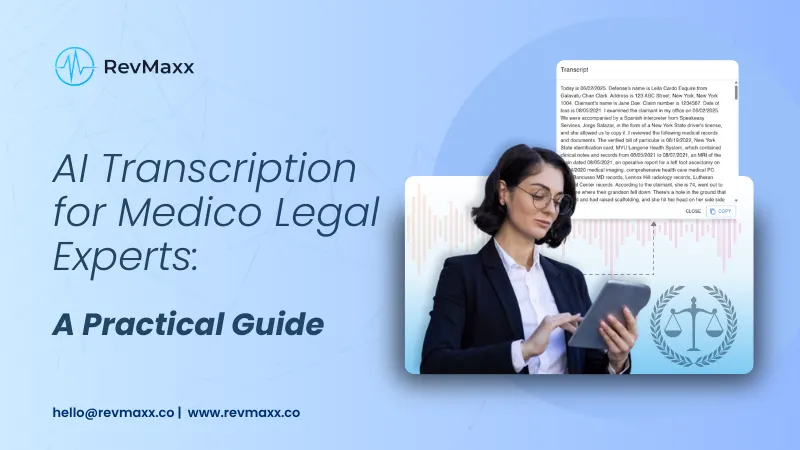
AI transcription for medico-legal has growing importance to healthcare and legal professionals as they work together through the interdisciplinary relationship of law and medicine. They often deal with sensitive medical issues, legal arguments, and medical opinions that need to be correct, clear, and able to withstand scrutiny in court. Historically, clinicians have documented these cases using traditional documentation techniques, but as the volume of documentation has grown and the complexity of these cases has increased, so have the challenges that clinicians now face regarding documenting these types of records.
Transcribing audio recordings of patient appointments from Medical Practice Recording into Medical Practice Files through audio transcription software provides a convenient means of converting audio files into written documentation in a timely and accurate manner. If utilized properly, this process has the potential to save time and money as well as enhance the quality of medico-legal reports. For those who work within the field of medico-legal, the following guide will describe how the AI transcription technology operates, why accuracy is vital, and how to best utilize the application of AI transcription technology in your daily practice.
Understanding AI Transcription in Medico-Legal Work
The transcription done through Artificial Intelligence isn’t just taking a voice and writing it down. With a Medico-Legal environment, there are additional complexities that must be taken into consideration. This includes medical terminology, legal terminology, and structures for reporting.
By knowing how AI transcription for medico-legal works, an expert can use the product with more confidence.
What Is AI Transcription for Medico-Legal Experts
AI transcription for medico-legal refers to the use of artificial intelligence systems to convert spoken medical and legal dictation into written text. These systems are designed to recognize clinical language, legal terminology, and professional speech patterns.
Medico-legal experts use AI transcription during independent medical examinations, record reviews, depositions, and expert opinion dictations. The goal is to produce accurate, readable, and legally usable documents with minimal manual effort.
Unlike general dictation tools, medico-legal transcription solutions are trained to handle complex and sensitive content. They focus on accuracy, consistency, and compliance.
How AI Converts Medical and Legal Dictations Into Text
AI transcription systems use advanced speech recognition models to analyze audio input. These models break speech into small sound units and match them with words and phrases.
Advanced AI systems in a medico-legal environment are trained on a variety of external documents, including medical records and legal strike-offs that establish expert opinions regarding medical records. This training enables the AI system to understand the context of documents, recognize different types of abbreviations, and use appropriate terms unique to this type of industry.
When audio (recorded speech) has been changed into a text document, the AI system will apply formatting rules automatically, such as placing content in chronological order or by category, like History, Findings, Opinions, and Conclusions. Some systems may also allow the creation of real-time transcriptions of audio while the speech is taking place.
Key Differences Between Traditional and AI Transcription
Traditional transcription relies on human transcriptionists who listen to recordings and type them out. This process can be slow and costly. Turnaround times may take days.
AI transcription works instantly or within minutes. It reduces dependency on third-party transcription services. Experts can review and edit transcripts immediately.
While human transcription depends on individual skill, AI transcription offers consistent output. With proper setup, it can follow the same structure every time.
Why Medico-Legal Transcription Requires High Accuracy
Accuracy is critical in medico-legal work. Even small errors can create serious problems. Reports are often used as legal evidence, so precision is essential.
Impact of Errors on Legal Outcomes
If there are mistakes in medico-legal transcripts they may cause the facts to be open to misinterpretation. For example, having a wrong date, diagnosis or an incorrect description of the injury could potentially weaken the case. Opposing counsel could question the credibility of the expert’s report due to transcribing errors and this could cast doubt on the reliability of the expert.
In many cases, this may result in the need to litigate, appeal or incur financial loss as a result of the error. Because of this reason it is imperative for AI transcribing of medico-legal related material to be rigorously scrutinized and validated.
Importance of Medical and Legal Terminology Recognition
The medical dictation contains several complex terms that relate to both health care and the law. Many times, these terms will have a similar-sounding name; however, the meanings are quite different from one another. Because of the complexity of the terminology within the medical and legal fields, AI systems may not be able to effectively interpret these terms.
Transcribing medico-legal materials will require additional recognition of medical diagnoses, medical procedures, a variety of legal terms, and every professional abbreviation that can be used by medico-legal professionals. If terminology is recognized correctly, it will ensure clarity and eliminate ambiguity as a factor in miscommunication.
Common Documentation Challenges Faced by Medico-Legal Experts
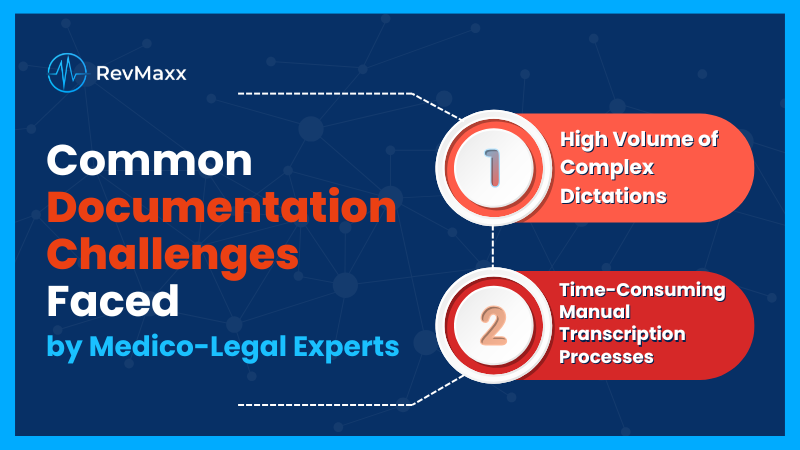
Medico-legal professionals face unique documentation challenges. These challenges affect productivity, accuracy, and work-life balance.
High Volume of Complex Dictations
Medico-legal work often involves long and detailed dictations. Each case may require hours of spoken analysis.
Independent Medical Examinations (IMEs)
IMEs require detailed documentation of patient history, examination findings, and expert opinions. These reports must be thorough and objective.
Dictating IME reports can be time-consuming. Manually transcribing them adds to the workload and delays report delivery.
Medical Record Reviews and Expert Opinions
Reviewing large medical files and summarizing findings is another challenge. Experts often dictate long narratives while reviewing records.
Manual transcription of these dictations slows down the process. It also increases the risk of errors due to fatigue.
Time-Consuming Manual Transcription Processes
Traditional transcription methods consume valuable time. This affects both efficiency and income.
Long Turnaround Times
Outsourced transcription services may take several days to return reports. Delays can affect legal timelines and client satisfaction.
Experts may have to wait before reviewing and finalizing their reports. This slows down case progress.
Administrative Burden on Experts
Many medico-legal experts end up editing or correcting transcripts themselves. This adds administrative work to their clinical and legal responsibilities.
Over time, this burden can lead to burnout and reduced productivity.
How AI Transcription Supports Medico-Legal Experts
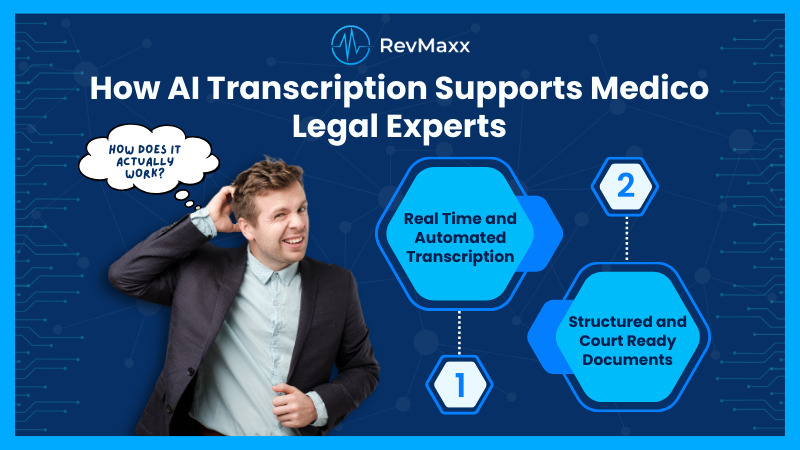
AI transcription addresses many of the challenges faced by medico-legal professionals. It supports faster, more organized documentation.
Real-Time and Automated Transcription
Modern AI tools offer real-time or near-real-time transcription. This changes how experts work.
Faster Dictation-to-Document Conversion
With AI transcription, spoken dictation is converted into text within minutes. Experts can see their words appear on screen as they speak.
This speed allows for quicker report completion. It also reduces delays in case handling.
Reduced Dependency on Manual Transcription
AI transcription reduces the need for outsourced transcription services. Experts can manage documentation in-house.
This gives more control over quality, timelines, and confidentiality.
Structured and Court-Ready Documentation
Medico-legal reports must follow clear and logical structures. AI transcription tools help achieve this.
Standardized Formatting for Legal Use
Many AI platforms offer templates for medico-legal reports. These templates ensure consistent formatting across cases.
Standardized documents are easier for legal teams and courts to review.
Clear, Organized, and Searchable Transcripts
AI-generated transcripts are digital and searchable. Experts can quickly locate specific sections or terms.
This improves efficiency during reviews, revisions, and legal discussions.
Key Benefits of AI Transcription for Medico-Legal Services
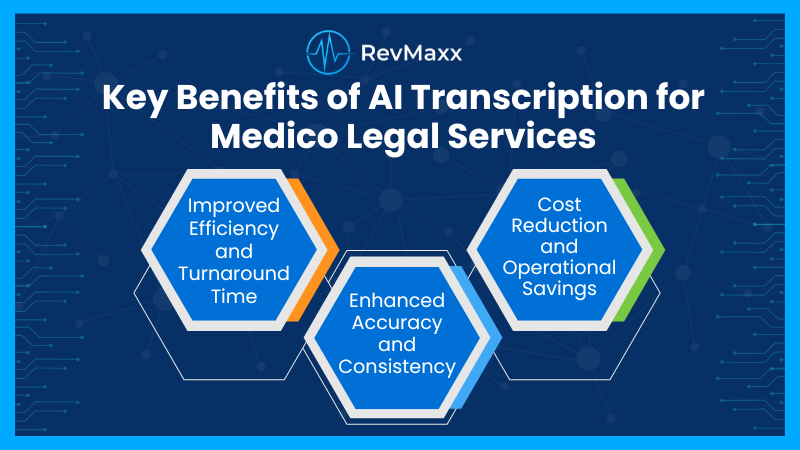
AI Transcription for Medico-Legal offers several practical benefits that directly impact daily work. It helps experts manage heavy workloads with less stress. Documentation becomes easier to handle. Reports are clearer and more organized. This allows professionals to focus more on expert analysis instead of paperwork.
Improved Efficiency and Turnaround Time
Speed is one of the biggest advantages of AI transcription. Experts no longer need to wait for manual transcription services. Dictation can happen anytime, even after office hours. Faster documentation helps maintain steady case progress and reduces delays in legal proceedings.
Completing Reports in Minutes Instead of Days
AI tools can produce transcripts within minutes of dictation. This allows experts to finalize reports on the same day. Quick access to drafts makes review easier. Changes can be made instantly. Faster turnaround improves client satisfaction and helps meet legal deadlines without pressure.
Enhanced Accuracy and Consistency
Accuracy improves when AI systems are trained on relevant language. These tools learn from repeated use. Over time, they adapt to an expert’s speaking style. This leads to fewer mistakes and more dependable transcripts across different types of medico-legal reports.
AI Models Trained on Medical and Legal Language
Specialized AI models understand both medical and legal terms. They reduce common errors seen in general dictation tools. The system correctly captures diagnoses, procedures, and legal phrases. Consistency across reports also improves. This strengthens the professional quality of documentation.
Cost Reduction and Operational Savings
AI transcription can significantly reduce costs over time. Experts spend less on external services and support staff. Fewer revisions also save time and money. Overall operational expenses decrease, making medico-legal practice more cost-efficient.
Eliminating Outsourced Transcription Costs
By reducing or eliminating the need for third-party transcription services, experts save money. There are no recurring outsourcing fees. Work remains in-house and under control. Operational savings increase profitability and allow resources to be used elsewhere.
Security, Compliance, and Confidentiality for AI-Transcription
Security is a top concern in medico-legal work. AI transcription tools must meet strict standards. Sensitive data must stay protected at all times. A secure system helps professionals work with confidence. It also reassures clients and patients that their information is safe and handled with care.
HIPAA and Legal Compliance Standards
Healthcare and legal compliance is vital for all organizations. Data use and storage must follow established protocols. Organizations should regularly update all tools used to ensure compliance due to evolving standards. Compliance will decrease risk and promote ethical behavior within an organization. Compliance also allows the organization to fulfill its audit/reporting obligations without creating additional work to do so.
Secure Handling of Medical Records and Case Data
AI transcription platforms designed for medico-legal use follow HIPAA and similar standards. They ensure that patient and case data is handled securely. Secure logins and controlled access reduce misuse. Clear data policies support responsible handling. This reduces the risk of data breaches and legal issues.
Data Protection and Access Control
Strong data protection measures are critical. Not all users need the same level of access. Role-based permissions help limit exposure. Activity logs can track changes and reviews. These steps help maintain control over sensitive information throughout the workflow.
Encryption and Secure Storage Practices
Secure AI platforms use encryption for data in transit and at rest. Access controls ensure that only authorized users can view or edit transcripts. Secure storage prevents unauthorized access. Regular backups protect against data loss. These practices help maintain confidentiality and trust.
AI Transcription Use Cases in Medico-Legal Practice
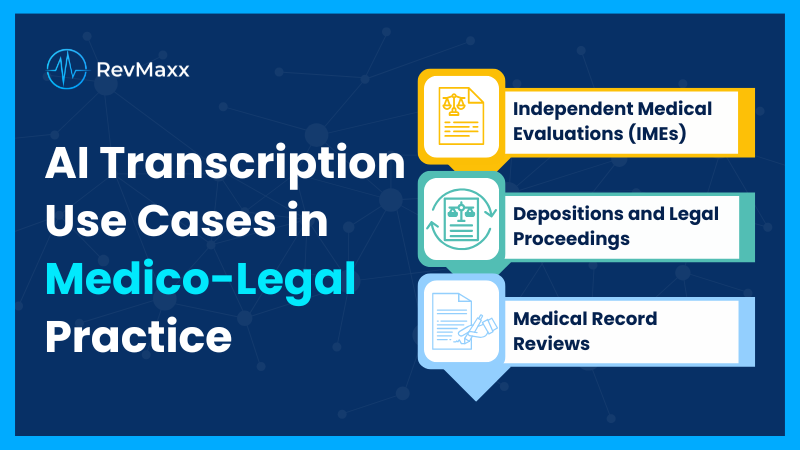
AI transcription supports a wide range of medico-legal activities. It helps reduce manual work and saves valuable time. Professionals can document complex cases without constant typing. This leads to better focus and fewer errors. AI tools also help maintain consistency across different reports and case types.
Independent Medical Evaluations (IMEs)
IMEs are one of the most common use cases. These evaluations often involve long sessions and detailed observations. AI transcription helps capture every important detail. Experts can speak naturally during the exam. This makes the process smoother and less tiring.
Capturing Detailed Clinical Findings Accurately
AI Transcription in assessments allows physicians to spend considerably less of their time typing up notes. Physicians who use AI Transcription software simply focus entirely on evaluating their patients rather than taking notes during patient visits.
Because of this, AI Transcription records your patient’s complaints, provider observations, and clinician evaluations in real-time, which results in greater accuracy and fewer opportunities for errors or the omission of important details. When writing an assessment or generating an overall summary, the accuracy of the information captured by AI Transcription enables you to create better and more clearly stated reports.
Depositions and Legal Proceedings
Legal proceedings require reliable records. Missed or unclear statements can cause issues later. AI transcription helps record spoken words clearly. It supports long discussions and multiple speakers. This makes it easier to track statements and review important points after the session.
Reliable Transcripts for Legal Review
AI transcription produces clear transcripts of depositions and hearings. These transcripts can be reviewed, edited, and used for legal preparation. Timestamps help locate key moments quickly. Clear formatting improves readability. This helps legal teams prepare cases with confidence.
Medical Record Reviews
Large record reviews benefit from automation. Reviewing files manually can be time-consuming. AI transcription helps experts work faster. It supports spoken summaries while reviewing reports. This makes record analysis less stressful and more efficient.
Faster Analysis of Large Medical Files
Experts can dictate summaries and opinions while reviewing records. AI transcription speeds up documentation and reduces fatigue. It allows steady progress without long typing sessions. This helps maintain focus and accuracy, even when handling large volumes of medical data.
Choosing the Right AI Transcription Platform
Not all AI transcription tools are suitable for medico-legal work. Choosing the right one is important. A good platform should be reliable and easy to use. It should also meet security and compliance needs. The right choice reduces rework and helps professionals trust the final transcripts.
Features that Medico-Legal Experts Should Look For
Certain features are essential for quality and usability. Accuracy should be consistent across different accents and speaking styles. The platform should also support long recordings. Simple navigation and clear settings make daily use easier. These features help experts work faster without added complexity.
Terminology Accuracy and Custom Templates
Look for platforms that support medical and legal terminology. Custom templates help match specific reporting needs. This reduces the need for manual edits. Templates also keep reports consistent across cases. Accurate terminology is important for clarity and professional acceptance in medico-legal documents.
Fast Turnaround and Easy Editing
The platform should offer quick transcription and simple editing tools. This makes review and correction easier. Features like search and timestamps save time. Easy playback helps verify key sections. Faster turnaround supports tight deadlines and improves overall productivity.
Integration With Legal and Medical Systems
Integration improves workflow efficiency. A connected system reduces manual file transfers. It helps keep records organized in one place. This allows professionals to focus on their core work instead of managing multiple tools.
Workflow Compatibility and File Export Options
AI transcription tools should integrate with document management systems and allow easy file export in common formats. This ensures smooth collaboration with legal teams and clients. Clear export options help share files quickly. Compatibility reduces errors and avoids repeated formatting work.
Best Practices for Using AI Transcription Effectively
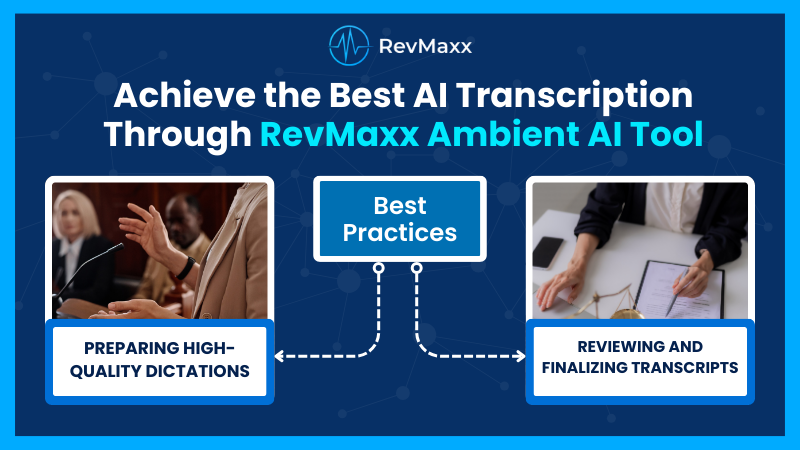
Using AI transcription correctly maximizes its benefits. It works best when users understand its limits and strengths. Following simple guidelines can improve accuracy and save time. Regular use also helps teams build better habits. When used the right way, AI transcription becomes a reliable daily support tool.
Preparing High-Quality Dictations
Good input leads to better output. A quiet environment makes a big difference. Background noise can affect accuracy. Using a good microphone also helps. Taking a moment to plan what to say before speaking can reduce mistakes and improve the final transcript.
Clear Speech and Structured Narration
Speak clearly and follow a logical structure when dictating. This helps the AI understand context and reduces errors. Pause between key points and avoid speaking too fast. Use full sentences instead of short fragments. These small steps make transcripts easier to read and review later.
Reviewing and Finalizing Transcripts
Human review remains important. AI tools support the process but do not replace expert judgment. Reviewing the transcript helps catch missing words or unclear phrases. This step ensures the final document meets professional standards and is ready for legal or medical use.
Ensuring Legal and Medical Accuracy
Always review transcripts for accuracy. Make corrections where needed to ensure compliance and clarity. Pay close attention to names, dates, and technical terms. Even small errors can cause confusion. A careful review helps protect record quality and supports trust in the documentation.
The Future of AI Transcription in Medico-Legal Services
AI transcription continues to evolve and improve. New tools are becoming faster and more reliable with each update. They can handle long recordings and complex terms with better clarity. This helps medico-legal professionals reduce manual effort and avoid common transcription errors. The future looks more efficient and time-saving.
Increasing Adoption Among Experts and Law Firms
More professionals are adopting AI tools. Doctors, legal experts, and law firms now see clear value in using them daily. These tools help manage heavy workloads and tight deadlines. Easy access and lower costs also make adoption faster. Many teams now rely on AI transcription for routine documentation.
AI as a Standard Tool in Medico-Legal Workflows
As accuracy and security improve, AI transcription is becoming a standard part of medico-legal workflows. It fits smoothly into existing systems and supports compliance needs. Professionals can review and edit transcripts quickly. This balance of speed and control helps maintain high documentation standards without added stress.
Final Thoughts: Is AI Transcription Right for Medico-Legal Experts?
AI transcription for medico-legal offers clear advantages for experts who manage complex documentation. It improves speed, accuracy, and cost efficiency while supporting compliance and confidentiality.
When chosen carefully and used responsibly, AI transcription becomes a valuable assistant. It allows medico-legal experts to focus on analysis and opinion rather than paperwork.
For professionals looking to modernize their workflow and reduce administrative burden, AI transcription is not just an option. It is a practical and forward-looking solution.