
Medical records play a crucial role in legal cases. Whether it is a malpractice lawsuit, personal insurance claim, or worker’s compensation, accurate documentation is important. Any errors or missing information can cost time and money and can even affect justice. Traditional manual transcription is prone to errors. That is why AI in medical transcription for legal cases steps in.
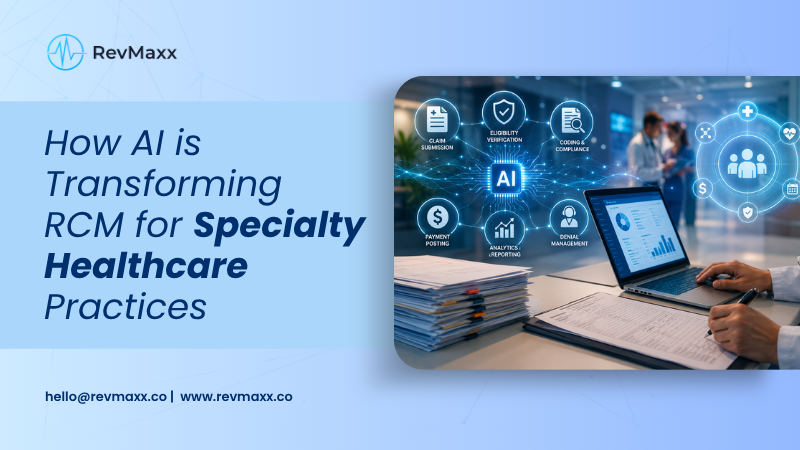
Its advanced speech recognition and natural language processing (NLP) technology can easily transcribe any provider’s dictation into detailed and accurate clinical notes. As a result, for legal professionals, it ensures better access to reliable clinical records and stronger support to build the cases. The global medical transcription market is projected to reach $6.9 billion by 2030, with AI-powered solutions driving the fastest growth
Today, in this blog post, we will explore what AI in medical transcription for legal cases is, its key benefits, and what to watch out for.
Let’s read this carefully.
Importance of Medical Transcription for Legal Cases
Before you go through the importance of adopting AI in medical transcription for legal cases, all you need to understand is why transcripts are used in legal cases:
Accuracy:
For medical transcription in legal cases, a small mistake, like errors in describing symptoms, diagnosis, dates, or medication, can change the whole thing. Studies show that manual transcription has an average error rate of 4–5%, often due to misheard terms or missed details. Any small error can weaken the entire case in court.
Meeting Legal Standards:
The court only accepts medical records if they meet strict legal rules and regulations. In the U.S. healthcare industry, healthcare reports must be authentic, reliable, properly handled, and created as a crucial part of normal business practices. If the medical transcription for legal cases does not meet those standards, it might not be allowed as evidence.
Time and Cost Issues:
Traditional medical transcription can be time-consuming and quite expensive. It often needs corrections and formatting. Sometimes, law firms have to handle hours of recordings across multiple cases, which can quickly add up to costs and delays. Law firms often spend $1.25–$3.00 per audio minute on manual transcription services. For a 10-hour deposition or clinical recording, this can easily cost $1,500–$2,000.
Security and Compliance:
Every medical record contains very sensitive patient information. In the U.S., laws like HIPAA rules and regulations strictly control how this confidential patient data is stored and shared, and accessed. In 2023, approximately 133 million healthcare records were exposed due to security incidents. Any mistakes in this could lead to serious legal and financial consequences. They even have to pay fines of $100-50,000 per violation.
Why Accuracy Matters in Legal Medical Transcriptions
Accuracy is very important when dealing with medical transcriptions for legal cases. Any word in any medical record can have a direct outcome.
A missed detail or errors in medical terms can entirely change the meaning of documentation and affect justice. For instance, mix-up between “hypertension” and “hypotension” might totally change the diagnosis of a patient.
Common Challenges with Manual Transcription
Manual transcription is a slow process and prone to mistakes. Sometimes, human transcriptionists can mishear patient-provider conversation. If the audio quality is poor or has strong accents, there is a huge chance of errors.
Most importantly, medical terms and abbreviations, drug names, and technical terms are quite complex. There are more than 20,000 drug names and abbreviations used in the healthcare industry, and these can be easily misunderstood by human transcriptionists.
Another issue of manual transcription for legal cases is fatigue. Sometimes, transcribing long patient-doctor conversation recordings requires hours of focus. Research shows human transcription performance drops by 20-30% after 2-3 hours of continuous transcription. Even professional transcriptionists often miss or misinterpret the details. For legal cases, this is quite risky, because during recording, leaving out a symptom or mentioning a wrong dosage of medicine can lower the credibility of the case.
Most importantly, the manual transcription process takes a lot of time. On average, manual transcription can take four to six hours per one hour of audio. So, with a large volume of audio files, it is quite common for backlogs and delays in preparing case documents. These delays can slow down the court proceedings.
How AI in Medical Transcription for Legal Cases Ensure Precision
AI for medical transcription is specially designed to overcome the issues with manual processes. These tools are fully trained to adopt a huge database filled with legal and medical terminology. This enables them to comprehend sophisticated language, identify abbreviations, and even accommodate various accents.
As opposed to humans, AI never tires, hence it has consistency on prolonged recordings. Most AI software also employs sophisticated machine learning; consequently, they learn and become better with each transcription. The more they work, the better they become with time. Sophisticated systems are even able to identify speakers and time-stamp conversations.
Key Benefits of AI in Medical Transcription for Legal Cases
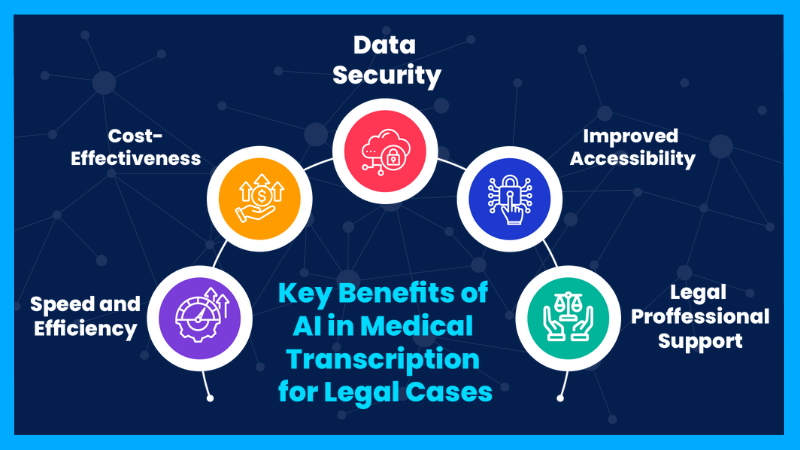
Speed and Efficiency:
One of the greatest benefits of AI medical transcription for court cases is speed. Rather than receiving transcripts after several days, AI produces them in a matter of minutes or in real time. This is particularly worthwhile in high-pressure cases where attorneys and judges require ready access to medical records.
AI eliminates the long waits due to backlog issues. Legal teams obtain transcripts without delay, study them, and craft their arguments without unnecessary delay. A recent study reveals that AI in medical transcription reduced documentation time by over 70% for legal teams. Faster turnaround means faster case progress.
Cost-Effectiveness:
Hiring human transcriptionists can be expensive, especially for large volumes of audio. During the manual transcription process, each hour of recording can cost law firms and healthcare providers significantly. On the other hand, AI transcription tools process bulk data at a fraction of the cost. And whereas human transcription costs $90–120 for each hour of audio, AI transcription can transcribe the same amount of data at one-tenth the price.
By decreasing manual labor, AI enables organizations to make cost savings and deploy resources more efficiently. Law firms can concentrate on legal strategy, while healthcare professionals can concentrate on patient care instead of paperwork.
Data Security:
Medical records include confidential patient details, which need to be treated withMedical records include confidential patient details, which need to be treated with utmost care. A majority of AI transcription platforms employ encryption and secure cloud storage to secure this information.
For legal and healthcare professionals in the U.S., HIPAA compliance is essential. A reliable AI in medical transcription for legal matters is developed to adhere to HIPAA, PHI and other legal provisions of privacy. This helps sensitive records stay confidential and secure from unauthorized access.
Improved Accessibility:
AI not only transcribes but also organizes data. Sophisticated systems index transcripts to enable quick searches for individual words such as “fracture,” “diagnosis,” or “surgery date.”
Rather than rooting around in stacks of paperwork, attorneys can immediately access key portions. That saves precious time when preparing depositions, arguments, or cross-examinations.
Supporting Legal Professionals in Complex Cases:
In malpractice or personal injury cases, medical records tend to be the best proof. AI guarantees such transcripts are correct, detailed, and straightforward to read, assisting legal teams with their claims of negligence or refutation of the same.
AI transcription also assists in insurance disputes and depositions. When every detail counts, having fast and reliable transcripts ensures nothing is overlooked.
The Future of AI in Legal Medical Transcription
The future of AI in medical transcription for legal cases is very bright. Legal cases widely depend on accurate and detailed medical records. AI is making this process faster, easier, and more reliable. As technology improves, it will change the way lawyers, healthcare providers, and insurance companies work with important medical information.
Integration with Legal Case Management Systems:
One exciting change is the way AI transcription will connect with legal case management systems. Currently, most law firms have case files, transcripts, and evidence scattered in various locations, which can be chaotic and time-consuming. In the future, AI will organize transcripts into the correct case file automatically. Lawyers can search for critical information within seconds.
For example, instead of having to dig through a few hundred pages, they are able to type “surgery date” or “fracture” and instantly have access to the right section. This will minimize stress, conserve time, and help teams prepare cases much more quickly.
Potential Advancements in Voice Recognition and NLP:
AI transcription software already employs voice recognition and natural language processing (NLP), but the future generation will be even more intelligent. They will more easily comprehend various accents, jargon in medicine, and even the context of words.
For example, the AI will understand whether “discharge” is a patient leaving the hospital or an illness symptom. Upcoming tools can also generate brief reports or accentuate major facts from long exchanges, so lawyers don’t need to go through each and every line.
The Final Thoughts
AI medical transcription for legal cases has several strong advantages such as: faster turnaround, cost savings, consistency, searchability, and scalability. If it is done with the proper tools, proper oversight, and care for legal and ethical protocols – it can fortify legal workflows and help deliver justice more effectively.
But always remember small transcription errors, unclear speaker labels, or missing metadata can create problems. The best path is a hybrid one: let AI do what it does best, and let human experts verify and validate.
If you are a lawyer, medical expert, or records manager, consider exploring RevMaxx, the most popular AI medical transcription tools that meet your jurisdiction’s admissibility standards, have strong security infrastructure, and offer robust human oversight.