In 2026, AI medical documentation is becoming a doctor’s best friend. These smart tools listen, understand, and write patient notes automatically – so healthcare providers can spend more time with patients instead of typing.
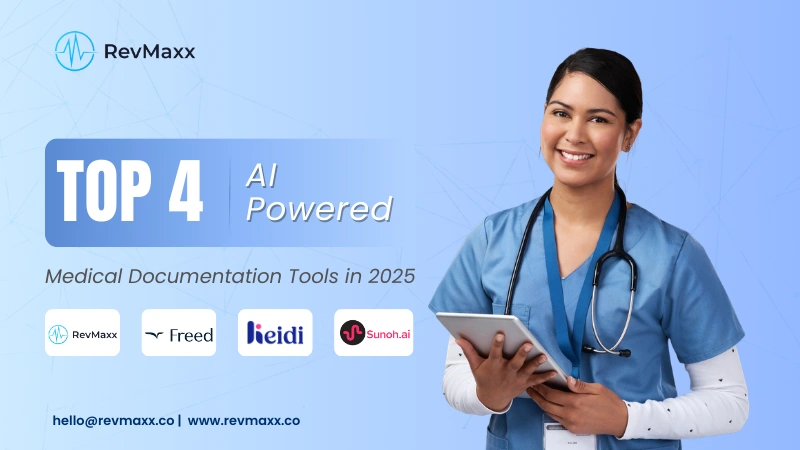
Today, in this blog post, we are going to explore the top 4 AI-powered clinical tools for seamless documentation. Whether you are a solo practitioner or a large hospital, this guide helps you to choose the right one best suited to your style and preferences.
Let’s read it carefully.
What is the role of AI in documentation?
When it comes to medical documentation, AI has become the best-ever assistant we never knew it needed. AI, or artificial intelligence, is transforming the way we create, manage and improve documentation in healthcare settings. From managing administrative workload to ensure accuracy and compliance, AI plays a significant role. This advanced technology helps physicians to spend less time on typing notes rather than focusing more on what really matters to them: delivering quality patient care.
Structuring Patient Details into Organised Records:
AI can easily organise messy notes, data from voice recordings and handwritten scribbles into clear text. This technology highlights critical details and auto-filled structured format. This not only helps doctors to save their precious time but also provides precise medical records.
Generating Clinical Notes:
Imagine having someone present during a patient visit and silently write everything down for you. This is what an AI scribe does. This healthcare assistant carefully listens to every patient-provider interaction and drafts medical notes instantly. These tools cut down the documentation time from 90 minutes to 30 minutes daily and reduced burnout.
Enhancing Note Accuracy and Quality:
Artificial intelligence in medical documentation not only accelerates the process but also identifies errors and increases the quality of the clinical notes. These are assisting healthcare professionals to maintain patient records accurate and guideline-compliant.
How is AI Used in Medical Documentation?
Physicians and healthcare professionals spend up to ⅓ of their daily working hours handling clinical paperwork. This leads to doctors’ burnout and reduces the patient’s care time. To ease this burdensome task, AI-powered tools step in.
A study reveals that AI enhances the medical documentation process by structuring data, evaluating clinical note quality and detecting errors.
Ambient scribes or AI medical scribes act as silent assistants, listen to doctor-patient conversations, draft patient notes, and suggest billing codes in real time. The adaptation of AI medical documentation reduces the after-hours charting by up to 30%.
Emerging scribing platforms like RevMaxx are rapidly expanding and cutting down the documentation time and creating notes in seconds with 95% accuracy.
Can AI Write a Doctor’s Note?
Yes. AI medical documentation is gaining significant popularity nowadays. This technology helps doctors generate clinical notes faster and more accurately than ever before.
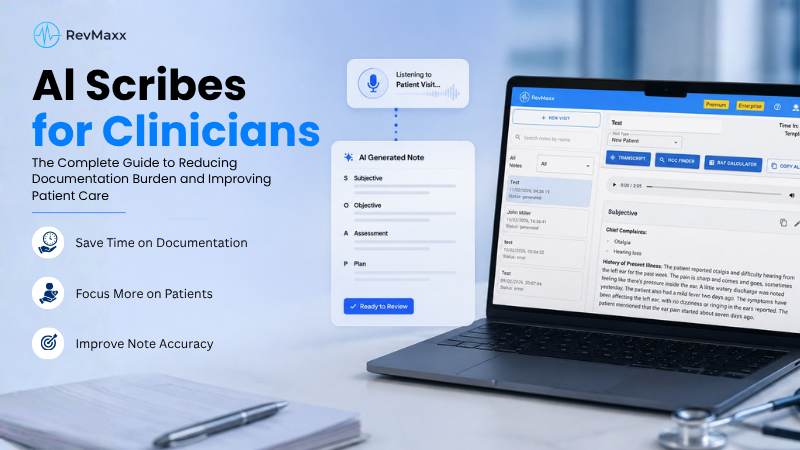
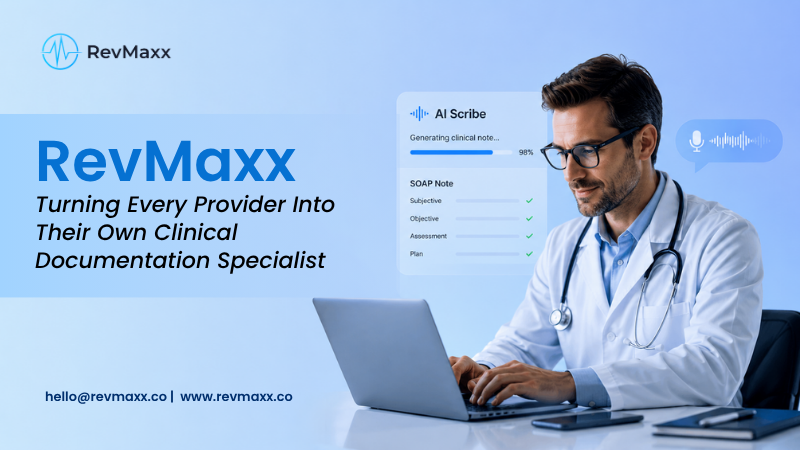
Tools like RevMaxx use generative AI technology to create clinical notes, patient summaries and treatment plans – all based on voice input. This ambient scribe, present during the patient visit, silently listens to doctor-patient conversation by using advanced machine learning and natural language processing (NLP) technology and generates notes in real-time.
After using this AI medical documentation tool, physicians report that their 10-20 hours of work can be done now in just 15 minutes. But still, these notes need careful human review.
So, on a simple note, these AI tools significantly lower the documentation burden and let healthcare professionals focus more on what’s important: their patients.
What Per cent of Doctors Use AI?
Based on a recent survey, close to 66% of doctors said they used AI-based healthcare tools in 2024, almost twice that of 2023. Physicians are utilising AI tools for various things, such as documenting billing codes and charts, developing treatment plans and so on.
The rate of adoption largely depends on the kind of healthcare practitioners. For instance:
- General Practitioners: Some 1 in 5 use AI programmes such as ChatGPT to assist with routine tasks, including writing clinical notes.
- Radiologists: Approximately two-thirds of US radiology departments use AI to interpret and read medical images.
Most importantly, the AMA survey also found that 68% of doctors believe AI brings some significant advantage to patient care, which is slightly higher than last year.
What is the Best Medical AI Scribe?
RevMaxx:
This AI medical scribe tool has gained immense popularity among solo physicians, group practitioners and large healthcare organisations. It uses advanced machine learning and NLP technology to transcribe doctor-patient conversations in real-time.
It provides:
- Easy, accurate clinical note generation in seconds without interrupting clinical workflows.
- Adaptable for various specialisations, like cardiology, dentists, dermatologists, mental healthcare, hospice and more
- It has customised templates suited to your clinical styles and preferences.
- Suggest accurate clinical codes like ICD-10, CPT, HCC and E/M coding to ensure proper billing and better reimbursement.
- Directly integrated into popular EHR systems, like eCW, Epic, Nextech, etc.
- Secure and HIPAA compliant to ensure patient data safety.
Freed:
This AI medical documentation is built by keeping clinicians in mind. More than 20000 healthcare professionals are now using Freed to cut down the documentation time, reduce burnout and maintain a smooth clinical workflow.
It provides:
- Lightening-fast clinical notes in just 1-5 minutes after visit.
- Capture live patient visits or upload transcripts to create organised SOAP notes.
- Directly integrated with popular EHR systems.
- Available on any device and adaptable to any workflow and template.
- Great choice for individual and group practitioners and fully HIPAA compliant.
Heidi:
Healthcare providers’ time-consuming documentation workload is handled by Heidi, an ambient AI clinical assistant. It operates in the background, quietly organising patient records based on style, allowing doctors to fully concentrate on providing better patient care.
It offers:
- Modify patient notes instantly by using straightforward, organic prompts.
- Custom templates to personalise documentation with AI assistance.
- Secure for multiple providers, solo practitioners, and large healthcare organisations.
- Its multilanguage support helps in generating notes for better patient communication.
Sunoh.ai:
The name means “listen” in Hindi. Sunoh does just that—it listens, allowing medical professionals to concentrate on patient care.
Sunoh was founded in 2019 to tackle two problems that are increasingly common in the healthcare sector: overwhelming administrative burden and doctor burnout. It records clinical discussions, synthesises them into organised notes, and puts them into the EHR. This is allowing physicians to spend more time with patients rather than typing.
It offers:
- Captures provider-patient conversations without interrupting the flow.
- Accurately transcribes and identifies different speakers.
- Automatically categorises content into Subjective, Objective, Assessment, and Plan sections.
- Records details on labs, imaging, procedures, medications, and follow-ups.
- Providers can edit and approve notes before sending them to the EHR.
Theralytics:
ABA and behavioural health practices can manage clinical and administrative workflows in one system with Theralytics. It connects scheduling, billing, session-level data collection, and progress monitoring in real time, helping BCBAs, supervisors, and clinicians reduce workflow silos and improve data accuracy.
If you want to learn more, visit https://www.theralytics.net/
It offers:
- Real-time connection between clinical documentation and billing to help reduce claim errors.
- Scheduling, billing, session-level data collection, and progress monitoring in one system.
- Automated graphing and a parent portal that help save time.
- An intuitive interface that helps new clinicians get up to speed quickly.
- SOC 2 Type II certification and AES-256 encryption for security.
The Final Thoughts
AI medical documentation in 2025 is becoming an essential part of modern healthcare facilities. From streamlining patient notes to ensuring accuracy and compliance, tools like RevMaxx are transforming how providers work.
This ambient scribe solution decreases after-hours charting, reduces documentation time by as much as 70%, and allows physicians to concentrate on what matters most: providing high-quality patient care.
By recording discussions, structuring information, and integrating with EHRs, this software enables physicians to have less time spent in front of screens and more time engaging with patients.
For medical professionals willing to take back their time and provide care uncompromised, the future begins today.